

.png)
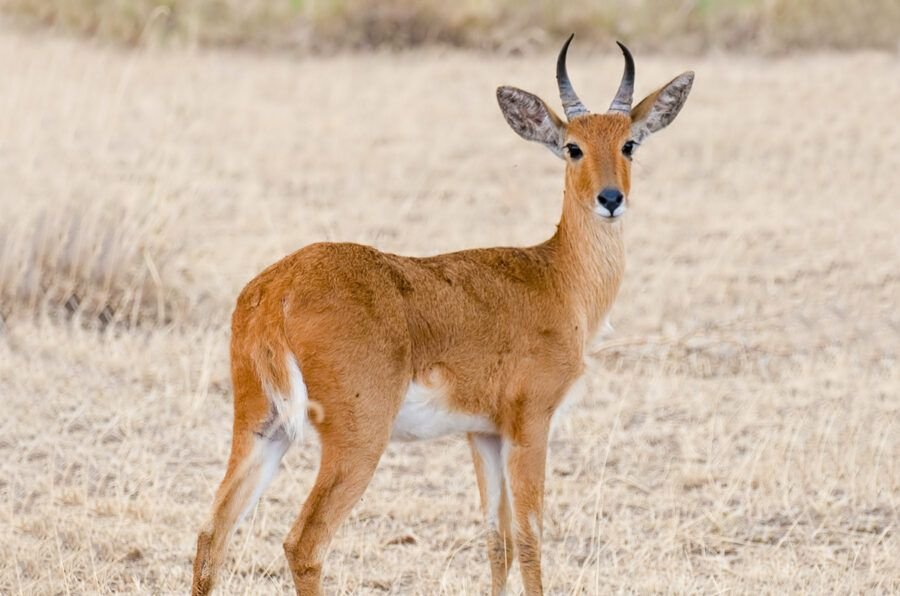
Bohor Reedbuck
Redunca reduncaThe whistling antelope of Africa’s wet grasslands.
Sightings are never guaranteed and depend on local conditions. Follow your guide and respect park rules.
Sandy-colored, alert and remarkably elusive, the Bohor Reedbuck is a specialist of moist grasslands, floodplains and wetland edges across much of sub-Saharan Africa. When danger approaches, it may freeze motionless before giving a sharp whistle and bounding into cover. In Tanzania, the species occurs in a variety of suitable grassland and wetland landscapes, although encounters are localized rather than guaranteed.
Bohor Reedbuck Quick Facts
What Is the Bohor Reedbuck?
The Bohor Reedbuck (Redunca redunca) is a medium-sized African antelope closely associated with moist grasslands, floodplains, swamp edges, reedbeds and other areas where nutritious grasses occur. Its most memorable defensive behavior is to remain inconspicuous until danger is close, then suddenly freeze, whistle and bound away. It has a broad distribution across sub-Saharan Africa — including parts of West, Central and East Africa — so it should not be described as primarily Tanzanian or Ugandan.
Appearance
The Bohor Reedbuck has a relatively understated appearance. Typical characteristics include sandy to reddish-yellow upperparts, grayish-brown variation, white underparts, pale facial markings, white beneath the tail, a dark line often visible on the front of each foreleg, a short bushy tail, and a bare skin patch near the ears. Adult males have a more strongly developed neck and horns. The coat can have a somewhat oily sheen from sebaceous secretions — a useful visitor takeaway is simply that this slightly oily coat contributes to its characteristic appearance in dry grass, reedbeds and floodplain vegetation.
Horns — Males Only
An important correction to generic antelope pages: only males normally have horns. The horns are short, thick at the base, ringed, and grow backward before curving sharply forward at the tip. The Tanzania field guide gives approximately 21 cm for the Tanzanian form, while broader measurements across the species can reach roughly 20–41 cm depending on region and source. The hooked tip — curving backward then inward/forward — is one of the best identification features and helps separate the Bohor reedbuck from some similar reedbuck species.
Bohor vs Southern Reedbuck
| Feature | Bohor Reedbuck | Southern Reedbuck |
|---|---|---|
| Scientific name | Redunca redunca | Redunca arundinum |
| General size | Smaller | Larger |
| Color | More reddish/yellowish | Generally duller gray-brown |
| Male horns | Short, hooked tips | Longer/wider-spreading |
| Habitat | Moist grassland, floodplain, swamp edge | Wet grassland, reedbeds, broader range |
| Tanzania | Yes | Yes |
The Tanzania field guide specifically notes that the Southern Reedbuck is significantly larger and has differently shaped male horns — a useful link to a future Southern Reedbuck page.
Habitat & Range
The species’ strongest ecological association is with moist grasslands and wetland-associated habitats: swamp grasslands, floodplains, marsh edges, reedbeds, moist savanna, grassland near water, open woodland adjacent to wet grassland, and seasonal wetlands — not simply “savannah.” A long-term ecological study in Ethiopia found especially strong association with swamp grassland, with larger dry-season aggregations around swamp habitat. The relationship is straightforward: water → green grass → nutritious forage → reedbuck, which explains why the species can be tied to river valleys and wetland edges even though it is not a purely aquatic antelope. The Bohor reedbuck has a broad distribution across sub-Saharan Africa; the American Society of Mammalogists and Mammal Diversity Database list countries including Kenya, Tanzania, Uganda, Ethiopia, Sudan, Rwanda, Burundi, Cameroon, Central African Republic, DR Congo and several West African nations, with distribution fragmented in parts of the western and central range.
Bohor Reedbuck in Tanzania
The Tanzania field guide identifies Redunca redunca wardi as the only Bohor reedbuck subspecies found in Tanzania under its taxonomy. Historical Tanzanian records include areas around Ngorongoro, Yaida, Bahi, Wembere, the Mara/Serengeti region, Biharamulo, Malagarasi, Katavi, Usangu, Lake Rukwa and other grassland/wetland landscapes — demonstrating the species is far more widespread in Tanzania than a Nyerere/Ruaha-only presentation implies. Suitable habitat may occur in wet grassland, floodplain and river-associated areas, but sightings are localized and opportunistic rather than “high.” Because this is a habitat specialist, it should not be sold as one of the easiest Serengeti animals to see.
Where to See Bohor Reedbuck in Tanzania
Bohor reedbuck are habitat specialists of moist grassland, floodplains and wetland edges, so sightings are localized and opportunistic rather than guaranteed. The Tanzanian localities with the most suitable habitat are:
- Nyerere National Park — northern wetland and floodplain grassland along the Rufiji system.
- Ruaha National Park — riverine grassland and seasonal wetlands of the Ruaha–Usangu landscape.
- Katavi National Park & the Lake Rukwa basin — extensive floodplains that can hold dry-season aggregations.
- Usangu wetlands — a key wetland complex feeding the Ruaha system.
They also occur more widely across Tanzanian grassland and wetland landscapes (including parts of the Serengeti–Mara region, Ngorongoro, Malagarasi and Wembere), but density is low and visibility is never comparable to impala or wildebeest. Target wet grassland at first light or late afternoon, and expect the classic freeze → whistle → bolt behavior.
Daily Activity
The rigid daily timetable on the old page must go. Bohor reedbuck are active during both day and night. A field study in the Bale Mountains found feeding peaks in the early morning and late afternoon, with midday resting, but also documented dusk and midnight feeding activity. A safe page wording: feeding often peaks in the early morning and late afternoon, with additional activity possible around dusk and at night.
Social Structure
Bohor reedbuck social structure is flexible, ranging from solitary animals and small family/territorial groups to much larger temporary aggregations under favorable conditions — not “groups for safety.” Animal Diversity Web reports they can occur individually, in small groups and in larger aggregations, with females’ ranges overlapping; in Bale, typical herd sizes were 3–5 animals, while dry-season aggregations reached as many as 59 individuals around swamp grassland. Male Bohor reedbuck can maintain territories and defend access to females (some sources describe territorial males with several females and young, while bachelor males can be tolerated). Importantly, Animal Diversity Web specifically states Bohor reedbucks do not scent-mark territories; instead, whistles communicate territorial presence and alarm. Avoid generic “they mark territories with urine and feces” claims unless a source specifically supports them for the population discussed.
The Famous Whistle & Escape
When alarmed, a Bohor reedbuck can give a sharp whistle. The sequence is: detect danger → freeze → whistle → explode into motion → bound toward cover. This is one of the easiest ways to recognize the animal even before seeing it. The reedbuck’s primary defense is camouflage + freezing + alarm whistle + rapid bounding + cover, rather than group defense — a far more species-specific description than generic herd protection.
Diet & Water
Bohor reedbuck are herbivores and primarily grazers, feeding on grasses, tender grass shoots, reed shoots and other herbaceous vegetation, benefiting from young, nutritious, relatively low-fiber grass in wet or moist grassland. Rather than claiming “water is essential every day,” the accurate statement is: Bohor reedbuck are strongly associated with water-rich grassland, and green pasture can contribute substantially to their water needs. This captures the ecology without overclaiming.
Predators & Threats
Potential predators vary by ecosystem and may include lions, leopards, spotted hyenas, African wild dogs, pythons and other large predators; young and exposed individuals are more vulnerable than adults in secure cover. A particular conservation detail: Bohor reedbucks are vulnerable to hunting with dogs because their escape behavior can be exploited when driven from cover (Kingdon/Mammals of Africa notes this as an important pressure in parts of the range). Road mortality is also documented where wetlands, roads, settlements and agricultural land intersect, and older literature records drowning incidents.
Reproduction & Lifespan
Bohor reedbuck females normally produce one calf. The mother keeps the young concealed early in life and visits it to nurse before the calf becomes more mobile — a hide-and-return strategy common in several antelopes that reduces the chance predators locate mother and calf together. Gestation is approximately 7–8 months. Sexual maturity occurs around 16–17 months in available data (ADW cites ~502 days), with variation expected among populations. On lifespan, the old page’s firm “10 years” wild figure is not well supported: Animal Diversity Web records captive averages around 10 years in one dataset and ~18 years in another, while wild longevity is less well documented. A safer wording: wild lifespan is not well documented; captive longevity can reach into the teens and beyond.
Conservation Status
The Bohor Reedbuck is currently classified as Least Concern (Mammal Diversity Database / Animal Diversity Web). But Least Concern does not mean no conservation problems. Major threats include hunting (particularly with dogs and nets), habitat loss from agricultural expansion and settlement, wetland degradation (including dam construction reducing floodplain habitat), agricultural conversion, and road mortality. An Ethiopian study specifically linked river/floodplain modification with population problems in some regions. In Tanzania, long-term conservation depends on protecting moist grassland and floodplain habitat while reducing unsustainable hunting and habitat conversion — the generic claim that an institution “monitors wild populations” should be removed unless tied to a specific current project/source.
Safari Viewing
The old page overpromised with “High sighting likelihood” and Nyerere/Ruaha as if the animal were a reliable target. A better description: sighting likelihood is localized / opportunistic. A Bohor reedbuck may be conspicuous in suitable wet grassland, but it is not comparable to zebra, impala, wildebeest, giraffe or elephant in general safari visibility. Visibility can be good in the dry season when animals concentrate around remaining moist grassland and water-rich habitats, but local habitat conditions matter more than a universal calendar window. Early morning and late afternoon are often productive, though the species can also be active at night. Photography rewards patience: watch for stillness → whistle → sudden movement, best framed with a 100–400 mm telephoto where vegetation and distance make the animal hard to frame.
Did You Know?
Whistle escape
Freezes, then gives a sharp whistle and bounds away.
Males only have horns
Hooked tips curve back then forward.
No scent-marking
ADW: they do not scent-mark territory.
Wetland specialist
Strongly tied to swamp grassland & floodplains.
Sex-specific size
Males 40–65 kg; females 35–50 kg.
Not just day
Active at night; midnight feeding recorded.
Huge dry-season groups
Up to ~59 around Ethiopian swamp grassland.
One calf
Mother hides it, then returns to nurse.
Least Concern
But hunted with dogs; wetlands threatened.
Broad range
West/Central/East Africa, not just Tanzania.
Tanzania form
R. r. wardi per the Tanzania field guide.
Dogs are a threat
Driven from cover, they’re vulnerable.
35 Accurate Bohor Reedbuck Facts
- It is a medium-sized antelope.
- Males are larger than females.
- Male shoulder height is roughly 75–89 cm.
- Female shoulder height is roughly 69–76 cm.
- Male weight can be around 40–65 kg in Tanzania.
- Female weight can be around 35–50 kg in Tanzania.
- Male horns are short and hook forward at the tip.
- The coat ranges from sandy/yellowish to gray-brown.
- The underparts are white.
- A dark foreleg stripe may be visible.
- The tail is short and white underneath.
- A bare skin patch occurs below each ear.
- It is strongly associated with moist grassland.
- Floodplains are important habitat.
- Swamp grassland can support large dry-season aggregations.
- It is primarily a grazer.
- Tender grasses and reed shoots are important foods.
- It can obtain some moisture from green vegetation.
- It can be active during both day and night.
- Early morning and late afternoon can be important feeding periods.
- Midnight feeding has also been documented in Ethiopia.
- Individuals may live alone.
- Small groups can occur.
- Large seasonal aggregations can occur.
- Territorial males can defend access to females.
- They use whistles for alarm and territorial signaling.
- Females usually produce one calf.
- Gestation is roughly 7–8 months.
- Leopards and lions can prey on reedbuck.
- Hunting with dogs is an important threat in parts of its range.
- Habitat loss and wetland degradation are significant concerns.
- The species is globally classified as Least Concern.
In the hush of a Tanzania floodplain at first light, a single sharp whistle can erupt from nowhere — a Bohor reedbuck breaking cover in a bound of pale legs, gone before you’ve raised your binoculars.
Gallery
Frequently Asked Questions
Redunca redunca.
No. It is currently classified as Least Concern globally.
In Tanzania, males are approximately 40–65 kg and 75–89 cm at the shoulder; females are approximately 35–50 kg and 69–76 cm at the shoulder.
Normally no. The horns are a male characteristic.
It primarily grazes grasses and tender reed or grass shoots.
It occurs across broad areas of sub-Saharan Africa, especially moist grasslands, floodplains and savanna habitats associated with water.
Yes. Tanzania is within its range, and the Tanzania field guide identifies R. r. wardi as the Tanzanian subspecies under its taxonomy.
They can occur in suitable Tanzanian habitats, but it would be misleading to promise “high” sightings. Their distribution is localized and habitat-dependent.
They can be active at night as well as during the day. Field research recorded feeding peaks early morning, late afternoon, dusk and around midnight.
The whistle functions as an alarm and can also communicate territorial presence.
Freezing can make the animal harder to detect; once danger is confirmed, it can suddenly bound toward cover.
They can occur singly, in small groups or in larger temporary aggregations.
Males can maintain territories and defend access to females.
Normally one calf.
Approximately 7–8 months.
Hunting, including hunting with dogs, habitat conversion, wetland degradation and road mortality are documented threats in parts of the range.
References & Further Reading
- American Society of Mammalogists / Mammal Diversity Database: Redunca redunca broadly distributed across sub-Saharan Africa (West/Central/East); listed as Least Concern.
- Animal Diversity Web (ADW): Medium antelope; males ~75–89 cm, females ~69–76 cm; mass ~36–55 kg in its dataset; grazer; flexible sociality (solitary to aggregations); does NOT scent-mark territory (whistles signal alarm/territory); gestation ~7–8 months; sexual maturity ~502 days; captive longevity ~10–18 years, wild poorly documented; Least Concern.
- Tanzania field guide (cited in spec): R. r. wardi as Tanzanian subspecies; male horns ~21 cm; Southern Reedbuck larger with differently shaped horns; historical Tanzanian records across Ngorongoro, Serengeti/Mara, Katavi, Usangu, Lake Rukwa, Malagarasi, Bahi, Wembere and more.
- Ethiopian ecological study (Bale Mountains, cited in spec): Strong association with swamp grassland; dry-season aggregations up to ~59 individuals; feeding peaks early morning/late afternoon with dusk and midnight activity.
- About these facts: Measurements are approximate ranges; conservation status should be checked against the current IUCN assessment.