

.png)
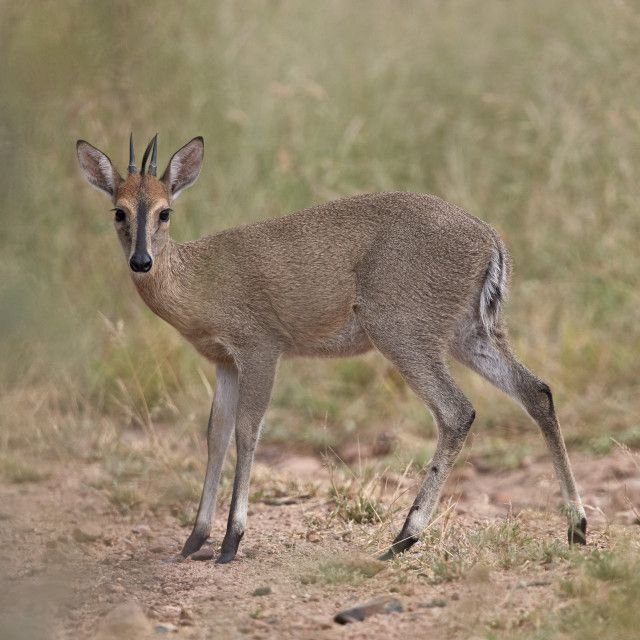
Common Duiker
Sylvicapra grimmiaThe shy, shape-shifting antelope that vanishes into the bushes.
Small, adaptable and supremely secretive, the Common Duiker is the most widespread of all duikers - and the only one found north of the equator. Rather than living in the open, it hunts the edges: woodland meeting grassland, riverine thicket and scrub, where it freezes invisible before exploding into a low dash for cover. Variable in colour, lone or in pairs, and surprisingly omnivorous, it is one of Africa's most successful small antelopes.
Common Duiker Quick Facts
What Is the Common Duiker?
The Common Duiker (Sylvicapra grimmia) - also called the grey duiker or bush duiker - is a small, supremely adaptable antelope and the only member of the genus Sylvicapra. It is the most widespread of all duikers and the sole duiker species found north of the equator, ranging across most of sub-Saharan Africa wherever there is enough vegetation cover to melt into.
Unlike the tiny, forest-dependent blue duiker, the common duiker thrives at the edges of habitats: where woodland meets grassland, along thickets, in riverine bush and even on the fringes of farms and settlements. Its survival strategy is built on stillness and sudden escape rather than speed or numbers. When a common duiker senses danger it often freezes, almost invisible against the grass and scrub, before exploding into a low, dodging dash for cover - the habit that gives duikers their name (the Afrikaans duiken, "to dive").
Why “Duiker”?
The English name comes from the Afrikaans word duiken, meaning "to dive" - a direct reference to the antelope's signature escape: dropping low and diving into dense cover when disturbed.
Its scientific name tells a second story. Sylvicapra combines the Latin silva ("woodland") and capra ("goat"), loosely "forest goat," while grimmia is the species epithet assigned at its original description. Together they mark the common duiker as a goat-like creature of the woods - apt for an antelope that prefers the edge of the forest to the open plain.
Signature Features
Common duikers are masters of camouflage through variability. Their coarse coat ranges from grizzled grey in dry savannas to reddish-brown in wooded regions and light brown in arid areas - roughly 12-14 subspecies are recognised across this enormous range.
Key identification features:
- Face stripe: a dark line runs from the nose up the centre of the face to a tuft of black hair on the forehead.
- Face glands: both sexes have large preorbital (face) glands set in slits beside the eyes, used in scent marking.
- Tail: short, dark on top and white underneath.
- Horns: only the male carries them - short, straight, sharply pointed and grooved at the base.
How Big Is a Common Duiker?
Adults stand about 45-60 cm at the shoulder and weigh roughly 12-25 kg. Unusually among antelopes, females are generally a little larger and heavier than males.
- Males: ~12-18 kg; shoulder height ~45-55 cm; horns 7-18 cm.
- Females: ~14-25 kg; shoulder height ~50-60 cm; normally hornless (occasionally tiny stunted horns).
Horns, Tail & Senses
Only male common duikers carry horns. They are short (about 7-18 cm), straight, sharply pointed and heavily grooved at the base, sloping backward. Females are normally hornless, though stunted horns are occasionally reported.
The species' large ears - longer in populations from open, arid habitats - and prominent preorbital glands point to senses tuned for detecting danger: keen hearing and smell compensate for an antelope that relies on remaining unseen.
Habitat & Range
The common duiker is one of Africa's most habitat-flexible antelopes. It occupies woodland, bushveld, thicket, grassland with scattered cover, savanna edges, riverine vegetation and even the margins of farmland and human settlements. The constant requirement is cover: somewhere to vanish into.
What it avoids is just as telling - it is generally absent from the dense interior of equatorial rainforests and from true deserts. In Tanzania this makes it a creature of the ecotone: woodland-grassland mosaics, acacia bush, riverine thickets and similar partly open, partly sheltered country.
Common Duiker in Tanzania
Common duikers occur widely across Tanzania wherever brushy cover is available, but they are shy, small and quick to hide - sightings are never guaranteed and should not be sold as "high." The most realistic encounters come at dawn and dusk along habitat edges.
Woodland & bush edges
The classic common-duiker setting - miombo and acacia woodland fringing grassland, where it forages and melts into scrub.
Riverine thickets
Dense vegetation along rivers and streams provides ideal cover across many Tanzanian parks.
Grassland with cover
Not open plains, but grassy clearings punctuated by thickets and termite mounds it can duck behind.
Farm & settlement fringes
Unusually tolerant; common duikers sometimes persist on the wooded edges of cultivated land.
You may come across sign of them in many Tanzanian protected areas with wooded habitat - including the Serengeti, Tarangire, Lake Manyara, Arusha, Ruaha, Nyerere (Selous) and Mikumi - always as a pleasant surprise rather than a scheduled sighting.
Behavior & Social Life
Common duikers are primarily solitary or found in monogamous pairs, each animal holding a territory it defends by scent-marking with glands in its hooves and beside its eyes. Males and females share a range but drive off rivals of the same sex.
Activity peaks at dawn and dusk and often continues into the night; in quiet areas they will also move by day. Their signature behaviour is the freeze-and-dash: on alarm the duiker stands motionless, patterned coat blending with the background, then bursts into a low, zig-zag sprint for the nearest cover. They can also kick with the front hooves and, in males, jab with the horns if cornered.
Diet & Feeding
The common duiker is a generalist feeder - unusually omnivorous for an antelope. The bulk of the diet is leaves, shoots, twigs, flowers, fruits, seeds, pods, roots and bark, taken from low vegetation and the ground.
It also eats invertebrates, small vertebrates, nestling birds and frogs when the chance arises, and will follow monkeys and baboons to feed on fruit they drop. This flexibility is a major reason the species thrives across such varied habitats.
Predators & Defense
A common duiker's small size puts it on the menu for many predators. Important hunters include leopards, eagles (especially for young), pythons, jackals, and - where ranges overlap - lions, cheetahs, African wild dogs and spotted hyenas.
Its defense is not fighting but evasion: freeze, then a short, explosive dash into thick cover, sometimes with a loud alarm call if a lamb is threatened. Adult males may also use their horns.
Young & Lifespan
After a gestation of about six months a single lamb is born. Like many hiding strategists, the lamb spends its first weeks concealed in vegetation, lying still while the mother returns periodically to nurse - she forages separately to avoid drawing predators to the young.
Lambs are well developed at birth and can run within a day. They reach sexual maturity at around eight months, and common duikers can live roughly 8-11 years in the wild (up to about 14 in captivity).
Conservation Status
The common duiker is listed as Least Concern on the IUCN Red List. It is among the most widespread and adaptable African antelopes, tolerant of habitat change and able to live near people.
The main pressure is hunting for bushmeat, which can locally depress populations, and habitat loss in some regions. Because it uses cover rather than open country, reserves with a mix of woodland and grassland - common across Tanzania - suit it well, though it is rarely a headline sighting.
Safari Experience
The common duiker is not a classic guaranteed-sighting safari animal, and should not be marketed as one. Encounters are specialist, cover-focused and often fleeting.
Realistic approach: scan woodland edges, thickets and grassy clearings with cover, especially around dawn and dusk, and keep expectations patient. Photography is a challenge - a 100-400 mm lens and a fast shutter help - because the animal is small, shy and quick to vanish. The reward is a genuinely wild glimpse of one of Africa's most successful small antelopes.
Comparisons
Three duikers appear in East and Southern African field guides. They differ sharply in size, habitat and even horn arrangement:
| Feature | Common Duiker | Blue Duiker | Yellow-backed Duiker |
|---|---|---|---|
| Scientific name | Sylvicapra grimmia | Philantomba monticola | Cephalophus silvicultor |
| Weight | ~12-25 kg | ~4-6 kg | ~45-80 kg |
| Horns | Male-only, straight | Male-only, tiny | Both sexes, long curved |
| Coat | Grey/brown/red, variable | Blue-grey | Dark with yellow back patch |
| Habitat | Woodland, bush, edges | Dense rainforest | Dense rainforest |
| Range in Tanzania | Widespread, wooded habitats | Forest (Mahale, coast) | Western & coastal forest |
Did You Know?
North of the equator
It is the only duiker found north of the equator, ranging farther across Africa than any of its relatives.
Females are larger
Females are generally larger than males - the reverse of most antelope species.
Eats more than plants
It is one of the few antelopes that eats insects, nestling birds and frogs, not just plants.
Named for diving
Its name means "diver" - it dives into cover rather than running across open ground.
Many subspecies
About 12-14 subspecies are described, explaining its huge colour variation.
Quick on its feet
When fleeing it can burst to roughly (often quoted up to ~) over a short distance.
On a quiet game drive, the common duiker is easy to miss - a flicker of grey at the thicket edge, gone before you point. Its genius is not speed but disappearance: stand still, blend, and wait. In a landscape built for being seen, this little antelope has mastered the art of not being found.
Gallery
Frequently Asked Questions
Sylvicapra grimmia. It is the only species in the genus Sylvicapra.
From the Afrikaans duiken, "to dive" - duikers dive into dense cover when alarmed rather than running across open ground.
Across sub-Saharan Africa in cover-rich habitats: woodland, bush, thicket, grassland edges, riverine vegetation and farm fringes. They avoid dense equatorial rainforest interiors and true deserts.
Yes. They are widespread across Tanzania in wooded and brushy habitats, though - like elsewhere - sightings are not guaranteed because they are small, shy and stay near cover.
They are mostly solitary or found in monogamous pairs, each holding a territory. They do not gather in numbers.
No. They are encountered singly or as a male-female pair, never alongside others.
A generalist diet of leaves, shoots, fruit, flowers, seeds and bark, plus insects, nestling birds and frogs when available. They even follow monkeys to eat dropped fruit.
Mostly crepuscular and nocturnal - active at dawn, dusk and into the night - though they also move by day in quiet areas.
Its real defense is the freeze-then-dash into cover. When it does flee it can burst to roughly (often quoted up to about ) over a short distance.
Leopards, eagles (especially for young), pythons and jackals are key predators, with lions, cheetahs, wild dogs and hyenas where ranges overlap.
Least Concern on the IUCN Red List. It is widespread and adaptable, though hunted for bushmeat in parts of its range.
References & Further Reading
- Animal Diversity Web - Sylvicapra grimmia: taxonomy, description, solitary/territorial behaviour, crepuscular activity, generalist diet and preorbital glands.
- IUCN Red List: Sylvicapra grimmia assessed as Least Concern; broad sub-Saharan range excluding dense rainforest interiors and deserts.
- Ultimate Ungulate / Dimensions.com: size (~45-60 cm shoulder height, 12-25 kg), male-only straight grooved horns, lifespan 8-14 years.
- Endangered Wildlife Trust (EWT): southern African status and distribution notes for the common (grey) duiker.
- Wikipedia - Common duiker: overview of 12-14 subspecies, colour variation, and range north of the equator.