

.png)
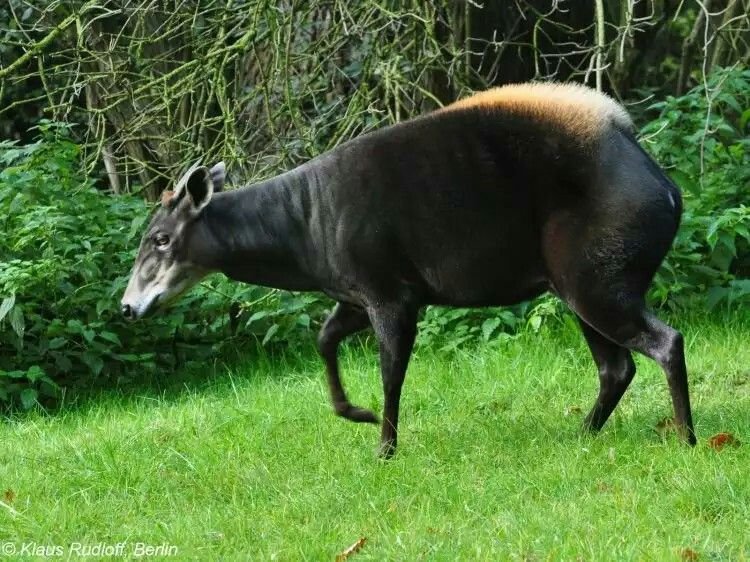
Yellow-backed Duiker
Cephalophus silvicultorThe largest of all duikers — a West and Central African forest antelope with an erectile yellow rump, and one you will not meet in Tanzania.
Sightings are never guaranteed and depend on local conditions. Follow your guide and respect park rules.
The yellow-backed duiker is a stocky, secretive bush-antelope of the Congo basin and West/Central Africa. When alarmed it raises a fan of yellow hair on its rump — a flash in the forest gloom. It is built for diving into dense undergrowth, not for the open plains of Tanzania.
Yellow-backed Duiker Quick Facts
What Is the Yellow-backed Duiker?
The yellow-backed duiker (Cephalophus silvicultor) is the largest of all duikers — a stocky, forest-dwelling antelope of West and Central Africa. Duikers are small, secretive bush-antelopes named for the Afrikaans word for "diver", because they dive into cover when alarmed.
The yellow-backed duiker ranges from Senegal east to western Uganda and south through the Congo basin to Angola and most of Zambia. It does not occur in Tanzania. Travelers interested in duikers in Tanzania should instead explore species that genuinely occur there, such as Abbott's duiker in appropriate montane-forest habitats, subject to current verified distribution information.
Why “Yellow-backed Duiker”?
The name is literal: a patch of yellow hairs on the rump that the antelope erects when alarmed, flashing a warning to others. The scientific name Cephalophus silvicultor means "crested forest-dweller" — the genus refers to the tuft of hair between the horns, and silvicultor to its woodland home. It was described by Adam Afzelius in 1815.
The Yellow-backed Duiker's Signature
The signature is the erectile yellow rump patch: when startled, the duiker raises a fan of yellow hair on its back, a flash visible in the dim forest. Combined with its hunched, convex profile (rump higher than shoulders) built for diving through undergrowth, it is among the most distinctive small-antelope signals in Africa.
Adults are grey-brown with white lips and a pale muzzle, a short tail, and an orange crest between the horns. Both sexes carry short, straight, ribbed horns about 8.5–21 cm long — a trait unusual among antelopes, where males usually monopolise the horns.
Size and Body Form
Yellow-backed duikers are the heavyweights of the duiker world: 60–80 kg, head-and-body 115–145 cm, shoulder height about 70–80 cm. The body is convex and hunched, the head long and narrow, the legs short — a shape made for slipping through dense forest. Females are often slightly larger than males, with little other sexual difference.
Horns
Both male and female yellow-backed duikers have horns. They are short (about 8.5–21 cm), cylindrical and ribbed at the base, with an orange crest of hair between them. Because the horns are small and the duiker flees into thickets rather than fighting, they are more a family trait than a weapon — a rarity among antelopes, where horns are usually a male feature.
Habitat
This is a forest species through and through: semi-deciduous and rainforest, riparian forest and montane forest, and isolated forest patches in savanna. It avoids open country and depends on dense understory for cover. That forest loyalty is exactly why it stops at the West/Central African belt and is absent from Tanzania's woodlands and plains.
Where to See the Yellow-backed Duiker (West & Central Africa)
The yellow-backed duiker is not found in Tanzania, so seeing one means a forest safari in West or Central Africa — think the Congo basin, Gabon, Cameroon or western Uganda's edges.
Congo Basin forests
The heart of the range — Gabon, Cameroon and the DRC hold the densest populations.
Western Uganda edge
The eastern limit of the range, in forest along the Uganda–Congo border.
Zambian forest
The southern range, in Zambia's woodland mosaics.
Tanzania's duikers instead
No yellow-backed duiker, but Tanzania has the blue duiker and Abbott's duiker.
Behaviour
Yellow-backed duikers are shy and elusive, active by both day and night, and usually seen alone or in a mated pair — they are largely monogamous. When threatened they freeze, then explode into a diving run for the nearest thicket, often smashing blindly through vegetation. In torchlight at night they may freeze and stare, which makes them tragically easy to hunt.
Diet
A frugivore first: fruits make up most of the diet (Animalia.bio, Brookfield Zoo), with leaves, shoots, seeds, bark and buds. The yellow-backed duiker is an efficient digester of poor-quality food and even swallows large, low-fibre fruits whole, making it an important forest seed-disperser. Unusually for an antelope, it will occasionally eat small animals, birds or carrion — a "concentrate selector" that targets high-energy food.
Predators
Adults are taken by leopard, python and crowned eagle, and calves by smaller predators. But the overwhelming threat is people: duikers are the most heavily hunted antelopes in West and Central African forests, prized as bushmeat, and their freeze-in-headlights habit makes them easy targets at night.
Reproduction and Calves
Yellow-backed duikers can breed year-round, often twice a year. After a gestation of about four to seven months a single calf (rarely two) is born and hidden in cover for its first week, then weaned at three to five months. Females mature slightly earlier than males, at around nine to twelve months.
Conservation
The yellow-backed duiker is listed as Near Threatened and decreasing on the IUCN Red List, with perhaps 160,000 animals. The driver is bushmeat hunting across its forest range and the clearing of those forests. Because it is the most hunted duiker, its future depends on protecting intact forest and curbing the commercial bushmeat trade.
Yellow-backed Duiker on Safari
This is a forest-safari species, not a Tanzania one. In Central Africa's reserves (Gabon's Loango, Congo's Odzala, Cameroon's parks) a quiet walk with a skilled guide may reveal a duiker freezing in a sunlit clearing, yellow rump raised. African Majestic Adventure can instead point you to Tanzania's own duikers — the blue duiker and the endemic Abbott's duiker — if a Tanzanian forest walk is what you want.
Yellow-backed Duiker vs Blue Duiker
The blue duiker is the yellow-backed duiker's tiny Tanzanian cousin — both are Cephalophus forest duikers, but the blue duiker weighs only 4–5 kg against the yellow-backed's 60–80 kg. The blue duiker is common in Tanzania's coastal and lowland forest; the yellow-backed duiker is a West/Central African giant you will not see there. For Tanzania's duiker, see the blue duiker.
Did You Know?
Biggest duiker
At 60–80 kg the yellow-backed duiker is the largest of the 16 Cephalophus duikers.
Yellow alarm patch
It erects a fan of yellow rump hair when alarmed — a forest warning flare.
Both sexes horned
Unusually, females as well as males carry the short, ribbed horns.
A Safarer's Perspective
Duikers are the woodland whispers of Africa — you more often hear the snap of a twig than see the animal. The yellow-backed duiker, with its sudden yellow flare, is the forest's exclamation mark, but it belongs to the Congo and the west, not to Tanzania. Knowing that is part of reading the continent: Tanzania has its own duikers, and honouring each species' true range is what makes a safari honest. African Majestic Adventure can match you to the right forest and the right duiker.
Gallery
Frequently Asked Questions
No. The yellow-backed duiker is a West and Central African forest antelope (Senegal to western Uganda, south to Angola and Zambia). Tanzania has other duikers instead — the blue duiker and the endemic Abbott's duiker.
Yes — both sexes carry short, straight, ribbed horns about 8.5–21 cm long. Females are often slightly larger than males.
A patch of yellow hairs on the rump stands erect when the duiker is alarmed, flashing a warning signal in the forest gloom.
Mainly fruit, plus leaves, shoots, seeds and bark. They are efficient seed-dispersers and, unusually for an antelope, will occasionally eat small animals or carrion.
They are Near Threatened and decreasing, mainly from heavy bushmeat hunting across their forest range and habitat loss.
References
- IUCN Red List of Threatened Species — Cephalophus silvicultor (Yellow-backed Duiker), Near Threatened, decreasing.
- Wikipedia — Yellow-backed duiker: West/Central African forest range; both-sex horns; erectile yellow rump patch.
- Animalia.bio — Yellow-backed Duiker fact sheet: largest duiker, fruit diet, absent from Tanzania.
- Animal Diversity Web (University of Michigan) — Cephalophus silvicultor: range to western Uganda and Zambia.
- Brookfield Zoo — Yellow-backed duiker: monogamous pairs, seed dispersal, bushmeat threat.