

.png)
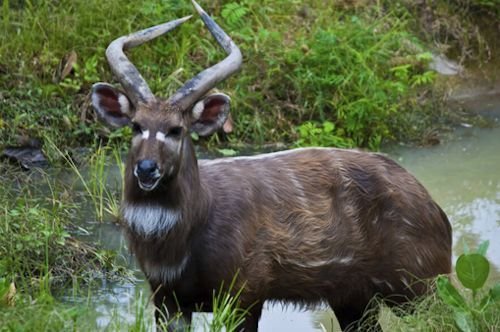
Sitatunga
Tragelaphus spekiiAfrica's swamp antelope - a splayed-hoofed phantom of the papyrus.
The sitatunga (Tragelaphus spekii), also called the marshbuck, is among the most specialised antelopes in Africa - a near amphibious creature of papyrus and reed beds with long, widely splayed hooves and flexible foot joints that let it walk on floating vegetation. It is found across central and eastern Africa wherever permanent wetlands remain, and Tanzania holds real populations in the Nyerere (Selous) swamps and the Moyowosi-Kigosi wetland system.
Sitatunga Quick Facts
What is a Sitatunga?
The sitatunga (Tragelaphus spekii), also called the marshbuck, is a medium-sized, swamp-dwelling antelope of central, eastern and southern Africa. It is one of the most specialised antelopes alive - a near amphibious creature of papyrus and reed beds that rarely leaves the water's edge. Long, widely splayed hooves and flexible foot joints let it walk on floating vegetation where other antelopes would sink.
In Tanzania, sitatunga survive in the wetland margins of the south and west: the Selous (now Nyerere National Park) and the Moyowosi-Kigosi river system near Katavi. It is a quietly famous safari prize because it is so hard to see, melting into the swamp with only its nostrils above the surface.
Why "Sitatunga"?
"Sitatunga" is the local name for this antelope across its range. The scientific name Tragelaphus spekii honours the English explorer John Hanning Speke, who first described the species in 1863 - and fittingly, its type locality is in Tanzania, on the Lake Victoria shore near Karagwe.
Signature Features
The sitatunga's signature is its splayed, elongated hooves - so wide and flexible that they act like snowshoes on soft mud and let it walk on floating vegetation where other antelopes would sink. Combined with a shaggy, oily coat, this makes the sitatunga a true swamp specialist, adapted for moving through deep, waterlogged swamp vegetation.
When seriously alarmed it sinks below the water and swims to deeper cover, leaving only its nostrils showing. It even builds dry resting platforms by trampling reeds into a springy mat - a behaviour unique among antelopes.
Size and Body Form
Sitatunga are strongly sexually dimorphic. Males are larger and greyish-chocolate, standing 88-125 cm at the shoulder and weighing 75-125 kg; females are brighter reddish-chestnut, 75-90 cm tall and 50-57 kg. Both sexes wear 6-8 vertical white body stripes and white facial and leg markings, but the female is hornless and the male bears long spiralled horns.
The body is slightly hunched, with the hindquarters higher than the shoulders, and the long hooves give a characteristically clumsy, splay-footed walk on firm ground.
Horns & Defence
Only the male sitatunga carries horns. They are long, twisted spirals (often loosely lyre-shaped), ivory-tipped when fully grown, and can reach about 50-90 cm. Females are hornless, as in the bushbuck. Males use the horns in ritualised sparring and to break off browse, but sitatunga are not territorial, so horn fights are less constant than in many antelopes.
Habitat & Range
The sitatunga is confined to permanently or seasonally flooded wetlands. ADW describes it as occurring in swamps or permanent marshes, especially papyrus, reeds, sedges and other wetland vegetation. It uses papyrus stands, reedbeds, sedge marshes, floodplain wetlands and the dense wet vegetation of deep swamp areas, and it avoids open water without cover and builds tunnels through dense reeds to reach its feeding grounds.
Across its range the sitatunga tracks these wetlands through central and eastern Africa and into the southern Congo basin and Zambia, with isolated pockets farther south. In Tanzania this means the humid swamps of Nyerere (Selous) and the Moyowosi-Kigosi wetlands of the west, plus papyrus-fringed Lake Victoria margins - classic animals of the wetland fringe rather than the open plains.
Where to See Sitatunga in Tanzania and Africa
In Tanzania, sitatunga are a wetland specialty of the south and west: Nyerere (the Selous) and Moyowosi-Kigosi above all. They are shy and localised, so a sighting is never a certainty - this is a secretive animal best sought by boat or guided walk. Across Africa the species ranges through permanent wetlands from the Congo basin and Zambia to South Sudan, Kenya and Tanzania, with isolated populations farther south.
Nyerere (Selous), Tanzania
Tanzania's best-known sitatunga - the great Rufiji swamps hold a resident population; boat safaris reach the reed margins where it hides.
Nyerere infoMoyowosi-Kigosi, Tanzania
Western wetland system near Katavi - a stronghold for this swamp antelope.
Katavi infoLake Victoria margins, Tanzania
Papyrus-fringed shores of the lake, including the Karagwe area where the species was first described.
Wildlife guideAcross Central & East Africa
From the Congo basin and Zambia through South Sudan, Kenya and Tanzania to isolated southern pockets, sitatunga track the continent's permanent wetlands.
Wildlife guideBehaviour & Daily Life
Sitatunga are mainly crepuscular and nocturnal, spending the hot day resting on reed platforms and feeding in the cooler hours. They are not territorial and only loosely social - usually solitary, in male-female pairs, or in small temporary groups of up to about 15. They move along well-worn tunnels through the reeds and are strong, if slow, swimmers, capable of crossing open water.
Male & Female
Sitatunga show strong sexual dimorphism in body size: males are considerably larger than females, standing up to 125 cm at the shoulder and weighing 75-125 kg against the female's 50-57 kg. The sexes also differ in coloration - the male is greyish-chocolate and the female brighter reddish-chestnut - though both carry the 6-8 vertical white body stripes.
The clearest difference is the horns: only the male bears the long spiralled horns (about 50-90 cm), while the female is hornless. Because sitatunga are not strongly territorial, the sexes are not held in rigid harems; they associate loosely as solitary animals, pairs, or small mixed groups in the reed beds.
Diet
A browser-grazer of the swamp, the sitatunga feeds on sedges, reeds, grasses and other wetland vegetation, plus leaves, buds, foliage and creepers, sometimes standing on its hind legs to reach higher growth. ADW notes it can feed while partially submerged, and it will even chew elephant dung for undigested seeds. Its diet is whatever the wetland offers, and it rarely leaves the reed beds to feed.
Predators & Defence
Adults are taken by leopard, lion and crocodile, and calves by pythons and other predators. The sitatunga's main defence is the swamp itself: it retreats into deep papyrus and submerges, visible only by its nostrils, and its splayed hooves carry it across ground where pursuers flounder.
Reproduction and Calves
Sitatunga breed year-round. After a gestation of about 7.5 months a single calf is born on a dry trampled reed platform and hidden among the reeds, visited by the mother only to suckle. The calf is unusually independent, foraging on its own while still young, and stays with its mother only a few months - unlike the closely sheltered young of many antelopes.
Conservation
The sitatunga is listed as Least Concern globally, but its numbers are decreasing as wetlands are drained, burned and settled. Rough estimates suggest around 170,000 animals (probably an overestimate), with about 40% inside protected areas. In Tanzania, Nyerere and Moyowosi-Kigosi hold significant populations, but the species is rare and localised, so protecting intact swamp is essential.
Sitatunga on Safari
Seeing a sitatunga is a safari highlight, but it demands patience - it is a secretive wetland animal, so a sighting is never a certainty. In Tanzania, take a boat safari on the Rufiji in Nyerere, or walk the papyrus fringes of Moyowosi-Kigosi near Katavi. Patience at dawn or dusk along a reed line is the trick - watch for a pair of spiralled horns or a striped flank emerging from the grass. African Majestic Adventure can build a wetland-focused itinerary around these reserves.
Sitatunga vs Bushbuck
The sitatunga is a close relative of the bushbuck - both are striped Tragelaphus antelopes - but they occupy opposite worlds. The bushbuck is a forest and woodland antelope of dry land; the sitatunga is a swamp specialist with splayed hooves and a semi-aquatic life. Both have male-only spiral horns, but only the sitatunga dives underwater to escape. For Tanzania's forest antelope, see the bushbuck.
Did You Know?
Snowshoe hooves
Elongated, splayed hooves let the sitatunga walk on floating papyrus where other antelopes would sink.
Underwater escape
Alarmed sitatunga sink below the surface and swim off with only the nostrils showing.
Born in Tanzania
The species was first described from Tanzania's Lake Victoria shore, near Karagwe.
A Safarer's Perspective
There is a special thrill in the sitatunga because you almost never get a clean look. A boat glides into a wall of papyrus, a kingfisher flushes, and for a second you see a striped flank and spiralled horns before it vanishes into the green. It is the antelope of patience and wetlands - and a reminder that Tanzania's safari riches include swamps as much as plains. African Majestic Adventure knows the boat routes that give you the best chance.
Gallery
Frequently Asked Questions
Yes. Tanzania holds sitatunga in the Nyerere (Selous) wetlands and the Moyowosi-Kigosi system near Katavi, as well as Lake Victoria papyrus margins. Boat safaris give the best views, though sightings are never guaranteed.
No - only males carry the long spiralled horns. Females are hornless but share the white body stripes.
They live deep in papyrus and reed swamps, are active at dawn, dusk and night, and submerge when alarmed. Their wetland home is simply hard for people to enter.
They browse and graze swamp plants - sedges, reeds, grasses, wetland vegetation, foliage and creepers - and can feed while partially submerged.
Globally Least Concern, but decreasing as wetlands are drained and burned. About 40% live in protected areas; Tanzanian populations are localised but significant.
References & Further Reading
- IUCN Red List of Threatened Species - Tragelaphus spekii (Sitatunga): Least Concern, decreasing.
- Animal Diversity Web (University of Michigan) - Tragelaphus spekii species account: swamp habitat, splayed hooves and aquatic behaviour.
- Smithsonian's National Zoo - Sitatunga fact sheet: reed platforms, semi-aquatic life and distribution.
- African Wildlife Foundation - Sitatunga: Tanzania populations in Nyerere (Selous) and Moyowosi-Kigosi wetlands.
- Wikipedia - Sitatunga: taxonomy, semi-aquatic habitat and broad central/eastern African distribution.