

.png)
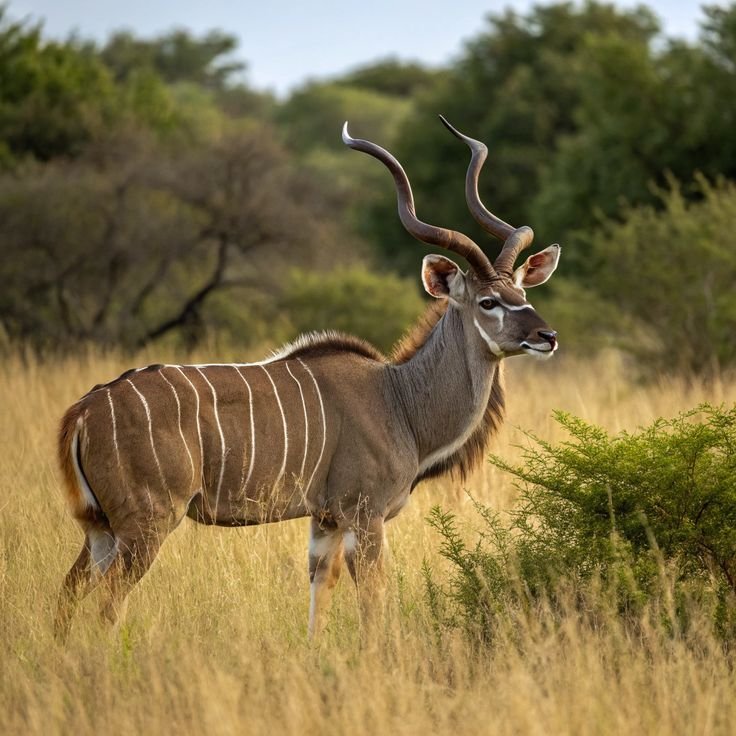
Greater Kudu
Tragelaphus strepsicerosThe antelope with the corkscrew crown.
Sightings are never guaranteed and depend on local conditions. Follow your guide and respect park rules.
The greater kudu is one of Africa's most statuesque antelopes - a tall, grey browser of woodland and thicket, crowned (in males) by spectacular spiral horns that can reach nearly two metres. Shy and largely nocturnal, it melts into cover more often than it shows itself, yet it is widespread across both eastern and southern Africa.
Greater Kudu Quick Facts
What Is the Greater Kudu?
The greater kudu (Tragelaphus strepsiceros) is a large antelope in the family Bovidae (subfamily Bovinae, tribe Tragelaphini) - the same group as the bushbuck, bongo, nyala and eland. It is one of Africa's biggest antelopes, second only to the eland, and is famous for the males' extraordinary spiral horns.
Crucially, the greater kudu is not a Tanzanian specialist. Its range spans eastern and southern Africa - from Ethiopia and Kenya down through Tanzania, Malawi, Zambia and Mozambique to Zimbabwe, Botswana, Namibia and South Africa. Within Tanzania it occurs mainly in the south and centre: Ruaha, the Selous/Nyerere ecosystem, Mikumi and Katavi, with animals also reaching the woodland edges of Tarangire.
Why “Kudu”?
"Kudu" comes from the Khoikhoi word koedoe for this antelope. The scientific name pairs Tragelaphus ("goat-deer") with strepsiceros, from the Greek for "twisted horn" - a perfect description of those corkscrew horns.
Signature Features
A greater kudu is a tall, narrow-bodied antelope with a greyish-brown coat (males greyer, females more reddish-brown). The give-away markings are 6-10 vertical white stripes running down the body, a white chevron between the eyes, large rounded ears, and a crest of hair along the spine. Males also carry a beard under the throat.
The headline feature is the horns: only males have them, and they are long, straight spirals with two and a half twists, sweeping up and slightly back from the head. Nothing else in the bush looks quite like them.
How Big Is a Greater Kudu?
Greater kudus are large and strongly sexually dimorphic. Males weigh 190-270 kg (occasionally up to 315 kg) and stand up to 1.6 m at the shoulder; females weigh 120-210 kg and reach about 1 m. Body length runs 1.85-2.45 m, with a tail adding 30-55 cm.
That bulk, carried on long legs, lets them slip through woodland and clear fences and bushes in a single, astonishing leap - they can jump over 2.5 metres high from a standstill.
Horns & Defence
The horns are male-only and grow slowly: they start at 6-12 months, form the first spiral by about two years, and reach the full two-and-a-half turns only around age six. Average length is about 1.2 m, with the record measured at 1.88 m (commonly cited as "up to 1.8 m").
They are weapons and advertisements: rival males wrestle by interlocking horns to settle dominance, and the spirals also signal fitness to females. Despite their size, broken horns are common from these contests.
Habitat & Range
Greater kudus favour woodland, bushland, thicket and hilly or rocky country, and they avoid open grassland where they would be exposed. Dense shrub gives them cover to hide and to bear calves. They are more water-dependent than some arid antelopes - they drink when water is available and prefer ranges within a few kilometres of it - yet they can browse moisture-rich leaves and go several days without drinking in dry seasons.
Across their range they use a gradient from dry Acacia woodland to riverine thicket, which is exactly the habitat found in Tanzania's Ruaha and Selous/Nyerere reserves.
Greater Kudu in Tanzania
In Tanzania, greater kudus are a woodland species of the south and centre. The standout spots are Ruaha and the Selous/Nyerere ecosystem, with strong populations in Mikumi and Katavi and animals on the wooded fringes of Tarangire (the park's own wildlife list includes the greater kudu). But remember the species is far more widespread - it is a hallmark antelope of southern Africa too.
Tarangire, Tanzania
Wooded hills and riverine thicket hold kudu; the park itself lists the species among its wildlife.
Tarangire safariRuaha, Tanzania
Ruaha's vast miombo and acacia woodlands are one of Tanzania's best places to see greater kudu.
Ruaha safariNyerere / Selous, Tanzania
The Selous/Nyerere riverine thickets are classic kudu country in southern Tanzania.
Nyerere safariSouthern & East Africa
Beyond Tanzania they thrive in Zimbabwe, Botswana, Namibia, South Africa, Zambia, Malawi, Mozambique, Kenya and Ethiopia.
Behavior & Social Life
Greater kudus are shy and largely crepuscular-to-nocturnal. They rest in shade or thicket through the hottest hours and do most feeding at dawn, dusk and into the night, using cover to stay hidden rather than open plains to scan. When alarmed they freeze, then explode into a series of high leaps (the "kudu leap") and may bark an alarm call.
Social life centres on female herds of 2-24 animals, typically led by a dominant female, with the current year's calves. Adult males are usually solitary or in loose bachelor groups, joining female herds only to mate; there is no resident male "leader" of the mixed herd. They are not territorial in the strict sense, ranging over home areas that shift with food and water.
Diet & Feeding
Greater kudus are selective browsers: the bulk of the diet is leaves, shoots, twigs, bark, fruit and flowers, taken from shrubs and trees. They will graze on fresh green grass when it is available (especially in the wet season) but are fundamentally browse specialists, which is why they favour woodland over open grassland.
This diet underpins their water economy - moisture-rich leaves let them go several days without drinking - and their ability to thrive in dry, woody habitats where pure grazers struggle.
Predators & Defense
Adults are taken by lions and leopards, and on open ground by cheetahs, African wild dogs and spotted hyenas; calves are also vulnerable to jackals and pythons. Their defence is flight: they burst away at up to about through dense cover and clear obstacles over 2.5 m high, making them very hard to follow.
Young & Lifespan
After a gestation of about 9 months (roughly 240 days), a single calf is born and hidden in thick cover for 4-5 weeks while the mother visits to nurse. The calf begins sampling solid food at around a month, is weaned by about 6 months, and reaches maturity between 1.5 and 3 years. Lifespan is about 7-8 years in the wild (over 20 in captivity).
Conservation Status
The greater kudu is rated Least Concern on the IUCN Red List. It remains widespread and common across southern Africa, and is even abundant on private ranches and conservancies there. The caveats are real, though: populations in the northern part of the range (East Africa and Chad) have declined through hunting and habitat loss, and the species is sensitive to woodland clearing and human expansion.
Tanzania's protected woodlands - Ruaha, Nyerere/Selous, Mikumi, Katavi and Tarangire - are important strongholds, and responsible tourism helps fund that protection.
Safari Experience
For a Tanzania safari, target the woodland reserves of the south and centre. Ruaha and the Selous/Nyerere ecosystem are the most reliable, with Mikumi, Katavi and the wooded edges of Tarangire also good. Look along drainage lines and hillside thicket rather than open plains, and go out at dawn or dusk when kudu move to feed.
Kudu are wary, so a calm vehicle, binoculars and patience pay off. Because they are Least Concern but declining in the north, choose operators who support habitat protection - and keep a respectful distance from these secretive giants.
Comparisons
The greater kudu is most often confused with its smaller cousin, the lesser kudu. Both have stripes and spiral horns (males only), but the differences are clear:
| Feature | Greater Kudu | Lesser Kudu |
|---|---|---|
| Scientific name | Tragelaphus strepsiceros | Tragelaphus imberbis |
| Size | Males 190-270 kg; up to 1.6 m shoulder | Males 90-105 kg; ~1 m shoulder |
| Vertical stripes | 6-10 white stripes | 11-15 white stripes |
| Horns (males) | Up to 1.8 m, 2.5 spirals | Up to ~0.9 m, tighter spiral |
| Range | Broad E & S Africa | East Africa & Horn of Africa |
| Habitat | Woodland, bushland, hills | Drier thornbush |
Did You Know?
Spiral crowns
Only males have horns; they average ~1.2 m and reach a record 1.88 m, with two and a half twists.
Second-largest antelope
Greater kudus are among Africa's biggest antelopes, behind only the eland.
High jumpers
From a standstill they can clear obstacles over 2.5 metres high.
In bursts they hit roughly , threading through dense cover.
Night feeders
Shy and largely nocturnal, they rest in thicket by day and feed at dusk and night.
More stripes, lesser kin
The lesser kudu has more stripes (11-15) than the greater (6-10).
You walk a dry riverbed at Ruaha and the bushes seem to breathe. Then one steps out - a grey ghost with stripes like fence-shadow and horns that curl like smoke - and is gone between the trunks before you have finished blinking. The greater kudu does not perform. It simply refuses, most of the time, to be seen.
Gallery
Frequently Asked Questions
Tragelaphus strepsiceros. It is a bovid in the tribe Tragelaphini, alongside the bushbuck, bongo, nyala and eland.
Across eastern and southern Africa: Ethiopia, Kenya, Tanzania, Malawi, Zambia, Mozambique, Zimbabwe, Botswana, Namibia and South Africa, among others. It is NOT confined to Tanzania and Uganda.
Yes. They occur in the south and centre - especially Ruaha, the Selous/Nyerere ecosystem, Mikumi and Katavi, and on wooded fringes of Tarangire (which lists the species).
They are selective browsers: leaves, shoots, twigs, bark, fruit and flowers, with some fresh grass in the wet season.
No - only males. The horns are long spirals (two and a half twists) averaging about 1.2 m and reaching a record 1.88 m.
It can burst to about and leap over 2.5 m high, which helps it escape through dense woodland.
Female herds (led by a dominant female) with calves; adult males are solitary or in bachelor groups and join herds only to mate. There is no resident male leader.
Largely crepuscular-to-nocturnal and secretive: they rest in thicket by day and feed at dawn, dusk and night.
Lions, leopards, cheetahs, African wild dogs and spotted hyenas; jackals and pythons take calves.
Males weigh 190-270 kg (up to 315) and stand up to 1.6 m at the shoulder; females 120-210 kg and about 1 m.
Least Concern overall, and common in southern Africa, but declining in the northern (East African) part of its range from hunting and habitat loss.
References & Further Reading
- Wikipedia - Greater kudu: Tragelaphus strepsiceros; bulls 190-270 kg (max 315), up to 1.6 m shoulder, body 1.85-2.45 m; horns average 120 cm, record 187.64 cm, 2.5 twists; Least Concern; broad E & S Africa range with three subspecies.
- Animal Diversity Web - Tragelaphus strepsiceros: shoulder height 100-150 cm; largest horns in the bushbuck tribe averaging 120 cm; browser.
- African Wildlife Foundation - Kudu: greater kudu horns up to 1.8 m with 2.5 twists; weight 120-315 kg; lesser kudu 60-105 kg with 11-15 stripes; gestation up to 9 months; predators leopards, wild dogs, hyenas.
- Mammal Diversity Database: distribution across Angola, Botswana, Chad, DRC, Djibouti, Eritrea, Ethiopia, Kenya, Malawi, Mozambique, Namibia, Somalia, South Africa, Sudan, Uganda, Zambia, Zimbabwe; subfamily Bovinae, tribe Tragelaphini.
- FunWildFacts - Greater Kudu: weight 120-315 kg, height 1-1.6 m, top speed , lifespan 7-15 years, herbivore.
- Ultimate Ungulate - Tragelaphus strepsiceros: detailed measurement and range references for greater kudu.