

.png)
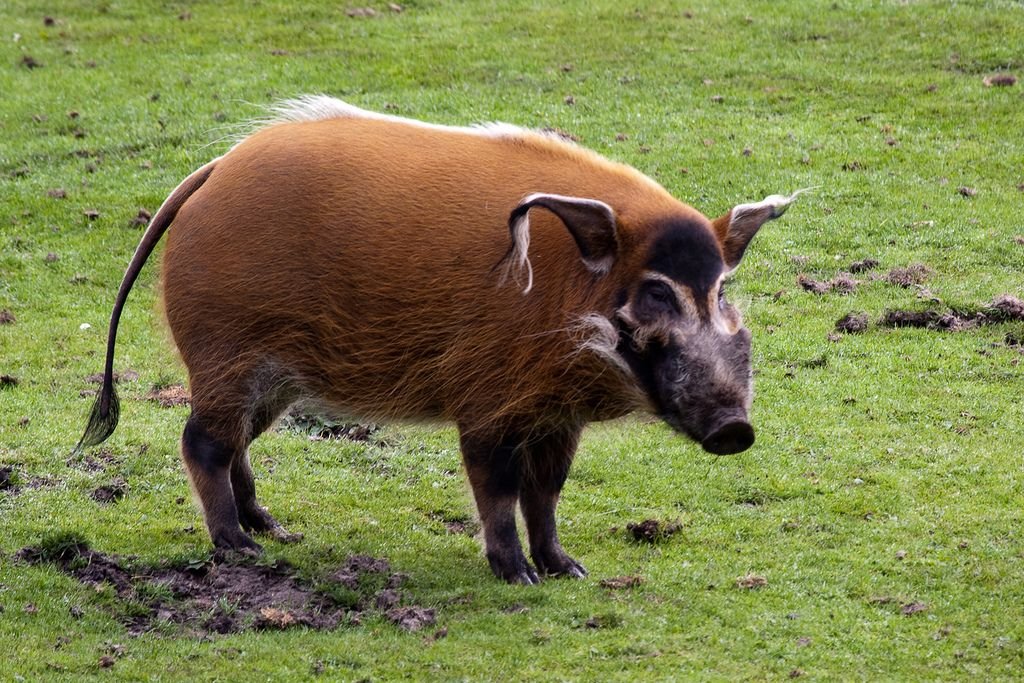
Red River Hog
Potamochoerus porcus — Africa's most colourful wild pig, a brick-red forest and thicket dweller of West and Central Africa.Introduction to the Red River Hog
The Red River Hog (Potamochoerus porcus) is Africa's smallest and most colourful wild pig, with a striking brick-red to orange coat, black legs, a white dorsal crest and bold white facial markings. Far from a generic plains animal, it is a true forest and thicket pig of West and Central Africa, at home in the Guinean and Congolian rainforests and the dense cover along rivers and swamps. It is currently listed as Least Concern by the IUCN, though its numbers are decreasing.
Because it is shy, secretive and largely nocturnal, the red river hog is one of the least-seen of Africa's pigs - but a patient observer on a forest night drive may be rewarded with a sounder slipping through the undergrowth, the white crest flashing as the animals startle.
Why the Red River Hog is Ecologically Vital
As an omnivorous rooter, the red river hog turns over soil, disperses seeds (including by eating elephant dung), and forms a major part of the prey base for forest leopards. Its abundance is a useful signal of healthy, intact forest.
A Species Worth Understanding
Its gaudy appearance and elusive habits make the red river hog easy to misdescribe. Understanding its real ecology - forest-bound, social in sounders, nocturnal and a prolific breeder - replaces myth with the genuine, remarkable animal.
Scientific Classification
The red river hog is one of two species in the genus Potamochoerus (the other being the bushpig, P. larvatus, of East and Southern Africa). Formerly lumped with the bushpig, it is now recognised as the forest specialist of the pair - a member of the Suidae, the pig family.
Physical Characteristics
The red river hog is built like a compact, vividly marked forest pig. Its defining traits:
- Length: Head-and-body about 1.0–1.45 m; tail 30–45 cm; shoulder height 0.55–0.8 m.
- Weight: Adults weigh about 45–115 kg, with males noticeably larger (large boars up to ~130 kg).
- Coat: Short, coarse hair in brick-red to orange; black legs; a narrow white dorsal line (erected when excited); longer bristles on the jaws and flanks.
- Face: A bold white facial mask - greyish muzzle, white brows around the eyes, white cheeks and whiskers, black marks on the snout and ears; prominent white ear tufts. Males carry two bony humps (warts) on the muzzle.
- Tusks: Small but sharp; the upper canines curve down beside the lower ones.
- Young: Piglets are dark brown with pale yellow spots and stripes for camouflage, fading by about six months.
Social Life & the Sexes
The red river hog is a gregarious suid that lives in sounders - groups of about 6–20 animals (females, subadults and young) attended by a single master boar. This is genuine pig biology, not antelope herd structure:
- Master boar: The dominant male leads and defends the sounder, scent-marking with tusks and glands and seeing off rivals.
- Subadult males: As they mature, younger males are driven off by the boar and often form small bachelor groups; old males may become solitary.
- Females: Form the core of the group and cooperate in raising the striped piglets.
- Daily life: Largely nocturnal - most foraging happens after dark - though in safe forest they may also move by day. By day they rest in a burrow within dense thicket.
- Voice & scent: Continuous grunts and squeals keep the sounder in contact; they tusk-scratch trees and use foot, neck and preorbital glands to mark trails.
Red River Hog Young
Young are raised within the sounder, in a nest hidden in dense cover:
- Breeding: Can occur through the year in the wetter parts of the range; peaks vary regionally (e.g. late dry to wet season).
- Gestation: About 120–127 days.
- Birth: A litter of usually 3–4 piglets (1–4, rarely up to 6). The sow builds a grass-and-leaf nest where the young are born and stay about 10–15 days before joining the sounder.
- Care: Both parents help guard the piglets; the boar stands watch over the nest. Spotted piglets freeze and 'play possum' when alarmed.
- Growth: Weaned at 2–4 months; reach sexual maturity at about 18–24 months.
Habitat: Where They Thrive
The red river hog is a forest and thicket specialist. It is most at home in the dense, moist cover of primary and secondary rainforest - especially gallery forest and swamp margins - and uses dry forest, savanna woodland and cultivated areas only where thick vegetation remains nearby. It is almost always found close to rivers, lakes and marshes, and it avoids open grassland.
Key Habitat Types:
- Rainforest & gallery forest: The core requirement - closed canopy and thick understory for resting by day and moving by night.
- Swamp margins & wetlands: Regularly near permanent water; fond of wallowing in shallow swampy pools.
- Thicket & dense secondary growth: Includes forest edges, regenerating logged forest and riverine bush.
- Savanna woodland & farmland edges: Used only with dense cover; it is here that it can come into conflict with crops.
Climate & Altitude:
A tropical, lowland species of humid forest; it does not extend into the dry Sahel or open East African savanna. Conservation areas that protect intact forest - above all in Gabon, Cameroon and the Congo Basin - hold the , with a small East African toehold in north-west Uganda.
Distribution Map
The red river hog occupies the main tropical rainforest belt of West and Central Africa, from Senegal and Gambia through the Guinean forests to the Congo Basin, and east to north-west Uganda. It is absent from East Africa south of that, and from Tanzania:
Not found in Tanzania or the rest of East Africa; the only East African population is in the country's north-west.
Because it is forest-bound and nocturnal, a sighting depends on habitat and patience far more than on country - but the Congo Basin's protected forests are the surest bet, with Uganda's northwest the easiest East African option.
Where to See Red River Hog on Safari
The red river hog is present across its West and Central African range but is seen mostly on forest game drives, often at dusk or after dark. Top regions to look:
Gabon & Congo Basin
Best: Forest drives, year-round | Region: Lope, Odzala, Nouabale-Ndoki, Salonga
Nocturnal
Tip: Ask your guide about dusk spotlight drives near forest edge.
Cameroon & CAR
Best: Forest drives, year-round | Region: Dja, Campo Ma'an, Dzanga-Sangha
Nocturnal
Tip: Dense forest reserves offer the best odds away from the plains circuit.
Uganda (NW)
Best: Forest drives, year-round | Region: Murchison, Budongo, Queen Elizabeth
Nocturnal
Tip: The only East African population; ask about forest-edge night drives.
West Africa
Best: Forest reserves, year-round | Region: Guinea, Liberia, Côte d'Ivoire, Ghana
Nocturnal
Tip: Remote forest parks hold healthy populations but little tourism infrastructure.
Red River Hog in Pictures
A closer look at the red river hog in its natural rainforest and thicket habitat - its vivid coat, white crest and masked face are best appreciated up close.
Where to Spot the Red River Hog on Safari
Plan your trip around the forests and riverine thickets where night drives give the best chance of a sighting. Explore the destinations below.
Diet: What They Eat
The red river hog is an omnivore and a powerful rooter, using its snout to dig for food at night:
- Primary Diet: Roots, tubers and bulbs; fallen fruit and nuts; grasses and herbs; bark and fungi.
- Animal matter: Insects, worms, eggs, small vertebrates, snails and carrion - it will even follow chimpanzees to glean dropped fruit.
- Feeding Time: Mostly after dark (nocturnal); in shaded forest it may also forage at dawn and dusk.
- Water: Stays near permanent water and wallows; drinks daily.
- Conflict: Where it raids crops (cassava, yams, maize) it is persecuted by farmers - a major local threat.
Daily Behaviour & Social Life
Daily Rhythm
Day: Rests in a burrow deep in dense thicket; rarely active.
Dusk & Night: Emerges to forage - most activity happens after dark.
Protected areas: Where not hunted, it may also feed by day.
Social Structure
- Sounders: Groups of about 6–20 led by a master boar, with several females and their young.
- Subadult males: Driven off by the boar and may form bachelor groups; old males may be solitary.
- Communication: Grunts and squeals keep contact; tusk-scratched trees and scent glands mark trails and status.
- Home range: Sounders roam 3–6 km a day between resting and feeding areas, often along gallery forest.
- Defence: Bold when cornered or wounded - a boar may charge. Leopards and spotted hyenas are the main wild predators; pythons take piglets.
Predators & Threats
In the wild, leopards (which rely heavily on these pigs in places like Lope), spotted hyenas and pythons take hogs and piglets; humans are by far the greatest source of mortality through hunting for bushmeat.
Watching tip: Night drives with a spotlight offer the best chance; by day, look for fresh tracks, rooting and wallows in forest.
Reproduction & Lifespan
- Mating: Polygynous; the master boar mates with several sows in the sounder.
- Gestation: About 120–127 days.
- Litter: Usually 3–4 piglets (range 1–6); born in a hidden grass-and-leaf nest and stay ~10–15 days before joining the sounder.
- Maturity: Young reach reproductive maturity at about 18–24 months.
- Lifespan: About 10–15 years in the wild, and up to ~20 years in captivity.
Conservation Status
IUCN Red List Status: Least Concern (population trend decreasing).
Major Threats
- Hunting: The most-hunted pig of the Congo Basin; a staple of the commercial bushmeat trade (up to ~40% of bushmeat in Gabon).
- Habitat loss: Deforestation and fragmentation of its rainforest home shrink and isolate populations.
- Crop conflict: Persecuted by farmers where it raids crops, adding local pressure.
Conservation Programs
Protected national parks and reserves are the backbone of conservation for the red river hog. Organisations such as African Parks and WWF work with governments to fund anti-poaching units and restore habitat, and the IUCN SSC Pigs & Peccaries Specialist Group coordinates suid research. In Uganda, the Uganda Wildlife Authority (UWA) protects the northwest forests where the species' only East African population persists.
32 Interesting Facts
Red River Hog vs Other Animals
Red River Hog vs Bushpig
| Feature | Red River Hog | Bushpig |
|---|---|---|
| Weight | 45–115 kg | 50–150 kg |
| Length | 1.0–1.45 m | 1.0–1.5 m |
| Speed | up to ~ | up to |
| Lifespan | 10–15 yrs | up to ~20 yrs |
| Range | West & Central Africa | East & Southern Africa |
Red River Hog vs Giant Forest Hog
| Feature | Red River Hog | Giant Forest Hog |
|---|---|---|
| Weight | 45–115 kg | 100–275 kg |
| Length | 1.0–1.45 m | 1.3–2.1 m |
| Speed | up to ~ | up to |
| Lifespan | 10–15 yrs | 10–15 yrs |
| Coat | Red & white-marked | Dark, coarse |
Red River Hog vs Warthog
| Feature | Red River Hog | Warthog |
|---|---|---|
| Weight | 45–115 kg | 50–150 kg |
| Length | 1.0–1.45 m | 1.2–1.5 m |
| Speed | up to ~ | |
| Lifespan | 10–15 yrs | 10–15 yrs |
| Habitat | Forest & thicket | Open savanna |
Red River Hog in African Culture
The red river hog features in the folklore of communities across West and Central Africa, where it is at once a wary forest animal and a prized source of bushmeat.
- Symbolism: In some traditions it represents forest abundance and resilience.
- Folklore: Stories across its range tell of its boldness and its sudden charges when cornered.
- Modern view: Today it is a little-known forest species best appreciated on a patient, responsible forest safari.
Wildlife Photography Guide
- Best Camera Lens: A 70–200mm or 100–400mm lens is ideal for forest distances and close-ups from a vehicle.
- Best Time: Dusk and after dark on spotlight drives - the red river hog is overwhelmingly nocturnal.
- Best Habitat: Forest edges and swamp margins in Gabon, Cameroon and Uganda's northwest.
- Best Behaviour: Look for rooting, wallowing and sounder movement rather than open grazing.
- Safety Distance: Always stay inside the vehicle, keep a safe distance, and never make sudden movements - a cornered boar is dangerous.
Frequently Asked Questions
The red river hog (Potamochoerus porcus) is Africa's smallest and most colourful wild pig and one of two species in its genus. A shy, largely nocturnal forest dweller of West and Central Africa, it is listed as Least Concern by the IUCN.
Its range is West and Central Africa - the Guinean and Congolian rainforests - from Senegal and Gambia to the Congo Basin, with a small East African population in north-west Uganda. It does not occur in Tanzania or the rest of East Africa.
It is an omnivore that roots for roots, tubers, bulbs, fallen fruit and nuts, plus grasses, herbs, insects, eggs, small vertebrates and carrion. It often forages after dark.
Adults are 1.0-1.45 m in head-body length and stand about 0.55-0.8 m at the shoulder (tail 30-45 cm).
About 45-115 kg, with males noticeably larger; large boars can reach roughly 130 kg.
Despite its build it can run at up to about over short bursts.
About 10-15 years in the wild, and up to around 20 years in captivity.
No - it is Least Concern on the IUCN Red List, but populations are decreasing because of heavy bushmeat hunting and deforestation.
Rainforest and gallery forest, swamp margins, dense thicket and riverine bush, usually near permanent water. It avoids open grassland and dry savanna.
Hunting for the commercial bushmeat trade (especially in the Congo Basin), deforestation and fragmentation of its forest home, and persecution where it raids crops.
Largely nocturnal, most active after dark; by day it rests in a burrow in dense thicket. It is a strong swimmer and loves to wallow.
Yes - it lives in sounders of about 6-20 animals led by a master boar; subadult males are driven off and may form bachelor groups, while old males may be solitary.
Mainly leopards (which rely heavily on these pigs in forests like Lope), spotted hyenas and pythons; humans are by far the greatest cause of mortality through hunting.
Year-round, but almost always on forest game drives; patience and a spotlight at dusk offer the best chance.
In West and Central African traditions it can symbolise forest abundance and resilience, while to hunters it is a wary, formidable quarry.
After a 120-127 day gestation a litter of usually 3-4 piglets (1-6) is born in a hidden grass-and-leaf nest; they stay about 10-15 days before joining the sounder, are weaned at 2-4 months and mature at 18-24 months. The spotted young freeze when alarmed.
Through near-constant grunts and squeals to keep the sounder in contact; it also scent-marks with tusk-scratched trees and glands on its feet, neck and face.
As an omnivorous rooter it turns over soil and disperses seeds (even from elephant dung), and it is a key prey species for forest leopards.
Yes - spotlight night drives in Gabon and the Congo Basin, or forest drives in Uganda's northwest, give the best chance, with a long lens and a steady vehicle position.
A forest game drive (ideally at night) in reserves that hold the species - above all in Gabon, Cameroon and Uganda's northwest.
Support protected forest reserves and responsible operators, and back efforts that reduce the commercial bushmeat trade.
Yes - protected parks and anti-poaching work, especially in Gabon, Cameroon, DRC and CAR, plus the IUCN SSC Pigs & Peccaries Specialist Group and organisations like African Parks and WWF.
It is the most colourful of all African pigs, yet so elusive that most visitors to Africa never see one.
The Red River Hog is a West and Central African forest pig; the most reliable viewing is in Gabon, Cameroon, the Congo Basin and Uganda's northwest on dedicated forest safaris - not on a standard Tanzania or East African plains safari.
No global population estimate is published. The IUCN lists it as Least Concern but decreasing; it remains abundant locally yet is heavily hunted across the Congo Basin.
Related Safari Packages & Tours
Plan a forest safari to see the red river hog and the rest of Africa's incredible wildlife with our expert guides.
References & Further Reading
- IUCN Red List: Potamochoerus porcus - Least Concern (decreasing).
- Animal Diversity Web (University of Michigan): Potamochoerus porcus account.
- Smithsonian National Zoo: Red River Hog fact sheet.
- IUCN SSC Pigs & Peccaries Specialist Group: Detailed species profile.
- Kingdon, J. (2015). The Kingdon Field Guide to African Mammals. Bloomsbury.
- About these facts: Weight, speed and lifespan are approximate adult ranges. They can vary with sex, age, season, location and measurement method; conservation status should be checked against the current IUCN assessment.
Sightings are never guaranteed and depend on local conditions.