

.png)
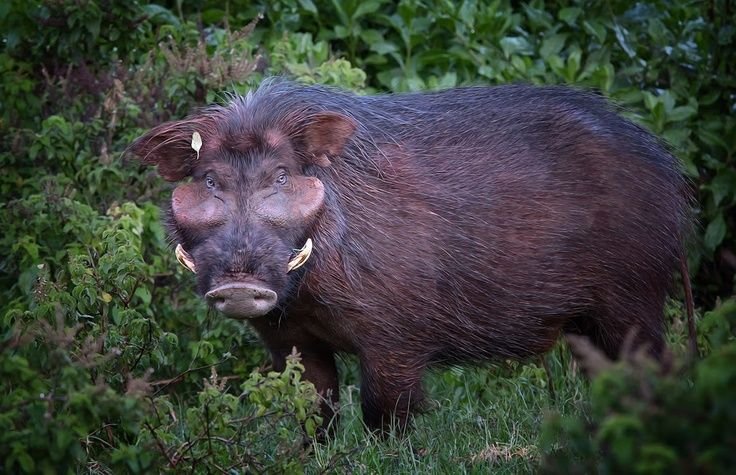
Giant Forest Hog
Hylochoerus meinertzhageni — Africa's largest wild pig, a huge, wrinkle-faced forest dweller of equatorial Africa.Introduction to the Giant Forest Hog
The Giant Forest Hog (Hylochoerus meinertzhageni) is Africa's largest wild pig, associated with dense forest, forest edge and highland habitats in parts of equatorial Africa. Seldom seen because it is shy and largely nocturnal, it forages in family groups called sounders and was only described by science in 1904. It is currently listed as Least Concern by the IUCN, though its numbers are decreasing.
Unlike the open-country antelopes that draw most safari headlines, the giant forest hog is a creature of cover and shadow. A confirmed sighting — usually a dark, bristly shape melting into the undergrowth at dusk — is a real prize for a patient observer, and Uganda's forests are the most reliable place to look.
Why the Giant Forest Hog is Ecologically Vital
As a large grazer-browser of forest and thicket, the giant forest hog shapes the vegetation it feeds on and, through its wallows, paths and dung, influences the forest floor. Its presence is a sign of intact, connected forest habitat.
A Species Worth Understanding
Because it is secretive and easily persecuted, the giant forest hog is poorly known even within its own range. Understanding its true ecology — forest-bound, social and nocturnal — helps separate myth from the real, remarkable animal and makes a sighting all the more rewarding.
Scientific Classification
The giant forest hog is the only member of its genus, Hylochoerus — a forest pig of the Suidae, the pig family. Its scientific name honours Richard Meinertzhagen, who shot the type specimen in Kenya in 1904, and researchers continue to study its genetics and declining populations.
Physical Characteristics
The giant forest hog is, on average, the largest living wild pig. Here are the traits that mark it as a forest specialist:
- Body & Weight: Adults weigh about 100–275 kg, with males noticeably larger (median male ~210 kg, female ~167 kg).
- Size: Head-and-body 1.3–2.1 m; shoulder height about 0.75–1.1 m.
- Coat: Coarse black hair with orange-tipped hairs near the skin; large, pointed ears; a huge broad head.
- Face & tusks: Adult males develop naked, inflated cheek pads (scent glands); both sexes have small, straight tusks that flare outward, reaching up to ~30 cm. A preputial scent gland is also present.
- Senses: Good smell and hearing, but only fair eyesight — it relies on nose and ears more than eyes.
- Build: Massive head and shoulders, short legs and a bristly tail; a powerful, intimidating frame built for pushing through dense cover.
Social Life & the Sexes
The giant forest hog is a social pig that lives in sounders — groups of about 6–14 animals (occasionally up to 20) in a roughly 1 male : 2 female ratio, led by a dominant male. This is genuine hog biology, not antelope herd structure:
- Dominant male: Leads and defends the sounder. Boars are intolerant of rivals and settle disputes by snout-pushing and forehead-ramming — fights can be loud and sometimes fatal.
- Subadult males: Young males leave the sounder and form bachelor groups; old males may become solitary.
- Females: Form the core of the group; unusually for pigs, all females in the sounder can nurse the piglets, and the whole group defends the young.
- Daily life: Largely nocturnal — most feeding happens between dusk and midnight — though in protected areas, where they are not hunted, they may be active by day.
- Home range: A sounder's range links wallows, mineral licks, latrines and feeding areas by well-worn paths through the underbrush; they scrape hollows in the earth to bed down.
Giant Forest Hog Young
Young are raised communally within the sounder:
- Breeding: Usually February–April and August–October.
- Gestation: About 151 days.
- Birth: A litter of 2–11 piglets. The sow leaves the sounder shortly before giving birth and returns with the piglets about a week later.
- Care: All sounder members help protect the piglets, and any female may nurse them.
- Growth: Piglets are weaned at about 9 weeks and reach reproductive maturity at roughly 18 months.
Habitat: Where They Thrive
The giant forest hog prefers the dense shade of thickets and bushes, ranging through dry forest, humid lowland forest and montane forest (up to about 3800 m), and is most common near permanent water with thick understory cover. It also uses forest-grassland mosaics, wooded savanna and subalpine habitats, but it cannot cope with low humidity or prolonged sun and is absent from arid, open country.
Key Habitat Types:
- Dense thicket & bush: The core requirement — cover for resting by day and moving by night.
- Forest (dry, lowland, montane): From sea level to high volcanoes and mountains; it ventures into clearings and grassland to feed.
- Riverine & permanent water: Always near reliable water; wallows and mineral licks are regular fixtures of a home range.
- Forest edge & mosaic: Forest-grassland edges offer the grasses and herbs it grazes.
Climate & Altitude:
It spans a wide elevational range but is tied to moist, closed or thickly vegetated habitats. Conservation areas that protect intact forest — above all in Uganda — secure the .
Distribution Map
The giant forest hog is a species of equatorial Africa, west of the Rift Valley, from West and Central Africa east to Uganda and western Kenya, with scattered populations north-east of Lake Victoria and in the Ethiopian Highlands:
Absent from southern Africa and most of East Africa east of the Rift; the most accessible populations are in Uganda.
Because it is shy and forest-bound, a sighting depends on habitat and patience far more than on country — but Uganda's protected forests are the surest bet.
Where to See Giant Forest Hog on Safari
The giant forest hog is present across its equatorial range but is seen mostly on forest game drives, often at dusk or after dark. Top regions to look:
Uganda
Best: Forest drives, year-round | Region: Bwindi, Semliki, Kibale, Queen Elizabeth, Murchison, Rwenzori
Nocturnal
Tip: Ask your guide about dusk spotlight drives near forest edge.
Kenya
Best: Forest drives, year-round | Region: Western & central forests, Mt Kenya
Nocturnal
Tip: Protected forests where the species is not hunted offer the best odds.
Giant Forest Hog in Pictures
A closer look at the giant forest hog in its natural forest and thicket habitat — its size, bristly coat and distinctive face are best appreciated up close.
Where to Spot the Giant Forest Hog on Safari
Plan your trip around the destinations where forest night drives give the best chance of a sighting. Explore the parks, itineraries and tour packages by destination below.
Diet: What They Eat
The giant forest hog is mainly a herbivore — a grazer-browser — feeding on grasses, leaves, sedges, herbs, roots and fruit, and it will also scavenge. In safe areas it may feed for up to four steady hours between dusk and midnight and travel 8–12 km a day.
- Primary Diet: Grasses and herbs (grazing) plus leaves, sedges, roots, bulbs and fallen fruit.
- Feeding Time: Mostly after dark (nocturnal); diurnal where the species is protected from hunting.
- Water: Needs permanent water; wallows and mineral licks are regular parts of its range.
- Seasonal Shifts: Moves locally with fresh growth and fruit availability.
- Ecosystem Role: A large grazer-browser that shapes forest-edge vegetation and turns the forest floor via wallows and paths.
Daily Behaviour & Social Life
Daily Rhythm
Day: Rests in dense cover or a scraped earth bed; rarely active.
Dusk & Night: Emerges to feed — most activity happens between dusk and midnight.
Protected areas: Where not hunted, it may also forage by day, especially in cool weather.
Social Structure
- Sounders: Groups of about 6–14 (up to 20) led by a dominant male, with several females and their young.
- Subadult males: Leave to form bachelor groups; old males may be solitary.
- Communication: Grunts and alarm calls; males use scent from cheek and preputial glands; boars fight by snout-pushing and forehead-ramming.
- Home range furniture: Wallowing places, mineral licks, latrines and paths connect a sounder's core areas.
- Defence: Bold and aggressive when cornered — a boar may charge to protect the group; leopards and spotted hyenas are the main wild predators, lions rarely (habitat separation).
Predators & Threats
In the wild, leopards and spotted hyenas take pigs and piglets; humans are the greatest source of mortality through hunting. Its best defences are cover, nocturnal habits and group vigilance.
Watching tip: Night drives with a spotlight offer the best chance; by day, look for fresh tracks, wallows and rooting.
Reproduction & Lifespan
- Mating: Breeding peaks February–April and August–October.
- Gestation: About 151 days.
- Litter: Usually 2–11 piglets; the sow leaves the sounder to give birth and returns ~1 week later.
- Maturity: Young reach reproductive maturity at about 18 months.
- Lifespan: Up to about 10–15 years (shorter where heavily hunted).
Conservation Status
IUCN Red List Status: Least Concern (population trend decreasing).
Major Threats
- Deforestation: Clearance and fragmentation of its forest habitat shrink and isolate populations.
- Hunting: Heavily hunted for bushmeat across its range; in some places it is also valued for its ivory-like tusks.
- Disease: A symptomless carrier of African Swine Fever, which is lethal to domestic pigs — an economic and management concern.
Conservation Programs
Protected national parks and reserves are the backbone of conservation for the giant forest hog. Organisations such as African Parks and WWF work with governments to fund anti-poaching units, restore habitat and support local communities. In Uganda, the Uganda Wildlife Authority (UWA) protects the forests where the species is most reliably seen, and KWS does the same in Kenya.
32 Interesting Facts
Giant Forest Hog vs Other Animals
Giant Forest Hog vs Bushpig
| Feature | Giant Forest Hog | Bushpig |
|---|---|---|
| Weight | 100–275 kg | 50–150 kg |
| Size | 1.3–2.1 m long | 1.0–1.5 m long |
| Speed | up to | up to |
| Lifespan | 10–15 yrs | up to ~20 yrs |
| Diet | Herbivore | Omnivore |
Giant Forest Hog vs Red River Hog
| Feature | Giant Forest Hog | Red River Hog |
|---|---|---|
| Weight | 100–275 kg | 45–115 kg |
| Size | 1.3–2.1 m long | 1.0–1.5 m long |
| Speed | up to | up to |
| Lifespan | 10–15 yrs | 10–15 yrs |
| Diet | Herbivore | Omnivore |
Giant Forest Hog vs Warthog
| Feature | Giant Forest Hog | Warthog |
|---|---|---|
| Weight | 100–275 kg | 50–150 kg |
| Size | 1.3–2.1 m long | 1.2–1.5 m long |
| Speed | up to | |
| Lifespan | 10–15 yrs | 10–15 yrs |
| Diet | Herbivore | Omnivore (more grazing) |
Giant Forest Hog in African Culture
The giant forest hog appears in the folklore of communities across equatorial Africa, and is both a wary forest animal and a prized hunted species.
- Symbolism: In some traditions it represents raw forest power and resilience.
- Folklore: Stories across its range tell of its strength and its sudden, fearless charges.
- Modern view: Today it is a little-known forest species best appreciated on a patient, responsible forest safari.
Wildlife Photography Guide
- Best Camera Lens: A 70–200mm or 100–400mm lens is ideal for forest distances and close-ups from a vehicle.
- Best Time: Dusk and after dark on spotlight drives — the giant forest hog is overwhelmingly nocturnal.
- Best Habitat: Forest edges and thickets in Uganda and Kenya offer the best opportunities.
- Best Behaviour: Look for wallowing, sounder movement and feeding rather than open grazing.
- Safety Distance: Always stay inside the vehicle, keep a safe distance, and never make sudden movements — a cornered boar is dangerous.
Frequently Asked Questions
The giant forest hog (Hylochoerus meinertzhageni) is Africa's largest wild pig and the only member of its genus. A shy, largely nocturnal forest dweller of equatorial Africa, it was first described by science only in 1904, and is listed as Least Concern by the IUCN.
Its range is equatorial Africa, west of the Rift Valley — from West and Central Africa east to Uganda and western Kenya, with scattered populations north-east of Lake Victoria. The most reliable place to look is Uganda's forests (Bwindi, Semliki, Kibale, Queen Elizabeth, Murchison).
It is mainly a herbivore (a grazer-browser), feeding on grasses, leaves, sedges, herbs, roots and fruit, and it will also scavenge.
Adults are 1.3–2.1 m in head-body length and stand about 0.75–1.1 m at the shoulder.
About 100–275 kg, with males noticeably larger than females (median male ~210 kg, female ~167 kg).
Despite its bulk it can run at up to about .
Up to about 10–15 years in the wild, shorter where the species is heavily hunted.
No — it is Least Concern on the IUCN Red List, but populations are decreasing because of deforestation and hunting.
Dense forest, thickets and bushes — dry, humid lowland and montane forest (up to about 3800 m) — usually near permanent water. It avoids open, arid country.
Deforestation of its forest habitat, hunting for bushmeat, and — because it is a carrier of African Swine Fever — conflict linked to domestic-pig disease.
Largely nocturnal, most active between dusk and midnight; in protected areas it may feed by day. It uses wallows, mineral licks, latrines and paths through the underbrush.
Yes — it lives in sounders of about 6–14 (up to 20) led by a dominant male; subadult males form bachelor groups.
Mainly leopards and spotted hyenas; lions are rarely a threat because the species lives in dense forest. Humans are the greatest cause of mortality through hunting.
Year-round, but almost always on forest game drives; patience and a spotlight at dusk offer the best chance.
In parts of equatorial Africa it appears in folklore as a symbol of forest strength, while to hunters it is a wary, formidable quarry rather than a safari headline.
After a ~151-day gestation a litter of 2–11 piglets is born; the sow leaves the sounder to give birth and returns about a week later. All females may nurse the young, which are weaned at ~9 weeks and mature at ~18 months.
Through grunts and alarm calls; males signal with scent from cheek and preputial glands, and rival boars fight by snout-pushing and forehead-ramming.
As a large grazer-browser it shapes forest-edge vegetation, and its wallows, paths and dung influence the forest floor.
Yes — spotlight night drives in Uganda's forests give the best chance, with a long lens and a steady vehicle position.
A forest game drive (ideally at night) in reserves that hold the species — above all in Uganda.
Support protected forest reserves and responsible operators, and respect wildlife guidelines on night drives.
Yes — protected parks and anti-poaching work, especially in Uganda (UWA) and Kenya (KWS), plus organisations like African Parks and WWF.
It is the world's largest wild pig, yet so elusive that many people living within its range have never seen one.
The Giant Forest Hog is best sought in suitable forest habitats within its verified range, particularly in Uganda and other parts of equatorial Africa — not on a standard plains safari.
No global population estimate is published. The IUCN lists it as Least Concern but decreasing; it is heavily hunted locally and disappearing from fragmented forest.
Related Safari Packages & Tours
Plan a forest safari to see the giant forest hog and the rest of Africa's incredible wildlife with our expert guides.
References & Further Reading
- IUCN Red List: Hylochoerus meinertzhageni — Least Concern (decreasing).
- Animal Diversity Web (University of Michigan): Hylochoerus meinertzhageni account.
- Uganda Wildlife Authority (UWA): Protection of forest reserves where the species persists.
- Kenya Wildlife Service (KWS): Conservation of Kenya's forest habitats.
- Kingdon, J. (2015). The Kingdon Field Guide to African Mammals. Bloomsbury.
- About these facts: Weight, speed and lifespan are approximate adult ranges. They can vary with sex, age, season, location and measurement method; conservation status should be checked against the current IUCN assessment.
Sightings are never guaranteed and depend on local conditions.