

.png)
Common Warthog
Phacochoerus africanus — Africa's only pig built for open, dry savanna - it trots with its tail erect and kneels to graze.Introduction to the Warthog
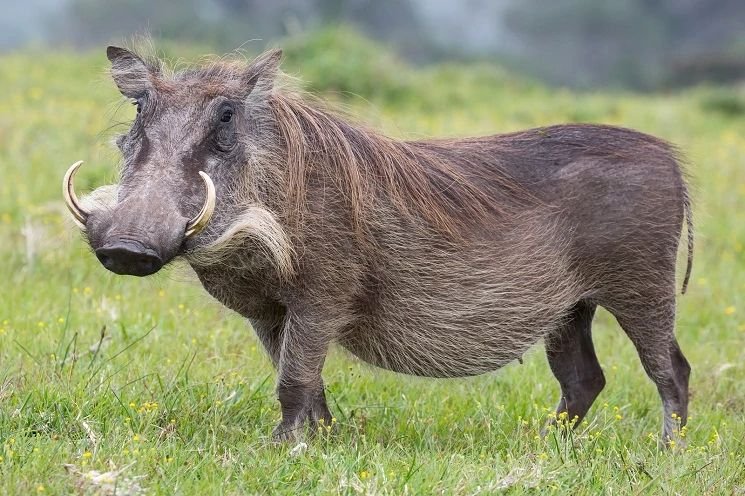
The Common Warthog (Phacochoerus africanus) is the savanna's signature pig - a surprisingly swift, bristle-coated grazer known for its quirky silhouette: a big-headed, sparse-haired body, a mane of erectable bristles down the spine, two pairs of facial warts, curved tusks, and a thin tail that springs straight up when it runs. It is the only pig truly adapted to open, dry country, and it is found across most of sub-Saharan Africa. It is currently listed as Least Concern by the IUCN.
Two behaviours define it: it faces its rump to the sun and kneels on hardened carpal pads to graze on short grass, and it trots with its tail held vertical - a clear signal for a line of piglets following their mother. On a Tanzanian safari, the warthog is about as reliable a sighting as you can get.
Why the Warthog is Ecologically Vital
As a widespread grazer it shapes grassland, turns soil at wallows and burrows, and is a staple prey species for lions, leopards, hyenas, wild dogs and cheetahs - linking the grass layer to the great predators of the plains.
A Species Worth Understanding
Its comical look hides a well-engineered survivor. Understanding its warts, tusks, kneeling posture and use of burrows replaces caricature with genuine appreciation - and makes every sighting richer.
Scientific Classification
The warthog is one of two species in the genus Phacochoerus, within the Suidae (the pig family). Unlike its forest-loving relatives, it is a specialist of open, sunny grassland and light woodland.
Physical Characteristics
The warthog is built for dry savanna life. Its defining, species-specific features:
- Size: Head-and-body 0.9–1.5 m; shoulder height about 0.6–0.85 m; tail 30–40 cm (with a dark terminal tuft).
- Weight: Adults weigh 50–150 kg, with males noticeably larger than females.
- Facial warts: Two pairs of fleshy warts - a smaller pair below the eyes and a larger pair on the cheeks (mandibular). They are bigger in males and act as cushioning during head-to-head fights.
- Tusks: The upper canines are sharpened into long, curved tusks (both sexes, larger in males); the lower canines are shorter, chisel-like teeth used to sharpen the uppers.
- Mane: A crest of long bristles runs from the neck along the spine and can be erected when the animal is alarmed.
- Sparse hair: Thin, bristly, grey-brown coat; the body is nearly bare in places, an adaptation to heat.
- Digging & kneeling adaptations: A tough, disc-like snout pad for rooting, and carpal (knee) pads that let it kneel comfortably to graze on short grass.
- Tail: Thin and whippy, held erect when running - the classic warthog signal.
Male vs Female Warthog
Boars and sows differ in size and in their social roles - not in the generic 'female = group core / male = bachelor' way, but in measurable, species-specific traits:
| Trait | Boar (male) | Sow (female) |
|---|---|---|
| Size | Larger and more massive | Smaller |
| Tusks & warts | Larger tusks and bigger facial warts | Smaller tusks and warts |
| Teats | None | Six teats; nurses the litter |
| Social life | Usually solitary or in bachelor groups; joins groups only to mate | Lives in family groups (sounders) with her young; related females may group |
| Role | Competes for mating opportunities and defends against rivals | Primary carer; leads piglets to grazing and back to the burrow |
Warthog Young
Young are raised with real maternal care, almost always in and around a burrow:
- Breeding: Linked to the rains; after the first rains the sow leaves the group to give birth.
- Gestation: About 5–6 months (roughly 170–180 days).
- Birth: A litter of usually 2–4 piglets (range 1–8) is born inside a burrow, often an abandoned aardvark hole.
- Burrow life: The piglets stay in the burrow for about 3 weeks before they first venture out.
- Following the mother: Once out, the piglets follow the sow single-file with tails erect; she leads them to grazing and back to safety.
- Care & growth: Weaned at about 4 months; reach sexual maturity at roughly 18–21 months. Family groups of females and young are the normal social unit.
Habitat: Where They Thrive
The warthog is a creature of open, sunlit country. It favours open and wooded savanna, grassland, grass-steppe and semi-desert, and it avoids dense forest and true desert. Two features are essential wherever it lives:
Key Habitat Types:
- Open savanna & grassland: The core habitat - short grass for kneeling grazing.
- Open woodland: Light, scattered trees and shrubland for shade and cover.
- Semi-arid & steppe: It tolerates dry, marginal country better than any other African pig.
- Wallows: Mud wallows are used to cool off and to protect the near-bare skin from sun and insects.
- Burrows: It relies on burrows (frequently abandoned aardvark holes) for shelter, to escape heat and predators, and to rear piglets.
Climate & Altitude:
A warm-climate species of low to moderate elevations; it is absent from rainforest and from the driest desert cores. Protected savanna - above all in Tanzania - holds healthy, easily seen populations.
Distribution Map
The warthog is one of the most widespread pigs in Africa. Its range spans sub-Saharan Africa, from Mauritania and Ethiopia south to Namibia and eastern South Africa, avoiding only dense rainforest and the driest deserts. It is common across East and Southern Africa:
In Tanzania, the most reliable viewing is the northern circuit: Serengeti, Tarangire and Lake Manyara.
Because it is common and diurnal, a sighting depends far less on luck than on simply being in open savanna - and Tanzania's parks are among the easiest places to watch them.
Where to See Warthog on Safari
Warthogs are seen on almost any savanna drive, but the classic Tanzanian strongholds are the northern parks:
Serengeti
Best: Year-round | Region: Open plains & grasslands
Common
Tip: Look for family groups grazing on short grass with tails up.
Tarangire
Best: Year-round (dry Jun-Oct) | Region: Wooded savanna
Common
Tip: Abundant near the river and swamps in the dry season.
Lake Manyara
Best: Year-round | Region: Groundwater forest & open glade
Common
Tip: Often seen on the roadside and at wallows.
Wider range
Best: Year-round | Region: Kenya, Namibia, Botswana, South Africa
Common
Tip: Almost any open-savanna reserve will produce sightings.
Warthog in Pictures
A closer look at the warthog in its open savanna home - warts, tusks, erectable mane and that famous upright tail.
Where to Spot the Warthog on Safari
Plan your trip around the open savanna reserves where warthogs are a daily sight. Explore the destinations below.
Diet: What They Eat
The warthog is a grazer that feeds mostly on grass, and it is one of the few mammals that regularly kneels to feed:
- Primary Diet: Short grasses (the bulk of the diet); also roots, bulbs, tubers, fallen fruit and bark.
- Feeding posture: Kneels on carpal pads and uses its disc-like snout to root and clip grass close to the ground.
- Water & dry season: Needs to drink where water is available; in dry periods it digs for roots and rhizomes and may eat more bulbs.
- Opportunistic: Occasionally takes carrion, eggs or small invertebrates; largely vegetarian overall.
- Ecosystem Role: A major grazer that links grassland to the predator community.
Daily Behaviour & Social Life
Daily Rhythm
Morning & late afternoon: Most grazing happens in the cooler hours; at midday it rests in shade or a burrow and wallows to keep cool.
Night: Usually returns to a burrow to sleep, safe from most predators.
Running: When alarmed it bolts with the tail held erect, often back to the nearest burrow.
Social Structure
- Sounders: Groups of related females and their young (typically 2–3 adult sows with piglets) are the normal unit.
- Boars: Adult males are usually solitary or in loose bachelor groups, joining sounders only to mate; they fight rivals with their warts and tusks.
- Burrows: Often use abandoned aardvark holes; a sow blocks the entrance with her body or soil when piglets are inside.
- Defence: Relies on early warning and a fast dash to a burrow; if cornered, a boar will turn and slash with its tusks.
Predators & Threats
Lions, leopards, spotted hyenas, wild dogs and cheetahs all take warthogs; piglets are also vulnerable to eagles, jackals and pythons. Its best defences are vigilance, group sentinel behaviour and the safety of the burrow.
Watching tip: On open plains at dawn or dusk, scan for the upright tail of a grazing family group - they are among the easiest animals to approach.
Reproduction & Lifespan
- Mating: Boars contest for access to sounders; mating follows the local rainy season.
- Gestation: About 170–180 days (roughly 5–6 months).
- Litter: Usually 2–4 piglets (range 1–8), born in a burrow.
- Maturity: Young reach reproductive maturity at about 18–21 months.
- Lifespan: About 7–11 years in the wild, and up to ~18 years in captivity.
Conservation Status
IUCN Red List Status: Least Concern - widespread and common across its range.
Major Threats
- Habitat conversion: Agriculture and settlement shrink open savanna locally.
- Hunting: Taken for bushmeat and, in some places, persecuted as a crop pest when it raids fields.
- Drought: Prolonged dry periods reduce grass and water, raising mortality - especially of piglets.
Conservation Programs
Protected national parks and reserves are the backbone of warthog conservation. In Tanzania, TANAPA and TAWA manage the parks where they thrive; organisations such as African Parks and WWF support protection and anti-poaching across the wider range. Because the species is common and adaptable, it needs general habitat protection more than species-specific rescue.
32 Interesting Facts
Warthog vs Other Animals
Warthog vs Bushpig
| Feature | Warthog | Bushpig |
|---|---|---|
| Weight | 50–150 kg | 50–150 kg |
| Length | 0.9–1.5 m | 1.0–1.5 m |
| Speed | up to ~ | up to |
| Lifespan | 7–11 yrs | up to ~20 yrs |
| Habitat | Open savanna | Forest & thicket |
Warthog vs Red River Hog
| Feature | Warthog | Red River Hog |
|---|---|---|
| Weight | 50–150 kg | 45–115 kg |
| Length | 0.9–1.5 m | 1.0–1.45 m |
| Speed | up to ~ | up to ~ |
| Lifespan | 7–11 yrs | 10–15 yrs |
| Coat | Grey, sparse, maned | Red & white-marked |
Warthog vs Giant Forest Hog
| Feature | Warthog | Giant Forest Hog |
|---|---|---|
| Weight | 50–150 kg | 100–275 kg |
| Length | 0.9–1.5 m | 1.3–2.1 m |
| Speed | up to ~ | up to |
| Lifespan | 7–11 yrs | 10–15 yrs |
| Habitat | Open savanna | Dense forest |
Warthog in African Culture
The warthog appears in the folklore of many savanna peoples, where its odd looks and plucky behaviour make it a comic, clever or stubborn figure rather than a noble one.
- Symbolism: Often a trickster or survivor figure in oral tradition.
- Modern view: Today it is a favourite of visitors - the comical, ever-present pig of the plains.
Wildlife Photography Guide
- Best Camera Lens: A 100–400mm or 70–200mm lens is ideal for plains distances and close-ups from a vehicle.
- Best Time: Early morning and late afternoon, when warthogs graze and the light is soft.
- Best Habitat: Open savanna in Serengeti, Tarangire and Lake Manyara.
- Best Behaviour: Capture the kneeling graze, the erect tail of a running group, and piglets in single file.
- Safety Distance: Always stay inside the vehicle and keep a respectful distance - a cornered boar can be dangerous.
Frequently Asked Questions
The common warthog (Phacochoerus africanus) is Africa's only pig built for open, dry savanna. Known for its facial warts, tusks, erectable mane and upright tail, it kneels to graze and trots with its tail held high. It is listed as Least Concern by the IUCN.
Across sub-Saharan Africa. In Tanzania the best places are the Serengeti, Tarangire and Lake Manyara; it is also common in Kenya and throughout Southern Africa.
It is a grazer that feeds mainly on short grasses, dropping to its knees to crop them; it also takes roots, bulbs, fallen fruit and bark, and occasionally carrion.
Adults are 0.9-1.5 m in head-body length and stand about 0.6-0.85 m at the shoulder (tail 30-40 cm).
About 50-150 kg, with males noticeably larger than females.
It can run at up to about - fast enough to reach a burrow when threatened.
About 7-11 years in the wild, and up to around 18 years in captivity.
No - it is Least Concern on the IUCN Red List, widespread and common across its range.
Open and wooded savanna, grassland, grass-steppe and semi-desert. It depends on wallows to cool off and on burrows (often abandoned aardvark holes) for shelter and to rear young.
Habitat conversion to farmland, hunting for bushmeat and persecution as a crop pest, and drought that hits piglets hardest.
Mostly diurnal; it grazes in the cool hours, rests and wallows at midday, and sleeps in a burrow at night. When alarmed it runs with its tail erect, usually toward a burrow.
Yes - females and their young form sounders (family groups), while adult males are usually solitary or in bachelor groups and join groups only to mate.
Lions, leopards, spotted hyenas, wild dogs and cheetahs take adults; piglets are also vulnerable to eagles, jackals and pythons.
Year-round - it is a common, diurnal plains animal. The dry season (June-October) is excellent as animals concentrate near water.
In many savanna traditions it is a comic, clever or stubborn figure - a survivor rather than a noble beast - and a familiar character of the plains.
After a 5-6 month gestation a litter of usually 2-4 piglets (range 1-8) is born in a burrow. They stay inside about 3 weeks, then follow the sow single-file with tails up, are weaned at ~4 months and mature at 18-21 months.
Through grunts, growls and alarm barks, plus visual signals (erect mane, upright tail, posture) and scent marking.
As a widespread grazer it links grassland to the predator community, and its burrowing and wallowing shape the ground it uses.
Yes - open savanna at dawn or dusk in the Serengeti, Tarangire and Lake Manyara gives great chances, especially of kneeling grazers and piglet groups.
Classic open-vehicle game drives on the plains - no special technique needed, as warthogs are common and easy to approach.
Support protected savanna reserves and responsible operators, and back efforts that reduce bushmeat hunting and habitat loss.
Yes - protected parks and anti-poaching work, including TANAPA/TAWA in Tanzania and organisations like African Parks and WWF, keep populations healthy.
It is the only pig fully at home in open, dry savanna - kneeling to graze, running with its tail up, and raising piglets in burrows.
Tanzania's northern circuit (Serengeti, Tarangire, Lake Manyara) is an excellent, reliable place to see warthogs, as are Kenya and the parks of southern Africa - almost any savanna safari will do.
No single global total is published, but the IUCN lists it as Least Concern - common and widespread across sub-Saharan Africa.
Related Safari Packages & Tours
Plan a savanna safari to see the warthog and the rest of Africa's incredible wildlife with our expert guides.
References & Further Reading
- IUCN Red List: Phacochoerus africanus - Least Concern.
- Animal Diversity Web (University of Michigan): Phacochoerus africanus account.
- Smithsonian National Zoo: Warthog fact sheet.
- Kingdon, J. (2015). The Kingdon Field Guide to African Mammals. Bloomsbury.
- About these facts: Weight, speed and lifespan are approximate adult ranges. They can vary with sex, age, season, location and measurement method; conservation status should be checked against the current IUCN assessment.
Sightings are never guaranteed and depend on local conditions.