

.png)
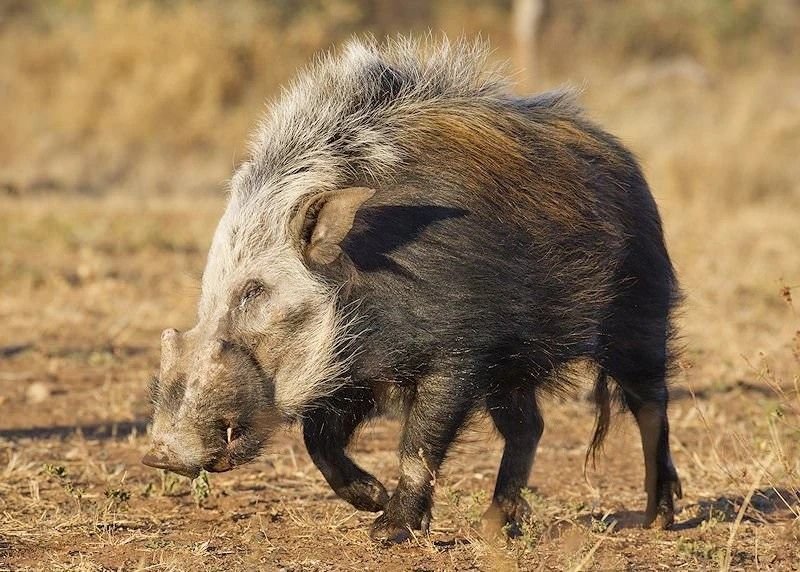
Bushpig
Potamochoerus larvatus — a bristly, nocturnal pig of forest and thicket, rooting by night in family sounders.Introduction to the Bushpig
The Bushpig (Potamochoerus larvatus) is a nocturnal, forest- and thicket-associated wild pig of sub-Saharan Africa — not an antelope and not a plains grazer. It forages mainly after dark in family groups called sounders, rooting with its snout for roots, fruit and small prey, and is currently listed as Least Concern by the IUCN.
Unlike the open-country antelopes that draw most safari headlines, the bushpig is a creature of cover and darkness: secretive, powerful and surprisingly widespread from the Horn of Africa to South Africa. Seeing one usually means a patient night drive or a lucky glimpse at dusk, and a confirmed sighting is a real highlight for a keen observer.
Why the Bushpig is Ecologically Vital
As an omnivore that digs constantly for roots and tubers, the bushpig is an ecosystem engineer and a major seed disperser. Its rooting turns over the soil, and the fruit it eats is carried and dropped across the forest floor — work that benefits countless other plants and animals.
A Species Worth Understanding
Because it raids crops, the bushpig is often in conflict with farmers. Yet inside protected forest and thicket it plays a quiet, vital role. Understanding its true range and behaviour helps separate myth from the real, fascinating animal — and makes a sighting all the more rewarding.
Scientific Classification
The bushpig belongs to the Suidae — the pig family — a group of omnivorous, snout-driven foragers rather than grazing antelopes. Its scientific name Potamochoerus larvatus places it among the African bush and river hogs, and researchers continue to study its genetics and porous species boundaries with the red river hog.
Physical Characteristics
The bushpig is a compact, powerfully built pig — here are the traits that make it a forest specialist rather than a plains animal:
- Body & Weight: Adults weigh about 50–150 kg, with males noticeably larger than females.
- Size: Head-and-body 100–150 cm; shoulder height roughly 66–100 cm.
- Coat: Highly variable — blonde, russet, dark brown to near-black — usually with a paler head, white face markings and a greyish dorsal crest that bristles when the animal is alarmed.
- Tusks: Both sexes have tusks; the upper pair is tiny, but the lower tusks are 9–16.5 cm and razor-sharp. Adult males develop bony ridges and calluses on the muzzle.
- Senses: Excellent smell and hearing, but eyesight is only fair — the bushpig reads the world through nose and ears, not eyes.
- Build: Short legs, rounded back, elongated snout and a tufted tail; females have six pairs of mammae.
Male vs Female: Key Differences
Within a bushpig sounder the sexes play distinct but cooperative roles — this is a social pig, not a plains antelope:
| Characteristic | Male | Female |
|---|---|---|
| Weight | Larger, up to ~150 kg | Smaller, often 50–100 kg |
| Build | Heavier head, bony muzzle calluses | Sleeker; six pairs of mammae |
| Social role | Dominant male leads and guards the sounder; helps rear & defend piglets | Core of the group; leads foraging and cares for young |
| Dispersal | Subadult males leave the natal group; old males may be solitary | Females typically remain on their natal home range |
| Lifespan | Up to ~20 yrs | Up to ~20 yrs |
Fun Fact: Unusually for a pig, the adult male bushpig takes an active role in defending and rearing the young — he will stand with the sow against threats to the litter.
Bushpig Young
Young bushpigs are born into the safety of the sounder, and both the sow and the dominant boar invest in their survival:
- Birth: After a gestation of 120–127 days, the female retires to a sheltered nest or hollow and gives birth to a litter of usually 3–4 (up to 10) piglets.
- Early Life: Newborns weigh about 700–800 g and are dark with paler longitudinal stripes or spots; they stay in the nest for their first days.
- Growth: Piglets are weaned at 2–4 months and soon forage with the sounder, sampling roots, fruit and fallen food.
- Protection: Adults are fiercely protective; the sow and boar, and often the whole sounder, will mob a threat to the litter.
- Learning: Young learn rooting, foraging and danger-avoidance by following experienced adults.
- Independence: Males disperse from the natal group as they mature (sexual maturity at 18–21 months); females tend to remain on the family range.
Habitat: Where They Thrive
The bushpig is one of the most widespread pigs in Africa, ranging from southern Somalia and Ethiopia south through East Africa (Kenya, Uganda, Tanzania, Rwanda, Burundi and the DRC) to Zambia, Malawi, Mozambique, Zimbabwe, Botswana, Namibia, Eswatini and South Africa — with introduced populations on Madagascar and the Comoros. It is not a Tanzania-only animal.
Key Habitat Types:
- Forest & thicket: The core of its range — dense cover where it rests by day.
- Riverine vegetation & reedbeds: Favoured valley bottoms with soft, moist soils ideal for rooting.
- Woodland & montane forest: Including high altitudes (up to ~4000 m on Mt Kilimanjaro).
- Agricultural edges: Bushpigs readily enter farms and croplands at night, which is the main source of conflict with people.
Climate & Altitude:
It is adaptable across a wide range of altitudes and climates, but always seeks dense vegetation and soft ground for rooting. Conservation areas protect the , yet the species is increasingly rare outside protected forest.
Distribution Map
The bushpig occurs across most of sub-Saharan Africa. The countries below mark the broad range — note how much wider it is than a single East African country:
Core populations span East and Southern Africa; the species is absent from the driest deserts and the deepest rainforest interior.
Its range overlaps many famous safari destinations — but because it is nocturnal and secretive, a sighting depends on timing and habitat, not just country.
Where to See Bushpig on Safari
Bushpig are present across their range but are seen mostly on night drives in forested and thicketed reserves. Top regions to look:
Uganda
Best: Night drives, year-round | Region: Kibale, Queen Elizabeth, Murchison
Nocturnal
Tip: Ask your guide about spotlight drives near forest edge.
Tanzania
Best: Night drives, year-round | Region: Udzungwa, Nyerere, Kilimanjaro foothills, coastal forests
Nocturnal
Tip: Look for fresh rooting and tracks on forest roads at dawn.
Kenya
Best: Night drives, year-round | Region: Aberdare, Mount Kenya, coastal forests
Nocturnal
Tip: Forest lodges with night drives offer the best odds.
Southern Africa
Best: Night drives, year-round | Region: Kruger, Hluhluwe–iMfolozi, Caprivi
Nocturnal
Tip: Winter days may bring brief daytime activity.
Bushpig in Pictures
A closer look at the bushpig in its natural forest and thicket habitat — its bristly coat, tusks and secretive nature are best appreciated up close.
Where to Spot the Bushpig on Safari
Plan your trip around the destinations where forest and thicket night drives give the best chance of a sighting. Explore the parks, itineraries and tour packages by destination below.
Diet: What They Eat
The bushpig is an omnivore built for rooting. With its snout it digs for roots, tubers and bulbs, and it also eats fruit, fungi, crops (maize, potatoes, sugarcane), eggs, invertebrates, small vertebrates and carrion. In cultivated areas a sounder can damage crops quickly, which is why it is often classed as a pest.
- Primary Diet: Roots, tubers, bulbs, fruit and fungi, supplemented by animal matter when available.
- Feeding Time: Mostly after dark (nocturnal); in cool weather it may also forage by day.
- Water: Needs regular access to water; rooting concentrates near soft, moist soils and riverine strips.
- Seasonal Shifts: It follows ripening fruit and soft ground, moving locally with food availability.
- Ecosystem Role: A major seed disperser and soil-turner that shapes the habitats it uses.
Understanding what the bushpig eats helps guides find signs of it — fresh rooting, tracks and droppings — even when the animal itself stays hidden.
Daily Behaviour & Social Life
Daily Rhythm
Day: Rests in dense thickets or a nest, rarely active.
Dusk & Night: Emerges to forage, root and move — most activity happens after dark.
Cool weather: In the colder months of southern Africa it may forage by day.
Social Structure
- Sounders: Bushpigs live in family groups of about 6–12, led by a dominant male, with several females and their young.
- Male care: Unusually for pigs, the adult male helps defend and rear the piglets.
- Dispersal: Subadult males leave the natal group; old males may be solitary, while females stay on their home range.
- Communication: Grunts, an alarm growl, scent marking and a dorsal crest erected when agitated.
- Defence: Courageous and dangerous when cornered — the sounder may mob a threat to protect the young.
Predators & Threats
In the wild the bushpig must stay alert. Lions, leopards, spotted hyenas, pythons and large eagles may take adults or piglets, and people hunt it heavily for bushmeat. Its best defences are vigilance, speed and group protection.
Watching tip: Night drives with a spotlight offer the best chance to observe active behaviour; by day, look for fresh rooting, tracks and wallows.
Reproduction & Lifespan
- Mating: Bushpigs are polygynous; a dominant male holds a sounder of several females and aggressively excludes rival males.
- Breeding: Can occur year-round, with a peak at the end of the dry season and the start of the rains.
- Gestation: 120–127 days.
- Litter: Usually 3–4 piglets (up to 10); born in a sheltered nest.
- Maturity: Young reach sexual maturity at 18–21 months.
- Lifespan: Up to about 20 years (shorter in the wild, where hunting and predators take their toll).
Conservation Status
IUCN Red List Status: Least Concern (population trend stable).
Major Threats
- Hunting & bushmeat: The most significant pressure; bushpigs are heavily hunted across their range.
- Habitat loss: Forest clearance and farmland expansion shrink and fragment suitable cover.
- Human-wildlife conflict: Crop raiding leads to retaliatory killing and exclusion from farmlands.
Conservation Programs
Protected national parks and reserves are the backbone of conservation for the bushpig. Organisations such as African Parks and WWF work with governments to fund anti-poaching units, restore habitat and support local communities. In Tanzania, TAWIRI monitors wild populations, while KWS (Kenya) and UWA (Uganda) protect forest reserves where the species persists.
32 Interesting Facts
Bushpig vs Other Animals
Bushpig vs Giant Forest Hog
| Feature | Bushpig | Giant Forest Hog |
|---|---|---|
| Weight | 50–150 kg | 100–275 kg |
| Size | 1.0–1.5 m long | 1.3–2.1 m long |
| Speed | up to | |
| Lifespan | up to ~20 yrs | 10–15 yrs |
| Diet | Omnivore | Herbivore |
Bushpig vs Red River Hog
| Feature | Bushpig | Red River Hog |
|---|---|---|
| Weight | 50–150 kg | 45–115 kg |
| Size | 1.0–1.5 m long | 1.0–1.5 m long |
| Speed | up to | up to |
| Lifespan | up to ~20 yrs | 10–15 yrs |
| Diet | Omnivore | Omnivore |
Bushpig vs Warthog
| Feature | Bushpig | Warthog |
|---|---|---|
| Weight | 50–150 kg | 50–150 kg |
| Size | 1.0–1.5 m long | 1.2–1.5 m long |
| Speed | up to | |
| Lifespan | up to ~20 yrs | 10–15 yrs |
| Diet | Omnivore | Omnivore (more grazing) |
Bushpig in African Culture
The bushpig appears in the folklore and daily life of many African communities, and is also a familiar crop-raider on the farm edge.
- Symbolism: In some traditions it represents resilience and the untamed spirit of the forest.
- Folklore: Stories across East and Southern Africa tell of its cunning and nocturnal ways.
- Rock Art: Pig-like animals appear in ancient rock paintings across the continent.
- Modern view: Today it is both a hunted wild pig and a species best appreciated on a responsible forest safari.
Wildlife Photography Guide
- Best Camera Lens: A 70–200mm or 100–400mm lens is ideal for both landscapes and close-ups from a vehicle.
- Best Time: Dusk and after dark on spotlight drives — the bushpig is overwhelmingly nocturnal.
- Best Habitat: Forest edges, thickets and riverine strips across its range offer the best opportunities.
- Best Behaviour: Look for rooting, wallowing and sounder movement rather than open grazing.
- Safety Distance: Always stay inside the vehicle, keep a safe distance, and never make sudden movements — a cornered bushpig is dangerous.
Frequently Asked Questions
The bushpig (Potamochoerus larvatus) is a nocturnal wild pig of sub-Saharan Africa, a member of the Suidae (pig family). It forages at night in family sounders and is listed as Least Concern by the IUCN.
Across a huge range — from Somalia and Ethiopia through East Africa to South Africa, plus Madagascar. The best chances are night drives in forest and thicket reserves in Uganda, Tanzania, Kenya and southern Africa.
It is an omnivore that roots for roots, tubers and bulbs, and also eats fruit, fungi, crops, eggs, invertebrates, small vertebrates and carrion.
Adults are 1.0–1.5 m in head-body length, with a shoulder height of about 66–100 cm.
About 50–150 kg, with males noticeably larger than females.
It can run at up to about and is also a strong swimmer.
Up to about 20 years, though wild animals often live shorter lives because of hunting and predators.
No — it is Least Concern on the IUCN Red List, with a stable trend. Locally, though, it is heavily hunted and increasingly rare outside protected forest.
Forest, thicket, riverine vegetation and woodland, including montane forest up to ~4000 m, plus farmland edges it visits at night.
Hunting for bushmeat, habitat loss and fragmentation, and conflict with farmers over crop raiding.
It is predominantly nocturnal, resting in dense cover by day and emerging after dark to forage and move, usually in a sounder.
Yes — it lives in family sounders of about 6–12 led by a dominant male, and unusually for a pig the male helps defend and rear the young.
Lions, leopards, spotted hyenas, pythons and large eagles, and — most significantly — humans through hunting.
Year-round, but always on night drives; by day you are more likely to find fresh rooting and tracks than the animal itself.
In parts of Africa it appears in folklore as a symbol of resilience and forest cunning, while to farmers it is better known as a nocturnal crop-raider.
A litter of 3–4 is born in a nest after a 120–127 day gestation; piglets weigh 700–800 g, are weaned at 2–4 months, and reach maturity at 18–21 months.
Through grunts, an alarm growl, scent marking, and a dorsal crest that bristles when the animal is agitated.
As a rooting omnivore it disperses seeds and turns over soil, shaping the forest and thicket habitats it uses.
Yes — spotlight night drives in forest reserves give the best chance, with a long lens and a steady vehicle position.
A dedicated night game drive in a forested or thicketed reserve, rather than a standard daytime plains drive.
Choose responsible operators, support protected forest reserves, and respect wildlife guidelines on night drives.
Yes — protected parks, anti-poaching units and organisations like African Parks and WWF help secure its future, with agencies such as TAWIRI, KWS and UWA monitoring populations.
It is a true forest pig — nocturnal, secretive and social — and one of the few pigs where the male actively helps raise the young.
Be patient: book a night drive in suitable forest or thicket habitat, scan with a spotlight, and look for rooting and tracks. It is a reward for the attentive, not a guaranteed day sighting.
No global population estimate is published. The IUCN lists it as Least Concern with a stable trend, but numbers are patchy and it is heavily hunted locally, so totals are unknown rather than comfortably large.
Related Safari Packages & Tours
Book a safari to see the bushpig and the rest of Africa's incredible wildlife with our expert guides.
References & Further Reading
- IUCN Red List: Potamochoerus larvatus — Least Concern.
- IUCN SSC Pigs, Peccaries & Hippos Specialist Group: Bushpig (Potamochoerus larvatus) detailed profile.
- Animal Diversity Web (University of Michigan): Potamochoerus larvatus account.
- African Parks: Conservation efforts for large mammals in Africa.
- Tanzania Wildlife Research Institute (TAWIRI): Monitoring wildlife populations in Tanzania.
- Kenya Wildlife Service (KWS): Wildlife conservation in Kenyan parks.
- Uganda Wildlife Authority (UWA): Protection of wildlife in Ugandan reserves.
- Kingdon, J. (2015). The Kingdon Field Guide to African Mammals. Bloomsbury.
- About these facts: Weight, speed and lifespan are approximate adult ranges. They can vary with sex, age, season, location and measurement method; conservation status should be checked against the current IUCN assessment.
Sightings are never guaranteed and depend on local conditions.