

.png)
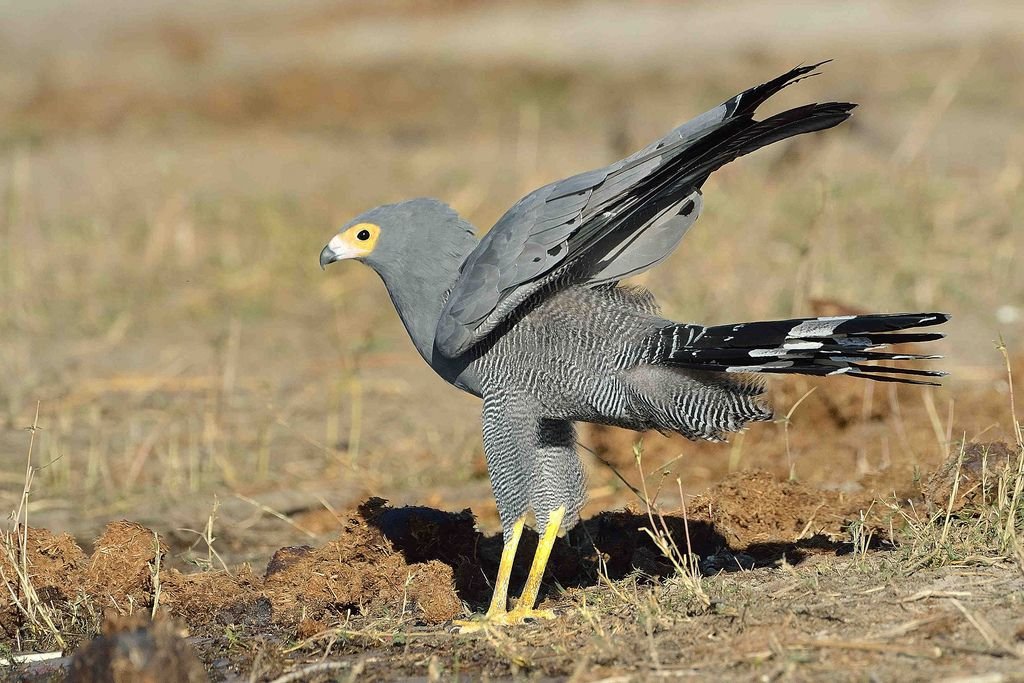
African Harrier-Hawk
Polyboroides typusA master contortionist of the African skies – the raptor that can reach into the deepest holes to extract its prey.
The African Harrier-Hawk (Polyboroides typus), also known as the Gymnogene, is a medium-sized bird of prey from the family Accipitidae. It is a distinctive raptor with a small, pointed head, a patch of naked yellow skin on the face that flushes red when excited, and a remarkable double-jointed ankle that allows it to reach into otherwise inaccessible holes and cracks for prey.[reference:0][reference:1]
African Harrier-Hawk Quick Facts
What Is the African Harrier-Hawk?
The African Harrier-Hawk (Polyboroides typus), also known as the Gymnogene, is a medium-sized bird of prey belonging to the family Accipitridae, which also includes eagles, kites, buzzards and hawks. It was first described by the Scottish zoologist Andrew Smith in 1829.[reference:11][reference:12]
The species is named after the 19th-century German explorer Eduard Rüppell? No, that's the vulture. The name "Gymnogene" comes from the Greek words gymnos (naked) and genos (race or kind), referring to the bird's distinctive bare facial skin. The only other member of the genus Polyboroides is the Madagascar Harrier-Hawk (Polyboroides radiatus).[reference:13]
This raptor is a common resident species south of the Sahara, found in a wide variety of habitats ranging from semi-desert scrub to lowland rainforest.[reference:14][reference:15] It is a versatile and opportunistic feeder, known for its remarkable ability to clamber around trees and cliffs to extract prey from deep holes and crevices.
How to Identify an African Harrier-Hawk
The African Harrier-Hawk is a distinctive and easily recognisable raptor. Here are its key identifying features:
- Size: A medium-sized raptor, measuring 60-66 cm (24-26 in) in length.[reference:16]
- Head: Small, pointed head with a patch of bare yellow skin on the face, which flushes red when the bird is excited.[reference:17][reference:18]
- Crest: A crest of feathers on the top of the head, which may be raised or lowered.[reference:19]
- Plumage: Upperparts, head and breast are pale grey. The belly is white with fine dark barring.[reference:20]
- Wings: Broad wings are pale grey with a black trailing edge fringed with a narrow white line.[reference:21]
- Tail: Black with a single broad white band.[reference:22]
- Legs: Long, yellow legs with small feet – remarkably flexible, able to bend both forwards and backwards.[reference:23]
Juvenile vs Adult
Juveniles have brown plumage instead of grey, blackish facial skin, a brown tail with four darker brown bars, and variable amounts of whitish, reddish-brown or dark bars or streaks on the abdomen.[reference:24] Adult plumage is not attained until about the third year.[reference:25]
Distinguishing from Other Raptors
Although similar to chanting-goshawks, the African Harrier-Hawk's long but small angular head, broad wings, and distinctive tail pattern are diagnostic.[reference:26] The bare facial skin and double-jointed ankles are unique features that set it apart from other African raptors.
Behavior & Social Life
The African Harrier-Hawk is typically seen singly or in pairs.[reference:27] It is a versatile and agile raptor, known for its remarkable climbing and foraging abilities.
Foraging & Hunting
- Climbing: It is often seen clumsily clambering around on cliffs and trees when foraging, hanging from tree limbs with wings flapping, or running up tree trunks.[reference:28]
- Double-Jointed Ankles: A unique feature of this species is the remarkable flexibility of its legs and feet. The long yellow legs and small feet are able to bend both forwards and backwards through large angles, enabling the bird to reach into nests, holes and crevices to extract otherwise inaccessible prey.[reference:29][reference:30]
- Hunting: It hunts by soaring or flapping slowly over open areas between trees, and also by actively searching for prey in trees, nests, rock faces, and from underneath objects on the ground.[reference:31][reference:32]
Vocalization
The African Harrier-Hawk is a fairly silent bird, but in the breeding season gives a long, whistled call described as sueee-sueee-sueee.[reference:33][reference:34] Near the nest, it produces a rapid chattering ki-ki-ki-ki.[reference:35]
Habitat & Distribution
The African Harrier-Hawk occurs in a wide variety of open and forested habitat, ranging from semi-desert scrub to riparian woodlands to lowland rainforest, and including exotic tree plantings in southern Africa.[reference:36] It is often associated with cliff faces in mountainous or hilly terrain, but it also occurs in flat plains.[reference:37] It is less common in more arid areas, and usually perches within cover.[reference:38]
Distribution: The species has an extremely large range, with an Extent of Occurrence of approximately 24,800,000 km².[reference:39] It is found throughout sub-Saharan Africa, from Senegambia in the west to Ethiopia in the east, and southwards to Angola and South Africa.[reference:40]
Two subspecies are recognised: P. t. typus (eastern Africa to South Africa) and P. t. pectoralis (western Africa to northwest Angola). The latter is smaller and darker, with more barring on the underparts.[reference:41]
Tanzania Distribution
In Tanzania, the African Harrier-Hawk is found in most national parks and game reserves. It has been recorded in Serengeti National Park, Ngorongoro Conservation Area, Tarangire National Park, and Ruaha National Park.[reference:42][reference:43]
African Harrier-Hawk in Tanzania
The African Harrier-Hawk is a distinctive and fascinating raptor of Tanzania's woodlands and savannas. Here are the best locations to see it:
Serengeti National Park
Recorded in the Serengeti, often seen clambering in trees or soaring over the plains. Photographed in the Serengeti ecosystem.[reference:44]
Serengeti safariNgorongoro Crater
Observed in the Ngorongoro Conservation Area, listed among the grey raptors of the region.[reference:45][reference:46]
Ngorongoro safariTarangire National Park
Found in the park's acacia woodlands and open savanna habitats.[reference:47]
Tarangire safariRuaha National Park
A resident species in Ruaha's miombo woodland and dry savanna habitats.
Ruaha safariSafari Methods
- Game drives through woodland and savanna habitats.
- Birdwatching – watch for the distinctive grey plumage, bare yellow face, and white-banded tail.
- Wildlife photography – the harrier-hawk's unique foraging behaviour makes it a fascinating subject.
Best Time to See Them
African Harrier-Hawks are present year-round in suitable habitat. They are most active during the cooler morning and evening hours. The dry season (June to October) is generally best for wildlife viewing.
Diet & Feeding
The African Harrier-Hawk is a versatile omnivore with a remarkably varied diet.[reference:48]
Food Sources
- Small mammals: Rodents and bats.[reference:49]
- Birds: Adults, eggs and nestlings.[reference:50]
- Reptiles: Lizards and snakes.[reference:51]
- Amphibians: Frogs.[reference:52]
- Insects: Various insects.[reference:53]
- Fish and carrion: Occasionally takes stranded fish or carrion.[reference:54]
- Fruit: In West Africa, often feeds on oil-palm fruits.[reference:55]
Foraging Behavior
The African Harrier-Hawk is notable for its habit of actively searching for prey in trees, nests, rock faces, and from underneath objects on the ground.[reference:56] It can often be seen clambering about and hanging from tree limbs, running up tree trunks with wings flapping, or hanging from foliage or birds' nests as it searches for food.[reference:57]
Its unique double-jointed ankles allow it to reach into nests, holes and crevices to extract otherwise inaccessible prey.[reference:58]
Breeding & Life Cycle
The African Harrier-Hawk is monogamous and territorial.[reference:59]
Nesting
- Nest: A relatively large stick nest, built in a tree or on a cliff ledge, and lined with sprays of green leaves.[reference:60]
- Eggs: One to three eggs are laid. They are white and boldly blotched with dark reddish-brown markings.[reference:61][reference:62]
- Incubation: About 35 days, shared by both parents but mainly the female.[reference:63][reference:64]
Chicks
Older chicks often kill younger siblings soon after hatching (siblicide), with usually only one, or sometimes two, chicks raised.[reference:65][reference:66] The fledging period is 45 to 55 days.[reference:67] The young leave the nest area soon after first flight.[reference:68] Adults and young are quiet and secretive at the nest, making the site unusually difficult to find.[reference:69]
Courtship
During courtship, the male performs a slow, circling display flight. Upon being joined by the female, the pair may come together, with the female rolling over and the pair sometimes briefly touching claws in mid-air.[reference:70]
Conservation Status
The African Harrier-Hawk is assessed as Least Concern on the IUCN Red List.[reference:71]
It has an extremely large range (Extent of Occurrence of approximately 24,800,000 km²) and does not approach the thresholds for Vulnerable.[reference:72][reference:73] The population trend is suspected to be declining, although this has not been formally quantified and is not believed to be approaching the threshold for Vulnerable status.[reference:74] The population size is inferred to be very large.[reference:75]
The species is listed on Appendix II of CITES, meaning that international trade in this species should be carefully monitored and controlled.[reference:76] It is also listed under Class B of the African Convention on the Conservation of Nature and Natural Resources, meaning that the African Harrier-Hawk should not be killed or captured without special authorisation.[reference:77]
Comparisons
The African Harrier-Hawk is sometimes confused with other raptors. Here are the key differences:
| Feature | African Harrier-Hawk | Pale Chanting-Goshawk | African Goshawk |
|---|---|---|---|
| Size | 60-66 cm | 45-55 cm | 35-45 cm |
| Head | Small, pointed, bare yellow face | Grey head with white eyebrow | Grey head, no bare skin |
| Plumage | Pale grey with white belly barred black | Pale grey with white underparts | Grey upperparts, barred underparts |
| Tail | Black with single white band | Grey with white tips | Grey with dark bars |
| Distinctive Feature | Double-jointed ankles | Long red legs | Short rounded wings |
Did You Know?
Double-Jointed Ankles
The African Harrier-Hawk has a reversible intertarsal ("knee") joint which can bend backward, as well as forward, enabling it to reach into deep holes.[reference:78]
Bare-Faced Whistling Hawk
It is also known by a few other names including African Gymnogene, Banded Harrier-hawk, and Bare-faced Whistling Hawk.[reference:79]
Convergent Evolution
A comparable leg-structure and behaviour can be found in the Neotropical Crane Hawk, as well as the extinct Australian Pengana – a case of convergent evolution.[reference:80]
Fruit Eater
In West Africa, this raptor often feeds on oil-palm fruits, making it one of the few raptors with a taste for fruit.[reference:81]
Slow Maturation
Adult plumage is not attained until about the third year of life.[reference:82]
Secretive Nesters
Adults and young are quiet and secretive at the nest, making the site unusually difficult to find.[reference:83]
There is a quiet, watchful presence in the African Harrier-Hawk. Its bare yellow face gives it an almost inquisitive expression, and its double-jointed ankles make it a contortionist of the avian world. Watching one of these birds clambering along a tree trunk, reaching into deep holes with its remarkably flexible legs, is to witness evolution at its most ingenious. It is a reminder that sometimes the most extraordinary adaptations are found in the most unassuming of creatures.
Gallery
Frequently Asked Questions
The African Harrier-Hawk (Polyboroides typus), also known as the Gymnogene, is a medium-sized bird of prey from the family Accipitridae. It is notable for its double-jointed ankles which allow it to reach into deep holes and crevices to extract prey.[reference:84][reference:85]
The African Harrier-Hawk is found in a wide variety of habitats across Tanzania. Key locations include Serengeti National Park, Ngorongoro Conservation Area, Tarangire National Park, and Ruaha National Park.[reference:86][reference:87]
The African Harrier-Hawk is an opportunistic omnivore. It feeds on small mammals, birds, eggs, nestlings, lizards, amphibians, insects, and occasionally fish and carrion. In some areas, it also feeds on oil-palm fruits.[reference:88]
No. The African Harrier-Hawk is listed as Least Concern on the IUCN Red List, with an extremely large range of 24,800,000 km². However, its population is suspected to be declining.[reference:89][reference:90]
The name 'Gymnogene' comes from the Greek words 'gymnos' (naked) and 'genos' (race or kind), referring to the bird's distinctive bare facial skin.
The African Harrier-Hawk is a medium-sized raptor, measuring 60-66 cm (24-26 in) in length.[reference:91]
The African Harrier-Hawk builds a stick nest in a tree or on a cliff ledge, lined with green leaves. One to three eggs are laid, with an incubation period of about 35 days. Older chicks often kill younger siblings, and usually only one or two chicks are raised.[reference:92]
In Swahili, the African Harrier-Hawk is often referred to as Kipanga or Kipanga-mavi, though local names can vary.
References & Further Reading
- Wikipedia – African harrier-hawk: Scientific name, description, distribution, habitat, behaviour, double-jointed ankles.[reference:93]
- Peregrine Fund – African Harrier-hawk: Did you know facts, habitat, diet, nests, eggs.[reference:94]
- BirdLife DataZone – African Harrier-hawk: IUCN Red List assessment, range, population trend.[reference:95]
- eBird – African Harrier-Hawk: Identification, distribution, sightings.[reference:96]
- Birds of the World – African Harrier-Hawk: Species names, taxonomy, citations.[reference:97]
- Encyclopedia of Life – African Harrier Hawk: Biology, diet, breeding, conservation.[reference:98]
- Brown, L. (1972) – The breeding behaviour of the African harrier hawk: Breeding cycle, incubation, fledging.[reference:99]