

.png)
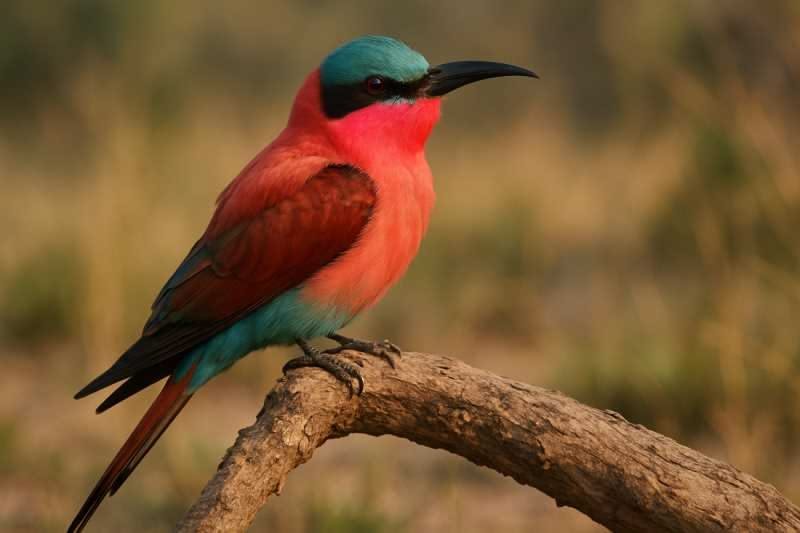
Carmine Bee-eater
Merops nubicusA brilliant carmine bee-eater of African river valleys and open country — fast, social and superbly adapted to catching insects on the wing.
The Carmine Bee-eater (Merops nubicus) is a large bee-eater in the family Meropidae, famous for its vivid red plumage, pointed wings and agile aerial hunting. In Tanzania, the Northern Carmine Bee-eater is documented in northeastern and coastal regions, often in wooded grassland and near water.
Carmine Bee-eater Quick Facts
What Is the Carmine Bee-eater?
The Carmine Bee-eater is one of Africa's most striking bee-eaters, with vivid carmine-red plumage and a streamlined body built for fast aerial pursuit of insects. It belongs to the family Meropidae and is closely associated with open country, woodland edges and river corridors.
The name can refer to a pair of closely related carmine bee-eaters in African field guides. In Tanzania, the northern form Merops nubicus is documented mainly in the northeast and along the coast, while the Southern Carmine Bee-eater occurs in western Tanzania.
Its combination of brilliant colour, social behaviour, aerial feeding and colonial nesting makes it an outstanding target for specialist birding and wildlife photography.
How to Identify a Carmine Bee-eater
The Carmine Bee-eater is large for a bee-eater and is immediately conspicuous because of its saturated carmine body and long pointed wings.
- Body: Brilliant carmine to deep red plumage dominates the appearance.
- Head: The crown and face show darker and bluish tones that contrast with the red body.
- Wings: Long, narrow and pointed for fast aerial manoeuvring.
- Tail: Streamlined and pointed, especially obvious in flight.
- Bill: Long, narrow and black, suited to aerial insect capture.
- Flight: Powerful, fast and direct, with frequent sallies from exposed perches.
Distinguishing from Other Bee-eaters
It is substantially larger and much redder than the Little Bee-eater and can be separated from European Bee-eater by its overwhelmingly carmine body. In Tanzania, the similar Southern Carmine Bee-eater is the key geographic comparison.
Behavior & Social Life
Carmine Bee-eaters are social birds that often gather in feeding groups and can form conspicuous colonies during the breeding season. They commonly perch together before making rapid flights after insects.
Daily Activity
- Hunting: It launches from a perch to capture bees, wasps, dragonflies and other flying insects.
- Social feeding: Several birds may exploit the same insect-rich area, especially near water.
- Roosting: Groups may gather communally at dusk in trees, reeds or other sheltered vegetation.
Migration
Movement patterns differ across the range and are linked to rainfall, breeding opportunities and food availability. In Tanzania the northern form is locally and seasonally mobile rather than uniformly resident everywhere.
Habitat & Distribution
The Carmine Bee-eater favours open landscapes where flying insects are abundant and elevated perches or suitable nesting banks are available.
- Wooded grassland with scattered trees and shrubs.
- River valleys and habitats near permanent or seasonal water.
- Open woodland used for perching and hunting.
- Floodplains and lightly cultivated land where insects remain plentiful.
Distribution: The Northern Carmine Bee-eater occurs mainly across northeastern and eastern Africa, with its range extending into Tanzania.
Tanzania Distribution
Documented Tanzanian records include Mkomazi National Park, Makame, Pembe Abwe, Fish Eagle Point and the Moshi area.
Carmine Bee-eater in Tanzania
For the Northern Carmine Bee-eater, the most useful Tanzanian search areas are in the northeast and along the coast, especially open habitats close to water.
Mkomazi National Park
Multiple documented records make Mkomazi one of the strongest Tanzanian localities for the Northern Carmine Bee-eater.
Mkomazi safariMakame
This northeastern locality is among the documented Tanzanian sites for the species.
Northern Tanzania safariFish Eagle Point & Coastal Tanzania
Coastal records show the species uses open, near-water habitats where flying insects are abundant.
Coastal safariMoshi Area
A documented record near Moshi extends the known Tanzanian occurrence into the Kilimanjaro region.
Northern circuit safariSafari Methods
- Birdwatching along open woodland and river corridors.
- Photography from quiet observation points near feeding and roosting sites.
- Game drives through open country where birds can be located on exposed perches.
Best Time to See Them
Local timing varies with rainfall and movements, but cooler morning and late-afternoon periods are often productive for watching aerial feeding activity.
Diet & Feeding
The Carmine Bee-eater is an aerial insectivore that captures much of its food in flight, usually from a perch-based hunting strategy.
Food Sources
- Bees: Regularly taken when flying insects are abundant.
- Wasps: Important aerial prey captured around open country.
- Dragonflies: Especially available around wetlands and rivers.
- Other insects: Beetles, grasshoppers and assorted flying arthropods may also be taken.
Hunting Behavior
The bird waits on an exposed perch, launches after passing prey and returns to a perch after the chase. Stinging insects can be processed before being swallowed, reducing the risk from their defensive sting.
Breeding & Life Cycle
Carmine Bee-eaters breed socially, often in colonies where suitable earthen banks allow burrows to be excavated close together.
Nesting
- Nest: A tunnel or burrow dug into a sandy or earthen bank.
- Eggs: Commonly a small clutch of white eggs, often around 2–3.
- Incubation: Around three weeks in typical bee-eater nesting conditions.
Chicks
Young remain in the burrow for several weeks and are fed by adults. After fledging they continue learning aerial hunting techniques while staying associated with the family or wider group.
Conservation Status
The Northern Carmine Bee-eater is currently assessed as Least Concern globally.
The species benefits from a broad African distribution, but local colonies depend on suitable feeding areas and nesting banks. Disturbance at breeding colonies and conversion of open feeding habitat can reduce local opportunities.
Important local pressures include:
- Riverbank disturbance that can damage occupied nesting colonies.
- Habitat conversion that reduces insect-rich feeding grounds and suitable perches.
Comparisons
The Carmine Bee-eater stands out among Tanzanian bee-eaters because of its large size and intense carmine-red plumage.
| Feature | Carmine Bee-eater | European Bee-eater | Little Bee-eater |
|---|---|---|---|
| Size | About 30–35 cm | About 27–29 cm | About 15–18 cm |
| Plumage | Brilliant carmine-red | Multicoloured green, yellow and chestnut | Green with yellow and chestnut |
| Habitat | Open woodland, river valleys and grassland | Open country and riverine habitats | Woodland, savanna and open country |
| Movement | Seasonal and local movements | Long-distance Palearctic migrant | Mostly resident with local movements |
| Diet | Flying insects, especially bees and wasps | Flying insects | Small flying insects |
| Key clue | Large and vivid red | Green body with chestnut crown | Much smaller and greener |
Did You Know?
Brilliant Carmine
The saturated red plumage makes this one of Africa's most spectacular bee-eaters.
Aerial Hunter
Much of its feeding is performed from the air, with rapid sallies from exposed perches.
Colony Breeder
Suitable earthen banks can support clusters of breeding burrows and active colonies.
Tanzania Records
Mkomazi, Makame, Pembe Abwe, Fish Eagle Point and the Moshi area all have documented records.
Stinging Prey
Bees and wasps are regular prey, requiring careful handling before swallowing.
Seasonal Movements
Rainfall and insect abundance can influence local abundance and movements.
A Carmine Bee-eater can transform an ordinary stretch of riverbank into a moving ribbon of colour. Birds flash red across the sky, return to favoured perches and launch again as insects pass overhead. In northeastern Tanzania, where open woodland, grassland and water meet, watching this cycle is one of the great small-scale spectacles of African birding.
Gallery
Frequently Asked Questions
The Carmine Bee-eater is a large, brightly coloured bee-eater of the family Meropidae. The Northern Carmine Bee-eater is known scientifically as Merops nubicus.
Documented Northern Carmine Bee-eater records include Mkomazi, Makame, Pembe Abwe, Fish Eagle Point and the Moshi area.
It mainly catches flying insects such as bees, wasps, dragonflies, beetles and grasshoppers.
The Northern Carmine Bee-eater is currently assessed as Least Concern globally.
The species naturally has intense carmine-red plumage, creating its distinctive appearance in flight and at rest.
It excavates burrows in suitable earthen or sandy banks, often nesting colonially and raising a small clutch of white eggs.
Look for the large size, vivid carmine body, long pointed wings and dark slender bill.
Its Tanzanian occurrence is influenced by seasonal and local movements, so it should not be assumed to be equally common everywhere throughout the year.
References & Further Reading
- Tanzanian Birds & Butterflies – Northern Carmine Bee-eater: distribution and documented Tanzanian localities.
- BirdLife International – current bird taxonomy and global Red List framework.
- IUCN / BirdLife assessments – conservation status and range context.
- eBird – identification, distribution and observations.
- Birds of the World – species ecology, behaviour and breeding biology.
- Oiseaux.net – identification and natural-history information.
- Tanzania national bird checklist – Northern and Southern Carmine Bee-eater entries.