

.png)
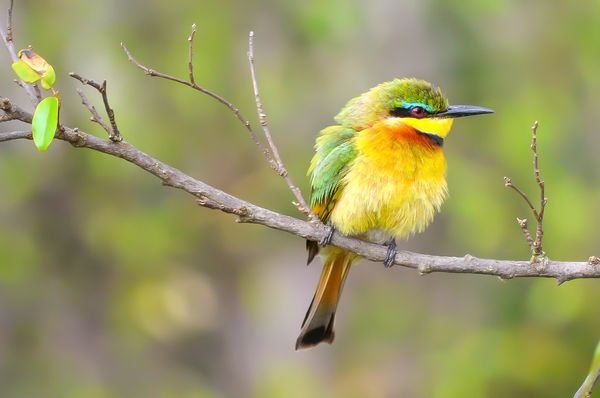
Little Bee-eater
Merops pusillusA distinctive, crested eagle of Africa's forests and woodlands – a master aerial insect hunter.
The Little Bee-eater (Merops pusillus) is a medium-sized bird of prey in the family Accipitridae. It is a distinctively shaped eagle with a long, full crest, long broad wings, and a relatively short tail . It is found in wooded habitats across much of sub-Saharan Africa .
Little Bee-eater Quick Facts
What Is the Little Bee-eater?
The Little Bee-eater (Merops pusillus) is a medium-sized bird of prey in the family Accipitridae . It is a distinctively shaped eagle with a long, full crest, long broad wings, and a relatively short tail .
It was first described by the German naturalist Friedrich Wilhelm Dillen in 1815, under the name Falco occipitalis . The species is the only member of the genus Lophaetus .
This eagle is a common and widespread resident of wooded habitats across much of sub-Saharan Africa, from Senegal to Ethiopia and south to South Africa .
How to Identify a Little Bee-eater
The Little Bee-eater is a distinctive bird, easily recognized by its crest and dark plumage .
- Crest: Long, full crest of feathers on the head, especially prominent when alert or excited .
- Plumage: Mostly dark brown to black .
- Belly: Brown and white streaked underparts .
- Eyes: Bright yellow eyes .
- Tail: Relatively short .
- Legs: Yellow legs .
Distinguishing from Other Eagles
It can be confused with the Crowned Eagle and Verreaux's Eagle, but it is smaller and more slender, and its long, full crest and dark plumage distinguish it from these larger species .
Behavior & Social Life
The Little Bee-eater is a solitary and territorial bird, often seen perched on a prominent branch in its home range .
Daily Activity
- Hunting: It is a insect specialist, often hunting from a perch and swooping down to catch prey on the ground .
- Soaring: Frequently seen soaring on flat wings, especially during the heat of the day .
- Vocalization: The call is a high-pitched "wee-oh" or a series of "kek-kek-kek" notes .
Migration
It is a resident species, but is known to wander locally in search of food .
Habitat & Distribution
The Little Bee-eater is found in a variety of wooded habitats :
- Woodland and savanna .
- Forest edges and riparian forest .
- Cultivated areas and grassland .
- Scrubland and semi-arid regions .
Distribution: The species has an extremely large range, with an Extent of Occurrence of approximately 14,800,000 km² . It is found throughout sub-Saharan Africa .
Tanzania Distribution
In Tanzania, the Little Bee-eater is found in most national parks and game reserves, including Serengeti, Ngorongoro, Tarangire, and Ruaha .
Little Bee-eater in Tanzania
The Little Bee-eater is a common raptor of Tanzania's woodlands. Here are the best locations to see it:
Ngorongoro Crater
Listed on the Ngorongoro Crater Bird Checklist, indicating it is a resident species in this caldera .
Ngorongoro safariSafari Methods
- Game drives through woodland and savanna habitats.
- Birdwatching – watch for perched birds and soaring during the day .
- Wildlife photography – the compact bee-eater form makes it a striking subject.
Best Time to See Them
Little Bee-eaters are present year-round in suitable habitat. They are most active during the cooler morning and evening hours .
Diet & Feeding
The Little Bee-eater is a carnivore with a diet dominated by small mammals .
Food Sources
- Rodents: Rats, mice, and shrews .
- Small birds: Occasionally .
- Reptiles: Lizards and snakes .
- Insects: Locusts and grasshoppers .
Hunting Behavior
It hunts from a perch, watching the ground below, then swoops down to capture prey . It is particularly valuable to farmers as a natural rodent control .
Breeding & Life Cycle
The Little Bee-eater is monogamous and territorial .
Nesting
- Nest: A large stick nest placed in the fork of a tall tree .
- Eggs: 1-3 white eggs .
- Incubation: About 42 days, performed mainly by the female .
Chicks
Chicks fledge at approximately 60 days, but remain dependent on the parents for several more weeks .
Conservation Status
The Little Bee-eater is assessed as Least Concern on the IUCN Red List .
It has an extremely large range (Extent of Occurrence of approximately 14,800,000 km²) and does not approach the thresholds for Vulnerable. The population is suspected to be stable .
Despite its secure status, it faces some local threats:
- Habitat loss due to deforestation and agricultural expansion .
- Persecution in some areas, though it is generally tolerated due to its rodent-control benefits .
Comparisons
The Little Bee-eater is sometimes confused with other eagles. Here are the key differences:
| Feature | Little Bee-eater | Wahlberg's Eagle | Martial Eagle |
|---|---|---|---|
| Size | 53-58 cm | 53-61 cm | 75-96 cm |
| Wingspan | 130-140 cm | 130-146 cm | 190-260 cm |
| Crest | Long crest | No crest | No crest |
| Plumage | Dark brown, streaked underparts | Uniform brown | Dark with white underparts |
| Habitat | Woodland, forest edge | Woodland, savanna | Open savanna |
| Diet | Rodent specialist | Reptiles, small mammals | Large gamebirds, mammals |
Did You Know?
Rodent Specialist
It is a master aerial insect hunter, making it a valuable ally to farmers .
Unique Genus
It is the only member of the genus Lophaetus .
Long Crest
The long, full crest on its head is especially prominent when the bird is alert or excited .
Widespread
It is found across an enormous range of 14,800,000 km² in sub-Saharan Africa .
Nocturnal Hunter
It is one of the few eagles known to hunt at dusk, particularly for mice and other rodents .
Local Wanderer
Though resident, it wanders locally in search of food .
There is a quiet, watchful presence in the Little Bee-eater. Its compact bee-eater form is a signature of its species, and its habit of hunting at dusk makes it a special sight on the savanna. As a insect specialist, it plays a crucial role in the ecosystem, keeping populations in check. Watching one of these eagles perched on a branch, scanning the ground below, is to see a master hunter at work.
Gallery
Frequently Asked Questions
The Little Bee-eater (Merops pusillus) is a medium-sized eagle of the family Accipitridae. It is a distinctively shaped bird of prey with a long, full crest, long broad wings, and a relatively short tail .
The Little Bee-eater is found in woodland, forest edges, and grassland across Tanzania. Key locations include Serengeti National Park , Ngorongoro Crater , Tarangire National Park , and Ruaha National Park .
It is primarily a insect specialist, feeding on small mammals such as rats, mice, and shrews. It also takes small birds, reptiles, and insects .
No. The Little Bee-eater is listed as Least Concern on the IUCN Red List, with a large range and stable population trend .
It gets its name from the long, full crest of feathers on its head that is especially prominent when the bird is alert or excited .
It builds a stick nest in a tree and lays 1-3 eggs. The female incubates for about 42 days, and chicks fledge at approximately 60 days .
It is identifiable by its long, full crest, dark brown plumage, bright yellow eyes, and relatively short tail .
Yes, it is a resident species in Tanzania, present year-round in suitable wooded habitat .
References & Further Reading
- BirdLife DataZone – Little Bee-eater species factsheet: IUCN Least Concern, Extent of Occurrence, range, threats .
- Wikipedia – Long-crested eagle: Scientific name, description, taxonomy, distribution, habitat, diet, breeding .
- eBird – Little Bee-eater: Identification, vocalization, range .
- Birds of the World (Kemp & Marks, 2020) – Little Bee-eater: Detailed species account, measurements, diet, breeding .
- Raptors of the World (Ferguson-Lees & Christie, 2001) – Little Bee-eater: Identification, flight, behavior .
- Oiseaux.net – Little Bee-eater: Confirmed photo records from Tanzania .
- iNaturalist – Little Bee-eater observation records from Tanzania .