

.png)
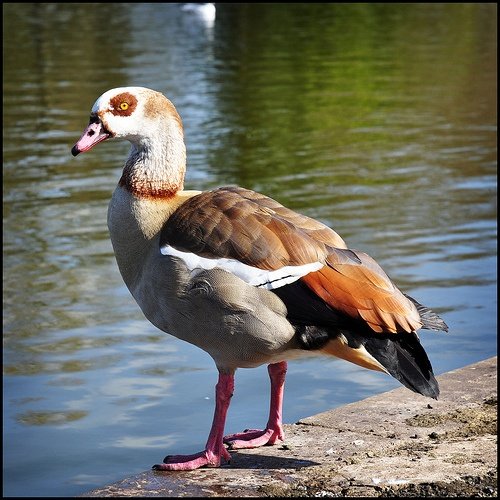
Egyptian Goose
Alopochen aegyptiacaA common and widespread waterfowl of East African freshwater ecosystems.
The Egyptian Goose (Alopochen aegyptiaca) is a highly distinctive pale reddish-brown goose with long pink legs and a pinkish bill [citation:1]. It is one of the most common and widespread waterfowl in East and Southern Africa [citation:11]. In Tanzania, it is a familiar sight on lakes, rivers, and wetlands across the country's parks and reserves.
Egyptian Goose Quick Facts
What Is the Egyptian Goose?
The Egyptian Goose (Alopochen aegyptiaca) is a member of the duck, goose, and swan family Anatidae [citation:6]. It is a highly distinctive pale reddish-brown goose with long pink legs and a pinkish bill [citation:1]. The species is native to Africa south of the Sahara and the Nile Valley [citation:6].
In Tanzania, the Egyptian Goose is a common and widespread species found on and around freshwater habitats throughout the country [citation:11]. It is a non-migratory species, typically found in noisy family groups and larger flocks when not breeding [citation:11]. The species was even domesticated by the Ancient Egyptians and figured prominently in Egyptian art of that period [citation:10].
It is listed as a resident species in Tanzania on the Avibase World Bird Database [citation:7].
How to Identify an Egyptian Goose
The Egyptian Goose is unmistakable in the field once you know what to look for:
- Body: Pale reddish-brown plumage [citation:1].
- Legs: Long pink legs [citation:1].
- Bill: Pinkish bill [citation:1].
- Face: Variable dark reddish-brown patches around the eyes [citation:1].
- Chest: Dark reddish-brown patch on the lower breast [citation:1].
- Wings in flight: Broad wings showing extensive white across the covert area of the inner wing [citation:1].
- Voice: Calls are loud and have a distinctive braying quality. The male gives a husky, wheezing call, while the female gives a high-pitched 'hur, hur, hur, hur' [citation:1][citation:6].
Distinguishing from Other Geese
The Egyptian Goose can be distinguished from other geese by its distinctive combination of pale reddish-brown body, pink legs, dark eye patches, and chest patch. It is also the only goose in the genus Alopochen native to Africa [citation:1][citation:6].
Behavior & Social Life
The Egyptian Goose is a very pugnacious and aggressive bird, especially during breeding season [citation:10]. They are intolerant of other birds, including individuals of their own kind, and are among the most vicious of all waterfowl. The ganders hiss when annoyed [citation:10].
Daily Activity
- Terrestrial and Aquatic: They are comfortable on land and in water, foraging in fields and wetlands [citation:6].
- Tree Perching: Egyptian Geese are at home in trees, frequently perching, roosting, and even nesting there [citation:10].
- Flocks: They are found in noisy family groups and larger flocks when not breeding [citation:11].
- Non-Migratory: They are non-migratory, though they may gather in moulting flocks in late summer [citation:1][citation:10].
Communication
The calls of the Egyptian Goose are loud and have a distinctive braying quality [citation:1]. The male gives a husky, wheezing call, while the female gives a high-pitched 'hur, hur, hur, hur' [citation:6].
Habitat & Distribution
The Egyptian Goose occupies a broad range of wetland habitats [citation:1]. It is a common and widespread goose found on and around freshwater anywhere in Southern and East Africa [citation:11].
Habitat Types
- Lakes and ponds [citation:1].
- Rivers and reservoirs [citation:1].
- Estuaries and sewage works [citation:1].
- Swampy woodland and meadows [citation:1].
- Agricultural land: On farmland, birds can sometimes be found on arable fields some distance from water [citation:1].
Distribution: The species is native to Africa south of the Sahara and the Nile Valley [citation:6]. In Tanzania, it is found across the country in suitable wetland habitats. The estimated global population is 210,000 - 510,000 individuals [citation:6].
Egyptian Goose in Tanzania
The Egyptian Goose is one of the most common waterfowl species in Tanzania, present in almost every wetland habitat across the country. Here are the best locations to see it:
Serengeti National Park
Confirmed sightings in the Serengeti, including at Seronera Region, where the species is a common resident [citation:5][citation:10].
Serengeti safariNgorongoro Crater
Listed on the Ngorongoro Crater Bird Checklist, indicating it is a resident species in this spectacular caldera [citation:13].
Ngorongoro safariRuaha National Park
Found in Ruaha National Park, where it is a common and widespread goose on and around freshwater habitats [citation:11].
Ruaha safariArusha & Mikumi NP
Recorded in Arusha National Park [citation:12] and Mikumi National Park [citation:8], among others across Tanzania.
Arusha safariSafari Methods
- Game drives along rivers and lakeshores.
- Birdwatching – they are active and noisy, making them easy to find.
- Boat safaris where available, to view waterfowl from the water.
- Wildlife photography – their distinctive plumage and aggressive displays make great subjects.
Best Time to See Them
Egyptian Geese are present year-round in suitable habitat. They are most active during the cooler morning and evening hours, when they call and forage.
Diet & Feeding
The Egyptian Goose is a herbivore, feeding mainly on plant matter [citation:1][citation:6].
Food Sources
- Leaves of grasses and other plants [citation:6].
- Seeds of cereal crops and other plants [citation:6].
- Grasses and green vegetation [citation:1].
Foraging Behavior
Egyptian Geese forage on land and in shallow water. They are known to feed in agricultural fields, sometimes some distance from water [citation:1].
Breeding & Life Cycle
Egyptian Geese are known for their aggressive territorial behavior during the breeding season [citation:10]. They are monogamous and form strong pair bonds.
Nesting
- Nest sites: They nest on the ground, often on small islands, but also in burrows, in caves, among reeds, in trees, and on buildings, at up to 3 km from water [citation:1].
- Tree nesting: In trees, they may use large holes or old stick nests of other birds, with a maximum recorded height above ground of 60 m [citation:1].
- Nest type: A mound of vegetation under a bush or in a hole [citation:6].
- Eggs: 8-9 off-white eggs [citation:6].
Incubation & Chicks
- Young: Young leap or slide to the ground from elevated nests within hours of hatching and are led to water by the adults [citation:1].
- Parental care: Both parents are protective of their young and will aggressively defend their territory [citation:10].
Lifespan
Egyptian Geese can live up to 15 years in the wild.
Conservation Status
The Egyptian Goose is assessed as Least Concern on the IUCN Red List [citation:4].
The estimated global population is 210,000 - 510,000 individuals, and the species has an extremely large range across sub-Saharan Africa [citation:6].
Despite its secure status, it faces some local pressures:
- Hunting: In Tanzania, the species is hunted in some areas for food, ceremonial, and monetary purposes. For example, it is recorded as hunted in Ugalla Game Reserve [citation:4][citation:9].
- Habitat loss: Wetland degradation and loss in some regions.
The species is also known for its aggressive interactions with other waterfowl, which has led to its negative impact on native species in non-native regions like the United Kingdom [citation:1].
Comparisons
The Egyptian Goose is sometimes confused with other waterfowl. Here are the key differences:
| Feature | Egyptian Goose | Spur-winged Goose |
|---|---|---|
| Size | 63-73 cm | 75-115 cm |
| Legs | Pink | Red |
| Plumage | Pale reddish-brown | Dark brown with white spots |
| Face | Dark patches around eyes | White face with black spots |
| Aggression | Very aggressive | Highly aggressive |
| Habitat | Freshwater wetlands | Freshwater wetlands |
Did You Know?
Ancient Egyptian
Egyptian Geese were domesticated by the Ancient Egyptians and figured prominently in Egyptian art of that period [citation:10].
Sacred Birds
They and Sacred Ibises were considered sacred by the Ancient Egyptians [citation:10].
Vicious Waterfowl
They are among the most vicious of all waterfowl, and the ganders hiss when annoyed [citation:10].
Tree Climbers
They are at home in trees, frequently perching, roosting, and even nesting there [citation:10].
Nesting Flexibility
They nest in a wide variety of locations including ground, burrows, caves, trees, and buildings [citation:1].
Global Population
The estimated global population is 210,000-510,000 individuals [citation:6].
There is a characteristic, assertive energy in the Egyptian Goose. Its loud braying calls and aggressive displays are as much a part of Africa's wetlands as the flamingos and herons. Watching a pair of these ancient waterfowl with their young is to see a family that has been a part of human and natural history for millennia – a true classic of the African waterways.
Gallery
Frequently Asked Questions
The Egyptian Goose (Alopochen aegyptiaca) is a highly distinctive pale reddish-brown goose with long pink legs and a pinkish bill. There are variable dark reddish-brown patches around the eyes and another on the lower breast. In flight, the wings are broad and show extensive white across the covert area of the inner wing. Calls are loud and have a distinctive braying quality .
The Egyptian Goose is a common and widespread goose found on and around freshwater anywhere in Southern and East Africa, including Tanzania [citation:11]. Key locations include Serengeti National Park [citation:5][citation:10], Ngorongoro Crater (listed on the bird checklist) [citation:13], Mikumi National Park [citation:8], Arusha National Park [citation:12], and Ruaha National Park [citation:11].
It is a herbivore, feeding mainly on leaves and seeds of cereal crops, grasses, and other vegetation . It is also known to feed in agricultural fields, sometimes some distance from water .
No. The Egyptian Goose is listed as Least Concern on the IUCN Red List. The estimated global population is 210,000 - 510,000 individuals . However, in Tanzania, the species is hunted in some areas for food, ceremonial, and monetary purposes [citation:4][citation:9].
Egyptian Geese are very pugnacious and aggressive, especially during breeding season. They are intolerant of other birds, including individuals of their own kind, and are among the most vicious of all waterfowl. The ganders hiss when annoyed [citation:10]. They are at home in trees, frequently perching, roosting, and even nesting there [citation:10]. They are non-migratory and found in noisy family groups and larger flocks when not breeding [citation:11].
Egyptian Geese nest on the ground, often on small islands, but also in burrows, in caves, among reeds, in trees, and on buildings. In trees, they may use large holes or old stick nests of other birds [citation:1]. The female lays 8-9 off-white eggs in a mound of vegetation under a bush or in a hole [citation:6]. Young leap or slide to the ground from elevated nests within hours of hatching and are led to water by the adults [citation:1].
The Egyptian Goose measures 63-73 cm (25-29 in) in length [citation:6].
Yes. It is a common resident in several Tanzanian parks including Serengeti, Ngorongoro, Ruaha, Mikumi, and Arusha [citation:5][citation:8][citation:11].
References & Further Reading
- Non-Native Species Secretariat (GB) – Egyptian Goose factsheet: Description, habitat, distribution, breeding, conservation .
- Birdpedia – Egyptian Goose: Size, taxonomy, habitat, diet, voice, eggs, population .
- Natural History Museum of Denmark – Alopochen aegyptiaca: Specimen record from North Pare Mountains, Tanzania .
- Explorer Kenya Safaris – Why you should go birding in Lake Manyara: Water bird abundance in Lake Manyara .
- Species Use Database – Egyptian Goose in Tanzania: Hunting for food, ceremonial, and monetary purposes in Ugalla Game Reserve [citation:4][citation:9].
- Media Storehouse Photo Prints – Egyptian Goose mother with chicks in Serengeti National Park, Tanzania [citation:5].
- Avibase – The World Bird Database: Egyptian Goose listed as a resident species in Tanzania [citation:7].
- African Bird Club – Egyptian Goose photo from Mikumi National Park, Tanzania [citation:8].
- NatureScapes.net – Egyptian Geese observed in Serengeti National Park (Seronera Region), Tanzania [citation:10].
- Alamy – Egyptian Goose photo from Ruaha National Park, Tanzania [citation:11].
- Oiseaux.net – Egyptian Goose photo from Arusha National Park, Tanzania [citation:12].
- Salt Holidays – Ngorongoro Crater Bird Checklist: Egyptian Goose listed [citation:13].
- BirdLife DataZone – Egyptian Goose in Tanzania [citation:14].