

.png)
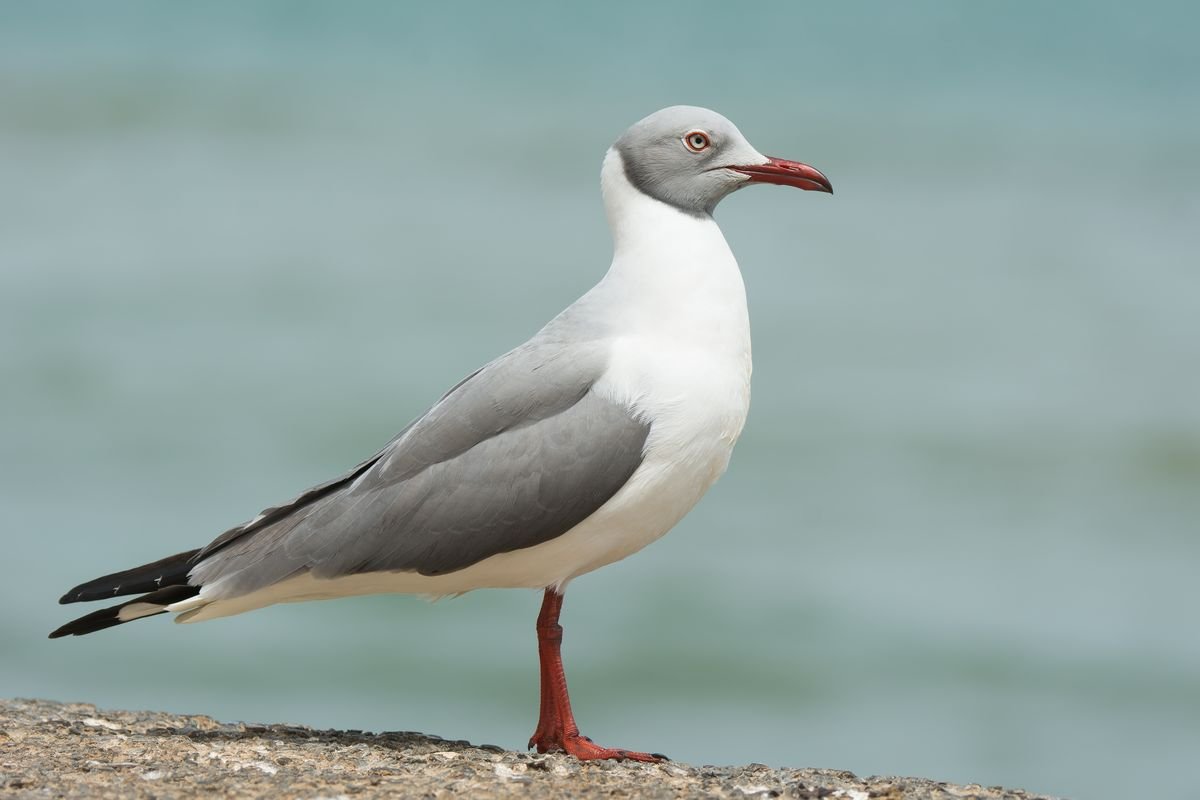
Grey-headed Gull
Chroicocephalus cirrocephalusA medium-sized gull with a distinctive grey hood – an elegant and adaptable inhabitant of Africa's waters.
The Grey-headed Gull (Chroicocephalus cirrocephalus), also known as the Grey-hooded Gull, is a medium-sized gull found in sub-Saharan Africa and South America. Named for the distinctive grey hood it develops during the breeding season, this elegant and adaptable bird is a common sight on lakes, rivers, and coastal areas across Tanzania.
Grey-headed Gull Quick Facts
What Is the Grey-headed Gull?
The Grey-headed Gull (Chroicocephalus cirrocephalus) is a medium-sized gull belonging to the family Laridae, which includes gulls, terns, and skimmers. It was first described by the French naturalist Louis Jean Pierre Vieillot in 1818. The species was formerly placed in the genus Larus but has since been moved to Chroicocephalus.
The species name cirrocephalus is from the Greek kirros meaning "tawny" or "grey" and kephale meaning "head", referring to the distinctive grey hood of the breeding adult. This gull is also known as the Grey-hooded Gull in some regions.
The Grey-headed Gull is widely distributed across sub-Saharan Africa and also occurs in South America. It is a common and adaptable bird, often found in both freshwater and coastal habitats, as well as in urban areas where it scavenges for food.
How to Identify a Grey-headed Gull
The Grey-headed Gull is a distinctive and elegant gull, easily recognised by its grey hood and slender build. Here are its key identifying features:
- Size: A medium-sized gull, measuring 37-43 cm (14.5-17 in) in length with a wingspan of 95-110 cm (37-43 in).
- Breeding plumage: Distinctive grey hood covering the head and upper neck, sharply demarcated from the white body. The bill and legs are bright red.
- Non-breeding plumage: The grey hood fades to white with dark spots on the crown and nape. The bill and legs become duller or blackish.
- Body: White underparts and pale grey upperparts.
- Wings: Grey with black tips and white spots at the tips of the primaries.
- Bill: Red in breeding season, becoming darker in winter.
- Legs: Red in breeding season, becoming darker in winter.
- Eyes: Dark.
- Juvenile: Browner plumage with a pale head, dark bill, and dark legs.
Distinguishing from Similar Species
The Grey-headed Gull can be confused with the Black-headed Gull (Chroicocephalus ridibundus). The Black-headed Gull has a chocolate-brown (not grey) hood in breeding plumage, is slightly smaller, and has a blackish bill and legs. The Grey-headed Gull is distinguished by its grey hood, red bill and legs, and its more southerly distribution in Africa.
Behavior & Social Life
The Grey-headed Gull is a social and adaptable bird, often seen in flocks, especially during the non-breeding season.
Foraging Behavior
- Opportunistic feeder: The Grey-headed Gull is an omnivore and opportunistic feeder, taking a wide variety of food items.
- Foraging techniques: It forages by scavenging, plunge-diving, wading in shallow water, and catching insects in flight.
- Urban adaptation: It is common in urban areas, where it scavenges for food around rubbish dumps, parks, and fishing ports.
Social Behaviour
- Flocking: Often found in large flocks, especially during the non-breeding season.
- Colonial breeding: Nests in colonies, often with other waterbirds.
Vocalization
- Call: The Grey-headed Gull has a loud, harsh call, described as a "kree-ah" or "kyow" sound.
- Communication: Uses a variety of calls for communication within the colony and during foraging.
Habitat & Distribution
The Grey-headed Gull is found in a variety of wetland and coastal habitats across sub-Saharan Africa and South America.
Key habitat types include:
- Freshwater lakes and rivers – particularly shallow water with abundant food.
- Wetlands and marshes – including floodplains and seasonal wetlands.
- Coastal areas – estuaries, lagoons, and rocky shores.
- Urban areas – parks, rubbish dumps, and fishing ports.
Distribution: The Grey-headed Gull has an extremely large range, with an Extent of Occurrence of approximately 45,400,000 km². In Africa, it is found across sub-Saharan Africa, from Senegambia in the west to Ethiopia and Kenya in the east, and southwards to South Africa. It also occurs in South America, where the subspecies C. c. cirrocephalus is found along the eastern coast from Brazil to Argentina.
Tanzania Distribution
In Tanzania, the Grey-headed Gull is found in freshwater lakes, rivers, wetlands, and coastal areas across the country. It has been recorded in Serengeti National Park (particularly in Lake Ndutu and other wetland areas), Ngorongoro Conservation Area (in Lake Magadi), Tarangire National Park, and Ruaha National Park.
Grey-headed Gull in Tanzania
The Grey-headed Gull is a common and elegant waterbird of Tanzania's lakes, rivers, and coastal areas. Here are the best locations to see it:
Serengeti National Park
Found in the Serengeti's lake and wetland areas, particularly around Lake Ndutu, Lake Magadi, and the seasonal floodplains. Often seen in large flocks.
Serengeti safariNgorongoro Crater
Recorded in the Ngorongoro Conservation Area, especially in the Lake Magadi area of the crater floor. Often seen resting on the shores or soaring over the water.
Ngorongoro safariTarangire National Park
Found along the Tarangire River and in the seasonal swamps. Often seen in flocks foraging in shallow water.
Tarangire safariRuaha National Park
A resident species in Ruaha's wetland areas along the Great Ruaha River. Often found in the riverine vegetation and seasonal pools.
Ruaha safariSafari Methods
- Game drives near lakes, rivers, and wetlands.
- Birdwatching – look for the medium-sized gull with a grey hood (breeding) or white head with dark spots (non-breeding).
- Wildlife photography – the Grey-headed Gull's elegant appearance and red bill and legs make it a striking subject.
- Boat safaris – where available, boat-based viewing offers excellent opportunities to observe gulls foraging.
Best Time to See Them
Grey-headed Gulls are resident year-round in suitable habitat. The breeding season typically occurs during the rainy season (November to May). The dry season (June to October) is generally best for wildlife viewing as birds congregate around remaining water sources.
Diet & Feeding
The Grey-headed Gull is an omnivore and opportunistic feeder with a varied diet.
Food Sources
- Fish: Small fish and fish scraps.
- Insects: Aquatic insects, larvae, and flying insects.
- Aquatic invertebrates: Crustaceans, molluscs, and worms.
- Small vertebrates: Amphibians, small mammals, and the eggs and chicks of other birds.
- Human refuse: Scavenges for food around rubbish dumps, fishing ports, and urban areas.
Foraging Behavior
The Grey-headed Gull is a versatile forager. It catches fish by plunge-diving from the air or by dipping from the surface. It also wades in shallow water, picks insects from the surface, and scavenges for food in urban areas.
Breeding & Life Cycle
The Grey-headed Gull is monogamous and breeds in colonies.
Nesting
- Breeding season: Typically during the rainy season, from November to May in East Africa.
- Nest site: Builds nests on the ground in marshes, on islands, or along lakeshores.
- Nest construction: A shallow depression or platform of aquatic vegetation and reeds.
- Clutch: 2 to 3 eggs.
- Incubation: 22 to 25 days, shared by both parents.
Chicks
Chicks are precocial (born covered in down and able to move around soon after hatching). Both parents care for the chicks, feeding them and protecting them. Young fledge at 30 to 35 days old.
Conservation Status
The Grey-headed Gull is assessed as Least Concern on the IUCN Red List.
Population: The global population has not been quantified, but it is not believed to approach the thresholds for Vulnerable. The population trend is stable.
Justification: This species has an extremely large range (45,400,000 km²) and hence does not approach the thresholds for Vulnerable under the range size criterion. The population size is not believed to approach the thresholds for Vulnerable under the population size criterion.
Threats: While the species is not currently threatened globally, it may face local threats including habitat loss, pollution, and human disturbance.
Comparisons
The Grey-headed Gull is sometimes confused with other gulls. Here are the key differences:
| Feature | Grey-headed Gull | Black-headed Gull | Hartlaub's Gull |
|---|---|---|---|
| Size | 37-43 cm | 35-40 cm | 36-42 cm |
| Breeding Hood | Grey | Chocolate-brown | Dark grey |
| Bill (breeding) | Red | Dark red | Red |
| Legs (breeding) | Red | Red | Red |
| Non-breeding Head | White with dark spots | White with dark spots | White with dark streaks |
| Range | Sub-Saharan Africa & South America | Europe, Asia, North Africa | Coastal South Africa |
Did You Know?
Distinctive Grey Hood
The Grey-headed Gull is named for the distinctive grey hood it develops during the breeding season, which sets it apart from other gulls.
Two Continents
This gull is found in both sub-Saharan Africa and South America – a relatively rare distribution pattern.
Urban Adaptability
Grey-headed Gulls are highly adaptable and have successfully colonised urban areas, scavenging for food in cities and towns.
Seasonal Change
In non-breeding plumage, the grey hood fades to white with dark spots, giving the bird a completely different appearance.
Colonial Nester
Like many gulls, the Grey-headed Gull nests in colonies, sometimes with hundreds of pairs breeding together.
Opportunistic Feeder
This gull will eat almost anything – from fish and insects to human rubbish, making it one of the most adaptable feeders in the gull family.
There is a quiet elegance to the Grey-headed Gull as it glides over the waters of an African lake. Its grey hood catches the light, a subtle shade against the blue of the sky, and its red bill and legs add a flash of colour to its otherwise understated appearance. It is a bird of contrasts – elegant yet adaptable, graceful yet tough. It rides the thermals with ease, soaring high above the water, and then drops with precision to pluck a fish from the surface. In a world where so many birds are specialists, the Grey-headed Gull reminds us that adaptability is its own kind of strength.
Gallery
Frequently Asked Questions
The Grey-headed Gull (Chroicocephalus cirrocephalus), also known as the Grey-hooded Gull, is a medium-sized gull found in sub-Saharan Africa and South America. It is named for the distinctive grey hood it develops during the breeding season, which is replaced by a white head with dark spots in non-breeding plumage.
Grey-headed Gulls are found in freshwater lakes, rivers, wetlands, and coastal areas across Tanzania. Key locations include Serengeti National Park (particularly in Lake Ndutu and other wetland areas), Ngorongoro Conservation Area, Tarangire National Park, and Ruaha National Park.
The Grey-headed Gull is an omnivore and opportunistic feeder. Its diet includes fish, insects, aquatic invertebrates, small mammals, eggs, chicks, and human refuse. It often forages by scavenging, plunge-diving, or wading in shallow water.
No. The Grey-headed Gull is listed as Least Concern on the IUCN Red List. It has a very large range of approximately 45,400,000 km² and a large, stable population.
The Grey-headed Gull is a medium-sized gull with a slender build. In breeding plumage, it has a distinctive grey hood covering the head and upper neck, a white body, black-tipped grey wings, and a red bill and legs. In non-breeding plumage, the hood fades to white with dark spots.
The Grey-headed Gull is a medium-sized gull, measuring 37-43 cm (14.5-17 in) in length with a wingspan of 95-110 cm (37-43 in). It weighs between 200-350 grams (7-12 oz).
Grey-headed Gulls are monogamous and breed in colonies. They build nests on the ground in marshes, islands, or along lakeshores, using aquatic vegetation and reeds. The female lays 2-3 eggs which are incubated by both parents for about 22-25 days. Chicks fledge after 30-35 days.
In Swahili, the Grey-headed Gull is known as Shakwe or Shakwe-kichwa-kijivu.
References & Further Reading
- BirdLife International – Grey-headed Gull: IUCN Red List assessment, Least Concern status, range 45,400,000 km².
- Wikipedia – Grey-headed gull: Description, distribution, habitat, diet, breeding, conservation.
- eBird – Grey-headed Gull: Identification, distribution, sightings.
- Avibase – Grey-headed Gull: Taxonomy, subspecies, distribution.
- Birds of the World – Grey-headed Gull: Introduction, identification, habitat, behavior, breeding.
- Oiseaux.net – Grey-headed Gull: Photo records from Tanzania.
- South African National Biodiversity Institute – Grey-headed Gull: Conservation status, threats, research.