

.png)
Knob-billed Duck
Sarkidiornis melanotosA large tree-perching duck with the male’s unmistakable bill knob – and a quiet, unhurried presence on Africa’s pans.
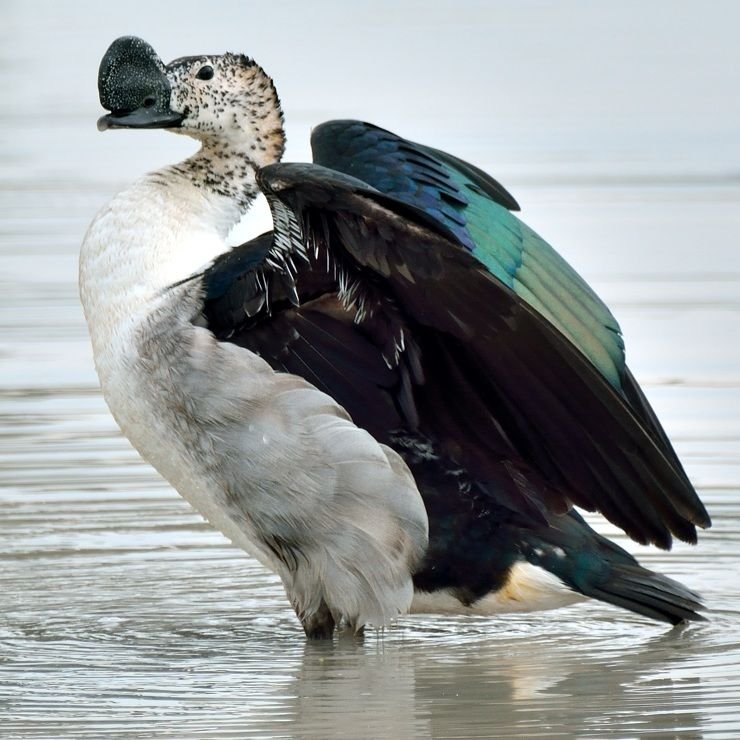
The Knob-billed Duck (Sarkidiornis melanotos), also called the Comb Duck, is a large and unmistakable African waterbird. Males are glossy black above and white below, with a speckled white head and a big black knob on the bill; females are smaller and duller. It frequents freshwater wetlands across sub-Saharan Africa and often perches — and even nests — in trees.
Knob-billed Duck Quick Facts
What Is the Knob-billed Duck?
The Knob-billed Duck (Sarkidiornis melanotos) is a large dabbling duck in the family Anatidae, widespread across sub-Saharan Africa, with a second subspecies in Asia.
Despite its size it is a true perching duck, roosting and nesting in trees more often than any other African duck. Early naturalists first described it as Anas melanotos. It occurs in wetlands throughout sub-Saharan Africa [citation:13].
The genus name, Sarkidiornis, joins the Greek sarx, ‘flesh’, with ornis, ‘bird’. The species name, melanotos, means ‘black-backed’.
How to Identify a Knob-billed Duck
The Knob-billed Duck is a large, powerful, broad-winged bird, and is unmistakable in the field:
- Plumage: Glossy black upperparts contrasting with white underparts; white head and neck finely speckled dark.
- Upperparts: Glossy, iridescent black upperparts with a greenish-purple sheen in good light.
- Legs: Dark grey legs and feet; long neck held upright.
- Face: Pale, speckled face with a dark bill.
- Bill knob: A large black fleshy knob on the male’s bill — biggest in the breeding season — from which the species takes its names.
- Subspecies variation: The African race S. m. melanotos is the form seen in Tanzania; the Asian race S. m. sylvicola of South and Southeast Asia is slightly smaller with greyer flanks.
Sex Differences
Males are bigger and glossier, with a large black knob at the base of the bill that swells in the breeding season. Females are smaller and duller brown-black above, with little or no knob, and juveniles resemble females.
Behavior & Social Life
Knob-billed Ducks are usually found in pairs or small flocks, gathering in larger numbers at favoured waters in the dry season. They move locally with rainfall and water levels, and — unusually for ducks — frequently perch and roost in trees.
Daily Activity
- Roosting: They commonly roost in trees and nest mainly in tree holes, sometimes in dense ground cover.
- Flight: They are strong, fast fliers, often commuting long distances between roosting and feeding waters.
- Feeding: Feeding takes place by day, dabbling and grazing on seeds, grasses and aquatic plants; birds often fly daily between separate roosting and feeding waters.
- Vocalization: They are mostly silent. Males give a thin wheezy whistle in display or flight, while females utter a harsh quack when alarmed.
Habitat & Distribution
The habitat of the Knob-billed Duck includes swamps, lakes, flooded meadows, and grassy plains [citation:4]. It is found in seasonal and permanent wetlands near grasslands or arable land. When moulting, it prefers areas with open shorelines, islands and sandbars, generally avoiding saline lakes and upland areas [citation:10].
Distribution: The range of the Knob-billed Duck is Africa south of the Sahara [citation:4]. It is found across a wide range of African countries, including Tanzania, Kenya, Uganda, Zambia, Zimbabwe, and South Africa [citation:10].
Extent of Occurrence: The species has an extremely large range, with an Extent of Occurrence spanning the continent south of the Sahara.
Subspecies
- S. m. melanotos: sub-Saharan Africa — the form found in Tanzania.
- S. m. sylvicola: South and Southeast Asia (the Asian Comb Duck).
Knob-billed Duck in Tanzania
The Knob-billed Duck is a common and widespread waterfowl species found in wetlands across Tanzania. Here are the best locations to see it:
Katavi National Park
Knob-billed Ducks occur in Katavi, where they are found in open flooded grasslands and seasonal pans.
Katavi safariNgorongoro Crater
The species is regularly recorded on the Ngorongoro Crater’s wetland margins in northern Tanzania.
Ngorongoro safariLake Rukwa
Lake Rukwa is an Important Bird Area whose wetlands hold rich waterfowl assemblages.
Explore DestinationsLake Manyara National Park
Listed on the park’s waterbird records, confirming its presence.
Lake Manyara safariSafari Methods
- Game drives along rivers and lakeshores.
- Birdwatching – parties are most active in the early morning and late afternoon.
- Boat safaris where available, to view waterfowl from the water.
- Wildlife photography – their gleaming plumage and the male’s bill knob make great subjects.
Best Time to See Them
Knob-billed Ducks are present year-round in suitable habitat. They undertake large localised movements following rainfall patterns, so they are often concentrated on flooded grasslands and full pans during the wet season.
Diet & Feeding
The Knob-billed Duck is an omnivore, feeding mainly on seeds, grasses and aquatic plants, plus grains, invertebrates and small fish. It feeds on plant matter such as seeds of grasses, sedges and aquatic plants, agricultural grain, fruit and tuberous crops. Occasionally, it may also eat small fish or insects [citation:10].
Feeding Style
It forages by dabbling and upending in shallow water and by grazing on land, mostly in the morning and late afternoon.
Because the ducks enjoy planted vegetable matter, they can cause considerable damage to crops [citation:4].
Breeding & Life Cycle
The breeding season of the Knob-billed Duck varies across its range, generally timed with rains and high water levels when tree-hole nest sites and feeding grounds are at their best.
Nesting
- Nest sites: Usually inside a tree hole, sometimes high above the ground; also in dense cover, reedbeds and holes in banks [citation:4].
- Nest type: A bed of down and plant material lining the cavity.
- Eggs: Clutch size is 7 to 15 eggs.
Incubation & Chicks
- Incubation: Only the female incubates the eggs. Incubation takes about 28 to 30 days to complete.
- Chicks: Like many waterfowl, the young are led to water soon after hatching [citation:4].
Conservation Status
The Knob-billed Duck is assessed as Least Concern on the IUCN Red List [citation:9][citation:14].
The species has an extremely large range and broad wetland habitat.
Despite its secure status, it faces some threats:
- Hunting: Birds are hunted outside of protected areas in parts of the range [citation:5].
- Habitat pressure: Drainage and degradation of wetlands reduce breeding and feeding grounds.
Its stronghold remains the great protected wetland systems of East and Southern Africa.
Comparisons
The Knob-billed Duck is sometimes confused with other waterfowl. Here are the key differences:
| Feature | Knob-billed Duck | Egyptian Goose |
|---|---|---|
| Size | 56-76 cm | 63-73 cm |
| Legs | Dark grey | Pink |
| Plumage | Glossy black above, white below, speckled head | Pale reddish-brown |
| Distinguishing Feature | Fleshy black knob on male’s bill | Dark patches around eyes |
| Habitat | Swamps, lakes, flooded meadows [citation:4] | Freshwater wetlands |
| Poisonous | No | No |
Did You Know?
Bill Knob
It gets its names from the male’s fleshy bill knob — knob-billed, or comb duck.
Tree-Duck
It is a true tree-duck: it commonly perches and roosts in trees and nests mainly in tree holes.
Two Subspecies
Two subspecies are recognised: the African form and a slightly smaller Asian form.
Mostly Silent
It is mostly silent, with males giving a thin wheezy whistle and females a harsh quack.
Notable Range
Its range sprawls across sub-Saharan Africa wherever suitable freshwater wetlands persist.
Movement Patterns
It is a strong, fast flier that moves with the rains between feeding and breeding waters.
There is something unmistakable about the Knob-billed Duck: the male’s great black knob, the silhouette of a big duck rowing across a mirror-still pan, and the odd sight of webbed feet gripping a branch. Watching a party lift off a flooded plain at dusk — fast wings, thin whistles — is one of the quiet spectacles of Africa’s wetlands.
Gallery
Frequently Asked Questions
The Knob-billed Duck (Sarkidiornis melanotos) is a large African dabbling duck, also called the Comb Duck. Adults are 56–76–115 cm long and weigh: males reach about 2.9–kg, with males noticeably larger than females. Males are glossy black above and white below, with a speckled head and a big black bill knob.
The Knob-billed Duck is found on freshwater wetlands throughout sub-Saharan Africa. In Tanzania, key locations include Katavi National Park, Ngorongoro Crater, Lake Manyara National Park and the Lake Rukwa wetlands.
It is an omnivore, feeding mainly on seeds, grasses and aquatic plants, plus grains and crops, invertebrates and occasionally small fish.
No. The Knob-billed Duck is listed as Least Concern on the IUCN Red List. Local pressures include wetland loss and hunting outside protected areas.
It is named for the male’s fleshy black bill knob, also likened to a comb — hence Comb Duck. The genus name Sarkidiornis joins the Greek sarx, ‘flesh’, with ornis, ‘bird’.
It nests mainly in tree holes, sometimes high up, as well as in dense cover. Only the female incubates, for about 28 to 30 days, and the clutch is 7 to 15 eggs.
Yes. Unusually for a duck, it commonly perches and roosts in trees and nests mainly in tree holes — a habit that surprises many first-time watchers.
S. m. melanotos is the African form seen in Tanzania, while S. m. sylvicola is the slightly smaller Asian form of South and Southeast Asia. Both share the male’s bill knob and tree-perching habits.
References & Further Reading
- BirdLife DataZone – Knob-billed Duck species factsheet: IUCN Least Concern, Extent of Occurrence, population trend [citation:5][citation:9].
- Wikipedia – Knob-billed duck: Description, size, subspecies, plumage and vocalization.
- Cleveland Metroparks Resource Library – Knob-billed Duck: Description, habitat, breeding, diet and conservation status.
- University of Nebraska-Lincoln – Knob-billed Duck reproductive biology: Nesting, clutch size, incubation period [citation:8].
- Birdpedia – Knob-billed Duck: Size, distribution and subspecies.
- CITES – Knob-billed Duck: trade and listing information, Lake Manyara National Park records.
- Alamy – Knob-billed Duck photos from Katavi National Park, Tanzania: Feeding behavior, vocalization [citation:1][citation:3].
- Oiseaux.net – Knob-billed Duck photo from Katavi National Park, Tanzania: Confirmed presence [citation:2].
- Oiseaux.net – Knob-billed Duck photo from Ngorongoro Crater, Tanzania: Confirmed presence [citation:11].
- East Africa Safaris Tours – Ruaha National Park Bird Checklist: Knob-billed Duck listed [citation:7][citation:12].
- Convention on the Conservation of Migratory Species (CMS) – Knob-billed Duck: IUCN Least Concern assessment [citation:14].