

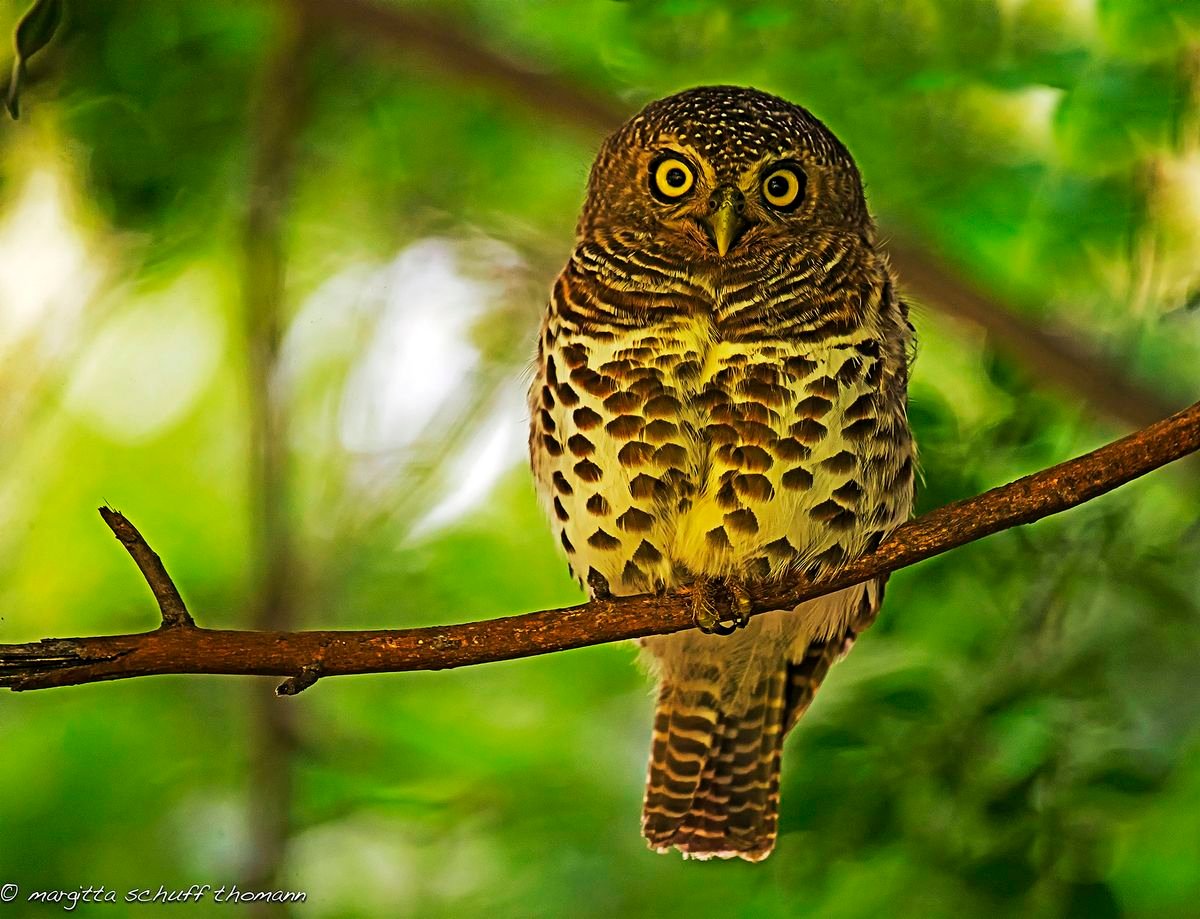
Pearl-spotted Owlet (Glaucidium perlatum) in natural woodland and savanna habitat in Tanzania
Africa's Tiny Day-active Owl

Pearl-spotted Owlet

Glaucidium perlatum

A tiny, fearless owl whose pearly spots and false eyes turn a small body into one of Africa's most memorable raptors.

The Pearl-spotted Owlet is a diminutive African owl of the family Strigidae. It is strongly associated with open savanna, thorny scrub and semi-open woodland, and unlike many owls it may be conspicuous in daylight. Its two dark, white-ringed false-eye markings, heavily spotted head and small size make it distinctive, while its varied diet gives it an important role in controlling insects and other small prey.

Scientific NameGlaucidium perlatum
FamilyStrigidae
DietArthropods & small vertebrates
ConservationLeast Concern
HabitatSavanna, scrub & woodland
RangeSub-Saharan Africa

Pearl-spotted Owlet Quick Facts

Glaucidium perlatum · Strigidae · Strigiformes
Scientific nameGlaucidium perlatum
Authority(Vieillot, 1817)
FamilyStrigidae
OrderStrigiformes
LengthAbout 17–21 cm
WeightAbout 61–147 g recorded; females generally heavier
AppearanceBrown, heavily white-spotted plumage
False eyesTwo dark spots with pale rings on the back of the head
Ear tuftsAbsent
EyesPale yellow
Primary foodGrasshoppers, crickets, beetles and other arthropods
Other preySmall mammals, birds, reptiles and snails
Typical habitatOpen savanna, thorny scrub and semi-open woodland
Daily activityOften active by day; also hunts and calls mainly at night
BreedingUsually in old woodpecker or barbet cavities
ClutchUsually 2–4 white eggs
ConservationLeast Concern
RangeBroad sub-Saharan African distribution

What Is the Pearl-spotted Owlet?

The Pearl-spotted Owlet is one of Africa's smallest owls and one of its most characterful. Despite its size, it behaves like a confident little predator: it watches from exposed branches, responds boldly to intruders and may be mobbed by smaller birds that recognize the danger of having a small owl nearby. Its common name refers to the numerous pale, pearl-like spots in its plumage.

Its scientific name is Glaucidium perlatum. The genus Glaucidium contains the pygmy-owls and owlets, a group of small owls distributed in several parts of the world. The Pearl-spotted Owlet belongs to the family Strigidae, the typical or true owls, within the order Strigiformes.

What makes this species especially rewarding on safari is the contrast between its small size and its presence. A bird barely twenty centimetres long can sit boldly in an open perch, stare at passing observers, flick its tail when excited and suddenly plunge toward prey. It is also unusual among owls in being regularly detectable during daylight, even though much feeding and vocal activity occurs after dark.

Taxonomy & Scientific Classification

Kingdom: Animalia · Phylum: Chordata · Class: Aves · Order: Strigiformes · Family: Strigidae · Genus: Glaucidium · Species: Glaucidium perlatum.

The taxon Glaucidium perlatum was described by Louis Jean Pierre Vieillot in 1817. Modern taxonomic databases recognize the species as valid. Regional bird lists can differ in how they treat subspecies and boundaries within this widespread African owl, so this page keeps the main species treatment conservative and focuses on the field-identifiable species as used by current international taxonomic sources.

Why the Name “Pearl-spotted”?

The name reflects the pale, pearl-like spots scattered across the brown head and upperparts. These spots are particularly striking when light catches the plumage, giving the bird a finely patterned appearance rather than the plain brown impression its size might suggest.

Identification: How to Recognize It

The quickest field clue is the combination of tiny size, no ear tufts, white spotting and the false-eye marks on the back of the head. The facial disc is relatively indistinct compared with larger owls, while the eyes are pale yellow and the upperparts are predominantly chestnut- to brown-toned with dense pale spotting.

Head, Face & False Eyes

The eyebrows are conspicuously whitish. At the rear of the head are two dark markings bordered by pale feathers, giving the impression of a second pair of eyes. When the owlet turns its head away, these “eyes” remain visible to observers behind it. The effect may help confuse predators or influence the response of birds that mob owls.

Body, Wings & Tail

The underparts are whitish to warm off-white and heavily marked with brown streaking. The flight feathers are barred, and the tail carries repeated pale spots framed by darker markings. The legs are lightly feathered and the toes are yellow-brown. The bird's compact proportions and spotted tail are useful clues at a distance.

Size & Sexual Difference

Sources place adults at roughly 17–21 cm in length, with recorded weights around 61–147 g. Females are generally larger and heavier than males, a common pattern among many owls of this type.

Lookalikes & How to Tell Them Apart

The Pearl-spotted Owlet can be confused with other small African owls, particularly the African Barred Owlet, but the pattern and habitat combination are helpful. The Pearl-spotted Owlet has prominent white spotting and the characteristic false eyes at the back of the head, while the African Barred Owlet is generally larger and more barred in appearance.

Pearl-spotted Owlet vs African Barred Owlet

Look first at the size and pattern. Pearl-spotted Owlets are very small and strongly spotted, with no ear tufts and conspicuous false-eye markings. African Barred Owlets are larger, more heavily barred and associated more strongly with wooded and forest habitats. In Tanzania, habitat and elevation can narrow the possibilities quickly.

Pearl-spotted Owlet vs African Scops-Owl

The African Scops-Owl is also small, but it normally shows obvious ear tufts and a different cryptic plumage pattern. A tiny owl with a smooth head and the two “eyes” on the back of the head points strongly toward Pearl-spotted Owlet.

Behavior & Social Life

This is a small owl with an outsized personality. It may sit in an exposed position during daylight, scanning for movement and reacting quickly to approaching birds or mammals. It is often encountered alone or as a pair, with breeding pairs maintaining territories around nest sites.

Unusually Day-active

Unlike many owls, it is regularly encountered during daylight, especially at dawn, morning and late afternoon.

Alert Watcher

It often selects exposed perches where it can observe the ground and surrounding vegetation.

Tail Flicker

When excited or disturbed it may cock and flick the tail from side to side.

Mobbing Magnet

Small birds may gather and harass the owlet after detecting it, helping birders locate a bird that might otherwise remain hidden.

Vocal Behavior

The Pearl-spotted Owlet is easier to hear around dusk and at night. Its vocalizations include clear, fluted whistles and sequences of notes that can carry surprisingly well across open woodland. Learning the call can be more reliable than waiting for a visual sighting, particularly in thick roadside scrub.

Flight & Hunting Technique

Its flight is fast and distinctly undulating, with rapid wingbeats alternating with short glides. Over short distances it can move between perches with remarkable speed. The compact body is built for quick maneuvers rather than long soaring flights.

How It Hunts

Most hunting is from a perch. The owlet watches the ground or nearby vegetation, then drops or swoops toward prey. It can take prey on the ground, grab animals from foliage or seize small birds and flying insects when opportunities arise. Hunting activity increases after dark, but daytime hunting and active foraging are important parts of its natural history.

Why Daylight Sightings Matter

For birders, a day-active owl is a gift. The Pearl-spotted Owlet often exposes itself just enough to be found, and the alarm behavior of smaller passerines can reveal its presence. Rather than searching only shaded tree cavities, scan open branches, thorn bushes and woodland edges.

Habitat & Distribution

The species favors open savanna with short grass, scattered trees and thorny shrubs. It also uses dry semi-open woodland and semi-open riverine forest where nearby open country provides feeding opportunities. Dense tropical rainforest, dense montane forest, extensive desert and areas dominated by long grass are poor fits for its typical habitat profile.

Where It Occurs in Africa

The Pearl-spotted Owlet has a broad sub-Saharan distribution extending from the western Sahel and West Africa across central and eastern Africa and south through much of southern Africa. Its range encompasses a wide variety of woodland and savanna landscapes, which is one reason it remains one of the more broadly distributed small African owls.

Microhabitat Matters

Within a large savanna, the best places to search are not necessarily the most open areas. Look for the transition zone where short grass meets thorn scrub, scattered trees, dry riverine woodland or an old cavity-bearing tree. Such edges provide both hunting perches and potential nesting sites.

Pearl-spotted Owlet in Tanzania

Tanzania is especially rewarding for this species because the country contains extensive savanna, dry woodland, acacia- and thorn-dominated landscapes and mixed habitats that suit the owlet. Documented photographic and observation records confirm its presence in several Tanzanian regions.

Tarangire National Park

Tarangire's open scrub and woodland mosaic provides classic Pearl-spotted Owlet habitat. Published photographic records from the park document the species.

Tarangire safari

Mikumi National Park

A documented Tanzania record comes from Mikumi National Park in Morogoro Region, showing the species in a southeastern Tanzania savanna setting.

Mikumi safari

Mkomazi Game Reserve

Recorded in Mkomazi, where dry bushland and woodland create suitable conditions for this small open-country owl.

Mkomazi safari

Moshi & Northern Tanzania

A Pearl-spotted Owlet has been recorded in Moshi Rural, demonstrating that the species can occur close to cultivated and semi-natural woodland landscapes as well as protected areas.

Kilimanjaro area

Other Tanzanian Birding Landscapes

Additional Tanzanian records are available from places such as the Selous ecosystem, the Kilimanjaro region and the Lake Victoria side of the country. Presence varies with local vegetation, prey availability and the availability of suitable trees and cavities.

Tanzania Habitat Guide

When searching for this owlet, focus on structure rather than simply “owl habitat”. A suitable site may include thorn bushes, scattered mature trees, short grass, a few exposed branches and nearby dense cover. The combination gives the bird a perch for observation, prey-rich ground below and protection when it needs to disappear.

Habitat Features to Watch

  • Short or moderate grass: more useful than tall, continuous grass that can reduce hunting visibility.
  • Scattered trees and thorn scrub: provide perches, shade and hunting platforms.
  • Old trees with cavities: essential potential nesting resources because the species commonly reuses holes made by other birds.
  • Ecotones and woodland edges: often combine open feeding areas with protected cover.
  • Lightly wooded river margins: can provide roosts and prey while retaining open ground nearby.

Best Time to See Pearl-spotted Owlets in Tanzania

Because the species is resident across much of its range, there is no single migration season that guarantees a Tanzanian sighting. Your best chances come from matching the bird's activity pattern to the landscape. Early morning can produce calling, movement and basking or hunting activity, while late afternoon can be productive before the bird settles into more nocturnal behavior.

Best Daily Windows

Early morning: listen for calls and scan exposed branches before the heat increases. Late afternoon: watch woodland edges and thorn scrub as activity rises again. After dark: the species can become vocally active and may hunt from low perches, but night drives must follow the regulations and practices of the protected area.

Birding Strategy

Do not drive too quickly past small owls. A bird sitting quietly in a thorn tree may be overlooked because its brown-and-white pattern blends into bark and foliage. Stop, scan slowly and watch for the sudden appearance of small birds mobbing one location.

Diet & Feeding

The Pearl-spotted Owlet is primarily an arthropod predator, but it is far from a specialist in the narrow sense. It can switch among prey types according to opportunity, making it an adaptable hunter in seasonal African landscapes.

Main Prey

  • Grasshoppers and crickets are important prey, especially where open grass and scrub produce abundant insects.
  • Beetles, spiders and millipedes add a broad arthropod component to the diet.
  • Small mammals such as rodents may be taken when encountered.
  • Small birds are within its capabilities, despite the owl's tiny size.
  • Reptiles including small lizards and snakes may be captured.
  • Snails and other small animal prey can also be consumed.

A Predator Larger Than It Looks

Small owls often surprise observers because their hunting ability is not proportional to their body size. The Pearl-spotted Owlet combines a strong bill and talons with patience, camouflage and rapid movement. Its capacity to take small vertebrates also explains why passerine birds may react so strongly when they discover one.

Ecological Role

This tiny owl occupies an important middle-predator position. It consumes large numbers of insects and also removes some small vertebrates from the food web. In agricultural and semi-rural landscapes, such predators can contribute to natural regulation of animals that people may otherwise try to control chemically.

Natural Pest Control

Grasshoppers, crickets and other arthropods can be abundant in African grasslands and cultivated edges. By hunting these prey, the owlet participates in the natural checks and balances that keep insect communities from becoming dominated by a few species.

Part of the Food Web

The owlet is also prey for larger predators and can be attacked by animals that perceive it as a threat. Its false-eye markings, cryptic plumage and rapid movement are therefore part of a larger survival strategy: hunt effectively while minimizing the chance of becoming someone else's meal.

Breeding & Life Cycle

Breeding pairs establish territories and use tree cavities rather than constructing an elaborate nest of their own. Old holes excavated by woodpeckers or barbets are especially important, although natural cavities and nest boxes can also be used where available.

Nest Site

Suitable cavities may be several metres above the ground and can be reused across years. Nest-hole availability is therefore a real ecological constraint: even in landscapes with plenty of prey, a shortage of safe cavities can limit breeding opportunities.

Eggs & Incubation

A normal clutch contains 2–4 white eggs. The female performs most incubation and the male brings food to her. Sources place incubation at roughly 28–29 days.

Chicks & Fledging

Young owlets hatch with closed eyes, which open during the second week. They leave the nest at roughly a month of age, around 27–31 days in sources consulted, and continue to depend on the parents while remaining close to the nest site before becoming independent.

Breeding Season

In southern African accounts, laying commonly occurs from August to November, with a peak around September and October. Timing can vary geographically, so a single calendar should not be treated as universal for the entire continent or Tanzania.

Migration & Seasonal Movement

The Pearl-spotted Owlet is best regarded as a largely resident African owl rather than a classic long-distance migrant. Its enormous distribution covers many climates, and individuals can respond to local prey and habitat conditions without undertaking continental-scale migrations.

What Changes Seasonally?

Rainfall can change insect abundance, vegetation structure and hunting conditions. Breeding timing also shifts with local climate. For birders, this means the most productive daily and seasonal search patterns can differ from one park to another even though the species itself remains present year-round in suitable habitat.

Conservation Status

The Pearl-spotted Owlet is currently listed as Least Concern in BirdLife International's owl species list. Its broad African distribution and continued occurrence across many suitable habitats mean it is not presently classified as globally threatened.

Least Concern Does Not Mean No Conservation Value

A species can be globally widespread while still being locally affected by habitat change. The owlet depends on a functional mix of prey-rich open ground, cover and mature trees containing suitable cavities. Protecting diverse savanna and woodland structure therefore benefits this owl as well as many other species.

Conservation Outlook

The most constructive approach is habitat conservation: retain native woodland and thorn scrub, protect mature cavity-bearing trees, reduce unnecessary pesticide use and maintain healthy insect and small-vertebrate communities. Local monitoring is also important because conditions can differ greatly between regions.

Threats & Local Pressures

No single major global threat dominates the species profile in the sources consulted, but several local pressures can matter. The strongest concern is usually the loss or simplification of the woodland-savanna structure the owl uses for hunting and nesting.

Habitat Simplification

Clearing thorn scrub, removing mature trees and converting diverse woodland mosaics to uniform land can remove both hunting perches and nesting cavities.

Loss of Invertebrate Prey

Because arthropods are a major part of the diet, intensive pesticide use and other factors that reduce insect abundance can indirectly reduce food availability.

Disturbance & Persecution

Owls can be misunderstood or feared in some cultural settings. Accurate interpretation of owl behavior and ecological roles is therefore part of conservation. The species is small and generally not a dangerous animal, yet its predatory nature can provoke mobbing and human curiosity.

What Helps

Protecting native vegetation, leaving old trees standing where safe, maintaining insect-rich habitats and supporting responsible birding all help preserve the ecological conditions on which Pearl-spotted Owlets depend.

Comparison with Similar Tanzanian Owls

FeaturePearl-spotted OwletAfrican Barred OwletAfrican Scops-OwlSpotted Eagle-Owl
Typical sizeVery small, about 17–21 cmLargerSmallMuch larger
Ear tuftsAbsentAbsentUsually obviousObvious
Back-of-head false eyesDistinctiveNot a key field markNot a key field markNot a key field mark
Plumage patternWhite-spotted brown with streaked underpartsMore barredCryptic and variableBoldly patterned, pale and darker tones
Day activityUnusually commonMostly crepuscular/nocturnalMainly nocturnalMainly nocturnal
HabitatOpen savanna and semi-open woodlandWoodland and forested habitatsWoodland and savanna, often with coverBroad savanna and woodland habitats

Did You Know?

False Eyes

Two dark spots ringed with pale feathers on the back of the head create the famous “false eyes”.

Tiny Predator

It measures only around 17–21 cm but can capture insects, reptiles, small mammals and birds.

Daylight Owl

It is one of the African owls most likely to be encountered openly during the day.

Tree-hole Breeder

It commonly occupies old cavities made by woodpeckers or barbets rather than building a nest.

Tail Signals

Excited birds may cock and flick the tail, a useful behavior to watch while birding.

Master of the Mosaic

Open grass, thorn scrub and scattered trees together provide the hunting and nesting structure it needs.

A Safari Moment with a Pearl-spotted Owlet

At first the thorn bush looks empty. Then a few small birds begin calling from the same branch, circling a spot they clearly dislike. You stop. There, almost motionless, is a tiny brown owl no bigger than your hand. It turns its head and the two false eyes on the back of its crown seem to stare straight through the birds behind it. A second later it flicks its tail, launches into the open, and disappears into another shrub. That sudden mixture of boldness, camouflage and speed is the magic of the Pearl-spotted Owlet.

Tanzania Birding Field Perspective

For many safari travelers, the moment is memorable precisely because the species is easy to underestimate. Large mammals can dominate a game drive, yet the small owlet rewards patience and the habit of looking closely. In a patch of savanna that appears quiet, an entire world of insects, songbirds and small predators is moving through the vegetation.

Wildlife Photography Tips

The Pearl-spotted Owlet is an excellent bird-photography subject because it may perch in open view and frequently holds a fairly steady posture while watching its surroundings.

Best Angles

Try to work at eye level when practical and safe. A slightly lower viewpoint can separate the bird from the background, while a side-on angle can reveal the spotted wings and tail. The rear view is especially interesting because it shows the false-eye markings that define the species.

Light

Soft morning or late-afternoon light can reveal the warm brown tones and white spots without harsh contrast. In bright midday conditions, expose carefully to preserve detail in the pale markings around the face and shoulders.

Behavior First

Do not chase an owlet to force a flight shot. Watch for natural tail flicks, head turns, prey launches and interactions with mobbing birds. The story of the behavior is usually stronger than a static portrait.

Ethical Birding

Keep a respectful distance, avoid blocking the bird's escape route and never use playback or disturbance where local park rules prohibit it. A great wildlife photograph should leave the bird's natural behavior unchanged.

References & Further Reading

  • BirdLife International — List of Owl Species: current BirdLife treatment of the Pearl-spotted Owlet as Least Concern.
  • Integrated Taxonomic Information System (ITIS): Glaucidium perlatum, valid species name, authority and taxonomy cross-referenced with IOC and HBW/BirdLife sources.
  • SANBI — Animal of the Week: identification, false-eye adaptation, habitat, feeding ecology and conservation context.
  • The Owl Pages: detailed field information on size, plumage, behavior, vocalization, diet, breeding and distribution.
  • Oiseaux.net: documented Tanzanian records from Mikumi National Park, Mkomazi, Tarangire and other locations.
  • Tanzania Owl Conservation: Tanzania-focused information on the Pearl-spotted Owlet and its ecological role.
  • Peer-reviewed record — American Journal of Primatology: documented predator interaction involving a Pearl-spotted Owlet in Uganda, illustrating that even small owls participate in complex predator-prey and antipredator dynamics.

Explore Tanzania Birding & Safari Destinations

Tarangire

Classic dry savanna and woodland birding, with documented Pearl-spotted Owlet records.

Explore Tarangire

Mikumi

Morogoro landscapes with open woodland and savanna habitat supporting a rich bird community.

Explore Mikumi

Mkomazi

Dry northeastern Tanzania habitat where small owls and other savanna birds can be found.

Explore Mkomazi

Kilimanjaro Region

Birding around the mountain and its surrounding woodlands adds a different dimension to a northern Tanzania trip.

Explore Kilimanjaro

Frequently Asked Questions

What is the Pearl-spotted Owlet?

The Pearl-spotted Owlet (Glaucidium perlatum) is a very small owl of the family Strigidae, usually about 17–21 cm long, with white-spotted brown plumage and two dark false-eye markings on the back of its head.

Where can I see Pearl-spotted Owlets in Tanzania?

Pearl-spotted Owlets occur in suitable savanna and woodland habitats in Tanzania. Documented records include Mikumi National Park, Tarangire National Park, Mkomazi Game Reserve and the Moshi Rural area, among other parts of the country.

Is the Pearl-spotted Owlet active during the day?

Yes. It is unusually easy to encounter by day for an owl, especially at dawn, in the morning and around late afternoon, although it also hunts and calls mostly at night.

What does the Pearl-spotted Owlet eat?

Its diet is dominated by arthropods such as grasshoppers, crickets, beetles, spiders and millipedes, but it also takes small mammals, birds, reptiles and snails.

What are the false eyes on a Pearl-spotted Owlet?

The two dark, white-ringed spots on the back of the head resemble eyes. They may confuse or deter predators and help during encounters with mobbing birds.

How does the Pearl-spotted Owlet nest?

It usually nests in an old tree cavity, especially holes made by woodpeckers or barbets. A typical clutch contains 2–4 white eggs, with incubation lasting about 28–29 days.

Is the Pearl-spotted Owlet endangered?

The Pearl-spotted Owlet is currently listed as Least Concern in BirdLife International’s owl list and is widespread across sub-Saharan Africa, although conditions can vary locally and habitat changes may affect some populations.

How big is a Pearl-spotted Owlet?

It is a tiny owl, about 17–21 cm long in sources consulted, with recorded weights roughly in the 61–147 g range; females are generally larger and heavier than males.

Ready to Discover Tanzania's Smaller Predators?

Turn a safari into a richer wildlife story by looking beyond the largest animals. Our Tanzania birding and safari specialists can help you explore habitats where Pearl-spotted Owlets and other remarkable African birds occur.

Hello!
Welcome to African Majestic Adventure.
Ready to plan your Tanzania birding safari?
African Majestic Adventure
Tanzania
WeChat QR Code
Scan the QR code to connect
Chat with Us
Hi! How can we help you today?