

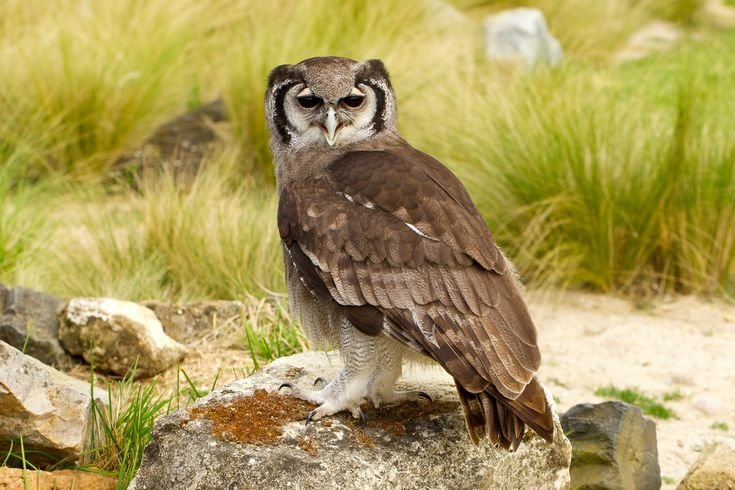
Verreaux's Eagle-Owl (Ketupa lactea) in Tanzania
Africa's Giant Night Hunter

Verreaux's Eagle-Owl

Ketupa lactea

Africa's largest owl — a silent, powerful predator of the wooded savanna.

Verreaux's Eagle-Owl is a huge African owl, easily recognized by its pale grey-brown plumage, short ear tufts, broad facial disc and bare pink upper eyelids. It is mainly nocturnal and hunts a wide range of prey in dry woodland, savanna, riverine country and other mature tree habitats.

Scientific NameKetupa lactea
FamilyStrigidae
DietMammals, birds & other prey
StatusLeast Concern
HabitatDry woodland & savanna
ActivityMainly nocturnal

Verreaux's Eagle-Owl Quick Facts

Ketupa lactea · Strigidae · Strigiformes
Scientific nameKetupa lactea
Authority(Temminck, 1820)
FamilyStrigidae
OrderStrigiformes
LengthAbout 58–66 cm
WingspanAbout 1.4–1.6 m
WeightRoughly 1.6–3.1 kg, with females generally larger
Signature featureBright pink bare upper eyelids
PlumagePale grey-brown with fine darker vermiculations
Ear tuftsShort, broad and tousled
DietMammals, birds, reptiles, frogs, insects and other suitable prey
HabitatDry woodland, savanna, riverine woodland and mature trees
ActivityPrimarily nocturnal
NestingOften reuses large stick nests; may also use hollows or ledges
ClutchUsually 2 eggs
ConservationLeast Concern

What Is Verreaux's Eagle-Owl?

Verreaux's Eagle-Owl (Ketupa lactea) is a giant African owl in the family Strigidae. It is widely recognized as the largest owl species in Africa and is also known as the Milky Eagle-Owl or Giant Eagle-Owl in older literature.

The species combines extraordinary size with the stealth expected of an owl. It has broad wings, soft flight feathers and powerful talons, allowing it to move through wooded landscapes at night and capture prey ranging from mammals to birds and reptiles.

Its pale facial disc and unmistakable pink upper eyelids are its most famous identification features. The eyes themselves are dark brown; the vivid pink belongs to the exposed eyelid skin that becomes especially obvious when the bird blinks or looks down.

Field identity: Think of a very large, pale-grey eagle-owl with short ear tufts, a dark-bordered facial disc and pink upper eyelids, usually discovered at a daytime roost or around dusk.

Taxonomy & Scientific Name

The scientific name used on this page is Ketupa lactea. Older books and websites commonly use Bubo lacteus, so both names may appear in wildlife literature and image captions.

Modern taxonomic treatments place this species in the genus Ketupa. Taxonomic lists do not all change genus placement at the same time, which explains why current and historical sources can show different combinations while referring to the same owl.

The species was described by the Dutch zoologist Coenraad Jacob Temminck in 1820. The name Verreaux's Eagle-Owl honors the French naturalist Jules Verreaux.

How to Identify Verreaux's Eagle-Owl

Once seen well, this owl is difficult to confuse with any other African species. The strongest identification comes from size, face, eyelids and overall pale coloration working together.

  • Pink eyelids: Bare pink upper eyelid skin is the standout feature.
  • Facial disc: Pale or off-white and enclosed by a broad dark border.
  • Ear tufts: Short, broad and slightly tousled rather than tall and sharply pointed.
  • Body: Mainly pale grey-brown with delicate vermiculated markings.
  • Shoulders: Pale scapular markings can form a noticeable light band across the folded wing.
  • Bill: Pale horn-colored with a darker base and heavy dark bristles around it.
  • Size: Much larger than most owls encountered on a Tanzanian safari.

At night, silhouette and behavior become especially useful. A huge owl crossing a road or open clearing with slow, deep wingbeats is worth investigating carefully.

How It Differs From Similar Large Owls

Tanzania has several impressive owls, but Verreaux's Eagle-Owl stands apart through its extreme size and facial details.

FeatureVerreaux's Eagle-OwlSpotted Eagle-OwlPel's Fishing-Owl
SizeHuge; Africa's largest owlMuch smallerLarge, but closely tied to water
Eye areaDark eyes with bare pink upper eyelidsYellow-orange eyesDark eyes without the pink eyelid feature
FacePale disc with strong dark borderMore patterned facial appearanceBroad pale face suited to aquatic hunting
Main habitatDry woodland and savannaBroad range of open and wooded habitatsRivers, lakes and wetland forests
Feeding strategyBroad terrestrial predatorGeneralist nocturnal predatorStrongly associated with aquatic prey

Behavior & Nocturnal Life

Verreaux's Eagle-Owl is mainly active after sunset. During daylight it often rests quietly in the shade of a large tree, where its grey-brown pattern can blend into bark and foliage.

Night Hunter

Most feeding takes place after dark when mammals, birds and other prey become active.

Patient Watcher

It may wait on a branch and scan or listen before dropping onto prey.

Silent Flight

Specialized feather edges reduce aerodynamic sound, helping the owl approach prey quietly.

Territorial Pair

Pairs occupy territories and can remain tied to traditional roost and nesting areas.

Daytime Roosting

A roosting owl may sit close to a trunk, behind foliage or on a large horizontal branch. Even though it is enormous, its still posture and camouflage can make it surprisingly difficult to detect.

At dusk the search changes. Watch the roost tree, listen for calling, and scan woodland edges and open tracks for the bird's first flight of the night.

Flight, Hunting & Silent Wings

Its broad wings favor controlled movement rather than the explosive acceleration of a falcon. The owl can move steadily between roosts, hunting perches and feeding grounds with surprisingly little audible disturbance.

Hunting commonly begins from an elevated perch. Once prey is detected, the bird can descend rapidly to the ground or into low vegetation. It may also intercept prey among trees or take advantage of animals exposed near water.

Owl feathers are specially adapted to reduce turbulence and sound. That silent approach is a crucial advantage against mammals and birds that can detect noisy predators quickly.

Birding tip: Look for large open perches around sunset. A silhouette that seems too large to be an ordinary owl may be the first clue that Verreaux's Eagle-Owl is leaving its roost.

Habitat & Distribution

Verreaux's Eagle-Owl is primarily associated with sub-Saharan African dry woodland and savanna, especially where mature trees occur beside open hunting ground.

  • Dry woodland: Large trees provide secure roosts, nest opportunities and hunting perches.
  • Wooded savanna: Open spaces allow prey to be detected and captured.
  • Riverine woodland: Water corridors can support productive prey communities and old trees.
  • Mixed bushland: A varied structure provides both cover and open hunting lanes.
  • Tree-rich human landscapes: It can sometimes persist where mature trees and prey remain.

The species occurs widely across eastern and southern Africa and other parts of sub-Saharan Africa. Within its range, local abundance is shaped by food availability, nesting opportunities and the survival of mature trees.

Verreaux's Eagle-Owl in Tanzania: Where to See It

Tanzania has a strong record of this giant owl. Documented observations span northern, western and lake-shore landscapes, making it a rewarding species for both general safari visitors and dedicated birders.

Lake Manyara National Park

Documented Tanzanian records include Lake Manyara, where mature woodland and wildlife-rich edges provide suitable habitat.

Explore Lake Manyara

Tarangire National Park

Dry woodland and large trees create classic conditions for this enormous savanna owl.

Explore Tarangire safari

Katavi National Park

Documented records from Katuma show the species in western Tanzania's woodland landscape.

Explore western Tanzania

Arusha & Kilimanjaro Area

Recent documented photographs include the Kilimanjaro Golf and Wildlife area near Arusha.

Explore northern Tanzania

Speke Bay & Lake Victoria

Records from Speke Bay in Simiyu show the species using lake-edge woodland in northern Tanzania.

Explore Lake Victoria

Dusk & Night Viewing

Where night drives are permitted, sunset can reveal owls leaving roosts, crossing tracks or beginning to hunt.

Plan a Tanzania safari

How to Watch Responsibly

Keep a respectful distance from daytime roosts and never repeatedly flush an owl for a better photograph. At night, avoid prolonged direct spotlighting and follow park rules and the guidance of your safari driver or guide.

Verreaux's Eagle-Owl Habitat in Tanzania

The strongest Tanzanian habitat is a mosaic: old trees for daytime shelter and nesting, open ground for hunting, and enough prey to support a predator of this size. Riverine strips, dry woodland and wooded savanna can all provide the combination.

The owl's presence also shows why scattered mature trees matter. A landscape does not have to be densely forested to support a giant owl; a few large trees can provide essential roosting structure when the surrounding habitat remains productive.

Habitat lesson: Protecting mature trees inside and around wildlife areas can benefit nocturnal predators even when the wider landscape is open savanna.

Best Time to See Verreaux's Eagle-Owl

The species is generally resident, so suitable Tanzanian habitats can hold birds year-round. The biggest difference is not the calendar but the clock: daytime finds are rare and often involve roosting birds, while dusk is when activity begins.

  • Late afternoon: Scan large trees while natural light still reveals facial details.
  • Dusk: A prime period for watching a bird leave a roost and begin hunting.
  • Early night: Tracks, clearings and woodland edges may become productive where night viewing is allowed.
  • Dry periods: Open vegetation can make some hunting movement easier to observe.

For serious owl watching, choose an itinerary that combines mature woodland with a legal night-drive option and experienced guides who know local roost sites.

Diet & Feeding Ecology

Verreaux's Eagle-Owl is an opportunistic predator with a remarkably broad diet. Mammals form a major component in many studies, but the owl can switch between prey classes when conditions change.

  • Mammals: Small to medium-sized mammals, especially nocturnal species.
  • Birds: Roosting or ground-active birds can be taken, sometimes including surprisingly large prey.
  • Reptiles: Lizards and snakes are among the potential prey.
  • Amphibians: Frogs may be captured near wet habitats.
  • Insects: Large insects can supplement the diet when they are abundant.

What the Diet Reveals

Its flexible menu is valuable in seasonal African ecosystems. Rainfall changes insect and amphibian numbers, vegetation changes the visibility of mammals and reptiles, and concentrations of birds can create short-lived feeding opportunities.

Ecological Role

As one of Africa's largest nocturnal predators, Verreaux's Eagle-Owl occupies a high position in the nighttime food web. Its prey links span mammals, birds, reptiles, amphibians and invertebrates.

Because it hunts both on the ground and around trees, the owl connects several habitat layers. A single territory can include roosting trees, open grass, woodland edges and water-associated feeding areas.

For safari visitors, this creates a different way to understand Tanzania. After the sun disappears, the same trees and tracks become part of a hidden food web dominated by animals that are rarely visible during daytime drives.

Breeding & Life Cycle

Verreaux's Eagle-Owls form territorial pairs and usually breed where suitable elevated nesting sites, old trees and adequate prey are available. Their breeding strategy often depends on reusing existing structures rather than constructing a large new nest from scratch.

Nesting

The species frequently reuses an old stick nest built by another large bird. It can also use tree hollows, cliff ledges and other secure elevated sites. The nesting location provides protection as well as a good view across the territory.

Eggs & Incubation

Two eggs are typical in many accounts, with breeding success influenced by food and weather. The female undertakes most incubation while the male supplies much of the food during the early nestling period.

Chicks & Development

The young remain dependent on the adults for an extended period. After fledging, they still need parental food and gradually improve their balance, flight control, hunting skills and ability to navigate the territory.

Movement, Territory & Night Ranges

Verreaux's Eagle-Owl is generally resident rather than migratory. Adults may remain associated with the same landscape for long periods when food and nesting resources remain suitable.

Nightly movements can still cover a substantial area. A hunting bird may travel from a daytime roost to open clearings, river edges and favored hunting perches before returning toward dawn.

Territorial calls help neighboring pairs maintain spacing. On calm nights, a distant deep hoot can reveal the presence of an owl long before a spotlight or binocular view does.

Conservation Status

Verreaux's Eagle-Owl is currently assessed as Least Concern globally. Its large range and continued occurrence across many protected African landscapes support this broad assessment.

Local security still matters. Large owls depend on mature trees, suitable nesting opportunities and productive prey communities, and those resources can decline when woodland is heavily modified.

Protecting old trees, maintaining functioning food webs and limiting unnecessary disturbance around nest and roost sites can help keep local populations healthy.

Conservation perspective: The species is globally secure, but a healthy local population still depends on the habitat structure required by one of Africa's largest nocturnal predators.

Local Pressures & Why Large Owls Matter

Large nocturnal raptors can lose important resources gradually. Even if a broad region remains wooded, removing old trees or simplifying the vegetation can reduce nesting and roosting opportunities.

  • Mature-tree loss: Old trees are valuable for roosts and reused nests.
  • Habitat simplification: Losing the mosaic of woodland and open ground can reduce hunting opportunities.
  • Disturbance: Repeated approaches to roosts and nests can interrupt resting or breeding.
  • Secondary poisoning: Rodent-control chemicals can create risks for predators that consume contaminated prey.
  • Infrastructure and roads: Development can fragment habitat and change nighttime movement corridors.

Large owls also have a powerful educational role. A night encounter can show visitors that a safari ecosystem continues to function long after the last daytime game drive has ended.

Verreaux's Eagle-Owl Compared With Other African Owls

The species is unusually easy to separate from many African owls once its size and facial pattern are recognized.

FeatureVerreaux's Eagle-OwlSpotted Eagle-OwlSouthern White-faced Owl
SizeHuge; about 58–66 cmMedium-sizedSmall
Upper eyelidsBright pink and bareNo equivalent pink featureNo equivalent pink feature
Facial discPale with broad dark rimMore patternedDistinct white face, much smaller body
HabitatDry woodland and wooded savannaWide range of habitats, including human areasOpen woodland and bushland
DietVery broad, with mammals and birds prominentSmall vertebrates and insectsSmall mammals, birds and insects

Did You Know?

Africa's Largest Owl

Verreaux's Eagle-Owl is widely recognized as the largest owl species in Africa.

Pink Upper Eyelids

The bare pink upper eyelids are the species' most famous visual feature and a powerful identification clue.

Night-Time Predator

Its main hunting period begins after sunset, when many of its mammal and bird prey become active.

Often Reuses Nests

It can occupy old stick nests made by other large birds rather than constructing a completely new nest every time.

Silent Flight

Specialized owl feathers help reduce flight noise and support close-range surprise attacks.

Broad Menu

Mammals, birds, reptiles, frogs and large insects can all become prey.

Tanzania Records

Documented observations include Lake Manyara, Tarangire, Katavi, Arusha and the Lake Victoria region.

Hard to Spot by Day

Despite its huge size, camouflage and a quiet roosting posture can make it surprisingly difficult to find.

The Story of a Giant Owl After Sunset

The last sunlight leaves the woodland crowns. During the day the trees seemed quiet, but now the grass begins to move and the first night calls rise from the darkness.

Inside a large tree, a giant owl opens its eyes. A slow wing stretch becomes a silent launch. There is no roar, no dramatic chase — only broad wings disappearing between the trees.

This is the world of Verreaux's Eagle-Owl: patient, powerful and almost invisible until the moment it chooses to move. The night has its own safari, and this giant is one of its masters.

Wildlife Photography & Owl-Watching Tips

  • Search before dark: Daylight makes it easier to locate roosting birds and study facial features.
  • Focus on the eyes: The pink upper eyelids can create a memorable portrait when the bird is comfortable and lighting is gentle.
  • Use a long lens: Large owls can still be surprisingly distant in open woodland.
  • Avoid prolonged lighting: Strong direct light can disturb nocturnal wildlife, particularly at close range.
  • Record behavior: Note roost site, calls, flight direction and prey attempts in addition to taking photographs.

Patience is more important than pursuit. A calm observer can often learn far more by watching a single owl's behavior than by repeatedly trying to move closer.

References & Further Reading

  • Tanzania Birds & Butterflies — Tanzania checklist and regional bird records using the current name Ketupa lactea.
  • Oiseaux.net — documented Tanzania photographs and records from Katavi, Arusha, Simiyu and Lake Manyara.
  • Avibase / IOC taxonomic references — current and historical scientific-name treatments, including Ketupa lactea and older Bubo lacteus.
  • BirdLife International — global bird taxonomy and conservation framework.
  • The Owl Pages — identification and natural-history information for the species, including the facial disc, pink eyelids and plumage.
  • African Birdlife — regional field observations and breeding accounts for Verreaux's Eagle-Owl.
  • Regional East African owl guides — habitat, identification, behavior and distribution references.

Explore Tanzania's Night-Wildlife Destinations

Good owl watching combines mature woodland, productive prey habitat and guides who understand nocturnal wildlife. Tanzania offers all three across several safari landscapes.

Frequently Asked Questions

What is Verreaux's Eagle-Owl?

Verreaux's Eagle-Owl (Ketupa lactea) is a huge African owl in the family Strigidae and is widely recognized as Africa's largest owl.

Why are its eyelids pink?

The exposed upper eyelid skin is naturally pink. It is one of the most distinctive field marks of the species.

What does Verreaux's Eagle-Owl eat?

It has a broad diet including mammals, birds, reptiles, frogs and large insects, with the exact mix changing by habitat and season.

Is Verreaux's Eagle-Owl nocturnal?

Yes. It is mainly active after sunset, although it may begin moving around dusk.

Where can I see Verreaux's Eagle-Owl in Tanzania?

Documented records include Lake Manyara, Tarangire, Katavi, the Arusha area and the Speke Bay/Lake Victoria region.

Does it migrate?

It is generally resident rather than migratory, although birds make regular nightly movements within their territories while hunting.

Where does it nest?

It often reuses large stick nests and can also use hollows, ledges and other secure elevated sites.

How many eggs does it lay?

Two eggs are typical in many accounts, although breeding output can vary with local conditions.

Is it dangerous to people?

It is a powerful wild predator, but it normally avoids people. Respectful observation is appropriate, especially around nest and roost sites.

What is its conservation status?

Verreaux's Eagle-Owl is assessed as Least Concern globally, although local populations still depend on mature trees and healthy prey communities.

See Verreaux's Eagle-Owl in Tanzania

Discover Tanzania after dark and experience the landscapes that shelter one of Africa's most extraordinary nocturnal predators. Explore woodland, river valleys and classic safari country with African Majestic Adventure.

Hello!
Welcome to African Majestic Adventure.
Ready to plan your Tanzania birding safari?
African Majestic Adventure
Tanzania
WeChat QR Code
Scan the QR code to connect
Chat with Us
Hi! How can we help you today?