

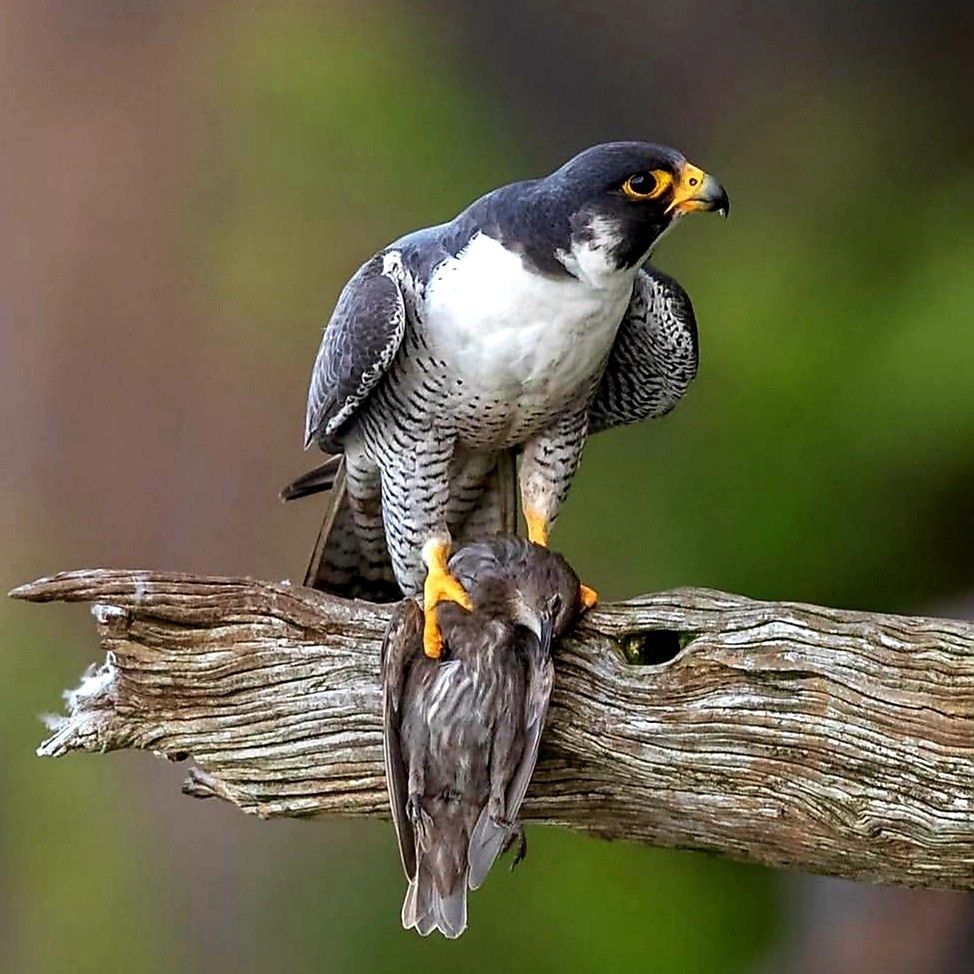
Peregrine Falcon (Falco peregrinus) in Tanzania
Africa's Legendary Speed Hunter

Peregrine Falcon

Falco peregrinus

A powerful falcon built for precision, altitude and astonishing speed.

The Peregrine Falcon is a globally widespread raptor whose long pointed wings, dark facial moustache and aerial hunting technique make it instantly memorable. Tanzania supports the African Peregrine Falcon form and offers suitable highland, savanna, wetland and coastal habitats for this remarkable hunter.

Scientific NameFalco peregrinus
FamilyFalconidae
DietMostly birds in flight
StatusLeast Concern
HabitatCliffs, wetlands & open country
Tanzania FormAfrican Peregrine Falcon

Peregrine Falcon Quick Facts

Falco peregrinus · Falconidae · Falconiformes
Scientific nameFalco peregrinus
AuthorityTunstall, 1771
FamilyFalconidae
OrderFalconiformes
LengthAbout 34–58 cm, depending on sex and population
WingspanAbout 74–120 cm, with females larger than males
Adult appearanceBlue-grey upperparts, barred pale underparts and a dark hood
Signature featureStrong dark facial moustache and sharply pointed wings
DietMostly birds captured in flight
Hunting styleAerial pursuit and steep stoop
NestingUsually a scrape on a cliff ledge or another elevated site
ClutchUsually about 3–4 eggs
IncubationAbout 30–33 days
FledgingRoughly 35–53 days
Tanzania formAfrican Peregrine Falcon, commonly treated as F. p. minor
ConservationLeast Concern

What Is the Peregrine Falcon?

The Peregrine Falcon (Falco peregrinus) is a powerful falcon in the family Falconidae and one of the world's most widespread birds of prey. It occurs across an extraordinary range of climates and landscapes, including parts of Tanzania and other African countries.

Its anatomy is built around controlled high-performance flight: long pointed wings, a compact body, strong feet and a tail that supports rapid changes in direction. The bird is especially famous for its steep hunting dive, or stoop, used to intercept other birds in the air.

The Peregrine is not simply a bird of dramatic speed. It is an adaptable predator that can hunt around cliffs, wetlands, mountains, open country, islands and modern cities. In each setting, the essential ingredients are similar: elevated viewpoints, open airspace and enough prey birds.

Field identity: Think long pointed wings, a compact falcon shape, dark hood and moustache, and a hunting style centered on fast aerial interception.

Taxonomy & African Peregrine Falcons

The accepted species name is Falco peregrinus. The Peregrine Falcon is divided into multiple geographic forms, and taxonomic treatments differ in how many subspecies or regional groups they recognize.

Tanzania bird references include the African Peregrine Falcon, traditionally identified as Falco peregrinus minor. Older books may also describe African birds differently as taxonomies have been revised.

Using the species name is therefore the clearest way to connect field observations, birding databases and scientific literature. Modern eBird taxonomy also treats African Peregrine as a named group within the Falco peregrinus species complex.

How to Identify a Peregrine Falcon

A Peregrine is usually easiest to recognize from a combination of structure and facial pattern. In flight it is much more pointed and powerful-looking than most buzzards.

  • Head: Dark hood with a bold moustache or malar stripe below the eye.
  • Upperparts: Adults are generally blue-grey to slate, with regional variation.
  • Underparts: Pale below with dark barring or spotting that becomes stronger toward the lower body.
  • Wings: Long, narrow and sharply pointed.
  • Tail: Relatively short for a raptor of this size and commonly barred.
  • Feet: Strong yellow feet in many adults, with powerful black talons.

Juveniles are browner and more heavily streaked, so age should be considered before rejecting a bird that does not match the classic grey adult appearance.

Peregrine Falcon vs Similar Falcons

In Tanzania the Peregrine can be confused with other large falcons, especially when the bird is distant or moving quickly.

FeaturePeregrine FalconLanner FalconSaker Falcon
BuildCompact, powerful, pointed-wingedLarge falcon, often broader-lookingHeavy-bodied large falcon
FaceStrong dark moustache and hoodDifferent, less strongly hooded patternVariable and less sharply moustached
HuntingHigh-speed aerial pursuit and stoopFlexible pursuit and surprise attacksFast low pursuit and powerful strikes
Key cluePointed wings + moustache + aerial bird huntingOverall size and different head patternHeavier proportions

Behavior & Hunting Strategy

The Peregrine Falcon is an intensely visual predator. It can sit quietly on a high ledge, tower or tree and then explode into action when a suitable bird enters its hunting space.

Sharp-eyed Hunter

It searches for flying prey using elevated viewpoints and open hunting corridors.

Precision Stooper

Altitude can be converted into speed during a steep controlled dive toward prey.

Airspace Specialist

Long pointed wings support powerful flight, pursuit and rapid directional changes.

Territorial

Breeding pairs defend nest areas and nearby hunting space, especially where prey is reliable.

Daily Activity

Activity patterns vary with location and prey. Peregrines may hunt in clear daylight, around wetland bird concentrations, along coastlines or near cliffs. Urban birds can also hunt around buildings where pigeons and other birds are abundant.

The essential strategy is timing. The falcon chooses when to accelerate, when to glide and when to commit to an interception. Speed is only useful because the bird can control it.

Speed, Stooping & Aerial Mastery

The Peregrine Falcon's famous stoop is a steep dive in which the bird uses gravity, body shape and wing control to reach extraordinary speeds. Reported maximum figures vary because measurement methods, dive angle and wind conditions differ.

Rather than repeating one universal speed number, it is more accurate to say that Peregrines are capable of exceptional high-speed dives and among the most impressive aerial hunters in the bird world.

After acceleration, the bird must still make a precise interception. The final moments require rapid control, strong feet and exact timing. This is why the Peregrine's reputation is better understood as mastery of speed rather than speed alone.

Birding tip: Watch both the sky and the prey community. Sudden panic or synchronized movement in smaller birds can reveal a hunting Peregrine before you see the falcon itself.

Habitat & Global Distribution

The Peregrine is remarkably adaptable. Across its range it uses sea cliffs, mountain cliffs, river gorges, islands, open countryside, wetlands and tall urban structures.

  • Cliffs: Traditional nesting sites with elevated viewpoints and protection from many ground predators.
  • Mountain landscapes: High relief provides nest ledges and broad hunting views.
  • Wetlands: Concentrations of waterbirds create rich hunting opportunities.
  • Open country: Wide airspace allows fast pursuit.
  • Urban areas: Buildings, bridges and towers can replace natural cliffs.

The global breadth of this habitat use helps explain why the species occurs on several continents and survives in environments that look very different from one another.

Peregrine Falcon in Tanzania: Where to See It

Tanzania supports suitable Peregrine habitat through highland landscapes, open savanna, wetlands, river valleys and the coast. The species is less conspicuous than common safari raptors, so dedicated birding is especially rewarding.

Arusha National Park

A recent photographic record documents the African Peregrine Falcon in Arusha National Park, showing the value of Tanzania's highland landscapes for this falcon.

Explore northern Tanzania

Serengeti Landscape

Open plains and large concentrations of smaller birds create potential hunting opportunities for a fast aerial predator.

Explore Serengeti safari

Lake Manyara & Wetlands

Wetland bird concentrations can provide exactly the prey base a Peregrine needs.

Explore Lake Manyara

Coastal Tanzania

Coastal cliffs, islands and migratory bird movements can create productive falcon-watching conditions.

Explore coastal Tanzania

How to Watch on Safari

Look high. Scan cliffs, ridges, towers and the open sky. Also watch the behavior of flocks of pigeons, doves and waterbirds, because abrupt evasive movement can reveal a hunting falcon.

Peregrine Falcon Habitat in Tanzania

The species can use several Tanzanian habitat types as long as prey birds and elevated viewpoints are available. Rocky escarpments, mountain valleys, wetland margins and tall structures can all provide useful hunting or nesting features.

This makes the Peregrine a functional habitat specialist rather than a vegetation specialist. It needs space to fly and prey to intercept, not one specific type of plant community.

Habitat lesson: Protecting bird-rich wetlands, cliff areas and safe elevated structures can benefit Peregrines even when the surrounding landscape is heavily used by people.

Best Time to See a Peregrine Falcon

There is no single Tanzania-wide month that guarantees Peregrine sightings because populations differ in residency and migration. Local weather, prey concentrations and seasonal movements all matter.

  • Clear mornings: Better visibility for distant perched birds and ridge flights.
  • Wetland seasons: Waterbird concentrations can make feeding sites more productive.
  • Migration periods: Moving birds can increase prey abundance and raptor activity.
  • Open-weather days: Strong visibility makes high-flying falcons easier to detect.

For a dedicated birding safari, combine wetlands, open plains and elevated viewpoints rather than relying on one park or one month.

Diet & Feeding Ecology

Peregrines are primarily bird predators. The exact prey varies by region, but their menu can include pigeons, doves, waders, waterfowl, passerines and many other flying birds.

  • Pigeons and doves: Important prey where abundant around cliffs, farms and towns.
  • Waterbirds: Ducks, waders and other wetland species may become targets.
  • Passerines: Smaller birds can be intercepted during fast pursuit.
  • Occasional non-bird prey: Bats and other small animals are recorded occasionally, but birds dominate.

How Prey Is Chosen

The Peregrine balances detection, pursuit and handling. A common bird in open airspace may be a better target than a larger bird that can turn quickly or defend itself. Successful hunting is as much about opportunity and timing as raw power.

Ecological Role

As a high-level aerial predator, the Peregrine Falcon influences bird communities through direct predation and the fear responses of potential prey. Its hunting presence can change where and how smaller birds move through open airspace.

Its strong association with bird-rich wetlands and cliffs also links several habitats into one ecological network. What looks like a falcon flying over a valley may actually be responding to the movement of an entire prey community below.

For safari visitors, studying the Peregrine is therefore a lesson in ecosystem behavior, not merely species identification.

Breeding & Life Cycle

Peregrines are generally monogamous and maintain breeding territories around suitable nesting sites. Pairs can return to the same site over successive seasons.

Nesting

The species normally does not build a conventional stick nest. Instead, the female prepares or uses a shallow scrape on a cliff ledge or another elevated surface. Buildings, bridges, towers and nest boxes can also substitute for natural cliffs.

Eggs & Incubation

Clutches commonly contain about three to four eggs. Incubation lasts roughly a month, with both adults participating while the female typically carries the greater share and the male supplies substantial food.

Young & Fledging

Young Peregrines grow quickly and generally fledge after several weeks. Fledging does not mean immediate independence: juveniles continue to learn flight control and hunting while receiving parental support.

Migration & Seasonal Movement

Peregrine movement varies dramatically between populations. Some birds are resident for most of the year, while others travel long distances between breeding and non-breeding areas.

Tanzania can therefore host both locally established birds and seasonally moving Peregrines, depending on region and population. Birds from northern breeding areas may move south, while resident African forms may make shorter local movements.

This variation is important for birding. A place with few Peregrines in one season can become more interesting when migratory birds and their prey are moving through.

Conservation Status

The Peregrine Falcon is assessed as Least Concern globally. Its huge geographic range and numerous populations mean that the species as a whole is not currently considered close to a threatened category.

That status hides an important conservation story. During the twentieth century, several populations suffered severe declines connected to persistent organochlorine pesticides, particularly through eggshell thinning. Restriction of these chemicals and focused protection helped many populations recover.

Local concerns can still include disturbance at nest sites, trapping in some regions, persecution and reductions in prey-rich habitat.

Conservation perspective: Global Least Concern reflects the strength of the species overall; it does not mean every local population or nesting site faces no pressure.

Local Pressures & Why Peregrines Matter

Peregrines live where cliffs, wetlands, towns and transport corridors intersect. Human activity can provide new structures but can also disturb breeding sites and alter prey communities.

  • Nesting disturbance: Repeated disturbance can reduce breeding success at sensitive ledges.
  • Pollutants: Chemical exposure has a documented historic impact on reproductive success.
  • Illegal taking: Trapping can affect local populations in parts of the range.
  • Prey habitat loss: Wetland and grassland change can reduce the birds available to hunt.
  • Infrastructure: Towers, wires and buildings can create both opportunities and hazards.

The Peregrine's recovery demonstrates that conservation can work when harmful practices are addressed and nesting habitat is protected.

Peregrine Falcon Compared With Other Tanzanian Raptors

The Peregrine stands apart from many Tanzanian raptors through its falcon shape and highly specialized aerial bird hunting.

FeaturePeregrine FalconLizard BuzzardWahlberg's Eagle
FamilyFalconidaeAccipitridaeAccipitridae
Wing shapeLong, narrow and pointedShorter, compact wingsBroad eagle wings
Main preyMostly birds in flightReptiles, frogs, rodents and insectsBirds, reptiles and other vertebrates
Signature huntStooping and aerial pursuitPerch-and-pounceSoaring, perch hunting and direct attacks
Best clueDark moustache + pointed wingsWhite throat with dark central streakLarger eagle-like profile

Did You Know?

Built for the Stooping Dive

The species can convert altitude into extraordinary speed during a hunting dive.

Birds Are the Main Course

Unlike many African raptors, Peregrines rely heavily on other birds as prey.

Cliffs Are Classic

Natural cliff ledges remain iconic Peregrine nesting sites.

City Adaptation

Tall buildings, bridges and towers can provide nesting and hunting opportunities.

Global Traveler

Different populations show everything from residency to long-distance migration.

Conservation Recovery

Many populations recovered after pesticide controls and targeted protection.

Watch the Flock

Alarmed or suddenly scattering prey birds can reveal a hunting Peregrine nearby.

Speed Needs Control

The remarkable part of the stoop is not only acceleration but the precision needed to intercept a moving target.

The Story of a Peregrine Above the African Sky

A flock of birds rises from the valley at once. There is no obvious reason until a second shape appears above them, higher and faster than the eye first expects.

The Peregrine has already seen the movement. It does not need to chase every bird. It needs one opening, one angle and one moment when altitude becomes speed.

For the observer, the lesson is simple: the African sky has its own food web. The Peregrine is one of the predators that makes that invisible world suddenly visible.

Wildlife Photography & Birding Tips

  • Start with silhouette: Pointed wings and a compact body are often visible before plumage detail.
  • Watch the face: The dark moustache is a strong clue on a perched adult.
  • Use a fast shutter: Flight transitions can happen extremely quickly.
  • Watch prey behavior: Sudden flock movements can be a better warning than searching the sky blindly.
  • Respect nest sites: Do not approach active ledges just for a photograph.

Record location, habitat, age class, behavior and prey if known. A detailed field note can turn a photograph into valuable birding evidence.

References & Further Reading

  • eBird / Cornell Lab of Ornithology — taxonomy and field identification resources for Peregrine Falcon groups.
  • Tanzanian Birds & Butterflies — Tanzanian bird checklist and regional bird records.
  • IUCN Red List / BirdLife International — global conservation status framework for Falco peregrinus.
  • Australian Museum — breeding behavior, nesting and life-cycle information.
  • U.S. Forest Service — detailed reproductive ecology and incubation/fledging synthesis.
  • Recent Arusha National Park photographic record — African Peregrine Falcon documented in Tanzania in August 2026.

Explore Tanzania's Raptor & Birding Destinations

A Peregrine-focused itinerary becomes stronger when it combines highland, wetland and open-country habitats. That approach also increases your chances of finding other falcons, eagles and raptors.

Frequently Asked Questions

What is the Peregrine Falcon?

The Peregrine Falcon (Falco peregrinus) is a globally widespread falcon and specialized aerial predator.

What does a Peregrine Falcon eat?

Birds form the main part of the diet, including pigeons, doves, waterbirds and many smaller species.

How does it hunt?

It can pursue birds in the air and use a steep controlled stoop to intercept prey.

Is the Peregrine Falcon the fastest bird?

It is widely recognized for extraordinary speed in its hunting dive, although exact maximum figures depend on measurement and conditions.

Where can I see Peregrines in Tanzania?

Suitable landscapes include highlands, open savanna, wetlands and coastal areas. Recent photographic documentation confirms the African form in Arusha National Park.

Does it migrate?

Some populations are resident and others undertake long seasonal movements; the pattern varies geographically.

Where does it nest?

Usually on a cliff ledge or other elevated scrape site; buildings, bridges and towers can also be used.

How many eggs does it lay?

Clutches are commonly about three to four eggs.

What is its conservation status?

The Peregrine Falcon is assessed as Least Concern globally, although local threats still occur.

See the Peregrine Falcon in Tanzania

From the open skies of the Serengeti to the woodlands of Tarangire and Ruaha, Tanzania offers extraordinary opportunities to discover African raptors in their natural habitats.

Hello!
Welcome to African Majestic Adventure.
Ready to plan your Tanzania birding safari?
African Majestic Adventure
Tanzania
WeChat QR Code
Scan the QR code to connect
Chat with Us
Hi! How can we help you today?