

.png)
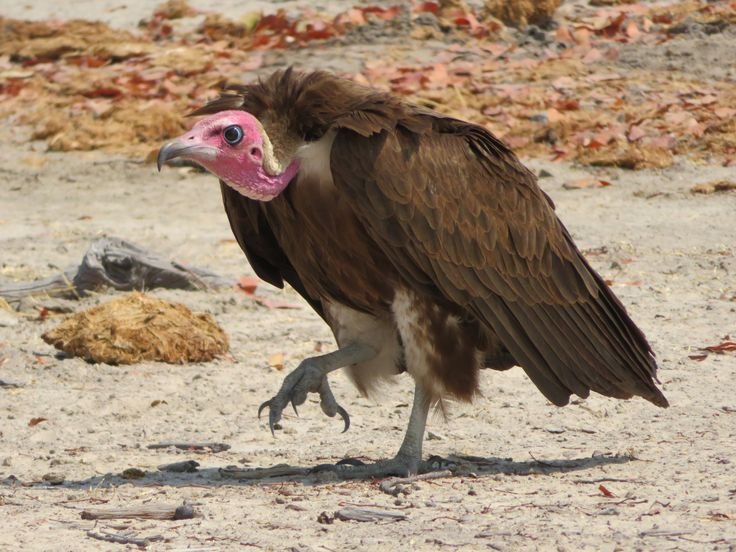
Hooded Vulture
Necrosyrtes monachusA discreet but essential member of Africa’s clean-up crew, built for life around carcasses, woodland edges and open country.
The Hooded Vulture is a small Old World vulture of the Accipitridae family. Its dark body, bare pinkish head, slender hooked bill and soft pale neck feathers make it distinctive, while its specialised scavenging lifestyle gives it an important ecological role across sub-Saharan Africa.
Hooded Vulture Quick Facts
The Hooded Vulture is an important part of Africa’s scavenging community and is considered Critically Endangered. Its conservation story highlights the need to protect breeding habitat, reduce poisoning, improve the safety of power infrastructure and support communities that share the landscape with vultures.
Measurements and breeding figures reflect species accounts available from Animal Diversity Web and ornithological sources; conservation status and Tanzania context are supported by BirdLife sources.
What Is the Hooded Vulture?
The Hooded Vulture (Necrosyrtes monachus) is a small Old World vulture and the only living species in its genus, Necrosyrtes. Unlike the huge, broad-winged vultures that dominate many African carcasses, the Hooded Vulture is relatively small, lightly built and highly manoeuvrable.
Its common name comes from the soft, pale, hood-like feathers around the rear of the head and neck. Ahead of those feathers is a largely bare face and crown, usually showing pinkish skin in adults. The combination of a dark body, pale neck, bare face and slender bill gives the species a characteristic, almost delicate appearance among Africa’s vultures.
Although it is capable of joining larger vultures at carrion, it often lives at the edges of feeding events rather than overpowering its larger relatives. That difference in build is important: the Hooded Vulture’s survival depends on finding suitable food and safe nesting places across a landscape increasingly shaped by people.
How to Identify a Hooded Vulture
At close range, the Hooded Vulture is one of the easier African vultures to recognise because its head and neck pattern is so unusual. Look first for the small body size and dark brown plumage, then examine the exposed head and pale neck feathers.
- Head and face: The head is largely bare and usually pinkish in adults, contrasting strongly with the dark body.
- Neck or “hood”: Fine pale or whitish downy feathers surround the rear of the neck and create its hooded appearance.
- Bill: The bill is comparatively slender, dark and drooping, rather than massive like that of some larger carcass-opening vultures.
- Eye area: A blue eye-ring can be distinctive at close quarters in adults.
- Body: Overall plumage is brown to dark brown, with softer feathering around the neck and chest.
- Flight: In the air, the rounded tail and silvery-looking flight feathers help separate it from some similarly dark raptors.
Juveniles and Ageing
Young Hooded Vultures do not simply look like miniature adults. Their facial skin is greyer and the downy neck feathers are browner, giving them a more muted appearance. Age-related differences matter when identifying birds at a waterhole, roost or feeding site, because the bare facial skin can change noticeably as a bird matures.
Distinguishing It From Other African Vultures
The Hooded Vulture is much smaller and more lightly built than the great Lappet-faced Vulture. It also differs from the White-backed Vulture, which is bulkier and much more closely associated with large ungulate carcasses. Its small frame, pink bare head and pale neck “hood” are particularly useful field marks.
Body Design & Survival Adaptations
A mostly featherless face reduces the amount of material that can become fouled while feeding around carrion, one of the classic adaptations found among vultures.
Like other diurnal scavengers, the Hooded Vulture relies heavily on keen eyesight to locate food and track feeding opportunities across open landscapes.
Its lighter bill suits a bird that can exploit smaller portions and scraps rather than competing head-on with the strongest carcass-opening vultures.
Broad wings allow it to travel between feeding areas while using rising air, reducing the energy cost of searching large landscapes.
These traits reveal the Hooded Vulture’s niche. It is not designed to win every argument at a carcass. Instead, it is a specialised small scavenger capable of moving through a complex feeding guild and taking advantage of food resources that can be overlooked by larger species.
Behavior & Social Life
Hooded Vultures are primarily diurnal. Much of their visible activity involves flying, perching, searching for food and visiting carrion or other feeding opportunities. They can occur alone, in pairs or in loose gatherings when food is available.
At a Feeding Site
One of the most revealing scenes on safari is the hierarchy around a carcass. Larger vultures may arrive with stronger bills and greater body mass, while the Hooded Vulture can wait at the margins and exploit pieces left available. This behaviour is not a sign of weakness; it is a strategy that reduces the need for direct competition.
Daily Rhythm
- Early hours: Birds may leave roosts and begin searching as the landscape warms and thermal activity increases.
- Midday: Soaring can become conspicuous over open country, woodland edges and areas with predictable food supplies.
- Afternoon: Feeding, social interactions, roosting movements and nest-related activity may become easier to observe.
Movement and Wandering
Breeding adults are tied to nest sites for much of the reproductive cycle, whereas non-breeding and immature birds can move more widely while searching for food. This distinction helps explain why sightings can vary between seasons and landscapes even where the species is resident.
Habitat & Distribution
The Hooded Vulture has a broad sub-Saharan distribution but uses a wide variety of habitats. It is strongly associated with open country, woodland, forest edges and landscapes where food and suitable nesting trees occur together.
- Wooded savanna: Trees provide roosts, lookout points and nesting opportunities.
- Forest edges: Ecotones can offer cover alongside open feeding areas.
- Open grassland and savanna: These landscapes make long-distance visual searching and soaring practical.
- Wetland and water-linked landscapes: In several parts of its range it uses well-foliaged trees near watercourses.
- Human-modified areas: The species can appear around settlements, livestock areas and other places where food waste or animal remains are available, although such opportunities can also expose birds to serious risks.
Where It Occurs Across Africa
The species is native to sub-Saharan Africa and occurs in both western and eastern parts of the continent as well as farther south. Its range is broad, but abundance has declined severely in many landscapes, making “widely distributed” very different from “secure.”
Altitude & Nesting Landscape
Hooded Vultures can occur from lowlands into higher country, but the species is most numerous at lower elevations. Nesting is commonly associated with tall, well-foliaged trees, especially those near watercourses or in landscapes that combine trees with open foraging habitat.
Hooded Vulture in Tanzania
Tanzania is an important country for African vulture conservation, and the Hooded Vulture is among the threatened vulture species recorded here. A Tanzania birding reference describes the species as widespread, especially in wetter areas, with observations from Tarangire, northern Serengeti and Ndutu among other locations.
Tarangire National Park
Tarangire provides open savanna, acacia woodland, water-linked habitat and wildlife carcasses—an attractive combination for a scavenger. Hooded Vultures have been photographed and recorded in the park.
Tarangire safariNorthern Serengeti
Field records from the northern Serengeti show that the species forms part of the park's wider vulture community, particularly where open feeding habitat meets roosting trees.
Serengeti safariNdutu Area
Hooded Vultures have been documented around Ndutu, where seasonal concentrations of wildlife can create important scavenging opportunities.
Ndutu & NgorongoroMakao Wildlife Management Area
Makao WMA in northern Tanzania is recognised as an Important Bird Area and hosts five vulture species, including Hooded Vulture, making it valuable for conservation-focused birding.
Explore Tanzania destinationsHow to Look for One on Safari
- Scan isolated trees and dead branches: perched vultures can sit quietly before a feeding opportunity develops.
- Watch mixed vulture groups: a small Hooded Vulture may appear on the margins of a larger feeding flock.
- Check open sky above carcass areas: soaring birds can be easier to spot against a clear background.
- Use early and late light: softer light can make the pink face and pale neck feathers easier to distinguish.
Responsible Wildlife Viewing
Because the Hooded Vulture is critically endangered, a good sighting should never become a reason to approach nests, crowd feeding birds or interfere with carcasses. The best birding experience is the one that leaves the animal completely undisturbed.
Diet & Feeding Ecology
The Hooded Vulture is principally a scavenger. Its food includes carrion from wild animals and domestic livestock, as well as smaller scraps and other organic food resources associated with carcasses and human activity.
What It Eats
- Wild-animal carrion: remains from mammals and other wildlife can form an important part of its diet.
- Livestock remains: pastoral landscapes can provide predictable food where animal remains are safely available.
- Small carcass fragments: its slender bill is well suited to picking at smaller pieces.
- Food scraps: around settlements and other modified landscapes, it may exploit accessible food waste.
Why Its Feeding Strategy Matters
A carcass is not a single food resource; it is an entire community of feeding opportunities. Large vultures can open tough hides, while smaller vultures can work around exposed tissue and pick up fragments. The Hooded Vulture’s role helps complete that process, allowing less food to remain on the landscape.
Competition With Larger Vultures
At large carcasses, Hooded Vultures are often subordinate to bigger and more aggressive vultures. Rather than relying on brute force, they can feed on scraps, smaller remains and opportunities around the edge of the main feeding event. That niche separation allows several vulture species to share the same ecosystem.
The Hooded Vulture’s Ecological Role
Vultures are often overlooked because their work happens around death rather than live prey. Ecologically, however, scavengers are essential. By rapidly consuming animal remains, they help return nutrients to the ecosystem and reduce the persistence of carrion across the landscape.
Scavenging moves nutrients from dead animals back into ecological cycles instead of leaving carcasses to decay slowly and unpredictably.
Efficient carcass removal can limit the time animal remains remain exposed in places shared by wildlife, livestock and people.
The Hooded Vulture is one member of a diverse scavenger community in which different species occupy different feeding niches.
Breeding & Life Cycle
Hooded Vultures are monogamous and normally produce just one egg per breeding attempt. For a long-lived bird with such low reproductive output, the loss of a mature adult or a single breeding season can have consequences that persist for years.
Nesting
- Nest site: Usually a stick nest placed in the canopy or just below the canopy of a tall, well-foliaged tree.
- Location: Nest trees are often associated with watercourses or landscapes where open foraging habitat lies nearby.
- Re-use: Nests may be re-used in successive breeding seasons.
- Clutch: Normally one egg.
Incubation
The egg is incubated for roughly 46–54 days. Adults share the responsibility for the nest, with one bird able to remain while the other searches for food. This creates a powerful connection between a safe nest tree and the surrounding feeding landscape.
Chick Development
The young bird grows slowly compared with a typical songbird. Fledging can take around 80–130 days, after which the juvenile still depends on adults while developing the skills required to find food, travel efficiently and survive independently.
Why Breeding Rate Matters
A species producing one egg at a time cannot quickly replace a population after mass mortality. This is one reason poisoning events and the loss of breeding adults are so dangerous for vultures: a single incident can kill more birds than natural reproduction can replace in many breeding seasons.
Conservation Status
The Hooded Vulture is among Africa’s most threatened scavenging birds. Its decline is linked to pressures such as poisoning, illegal killing and belief-based use, loss of suitable nesting habitat, electrocution and collisions. Conservation measures that keep carcasses safe from poison, protect mature nesting trees and make infrastructure safer can directly support the species.
Major Threats
- Poisoning: Poison set during human-wildlife conflict can kill vultures that gather at affected carcasses.
- Belief-based use: Vulture body parts are illegally taken in some areas for traditional or belief-based uses.
- Habitat and nest loss: Removal of mature trees and landscape change can reduce secure nest sites.
- Electrocution and collisions: Power infrastructure and other structures can kill birds moving through the landscape.
- Reduced food availability: Changes in wild herbivore populations, livestock management and carrion availability can alter the food base.
- Human disturbance: Nest disturbance and direct persecution can reduce reproductive success.
Vulture Conservation in Tanzania
BirdLife reports that Tanzania holds eight vulture species and that six of them, including the Hooded Vulture, are classified as Critically Endangered or Endangered. Conservation work in northern Tanzania has included community engagement around poisoning and belief-based use, with Makao Wildlife Management Area serving as an important landscape for threatened vultures.
What Helps the Species
Effective conservation combines safer livestock and wildlife-conflict practices, rapid response to poisoning, protection of mature nest trees, safer energy infrastructure, enforcement against illegal killing and trade, and community programmes that build alternatives to vulture killing. Protected areas matter, but connected landscapes and local stewardship matter too.
Hooded Vulture Compared With Other African Vultures
The Hooded Vulture is often identified in mixed vulture groups. Its size, bill shape and pale neck “hood” are particularly useful clues.
| Feature | Hooded Vulture | White-backed Vulture | Lappet-faced Vulture |
|---|---|---|---|
| Build | Small and relatively slender | Larger, broad-winged Gyps vulture | Very large and powerful |
| Head | Bare pinkish head with pale neck feathers | Mostly bare head with contrasting neck area | Large bare head with heavy bill |
| Bill | Slender, hooked | Heavier bill | Massive bill for opening carcasses |
| Feeding niche | Smaller scraps and carrion resources | Major carcass feeder, often in large groups | Powerful carcass-opening specialist |
| Flight impression | Smaller, more compact | Broader and more imposing | Huge wings and heavy silhouette |
A mixed flock can therefore become an excellent identification lesson: size tells you which bird you are looking at first, while head pattern, bill size and body shape confirm the identification.
Did You Know?
Small for a Vulture
At around 67–70 cm long, the Hooded Vulture is much smaller than the giant lappet-faced and many large Gyps vultures.
One Egg
Its normal clutch is a single egg, making the species particularly vulnerable to repeated adult mortality and nest failure.
Nest Trees Matter
Breeding birds depend on suitable tall, well-foliaged trees, often close to feeding habitat and watercourses.
Blue Eye-ring
At close range, the blue eye-ring can be a striking field mark of an adult Hooded Vulture.
Built for Scavenging
The bare face, hooked bill and broad wings work together in a lifestyle centred on locating and processing animal remains.
Tanzania Matters
Tanzania supports multiple threatened vulture species, making the country a major focus for conservation and birding.
Look beyond the spectacle of the big mammals. Above a quiet woodland, a Hooded Vulture may be doing work that few safari visitors notice: searching, waiting, recycling what the landscape can no longer use, and keeping an invisible ecological process moving. The bird may appear modest beside a lion or elephant, but its absence would leave a much bigger gap than its size suggests.
Hooded Vulture Gallery
Frequently Asked Questions
The Hooded Vulture (Necrosyrtes monachus) is a small Old World vulture of the Accipitridae family, recognised by its dark brown body, bare pinkish head, slender hooked bill and pale neck feathers.
Yes. It is classified as Critically Endangered and faces severe pressures including poisoning, illegal killing, belief-based use, habitat and nest loss, electrocution and infrastructure collisions.
They are widespread in Tanzania, especially in wetter areas, with records from Tarangire, northern Serengeti, Ndutu and other localities. Sightings depend on habitat, food availability and season.
It mainly scavenges carrion from wild animals and livestock, as well as smaller scraps and other accessible organic food resources.
It is monogamous, normally lays one egg, and nests in tall, well-foliaged trees. Incubation lasts roughly 46–54 days and fledging may take approximately 80–130 days.
Look for a small dark-brown vulture with a bare pinkish head, pale fluffy neck feathers, a slender hooked bill, rounded tail and silvery flight feathers.
As a scavenger it helps remove animal remains, recycle nutrients and complete the work of Africa's wider scavenger guild.
The species occurs in Tanzania as a resident, while individual movement can vary with age, food availability and breeding demands.
References & Further Reading
- BirdLife International — Tanzania vulture conservation: national context, threatened species, poisoning and other major pressures on vultures in Tanzania.
- Tanzania Birds — Hooded Vulture: Tanzanian distribution, field observations and locality records including Tarangire, northern Serengeti and Ndutu.
- eBird: field identification characters including the small size, bare pinkish head, pale neck feathers, slender bill and flight pattern.
- Animal Diversity Web: morphology, mass and length ranges, nesting and reproductive biology.
- Scientific Reports (2024): research on conservation significance and anthropogenic threats affecting Hooded Vulture populations.
- Bird Conservation International: recent research into nesting ecology and causes of mortality in the Critically Endangered species.