

.png)
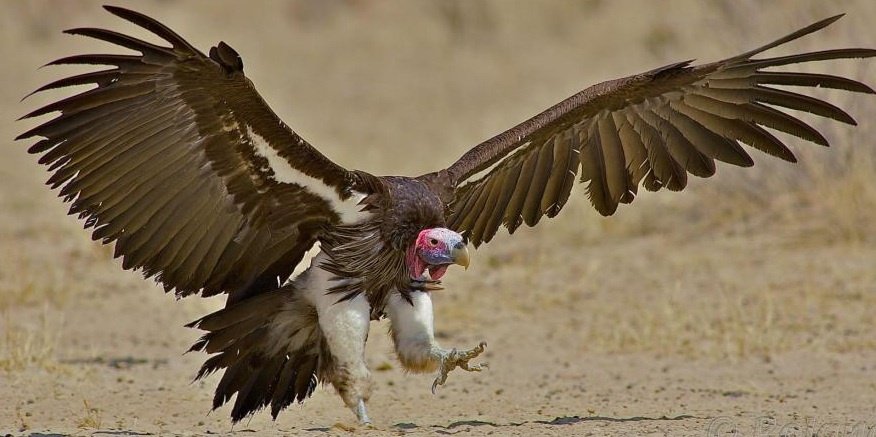
Lappet-faced Vulture
Torgos tracheliotosThe undisputed giant of Africa's vultures – a master scavenger with a beak that can tear through the toughest hide.
The Lappet-faced Vulture (Torgos tracheliotos), also known as the Nubian Vulture, is one of Africa's largest and most powerful birds of prey[reference:0]. With a wingspan reaching nearly 3 metres and a massive, two-toned beak, this Old World vulture dominates carcasses and plays a critical role as nature's clean-up crew[reference:1][reference:2].
Lappet-faced Vulture Quick Facts
What Is the Lappet-faced Vulture?
The Lappet-faced Vulture (Torgos tracheliotos) is a massive Old World vulture belonging to the family Accipitridae, which also includes eagles, kites, buzzards and hawks[reference:12]. It was first described by the German naturalist Johann Reinhold Forster in 1791[reference:13]. This species is the only member of the genus Torgos.
As the largest vulture in Africa, the Lappet-faced Vulture dominates other vultures when feeding and is even powerful enough to fend off a jackal[reference:14]. This impressive species is armed with a large and powerful beak, capable of tearing off the hides, tendons and other coarse tissue of its scavenged prey that are too tough for smaller scavengers[reference:15]. This enormous, broad-winged bird is easily recognised by its conspicuous size, bare, pink-skinned head and distinctive fleshy folds of skin, known as lappets, on the sides of its neck, for which it earns its common name[reference:16].
Old World vultures of the subfamily Aegypiinae, such as the Lappet-faced Vulture, split from all other birds around 35 million years ago, long before the evolution of apes[reference:17]. The species is also known by several alternative names including the Nubian Vulture and the African King Vulture[reference:18].
How to Identify a Lappet-faced Vulture
The Lappet-faced Vulture is one of the most visually striking and unmistakable birds in Africa. Here are its key identifying features:
- Size: Massive – one of the largest vultures in the world, standing about 1 metre tall[reference:19].
- Head: Large, bare, square-shaped head with pinkish skin[reference:20].
- Lappets: Distinctive fleshy folds of skin (lappets) hanging from the sides of the neck[reference:21].
- Beak: Bulky, two-toned bluish-yellow beak – extremely powerful[reference:22].
- Plumage: Mostly dark brown to black feathers, with a brown-and-white streaked chest[reference:23].
- Leggings: Puffy white feathers on the thighs (white leggings) – diagnostic in flight[reference:24].
- Underwing: Small white lines at the front of the wing in flight[reference:25].
- Eyes: Dark eyes[reference:26].
- Legs and feet: Pale blue-grey[reference:27].
There are two subspecies: The African subspecies Torgos tracheliotus tracheliotus has mostly dark brown to black feathers, which contrast starkly with the white thighs and white bar running across the leading edge of the underwing[reference:28]. The north-east African subspecies, Torgos tracheliotus negevensis, is altogether browner, including partially-brown thighs[reference:29].
Distinguishing from Other Vultures
Juveniles transition to adult plumage over about six years, and differ from adults mainly in their brown leggings and darker bills. Young birds also lack white wing markings and thus appear very similar to juvenile and immature Hooded Vultures and White-headed Vultures[reference:30]. Adults can be distinguished from the superficially similar Hooded Vulture by their massive size, large bare head with prominent skin folds and lappets, and robust bill[reference:31].
Behavior & Social Life
The Lappet-faced Vulture is typically solitary or found in pairs, spending most of its time alone unless congregating at a carcass[reference:32]. Despite its solitary nature, it is a social species, with individuals often congregating from miles around to feed on carcasses[reference:33].
Daily Activity
- Soaring: Lappet-faced vultures are well equipped for searching for food. They soar and glide on broad wings and look down with sharp eyes[reference:34]. Its huge wings allow it to soar almost effortlessly through the air[reference:35].
- Aggression: Known as a bit of a bully, these huge birds are one of the most aggressive species, dominating over other vultures at carcasses[reference:36]. It drives away smaller carrion-eaters, including jackals[reference:37].
- Bathing: Lappet-faced vultures love to bathe and are often found chilling around watering holes[reference:38].
- Vocalization: Like other vultures, they are generally silent but may make hissing or grunting sounds at carcasses.
Movements
Lappet-faced Vultures are regarded as a partial migrant that makes significant movements in response to rainfall[reference:39]. Tagged birds have been recorded with an average home range size of 22,000 km², moving between Kenya and Tanzania[reference:40]. The species is capable of long-distance movements, as evidenced by ring recoveries[reference:41].
Habitat & Distribution
The Lappet-faced Vulture inhabits dry savanna, arid plains, deserts and open mountain slopes up to 3,500 metres[reference:42][reference:43]. It prefers open, semi-arid or arid habitat, including deserts, steppes, grasslands, savannas, and open woodland, especially where there are scattered acacia trees for perching[reference:44]. It is less likely to be found in wetter or forested areas[reference:45]. In fact, this species occurs in extremely dry areas, including the Namib, Kalahari, and Somalia Deserts[reference:46].
Distribution: Despite being widely distributed across Africa and the Middle East, the Lappet-faced Vulture has a small and rapidly declining population[reference:47]. It is found throughout much of Africa, though its distribution is considered patchy[reference:48]. The African population has been estimated to be at least 8,000 individuals, with maybe 500 in the Middle East[reference:49]. The species has an Extent of Occurrence of 34,200,000 km²[reference:50].
Nations where it can be found include Angola, Benin, Botswana, Burkina Faso, Central African Republic, Chad, Democratic Republic of Congo, Egypt, Ethiopia, Gambia, Guinea, Kenya, Ivory Coast, Malawi, Mali, Mozambique, Namibia, Niger, Rwanda, Senegal, Sudan, Somalia, Swaziland, South Africa, Tanzania, Uganda, Zambia, as well as Arabia, Yemen, Oman and the United Arab Emirates[reference:51].
Tanzania Distribution
In Tanzania, the Lappet-faced Vulture is found in most national parks and game reserves, particularly in the drier regions. It has been recorded in Serengeti National Park, Ngorongoro Conservation Area, Tarangire National Park, and Ruaha National Park[reference:52][reference:53].
Lappet-faced Vulture in Tanzania
The Lappet-faced Vulture is a magnificent and powerful raptor of Tanzania's drier woodlands and savannas. Here are the best locations to see it:
Serengeti National Park
Recorded in the Serengeti, particularly in the Ndutu area in the southeastern part of the park[reference:54][reference:55]. Breeding has been documented on the Serengeti Plains[reference:56].
Serengeti safariNgorongoro Crater
Observed at Big Marsh, Ndutu, in the Ngorongoro Conservation Area, which borders the Serengeti[reference:57].
Ngorongoro safariTarangire National Park
Found in the park's acacia woodlands and open savanna habitats, where it can be seen soaring or perched in tall trees.
Tarangire safariRuaha National Park
A resident species in Ruaha's miombo woodland and dry savanna habitats[reference:58].
Ruaha safariSafari Methods
- Game drives through open woodland and savanna habitats, especially during the dry season.
- Birdwatching – watch for soaring vultures with their distinctive broad wings and white leggings[reference:59].
- Wildlife photography – the lappet-faced vulture's striking appearance makes it a spectacular subject.
- Look for carcasses – as dominant scavengers, they are often the first to arrive at large kills.
Best Time to See Them
Lappet-faced Vultures are present year-round in suitable habitat. They are most active during the cooler morning hours when thermal currents allow them to soar[reference:60]. The dry season (June to October) is generally best for wildlife viewing as animals congregate around water sources, increasing the chances of observing these magnificent vultures.
Diet & Feeding
The Lappet-faced Vulture is a carnivore with a diet dominated by carrion, but it is also an active predator[reference:61].
Food Sources
- Carrion: Primarily a scavenger, feeding on carcasses of large mammals[reference:62]. It feeds mainly on skin, meat, tendons and ligaments – parts other vultures are less well equipped to handle[reference:63]. It appears to have a special liking for the heads of animals[reference:64].
- Live prey: Known to attack young and weak living animals[reference:65]. It hunts small reptiles, fish, birds and mammals[reference:66]. It has been observed apparently group-hunting flamingo chicks[reference:67].
- Kleptoparasitism: Regularly steals from smaller vultures[reference:68][reference:69].
- Nest raiding: Raids the nests of other birds for eggs and chicks[reference:70].
- Insects: Opportunistically feeds on termites and locusts[reference:71].
Hunting & Feeding Behavior
The Lappet-faced Vulture is well equipped for getting its food[reference:72]. A powerful hooked bill can tear into hide and sever tendons[reference:73]. Considering where its head must go, this vulture benefits from having a featherless head and neck[reference:74]. It dominates other vulture species at carcasses and is a regular kleptoparasite[reference:75].
The Lappet-faced Vulture can eat up to 1,450 g (51 oz) of food in one meal[reference:76]. It may be particularly important in African ecosystems as it breaks open carcasses, allowing other vultures access to the soft tissues[reference:77].
Breeding & Life Cycle
The Lappet-faced Vulture is monogamous and mates for life[reference:78][reference:79].
Nesting
- Nest: A gigantic stick nest situated in the crown of a tree, usually lined with grass[reference:80]. Nests are typically solitary but may be loosely clustered where suitable sites are rare[reference:81].
- Eggs: A single egg (very rarely two)[reference:82]. Females may re-lay after early failure[reference:83].
- Incubation: Approximately 54-56 days, shared by both parents[reference:84][reference:85].
Chicks
The nestling period is 120-128 days[reference:86]. The chick fledges in 125-135 days but remains dependent upon its parents for some time, with a post-fledging dependence period of up to a further 170 days[reference:87][reference:88]. It will not be ready to breed until it is about six years old[reference:89][reference:90]. The generation length is 15 years[reference:91].
Breeding success is reported at 44%[reference:92]. Natural causes of breeding failure include predation of nestlings by African Wild Cat, Secretarybird, and possibly Leopard[reference:93]. The survival rate of lappet-faced vultures from laying to fledging on the Serengeti Plains was about 40%[reference:94].
Conservation Status
The Lappet-faced Vulture is assessed as Endangered on the IUCN Red List[reference:95][reference:96]. Only a small, very rapidly declining population remains[reference:97].
Population: The African population has been estimated to be at least 8,000 individuals, with maybe 500 in the Middle East[reference:98]. BirdLife International estimates the total population at approximately 6,500 mature individuals[reference:99]. The population trend is decreasing[reference:100]. Data published in 2016 suggests that the population in Africa is declining extremely rapidly, and future population assessments may lead to further uplisting[reference:101]. Some experts believe that if the species were reassessed today, it would likely be considered Critically Endangered[reference:102].
Main threats:
- Poisoning: Accidental poisoning by farmers using poisons (strychnine and carbofuran) to control predators is the primary threat[reference:103]. Vultures die when they eat carcasses that farmers have laced with poison to kill marauding lions[reference:104].
- Persecution: Direct persecution in some areas[reference:105].
- Habitat loss: Ecosystem alterations and habitat modification[reference:106][reference:107].
- Decreased food availability: Declines in wild ungulate populations reduce carrion availability[reference:108].
- Nest predation: By humans[reference:109].
- Electrocution: From power lines[reference:110].
The species is listed on CITES Appendix II[reference:111]. The Lappet-faced Vulture has gone extinct in Israel, Jordan, and the western Sahara[reference:112]. Conservation and research actions have been proposed to clarify the population size and decline, but further research is required[reference:113].
Comparisons
The Lappet-faced Vulture is sometimes confused with other vultures. Here are the key differences:
| Feature | Lappet-faced Vulture | White-backed Vulture | Hooded Vulture |
|---|---|---|---|
| Size | 100-115 cm | 78-98 cm | 62-72 cm |
| Wingspan | 2.5-3.0 m | 2.0-2.3 m | 1.5-1.7 m |
| Head | Large, bare, pink with lappets | Smaller, bare, dark | Small, bare, pinkish |
| Beak | Massive, two-toned bluish-yellow | Slender, dark | Slender, dark |
| Plumage | Dark brown, streaked chest, white leggings | Dark brown with white back | Dark brown, pale collar |
| Diet | Carrion (skin, tendons), live prey | Carrion (soft tissues) | Carrion, insects, human waste |
Did You Know?
Africa's Largest Vulture
With a wingspan of up to 3 metres, the Lappet-faced Vulture is the largest vulture in Africa[reference:114].
Most Powerful Vulture
It is thought to be the most powerful vulture in Africa, capable of fending off jackals and dominating all other vultures at carcasses[reference:115][reference:116].
Massive Appetite
It can eat up to 1,450 g (51 oz) of food in one meal[reference:117].
Ancient Lineage
Old World vultures like the Lappet-faced Vulture split from all other birds around 35 million years ago, long before the evolution of apes[reference:118].
Mates for Life
These vultures are monogamous and mate for life[reference:119].
Late Bloomer
They don't start breeding until about six years of age[reference:120].
There is something prehistoric and powerful about the Lappet-faced Vulture. When it lands at a carcass, other vultures part like waves before a battleship. Its massive beak – a tool honed by millions of years of evolution – tears through hide and sinew with surgical precision. This is not just a scavenger; this is Africa's cleanup crew foreman, the bird that makes the savanna work. Without it, disease would spread, and the circle of life would falter. To see one soar overhead, its white leggings flashing against the blue African sky, is to witness nature at its most raw and magnificent.
Gallery
Frequently Asked Questions
The Lappet-faced Vulture (Torgos tracheliotos), also known as the Nubian Vulture or African King Vulture, is one of Africa's largest and most powerful vultures, easily recognized by its massive size, bare pink-skinned head, and distinctive fleshy folds of skin (lappets) on the sides of its neck[reference:121].
The Lappet-faced Vulture is found in open, semi-arid and arid habitats across Tanzania. Key locations include Serengeti National Park, Ngorongoro Crater, Tarangire National Park, and Ruaha National Park[reference:122][reference:123].
The Lappet-faced Vulture is primarily a scavenger that feeds on carrion, especially skin, tendons and ligaments that other vultures cannot process[reference:124]. It also hunts small mammals, reptiles, fish, birds, and raids nests of other birds[reference:125][reference:126].
Yes. The Lappet-faced Vulture is listed as Endangered on the IUCN Red List, with a rapidly declining population of approximately 6,500 mature individuals, primarily due to poisoning, persecution, and habitat alteration[reference:127].
It is named for the loose, fleshy folds of skin (lappets) on the sides of its neck and face. These distinctive flaps give the bird its characteristic appearance and common name[reference:128].
The Lappet-faced Vulture is one of the largest vultures in Africa. It measures 100-115 cm (39-45 in) in length with a wingspan of 2.5-3.0 m (8.2-9.8 ft), and weighs between 6.5-13.9 kg (14.3-30.6 lb), with females significantly larger than males[reference:129].
Lappet-faced Vultures are monogamous and mate for life[reference:130]. They build a solitary stick nest in a tree crown, laying a single egg (rarely two)[reference:131]. Incubation lasts 54-56 days and is shared by both parents[reference:132]. The chick fledges at 125-135 days but remains dependent for up to 170 more days[reference:133][reference:134]. They first breed at about six years old[reference:135].
In Swahili, the Lappet-faced Vulture is known as Tumbusi[reference:136].
References & Further Reading
- BirdLife International (2024) – Lappet-faced Vulture species factsheet: Endangered status, population 6,500 mature individuals, range 34,200,000 km²[reference:137].
- EDGE of Existence – Lappet-faced Vulture: Distribution, habitat, ecology, threats, population[reference:138].
- The Peregrine Fund – Lappet-faced Vulture: Did you know facts, distribution, description, conservation efforts[reference:139].
- Mpala Live! Field Guide – Lappet-faced Vulture: Scientific name, Swahili name, weight, size, wingspan, diet, breeding, behaviour[reference:140].
- Smithsonian Institution – Lappet-faced vulture description: Subspecies, identification, size, behaviour[reference:141].
- Sanbi Red List of South African Species – Lappet-faced Vulture: Identification, trophic ecology, breeding biology[reference:142].
- eBird – Lappet-faced Vulture: Identification, distribution, sightings from Tanzania[reference:143].