

.png)
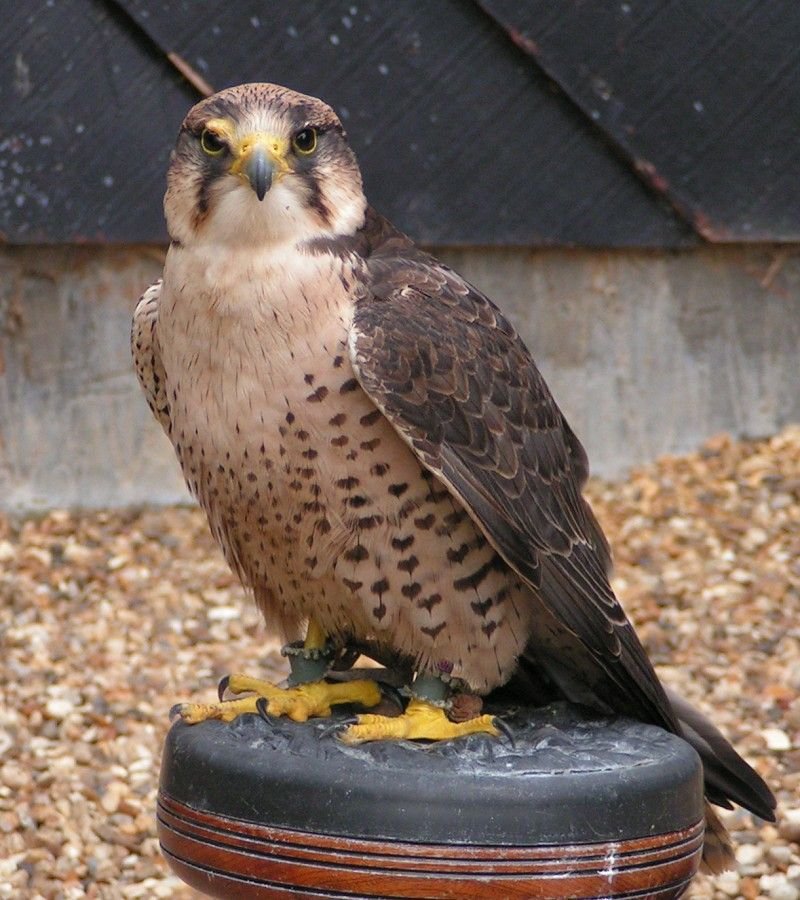
Lanner Falcon
Falco biarmicusA powerful, elegant falcon of open country – the bird that may have inspired the gods of ancient Egypt.
The Lanner Falcon (Falco biarmicus) is a medium-sized bird of prey that breeds in Africa, southeast Europe and just into Asia[reference:0]. A large and powerful falcon[reference:1][reference:2], it preys on birds and bats[reference:3]. Most likely either the lanner or peregrine falcon was the sacred species of falcon to the ancient Egyptians, and some ancient Egyptian deities, like Ra and Horus, were often represented as a man with the head of a lanner falcon[reference:4].
Lanner Falcon Quick Facts
What Is the Lanner Falcon?
The Lanner Falcon (Falco biarmicus) is a medium-sized bird of prey belonging to the family Falconidae, which also includes kestrels, hobbies and other falcons[reference:16][reference:17]. It was first described by the Dutch zoologist Coenraad Jacob Temminck in 1825[reference:18]. The species is a member of the Hierofalco subgenus, which includes other large falcons such as the Saker Falcon and Gyrfalcon[reference:19].
The name biarmicus is derived from the Latin, though its exact meaning is uncertain. The common name "lanner" comes from the Old French lanier, meaning "woollen" or "cowardly", though the falcon is anything but cowardly. The Lanner Falcon is one of the commonest large falcons in Africa[reference:20], with a very wide distribution range from the Mediterranean to South Africa[reference:21].
Most likely either the Lanner or Peregrine Falcon was the sacred species of falcon to the ancient Egyptians[reference:22]. Some ancient Egyptian deities, like Ra and Horus, were often represented as a man with the head of a Lanner Falcon, underscoring the cultural significance of this magnificent bird[reference:23].
How to Identify a Lanner Falcon
The Lanner Falcon is a large and powerful falcon, slightly smaller and more slender than the Saker Falcon[reference:24][reference:25]. Here are its key identifying features:
- Size: A medium to large falcon, ranging from 35 to 50 cm (14-20 in) in length with a wingspan of 90 to 110 cm (35-43 in)[reference:26].
- Upperparts: Adults have a slate-grey back[reference:27].
- Head: Pale orangish hindcrown and nape (rufous to light buff)[reference:28][reference:29]. The forehead is pale buff, and the forecrown is dark greyish blue[reference:30].
- Underparts: Pale, varying from mostly unmarked whitish to whitish with a pink or buff-coloured wash[reference:31]. There are usually fine dark spots on the breast and belly, and dark bars and spots on the flanks and thighs[reference:32].
- Head Pattern: A distinctive black 'moustache' stripe (malar stripe) on the face[reference:33].
- Bill: Grey with a blackish tip[reference:34].
- Eye ring, cere, legs and feet: Dark yellow[reference:35].
- Eyes: Dark brown[reference:36].
- Tail: The underside of the tail has 8-12 narrow dark bars[reference:37].
Juvenile vs Adult
Juveniles are dark brown above and well-streaked below[reference:38][reference:39], with the crown and nape whitish to pale rufous[reference:40]. The underparts are buff coloured with heavy, smudged brown streaks[reference:41]. Flight feathers have whitish edges[reference:42]. The cere, eye ring, legs, and feet are greyish-blue in juveniles[reference:43]. Young birds between 6 to 18 months show plumage features intermediate between juveniles and adults[reference:44].
Distinguishing from Other Falcons
The Lanner Falcon is most often mistaken for the Peregrine Falcon (Falco peregrinus)[reference:45]. The Peregrine is more compact and, although smaller, is more heavily built than the Lanner[reference:46]. The Peregrine also has more pointed wings and a shorter tail[reference:47]. Adult Peregrines have dark blackish (not rufous) crowns, broader malar stripes, and darker grey upper parts[reference:48]. Their underparts are densely barred and spotted black[reference:49].
Juvenile Lanner Falcons can be easily confused with Saker and Peregrine Falcons; note the unstreaked "trousers" and very heavy streaking on the underwings and underparts of juvenile Lanners[reference:50][reference:51].
Behavior & Social Life
The Lanner Falcon is a solitary and territorial bird, though pairs may be seen together during the breeding season. It is a fast-flying raptor of open country and savannahs[reference:52].
Flight & Hunting
- Hunting style: The Lanner Falcon captures prey in a level aerial chase or by stooping from above[reference:53].
- Surprise attack: Prey is caught in the air or on the ground after a surprise attack[reference:54].
- Cooperative hunting: Lanner Falcon pairs sometimes hunt together. Males flush out prey for the female[reference:55].
- Speed: Like other large falcons, Lanners are fast and agile flyers, capable of rapid acceleration in pursuit of prey.
Vocalization
The Lanner Falcon has a typical falcon scream[reference:56][reference:57]. During courtship, both males and females engage in elaborate flying and loud calling as part of the courtship display[reference:58].
Habitat & Distribution
The Lanner Falcon is found in habitats varying from flat, dry areas near sea level to wet, forested mountains as high as 5,000 metres[reference:59]. It prefers open habitat[reference:60] and haunts open country[reference:61], including mountain steppe, semi-desert, and cliffs[reference:62]. It requires large open or lightly wooded hunting areas, as well as rocky formations such as cliffs for nesting[reference:63]. However, it is also known to nest in trees and abandoned structures, as well as near the ground in desert areas[reference:64].
Key habitat types include:
- Open country and savannah – for hunting[reference:65].
- Mountain steppe and cliffs – for nesting[reference:66].
- Semi-desert and dry areas[reference:67].
- Forest margins and lightly wooded areas[reference:68].
Distribution: The Lanner Falcon has an extremely large range, with an Extent of Occurrence of 42,800,000 km²[reference:69]. It is found as far north as the central/eastern Mediterranean region, extending south throughout most of Africa[reference:70]. It is primarily a sedentary species, though extensive wandering is frequently observed in Africa, especially in juveniles and non-breeding adults[reference:71]. Ringed individuals have been recovered as far as 1,528 km from their breeding territory[reference:72]. The species is also known to move according to weather patterns[reference:73].
The Lanner Falcon ranges throughout southern Africa, with a stronghold in Lesotho and south-eastern South Africa[reference:74]. It occurs throughout most of Africa, avoiding only the equatorial rainforests[reference:75].
Tanzania Distribution
In Tanzania, the Lanner Falcon is found in various national parks and conservation areas. It has been recorded in the Ngorongoro Crater (Arusha region)[reference:76] and on the Kitulo Plateau in the Njombe region[reference:77]. It is also present in Serengeti National Park, Tarangire National Park, and Ruaha National Park[reference:78].
Lanner Falcon in Tanzania
The Lanner Falcon is a magnificent and powerful raptor of Tanzania's open country and savannas. Here are the best locations to see it:
Serengeti National Park
Found in the open savanna and grassland habitats of the Serengeti, often seen soaring or perched on prominent trees and termite mounds.
Serengeti safariNgorongoro Crater
Recorded in the Ngorongoro Conservation Area[reference:79], often seen soaring over the crater rim or hunting in the open grasslands of the crater floor.
Ngorongoro safariTarangire National Park
Found in the park's acacia woodlands and open savanna habitats, where it can be seen perched in tall trees or soaring over the riverine areas.
Tarangire safariRuaha National Park
A resident species in Ruaha's miombo woodland and dry savanna habitats. Also recorded on the Kitulo Plateau in the southern highlands[reference:80].
Ruaha safariSafari Methods
- Game drives through open savanna and grassland habitats.
- Birdwatching – watch for the distinctive rufous crown, slate-grey back, and powerful flight.
- Wildlife photography – the Lanner Falcon's elegant appearance and hunting behaviour make it a spectacular subject.
- Look for perches – Lanners often hunt from prominent perches such as dead trees, termite mounds, and rocky outcrops.
Best Time to See Them
Lanner Falcons are present year-round in suitable habitat. They are most active during the cooler morning and evening hours when hunting is at its peak. The dry season (June to October) is generally best for wildlife viewing as animals congregate around water sources, increasing the chances of observing these magnificent falcons.
Diet & Feeding
The Lanner Falcon is a carnivore with a diverse diet dominated by birds[reference:81][reference:82].
Food Sources
- Birds: Feeds mainly on small to medium-sized birds[reference:83]. It can take prey up to the size of guineafowl[reference:84].
- Bats: Known to prey on bats[reference:85][reference:86].
- Small mammals: Rats, rabbits[reference:87].
- Reptiles: Lizards and snakes[reference:88].
- Insects: Locusts and beetles[reference:89].
Hunting Behavior
The Lanner Falcon is a fast and agile hunter. It captures prey in a level aerial chase or by stooping from above[reference:90]. It can also catch prey on the ground after a surprise attack[reference:91]. Lanner Falcon pairs sometimes hunt together, with males flushing out prey for the female[reference:92].
Breeding & Life Cycle
The Lanner Falcon is monogamous[reference:93][reference:94].
Nesting
- Nest site: Nests in inaccessible crags and rock faces, sometimes in trees or abandoned structures[reference:95][reference:96].
- Breeding season: Lanners arrive on the nesting grounds and commence breeding in mid-February[reference:97].
- Clutch: A brood typically includes 3 to 4 eggs[reference:98]. Some sources report clutch sizes of 4-6 eggs[reference:99].
- Incubation: The incubation period is around 32-35 days[reference:100][reference:101].
Chicks
Chicks fledge in 35 to 47 days[reference:102]. The various stages of the breeding cycle include egg laying (a minimum of 7 days), incubation (32-35 days), and hatching to fledging (44-46 days)[reference:103].
Conservation Status
The Lanner Falcon is assessed as Least Concern on the IUCN Red List[reference:104][reference:105].
Population: The global population is estimated at between 67,000 and 670,000 mature individuals[reference:106]. The population trend is decreasing[reference:107].
Justification: This species has an extremely large range (42,800,000 km²) and hence does not approach the thresholds for Vulnerable[reference:108]. Although the population appears to be declining in some parts of its range, the global population decline is not thought to approach the thresholds for Vulnerable[reference:109]. The population size is very large and does not approach the thresholds for Vulnerable[reference:110].
Regional Status: Despite its global Least Concern status, the Lanner Falcon is listed as Near-threatened in South Africa[reference:111] and has experienced a drastic decline in Europe and parts of the Middle East[reference:112]. Local declines are also known in parts of North and sub-Saharan Africa[reference:113]. In South Africa, evidence of decreasing numbers from the central areas of the grassland biome suggests the Lanner Falcon is prone to pesticide contamination[reference:114]. The localised application of poisons to control locusts and Red-billed Queleas is a significant threat[reference:115].
The species is listed on CITES Appendix II[reference:116].
Comparisons
The Lanner Falcon is sometimes confused with other falcons. Here are the key differences:
| Feature | Lanner Falcon | Peregrine Falcon | Saker Falcon |
|---|---|---|---|
| Size | 35-50 cm | 34-50 cm | 45-56 cm |
| Build | Slender | Compact, heavily built[reference:117] | Stocky, powerful |
| Crown | Rufous / pale orangish[reference:118] | Dark blackish[reference:119] | Pale brown |
| Upperparts | Slate-grey | Darker grey[reference:120] | Brownish-grey |
| Wings | Broader | More pointed[reference:121] | Broad |
| Tail | Longer | Shorter[reference:122] | Longer |
Did You Know?
Sacred Falcon of Ancient Egypt
Most likely either the Lanner or Peregrine Falcon was the sacred species of falcon to the ancient Egyptians. Deities like Ra and Horus were often depicted with the head of a Lanner Falcon[reference:123].
Long-Distance Wanderer
Ringed Lanner Falcons have been recovered as far as 1,528 km from their breeding territory[reference:124].
High-Altitude Hunter
Lanner Falcons are found at elevations up to 5,000 metres (16,400 feet)[reference:125].
Cooperative Hunters
Lanner Falcon pairs sometimes hunt together, with males flushing out prey for the female[reference:126].
Sexual Dimorphism
Females are significantly larger than males, weighing 700-900 g compared to 500-600 g for males[reference:127].
Declining in Europe
Despite being globally Least Concern, the Lanner Falcon has experienced a drastic decline in Europe and parts of the Middle East[reference:128].
There is an ancient power in the Lanner Falcon. For millennia, this bird has inspired awe and reverence – from the pharaohs of Egypt who saw the face of their gods in its hooded eyes, to the modern-day safari-goer who watches it streak across the savanna sky. It is a bird of contradictions: powerful yet elegant, fierce yet regal. To see a Lanner Falcon stoop on its prey, or to hear its wild scream echo across the African plains, is to connect with something timeless and untamed – a living link to a world that has not changed in thousands of years.
Gallery
Frequently Asked Questions
The Lanner Falcon (Falco biarmicus) is a medium-sized bird of prey that breeds in Africa, southeast Europe and just into Asia[reference:129]. It is a large, powerful falcon that preys on birds and bats[reference:130], and is a member of the family Falconidae[reference:131].
Lanner Falcons are found across much of Africa, including Tanzania[reference:132]. Key locations include Serengeti National Park, Ngorongoro Conservation Area (with records from the Crater)[reference:133], Tarangire National Park, and Ruaha National Park. They have also been recorded on the Kitulo Plateau[reference:134].
The Lanner Falcon feeds mainly on small to medium-sized birds[reference:135], but it also takes rats, rabbits, bats, lizards, snakes, locusts, and beetles[reference:136]. It can take prey up to the size of a guineafowl[reference:137].
The Lanner Falcon is listed as Least Concern on the IUCN Red List[reference:138][reference:139] due to its extremely large range and very large population size (estimated at 67,000-670,000 mature individuals)[reference:140]. However, the population is decreasing[reference:141] and it is listed as Near-threatened in South Africa[reference:142] and has experienced drastic declines in Europe[reference:143].
Adult Lanner Falcons have a slate-grey back[reference:144] and a pale orangish hindcrown and nape (rufous crown)[reference:145][reference:146]. They have pale underparts with fine dark spots on the breast and belly[reference:147]. Juveniles are dark brown above and well-streaked below[reference:148][reference:149]. They can be confused with Saker and Peregrine Falcons, but note the unstreaked 'trousers' and very heavy streaking on the underwings and underparts of juveniles[reference:150][reference:151].
The Lanner Falcon is a medium-sized falcon, ranging from 35 to 50 cm (14-20 in) in length with a wingspan of 90 to 110 cm (35-43 in)[reference:152]. Females are larger and heavier (700-900 g) compared to males (500-600 g)[reference:153].
Lanner Falcons are monogamous[reference:154][reference:155]. They nest in inaccessible crags and rock faces, sometimes in trees or abandoned structures[reference:156][reference:157]. A brood typically includes 3 to 4 eggs[reference:158] with an incubation period of around 32-35 days[reference:159][reference:160]. Chicks fledge in 35 to 47 days[reference:161].
Yes. Most likely either the Lanner or Peregrine Falcon was the sacred species of falcon to the ancient Egyptians[reference:162]. Some ancient Egyptian deities, like Ra and Horus, were often represented as a man with the head of a Lanner Falcon[reference:163].
References & Further Reading
- Wikipedia – Lanner falcon: Scientific name, description, taxonomy, distribution, habitat, diet, breeding, conservation[reference:164].
- eBird – Lanner Falcon: Identification, plumage, vocalisation, habitat[reference:165][reference:166].
- BDI – Lanner Falcon (Falco biarmicus): Identification, status and distribution, conservation[reference:167].
- Animal Diversity Web – Falco biarmicus: Geographic range, habitat, physical description, reproduction[reference:168].
- BirdLife DataZone – Lanner Falcon: IUCN Red List assessment, population size, range[reference:169].
- IUCN Red List – Falco biarmicus: Conservation status, population trend[reference:170].
- Oiseaux.net – Lanner Falcon: Distribution records from Tanzania[reference:171].