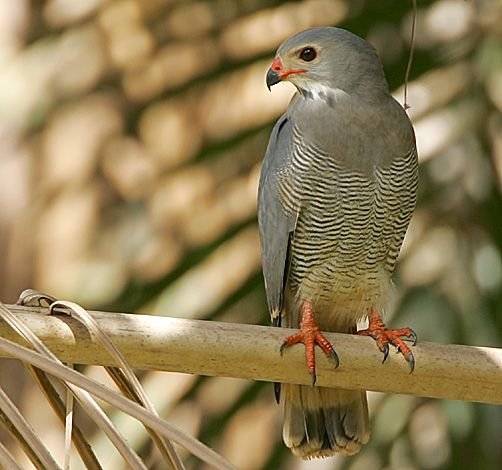
What Is the Lizard Buzzard?
The Lizard Buzzard (Kaupifalco monogrammicus) is a small, compact African bird of prey in the family Accipitridae. Despite its common name, it is not a large buzzard; its short, pointed wings, relatively short tail and quick movements give it a distinctly different silhouette from broad-winged soaring raptors.
The species is especially associated with open woodland and tree-rich savanna where a bird can perch with a clear view over grass or leaf litter. From that lookout it waits for a suitable opportunity, then drops or glides rapidly toward prey.
Its common name reflects one of its best-known food groups: lizards. But the name should not be taken too literally. The Lizard Buzzard is an opportunist that also takes snakes, frogs, rodents and sizeable insects, allowing it to adjust to what the landscape offers.
Field identity: A small grey woodland raptor with a conspicuous pale throat marked by a dark vertical streak, often sitting quietly before making a fast, low attack.
Taxonomy & Scientific Name
The accepted scientific name is Kaupifalco monogrammicus, first described by Coenraad Jacob Temminck in 1824. The species belongs to the family Accipitridae and the order Accipitriformes.
The genus name Kaupifalco is currently represented by the Lizard Buzzard as its living species. Older sources may use different common-name combinations or historical taxonomic arrangements, so the scientific name is the safest way to keep field records and reference material aligned.
The epithet monogrammicus is associated with the species' distinctive single, dark throat marking, a useful clue when identifying the bird in the field.
How to Identify a Lizard Buzzard
The Lizard Buzzard is a rewarding bird for observers who enjoy structure and pattern. Its size alone can be misleading, so focus on the combination of body shape, throat pattern, tail and habitat.
- Size and shape: A small, stocky raptor with relatively short pointed wings and a compact profile.
- Head and throat: The white throat carries a bold dark vertical streak, the diagnostic feature behind the scientific epithet.
- Upperparts: Adults are mainly grey above with darker flight feathers.
- Underparts: The lower body is much paler, producing a strong two-tone appearance.
- Tail: A prominent white tail band is visible, especially when the tail is spread or the bird turns.
- Flight: It usually flies rapidly and close to cover rather than spending long periods circling high in the sky.
Juveniles are generally browner and less crisply marked than adults, with the throat pattern less sharply defined. Habitat remains useful when the plumage is difficult to read.
How It Differs From Similar Raptors
In woodland and cultivated country the Lizard Buzzard can be mistaken for other small hawks and buzzards. Its compact shape and throat pattern are particularly helpful.
| Feature | Lizard Buzzard | Shikra | Grasshopper Buzzard |
|---|
| Overall build | Compact, stocky woodland raptor | Slender hawk-like build | More open-country buzzard profile |
| Throat | White with bold dark vertical streak | Usually finely barred or streaked, without the same bold single mark | Paler throat pattern, less diagnostic |
| Tail clue | Distinctive white band | Barred tail | Tail pattern differs, less strongly banded |
| Typical habitat | Open woodland and wooded savanna | Woodland, scrub and semi-open country | Open grassland and savanna |
| Hunting style | Perches and pounces onto ground prey | Active pursuit of small birds, reptiles and other prey | Often watches open ground for insects and vertebrate prey |
Behavior & Social Life
Lizard Buzzards are usually solitary and quiet when they are not breeding. A bird may remain nearly motionless on a branch or pole for an extended period, conserving energy while scanning the ground below.
Patient Watcher
It often relies on a concealed perch and waits for prey to reveal itself rather than constantly searching on the wing.
Fast Strike
Once prey is located, the bird can make a short, rapid descent or glide to the ground.
Woodland Specialist
Its compact shape and quick flight are well suited to hunting around trees, scrub and grassy openings.
Seasonal Voice
It is generally unobtrusive, but calling becomes more noticeable during the breeding period.
Daily Activity
The species does not need prolonged soaring to succeed. Much of its hunting strategy is based on sitting, watching and making a carefully timed attack. That behavior can make it surprisingly easy to overlook on a busy game drive.
During the warmer part of the day, individuals can still be active, but they are often easier to detect when perched because their compact silhouette stands out against an open sky or pale dead branch.
Flight, Hunting & Aerial Skills
The Lizard Buzzard's wings are relatively short and pointed compared with those of soaring raptors. This shape supports quick, controlled movement through woodland rather than long-distance thermal gliding.
Most hunting begins from a perch. The bird watches a strip of ground, then drops, swoops or glides toward the target. Insects may be taken quickly, while lizards, frogs, rodents and snakes can require a more deliberate strike.
Snake hunting can be particularly dramatic. A Lizard Buzzard may attack prey that can fight back, making the speed and precision of the first contact critical.
Birding tip: Search dead branches, fence posts, telephone poles and exposed woodland perches at the edge of grass. A stationary bird can be easier to find than a rapidly moving one.
Habitat & Distribution
The Lizard Buzzard is primarily a bird of wooded and semi-open country. It favors habitats where trees provide elevated perches while nearby grass, leaf litter and clearings expose terrestrial prey.
- Broad-leaved woodland: A core habitat with plenty of branches for concealed hunting perches.
- Mixed bushveld and savanna woodland: Openings between trees give access to ground prey.
- Riverine and park-edge woodland: Tree cover and open feeding areas occur close together.
- Well-treed farmland: The species can use cultivated landscapes when mature trees and suitable hunting ground remain.
- Gardens and settlements: In some Tanzanian localities it has been recorded in gardens and cultivation, demonstrating flexibility around human habitation.
Its broad African distribution extends through suitable woodland zones south of the Sahara. Local abundance depends strongly on habitat structure and food supply rather than simply on whether a place is formally protected.
Lizard Buzzard in Tanzania: Where to See It
Tanzania has a wide range of habitats suitable for the Lizard Buzzard, and documented observations come from several different regions. It is a species worth searching for both inside protected areas and around tree-rich landscapes beyond the classic big-mammal circuit.
Arusha Area
Local Tanzanian bird records include observations around Arusha, where gardens, cultivation and wooded habitat can support the species.
Explore northern TanzaniaSelous / Nyerere Landscape
Photographic records from the Selous Game Reserve document the species in southern Tanzania woodland habitats.
Explore Southern CircuitKatavi National Park
A documented Tanzanian observation comes from Katavi, highlighting the species' presence in western woodland and savanna.
Explore Tanzania destinationsSaadani Area
Records from Saadani show that the species can also occupy coastal woodland and bush habitats in eastern Tanzania.
Explore coastal destinations
How to Watch on Safari
Scan the roadside canopy and dead branches before scanning the distant sky. Look especially where woodland borders grass. Telephone poles and fence posts can also be useful observation points, although natural perches are preferable for understanding the bird's wild behavior.
A slow-moving vehicle and a patient guide make a major difference. Because the species can remain still for long periods, it rewards observers who spend time looking at one patch of habitat rather than continuously searching the horizon.
Lizard Buzzard Habitat in Tanzania
Tanzania's mixture of woodland, grassland, farmland and river corridors gives the Lizard Buzzard many of the ingredients it needs: elevated perches, warm ground and accessible reptiles, frogs, rodents and insects.
Its presence near gardens and cultivation is especially interesting because it shows that a wildlife species does not always require untouched wilderness. The important condition is often the survival of tree cover and enough natural prey around it.
Habitat lesson: Protecting isolated mature trees and woodland edges can benefit small predators such as the Lizard Buzzard even in working landscapes.
Best Time to See the Lizard Buzzard
The Lizard Buzzard can be encountered year-round in suitable parts of Tanzania because it is generally a resident species, although local movements and changes in detectability can occur.
- Morning: Fresh activity and good light can make perched birds easier to spot.
- Late morning: Exposed perches can remain productive as the bird watches warm grass and woodland edges.
- Breeding season: Vocal activity can increase during the period when pairs are establishing or defending territories.
- Green-season landscapes: Abundant prey can create productive hunting conditions, even when thicker vegetation makes the bird harder to see.
For dedicated birding, habitat and guide expertise matter more than relying on a single universal month.
Diet & Feeding Ecology
The Lizard Buzzard has a strong preference for terrestrial prey, especially animals that can be detected from a perch and reached with a short attack.
- Lizards: A signature prey group and an important part of the species' reputation.
- Snakes: Small snakes can be attacked from the perch and may provide substantial food relative to the bird's size.
- Frogs: Wet conditions can increase access to amphibian prey.
- Rodents: Small mammals are taken when available.
- Grasshoppers and other insects: Large insects supplement the diet, especially when abundant.
- Other prey: Records include spiders, molluscs and occasional small birds.
Why Perch Hunting Works
Perch hunting trades time for energy efficiency. Instead of flying constantly, the bird waits until movement below reveals a target, then uses a short burst of effort to reach it. This strategy can be particularly effective in warm African woodland where prey is scattered across a relatively broad hunting area.
Ecological Role
The Lizard Buzzard occupies a useful middle position in the woodland food web. It preys on reptiles, amphibians, rodents and large invertebrates, linking several lower trophic levels to a small specialist predator.
Because it consumes both vertebrate and invertebrate prey, its diet responds to seasonal changes in the environment. A wet period may increase frogs and insects, while dry conditions can make exposed lizards or rodents more visible.
For birders, its hunting behavior is a reminder that a woodland ecosystem is full of activity even when large mammals are absent. A quiet branch overlooking grass can be the stage for a highly efficient predator.
Breeding & Life Cycle
Breeding information is better documented in some parts of the species' range than others, but the Lizard Buzzard is generally described as a solitary, territorial nester. Pairs defend a nesting area and use tall trees that provide a secure platform above the surrounding woodland.
Nest Building
Both sexes can contribute to a stick nest. The structure is usually a platform with a shallow central depression and can be lined with softer material such as lichen, grass or other vegetation. Suitable natural trees are important, although the species can also use some introduced trees in modified habitats.
Eggs & Incubation
Clutches commonly contain 1–3 eggs. Published observations from southern Africa report incubation of about 32–34 days, with the female doing most of the incubation while the male supplies food.
Young & Independence
Chicks leave the nest at roughly five to six weeks in documented observations, but they remain dependent on the adults after fledging while their flight and hunting skills mature. Full independence takes considerably longer than the first flight itself.
Movement & Territorial Life
The Lizard Buzzard is generally regarded as resident, with limited soaring and relatively little need for long-distance movement. Local movements can still occur, particularly when food or habitat conditions change.
Its quiet territorial behavior means an apparently empty woodland can still contain a breeding pair. Regular use of a favorite hunting perch may provide a clue that a territory is nearby.
During courtship and the breeding season, aerial displays and calling become more noticeable. Outside that period, the bird often returns to its characteristic sit-and-wait hunting strategy.
Conservation Status
The Lizard Buzzard is currently assessed as Least Concern at the global level. It remains widespread across suitable woodland and savanna habitats in Africa.
A globally secure category does not mean that every local habitat is secure. Loss of mature woodland, removal of nesting trees and increasing pressure on natural prey can reduce opportunities for small woodland raptors in heavily modified landscapes.
Maintaining tree-rich habitat, protecting nesting trees and limiting unnecessary persecution of birds of prey are practical ways to support the species and the wider raptor community.
Conservation perspective: The Lizard Buzzard is not a conservation emergency at the global scale, but preserving the woodland structure it depends on remains important for healthy local populations.
Habitat Pressures & Why Small Raptors Matter
Small woodland raptors can be affected long before a landscape appears completely degraded. Removing scattered trees, simplifying farmland or eliminating mature nesting sites can gradually reduce the habitat's usefulness.
- Woodland loss: Clearing broad-leaved woodland removes both perches and nest sites.
- Tree removal in farmland: Isolated mature trees may be important hunting and nesting structures.
- Prey decline: Heavy alteration of ground habitat can reduce lizards, frogs, rodents and insects.
- Persecution: Misunderstandings about raptors can create avoidable local mortality.
- Infrastructure and disturbance: Roads, power lines and intensive development can fragment previously continuous habitat.
Small raptors are valuable because their presence reflects a working food web. Protecting them often means protecting the insects, reptiles, amphibians, mammals and trees that make the whole habitat function.
Lizard Buzzard Compared With Similar Birds of Prey
The best comparisons are based on body structure and hunting style as well as color.
| Feature | Lizard Buzzard | Shikra | Wahlberg's Eagle |
|---|
| Size | Small, about 35–37 cm | Small hawk, generally more slender | Much larger eagle |
| Throat | White with one bold dark vertical streak | Different barred/streaked pattern | Plain or patterned depending on age and phase |
| Tail | Strong white band is a useful clue | Barred tail | Longer eagle-like tail |
| Flight | Fast, low and limited soaring | Agile hawk-like flight | Powerful flight with more soaring |
| Main hunting style | Perch-and-pounce onto ground prey | Active pursuit and surprise attacks | More powerful attacks on larger prey |
Wildlife Photography & Birding Tips
- Search perches first: Look at dead branches, roadside poles and exposed limbs before searching the sky.
- Watch the throat: A clear view can reveal the white throat and strong central dark streak.
- Use habitat clues: Woodland edge beside open grass is often more productive than dense forest.
- Be patient: A bird may remain still for several minutes before showing its hunting behavior.
- Keep your distance: Avoid flushing perched birds repeatedly, especially during breeding.
For a useful birding record, note the perch type, habitat, prey item if seen, behavior, date and location. A detailed behavioral note can be as valuable as a sharp photograph.
Explore Tanzania's Woodland & Birding Destinations
The Lizard Buzzard is best understood as part of a larger woodland bird community. Exploring different habitat zones can reveal how raptors, reptiles, insects and trees interact across Tanzania.


.png)