

.png)
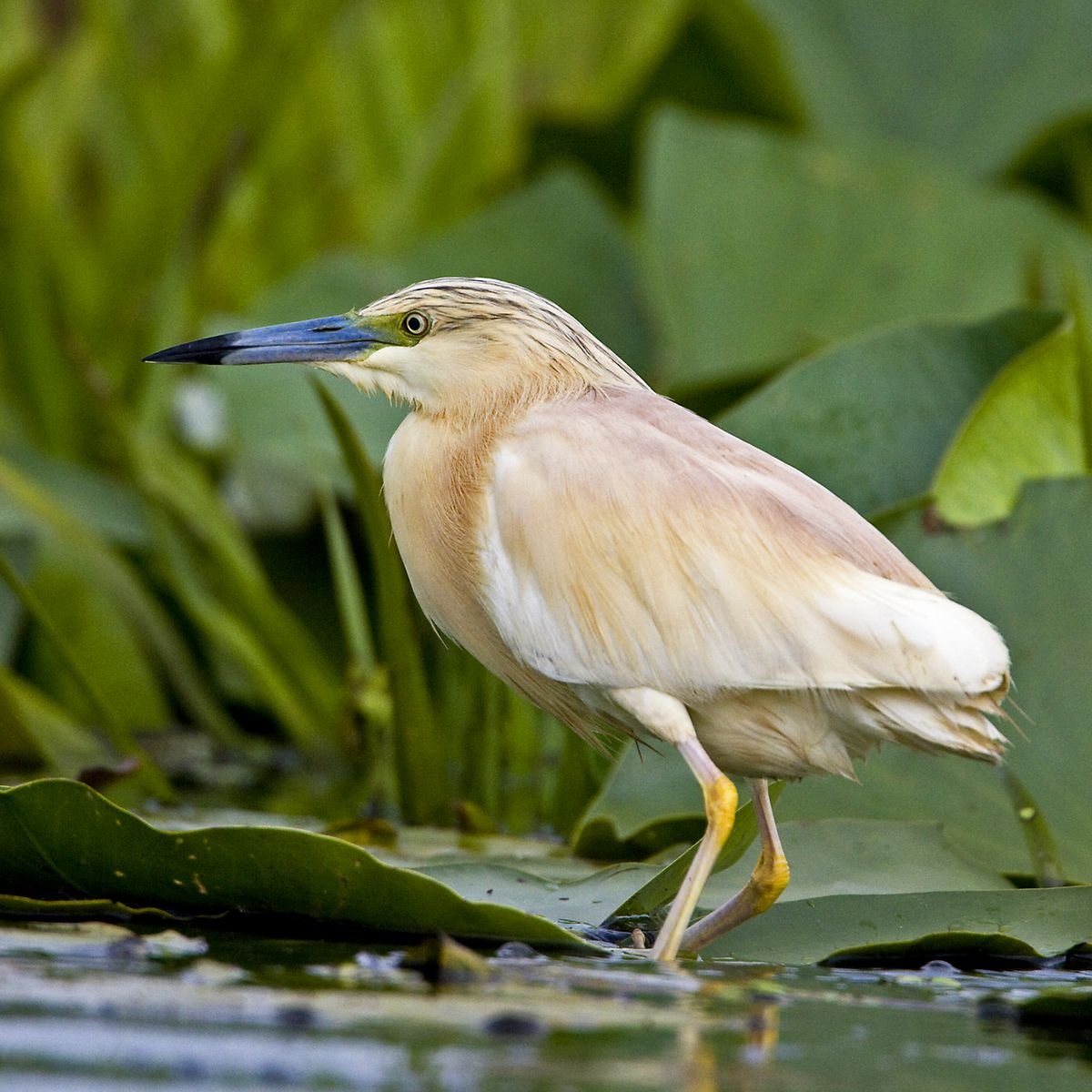
Squacco Heron
Ardeola ralloidesA small heron that disappears into the reeds – a master of stillness and patience in the African wetlands.
The Squacco Heron (Ardeola ralloides) is a small heron found in Africa, southern Europe, and western Asia. A master of camouflage, its buff and brown plumage blends perfectly with wetland vegetation, making it almost invisible among the reeds and papyrus. This patient hunter uses a 'sit-and-wait' strategy, remaining motionless for long periods before striking with lightning speed.
Squacco Heron Quick Facts
What Is the Squacco Heron?
The Squacco Heron (Ardeola ralloides) is a small heron belonging to the family Ardeidae, which includes herons, egrets, and bitterns. It was first described by the Italian naturalist Giovanni Antonio Scopoli in 1769. The species name ralloides is derived from the Latin word rallus (referring to rails) and the Greek suffix -oides (resembling), meaning "rail-like", a reference to its rail-like appearance and behaviour.
The common name "Squacco" comes from the Italian dialect word "squacco", which is thought to be imitative of the bird's call. This heron is also known by several alternative names, including the Ralloid Heron and the Crabier in French-speaking regions.
The Squacco Heron is a migratory species in parts of its range. Birds breeding in Europe and western Asia migrate south to Africa for the winter, while populations in sub-Saharan Africa are largely resident. This heron is closely related to the Indian Pond Heron and the Chinese Pond Heron, sharing many behavioural and ecological characteristics.
How to Identify a Squacco Heron
The Squacco Heron is a small and distinctive heron, easily recognised by its camouflage plumage and compact body. Here are its key identifying features:
- Size: A small, compact heron measuring 44-47 cm (17-19 in) in length with a wingspan of 80-92 cm (31-36 in).
- Plumage: Overall buff or tawny-brown colouration, with a white belly. The back and wings are covered in buff-brown feathers with fine dark streaks.
- Breeding plumage: During the breeding season, adults develop beautiful long, flowing plumes on the head, neck, and back. The bill also becomes brighter, turning from pale brown to a striking blue-black with a pinkish base.
- Non-breeding plumage: The plumage becomes duller and more uniform, with less prominent streaking and no plumes.
- Bill: Stout, dagger-like bill, pale brownish in non-breeding, blue-black with a pinkish base during breeding.
- Legs: Short, yellowish-green legs.
- Eyes: Yellowish.
Distinguishing from Similar Herons
The Squacco Heron can be confused with the Indian Pond Heron and the Chinese Pond Heron. The Squacco Heron is generally paler and more uniformly buff-coloured, with a shorter, more compact neck. During breeding season, the long plumes on the head and neck are distinctive. The Madagascar Pond Heron is similar but has a darker chest and more extensive white markings.
Behavior & Social Life
The Squacco Heron is a solitary or gregarious bird, often seen alone or in small groups, especially during the non-breeding season. It is most active during the day, foraging in shallow water or along the edges of wetlands.
Foraging Behavior
- Hunting technique: The Squacco Heron is a classic "sit-and-wait" predator. It stands motionless in shallow water, often with its neck hunched and head tucked in, waiting for prey to come within striking distance.
- Striking: When prey approaches, the heron strikes with lightning speed, using its dagger-like bill to capture fish, frogs, or insects.
- Camouflage: Its buff and brown plumage provides excellent camouflage among the reeds and vegetation, making it difficult for both prey and predators to spot.
Social Behaviour
- Solitary foraging: Generally forages alone, maintaining a feeding territory.
- Colonial breeding: Nests in colonies, often alongside other herons, egrets, and waterbirds.
Vocalization
The Squacco Heron is generally silent outside the breeding season. During the breeding season, it produces a variety of sounds, including harsh croaks, "kraak" calls, and other vocalisations used in courtship and territorial displays.
Habitat & Distribution
The Squacco Heron is found in a variety of freshwater wetland habitats across Africa, southern Europe, and western Asia.
Key habitat types include:
- Freshwater wetlands – including marshes, swamps, and floodplains.
- Lakes and ponds – with shallow margins and abundant vegetation.
- Rivers and streams – especially slow-moving water with overhanging vegetation.
- Rice paddies – agricultural areas that provide excellent foraging opportunities.
- Irrigation channels – man-made water channels.
Distribution: The Squacco Heron has a wide distribution across three continents. It breeds in southern Europe (including Spain, Portugal, France, Italy, and the Balkans), western Asia (including Turkey, Iran, and the Middle East), and Africa. The African population is concentrated in sub-Saharan Africa, from Senegambia in the west to Ethiopia and Kenya in the east, and southwards to South Africa. The species has an estimated Extent of Occurrence of 18,700,000 km².
Migration: The Squacco Heron is a partial migrant. European and Asian populations migrate south to Africa for the winter, while African populations are largely resident, though some may make local movements in response to rainfall.
Tanzania Distribution
In Tanzania, the Squacco Heron is found in wetland areas across the country. It has been recorded in Serengeti National Park (particularly in the wetland areas), Ngorongoro Conservation Area, Tarangire National Park, and Ruaha National Park.
Squacco Heron in Tanzania
The Squacco Heron is a master of wetland camouflage, often overlooked until it moves. Here are the best locations to see it in Tanzania:
Serengeti National Park
Found in the Serengeti's wetland areas, particularly in the seasonal floodplains and along the Grumeti and Mara rivers. Often seen standing motionless among the reeds.
Serengeti safariNgorongoro Crater
Recorded in the Ngorongoro Conservation Area, especially in the swampy areas of the crater floor. Often seen foraging in the shallow water of Lake Magadi and the Lerai Forest area.
Ngorongoro safariTarangire National Park
Found along the Tarangire River and in the seasonal swamps. Often seen wading in shallow water or standing among the reeds along the riverbanks.
Tarangire safariRuaha National Park
A resident species in Ruaha's wetland areas along the Great Ruaha River. Often found in the riverine vegetation and seasonal floodplains.
Ruaha safariSafari Methods
- Game drives near wetlands, rivers, and agricultural areas.
- Birdwatching – look for the buff-brown plumage and compact body, often standing motionless at the water's edge.
- Wildlife photography – the Squacco Heron's camouflage and patient hunting technique make it an excellent subject for photographers.
- Look for movement – the heron's stillness is its greatest asset, but its movements can give away its position.
Best Time to See Them
Squacco Herons are present year-round in Tanzania. European and Asian migrants join the resident population during the non-breeding season (October to March). The dry season (June to October) is generally best for wildlife viewing as birds congregate around remaining water sources.
Diet & Feeding
The Squacco Heron is a carnivore with a varied diet that reflects its wetland habitat.
Food Sources
- Fish: Small fish of various species.
- Amphibians: Frogs and tadpoles.
- Aquatic insects: Beetles, dragonflies, and larvae.
- Crustaceans: Small crabs, crayfish, and shrimps.
- Reptiles: Small lizards and snakes.
Hunting Behavior
The Squacco Heron is a patient and efficient hunter. It uses a "sit-and-wait" strategy, standing motionless in shallow water for extended periods, often with its neck hunched and body held low. When a fish, frog, or insect comes within range, the heron strikes with lightning speed, using its sharp bill to capture the prey. It may also slowly stalk prey, moving with deliberate, careful steps.
Breeding & Life Cycle
The Squacco Heron is monogamous during the breeding season.
Nesting
- Breeding season: In Tanzania and East Africa, breeding typically occurs during the rainy season (February to June).
- Nest site: Nests in colonies, often with other herons, egrets, cormorants, and ibises. Nests are built in trees, bushes, or reedbeds, often over or near water.
- Nest construction: Both sexes build the nest, which is a platform of sticks, reeds, and aquatic vegetation.
- Clutch: 3 to 5 pale blue-green eggs.
- Incubation: 20 to 25 days, shared by both parents.
Chicks
The chicks are altricial (born helpless with down feathers) and are fed by both parents. They fledge at about 40-45 days old but remain dependent on the parents for some time after fledging. The chicks leave the nest at around 6-7 weeks of age.
Conservation Status
The Squacco Heron is assessed as Least Concern on the IUCN Red List.
Population: The global population is estimated at between 100,000 and 1,000,000 individuals. The population trend is stable.
Justification: This species has an extremely large range (18,700,000 km²) and hence does not approach the thresholds for Vulnerable. The population size is very large, and the population trend is stable, so the species does not approach the thresholds for Vulnerable.
Threats: While the species is not currently threatened globally, it faces local threats including:
- Habitat loss: Drainage and degradation of wetlands.
- Pollution: Pesticides and other chemicals used in agriculture.
- Disturbance: Human disturbance at breeding colonies.
The Squacco Heron is listed on CITES Appendix II and is protected by various international agreements, including the African-Eurasian Waterbird Agreement (AEWA).
Comparisons
The Squacco Heron is sometimes confused with other herons. Here are the key differences:
| Feature | Squacco Heron | Indian Pond Heron | Madagascar Pond Heron |
|---|---|---|---|
| Size | 44-47 cm | 45-50 cm | 40-45 cm |
| Plumage | Buff/tawny-brown with white belly | Brown with white streaks | Darker chest, more white markings |
| Breeding Plumes | Long plumes on head & neck | Plumes on back & neck | Plumes on head & back |
| Bill | Stout, blue-black with pink base | Yellow with black tip | Dark with pale base |
| Range | Africa, Europe, W Asia | South Asia | Madagascar |
Did You Know?
Master of Camouflage
The Squacco Heron's buff and brown plumage blends perfectly with wetland vegetation, making it almost invisible among the reeds.
Sit-and-Wait Hunter
This heron can stand motionless for long periods, waiting patiently for prey to come within striking distance.
Colonial Breeder
Squacco Herons nest in large colonies, often with hundreds of other herons, egrets, and waterbirds.
Striking Plumes
During the breeding season, adults develop beautiful long plumes on the head, neck, and back, making them far more colourful and visible.
Three-Continent Range
The Squacco Heron is found in Africa, southern Europe, and western Asia, making it one of the most widespread herons.
Migratory Wanderer
European and Asian populations migrate south to Africa for the winter, while African populations are largely resident.
There is a quiet magic in the Squacco Heron. It stands among the reeds, perfectly still, its buff and brown plumage dissolving into the background like a ghost. For minutes, sometimes hours, it waits – a study in patience, a master of stillness. And then, in a flash, the moment arrives: a fish drifts too close, a frog ventures within reach, and the heron's bill strikes with a speed that seems impossible for a bird of its size. It is a reminder that sometimes the most effective hunters are not the fastest or the fiercest, but the ones who have learned the art of waiting.
Gallery
Frequently Asked Questions
The Squacco Heron (Ardeola ralloides) is a small heron found in Africa, southern Europe, and western Asia. It is a master of camouflage, with buff and brown plumage that blends perfectly with wetland vegetation, making it difficult to spot.
Squacco Herons are found in freshwater wetlands, marshes, lakes, and rivers across Tanzania. Key locations include Serengeti National Park, Ngorongoro Conservation Area, Tarangire National Park, and Ruaha National Park.
The Squacco Heron feeds on fish, frogs, aquatic insects, crustaceans, and small reptiles. It uses a 'sit-and-wait' hunting technique, remaining motionless before striking with precision.
No. The Squacco Heron is listed as Least Concern on the IUCN Red List. It has a large range and a stable population, though local threats include habitat loss and wetland degradation.
It is a small heron with buff or tawny-brown plumage, a dark bill, and pale legs. During breeding season, adults develop beautiful long plumes on the head, neck, and back, and the bill becomes brighter.
The Squacco Heron measures 44-47 cm (17-19 in) in length with a wingspan of 80-92 cm (31-36 in). It weighs between 250-300 grams (8.8-10.6 oz).
Squacco Herons breed in colonies, often with other waterbirds. They build nests in trees or bushes over water, using sticks and reeds. The female lays 3-5 eggs which are incubated by both parents for about 20-25 days. Chicks fledge after 40-45 days.
In Swahili, the Squacco Heron is known locally as Hongo or Kambamwitu, though local names can vary across regions.
References & Further Reading
- BirdLife International – Squacco Heron: IUCN Red List assessment, Least Concern status, population estimate, range.
- Wikipedia – Squacco heron: Scientific name, description, distribution, habitat, diet, breeding, conservation.
- eBird – Squacco Heron: Identification, distribution, sightings.
- Avibase – Squacco Heron: Taxonomy, subspecies, distribution.
- Biodiversity Explorer – Squacco Heron: Biology, ecology, distribution.
- Oiseaux.net – Squacco Heron: Photo records from Tanzania.
- Heron Conservation – Squacco Heron: Conservation status, threats, research.