

.png)
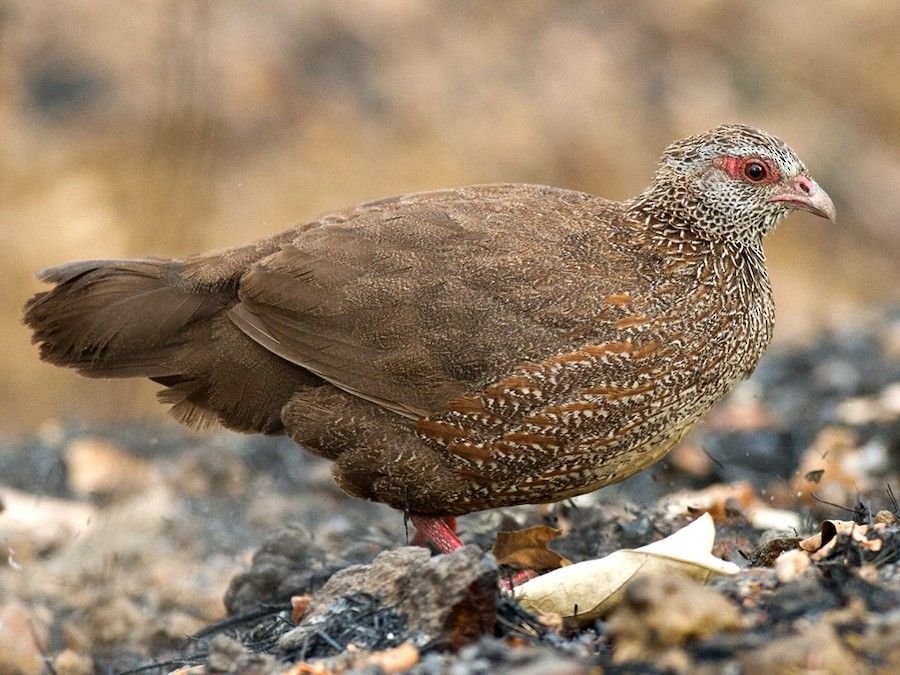
Stone Partridge
Ptilopachus petrosusA small, dark partridge with a tail-up posture – a rock-loving bird of the African savanna.
The Stone Partridge (Ptilopachus petrosus) is a bird of the New World quail family. This largely brown bird, which commonly holds its tail raised, is found in scrubland and lightly wooded habitats, often near rocks, from Kenya and Ethiopia to Gambia. A good view reveals red legs, red bare skin around the eye, and fine markings on the breast and head .
Stone Partridge Quick Facts
What Is the Stone Partridge?
The Stone Partridge (Ptilopachus petrosus) is a bird of the New World quail family . This largely brown bird, which commonly holds its tail raised, is found in scrubland and lightly wooded habitats, often near rocks, from Kenya and Ethiopia to Gambia (a large part of its range is in the Sudanian Savanna) .
The species was formally described in 1789 by the German naturalist Johann Friedrich Gmelin under the binomial name Tetrao petrosus. The genus name Ptilopachus is from the Ancient Greek ptilon meaning "feather" with pakhus meaning "thick" or "dense". The specific epithet petrosus is Latin meaning "rocky" .
There is some confusion in the naming of this species because the name of this bird in many languages translates literally into English as "rock partridge", which is actually a member of another genus, Alectoris graeca .
How to Identify a Stone Partridge
The Stone Partridge is a small, dark partridge that is easily recognized by its distinctive posture and markings:
- Plumage: Predominantly earthy chocolate brown above, with sparse, pale, cream-grey spotting .
- Head, neck, and chest: Pale brown with broad cream edging to the feathers, giving a scaled appearance .
- Underparts: In males, the lower chest and belly are orange-cream; in females, very pale cream .
- Legs: Red legs .
- Eye: Bare red skin around the eye .
- Tail: Thick tail that is usually cocked up .
- Size: Small, 20-25 cm in length .
Regional Variation
There is some regional variation: the plumage is generally darker in moister areas and paler in drier areas .
Distinguishing from Other Partridges
The Stone Partridge is similar to the Crested Francolin, but it is smaller, darker, and without a bold pale eyebrow stripe . It is also similar to the Nahan's Partridge but is found in drier, rockier habitats .
Behavior & Social Life
The Stone Partridge is a largely terrestrial bird, adept at running but not a strong flier . It is usually found in pairs or small groups of 4-6 individuals .
Daily Activity
- Terrestrial: It spends most of its day on the ground, foraging in scrub and rocky areas.
- Flight: It is more inclined to run than fly when disturbed, but will flush if necessary.
- Roosting: It roosts on the ground or in low bushes at night.
Communication
The distinctive vocalization is a series of loud "wheet" notes that rises and becomes more emphatic, usually given as a duet by a pair . The call is a sequence of high, clear notes that carry well in open savanna habitats.
Habitat & Distribution
The Stone Partridge is found in a variety of habitats, with a strong preference for rocky areas :
- Scrubland and lightly wooded habitats, often near rocks .
- Rocky savanna with thick, grassy understory .
- Boulders at the base of rocky hills .
- Dry woody country and watercourses .
- Pastureland and artificial terrestrial habitats .
Distribution: The species is widespread across 25 countries in sub-Saharan Africa, from Gambia in the west to Ethiopia and Kenya in the east . Its Extent of Occurrence is approximately 9,450,000 km² .
Subspecies
- P. p. petrosus: Gambia to Cameroon .
- P. p. brehmi: South Chad to central Sudan .
- P. p. major: North Ethiopia .
- P. p. florentiae: South Sudan and south Ethiopia to northeast DR Congo, north Uganda and central Kenya .
Tanzania Distribution
In Tanzania, the Stone Partridge is found in the northwest, particularly along the border with Kenya and Uganda. It prefers rocky areas within the savanna, where it can be seen in pairs or small groups .
Stone Partridge in Tanzania
The Stone Partridge is a specialist of rocky savanna and scrubland in northwest Tanzania. Here are the best places to look for it:
Northwest Tanzania
Found in rocky areas along the Kenya-Uganda-Tanzania border, particularly in the far northwest .
Explore DestinationsWestern Tanzania
Occurs in scrubland and lightly wooded habitats, often near rocks, in the western regions .
Explore DestinationsKenya Border
Shared populations with Kenya, where the species is more commonly recorded .
Kenya safariRocky Hills & Watercourses
Prefers boulders at the base of rocky hills and dry woody country near watercourses .
Safari Methods
- Game drives through rocky savanna and scrubland.
- Birdwatching – they are shy but can be located by their distinctive 'wheet' duet calls.
- Walking safaris where permitted, to flush them from cover.
- Wildlife photography – their red legs and tail-up posture make them distinctive subjects.
Best Time to See Them
Stone Partridges are present year-round in suitable habitat. They are most active during the cooler morning and evening hours, when they call and forage in open areas.
Diet & Feeding
The Stone Partridge is a herbivore, feeding mainly on plant matter :
Food Sources
- Seeds and grasses .
- Green leaves .
- Fruits and buds .
- Insects such as ants and beetles .
Foraging Behavior
It scratches in leaf litter and soil to uncover seeds and small invertebrates . It typically forages in pairs or small family groups, keeping close to cover.
Breeding & Life Cycle
The Stone Partridge is notable among gamebirds because the female, to human eyes, is showier than the male .
Nesting
- Nest: A scrape on the ground, often placed among rocks or in dense grass .
- Location: The nest is usually well-concealed in rocky crevices or under bushes.
- Eggs: A clutch of 4-6 eggs .
- Egg color: Pale pink, fading to cream .
Incubation & Chicks
- Incubation: The male plays a major role in both incubation and rearing of the young .
- Chicks: Juveniles are dark chocolate-brown throughout, moulting into adult plumage at several weeks old .
- Parental care: The male offers young small items of food by picking them up, dropping them, and calling to the chicks .
Lifespan
The estimated generation length for this species is 4.4 years .
Conservation Status
The Stone Partridge is assessed as Least Concern on the IUCN Red List .
It has an extremely large range (Extent of Occurrence of 9,450,000 km²) and does not approach the thresholds for Vulnerable. The population size has not been quantified, but it is not believed to approach the thresholds for Vulnerable, and the population trend appears to be stable .
Despite its secure status, it faces some local pressures:
- Habitat loss and fragmentation in some regions.
- Overhunting in some parts of its range .
- Habitat degradation due to agricultural expansion and grazing pressure.
Since 2000, the Stone Partridge has been imported into the United States and Europe, where it is hoped that it will become established in zoos and bird collections .
Comparisons
The Stone Partridge is often confused with other partridges. Here are the key differences:
| Feature | Stone Partridge | Crested Francolin | Rock Partridge |
|---|---|---|---|
| Size | 20-25 cm | 33-40 cm | 32-38 cm |
| Legs | Red | Red | Red |
| Eyebrow | No pale eyebrow stripe | Bold pale eyebrow | Dark stripe |
| Plumage | Dark, chocolate brown | Brown with white spotting | Grey-brown |
| Habitat | Rocky savanna | Open grassland | Rocky mountains |
Did You Know?
Female Showier
It is exceptional among gamebirds in that the female appears showier than the male .
Rock Name
The scientific name petrosus means 'rocky', reflecting its preferred habitat .
Four Subspecies
Four subspecies are recognized, ranging from Gambia to central Kenya .
Naming Confusion
In many languages its name translates to 'rock partridge', a different species in the genus Alectoris .
Doting Father
The male plays a major role in incubating eggs and rearing the young .
Duet Call
A pair often duets with a series of loud 'wheet' notes that rise and become more emphatic .
There is a quiet charm in finding a Stone Partridge – a small dark bird scurrying across the rocks, its tail cocked up in a distinctive posture, watching you with bright red eyes. It is a bird of the African savanna that rewards the patient observer, a reminder that the continent's gamebird diversity extends far beyond the more famous species.
Gallery
Frequently Asked Questions
The Stone Partridge (Ptilopachus petrosus) is a small, dark partridge in the New World quail family. It has a thick tail that is usually cocked up, red legs, red bare skin around the eye, and fine markings on the breast and head. It is found in scrubland and lightly wooded habitats, often near rocks, from Kenya and Ethiopia to Gambia .
The Stone Partridge is found in scrubland and lightly wooded habitats in northwest Tanzania, often near rocks. The subspecies P. p. florentiae is found in south Sudan and south Ethiopia to northeast DR Congo, north Uganda and central Kenya, reaching into northwest Tanzania .
It feeds on seeds, grasses, green leaves, fruits, buds, and some insects. It is an omnivore, mainly herbivorous in its feeding habits .
No. The Stone Partridge is listed as Least Concern on the IUCN Red List, with a stable population across its 9,450,000 km² range .
Both sexes have chocolate brown upperparts with cream-grey spotting. In males, the lower chest and belly are orange-cream, while females have very pale cream underparts. The female's crown feathers are longer, making its crest more obvious when raised .
The species gets its name from its rocky habitat preference. The scientific name petrosus means 'rocky' in Latin. There is naming confusion because in many languages, its name translates literally to 'rock partridge', which is a different species in the genus Alectoris .
Four subspecies are recognized: P. p. petrosus (Gambia to Cameroon), P. p. brehmi (south Chad to central Sudan), P. p. major (north Ethiopia), and P. p. florentiae (south Sudan to central Kenya) .
The distinctive vocalization is a series of loud 'wheet' notes that rises and becomes more emphatic, usually given as a duet by a pair .
References & Further Reading
- BirdLife DataZone – Stone Partridge: IUCN Least Concern, Extent of Occurrence, distribution, habitat, elevation .
- eBird – Stone Partridge: identification, voice, habitat .
- Wikipedia – Stone partridge: taxonomy, description, distribution, subspecies, naming confusion .
- Baidu Baike description, habitat, diet, breeding, taxonomy .
- physical characteristics, vocalization, habitat, group size .
- Encyclopedia of Life – Ptilopachus petrosus: attributes, population trend, weight .
- Oiseaux.net – Poulette de roches: habitat, altitude, diet, reproduction .
- BirdForum Opus – Stone Partridge: identification, distribution, habitat .
- Avibase – Stone Partridge: taxonomy, alternative names .