

.png)
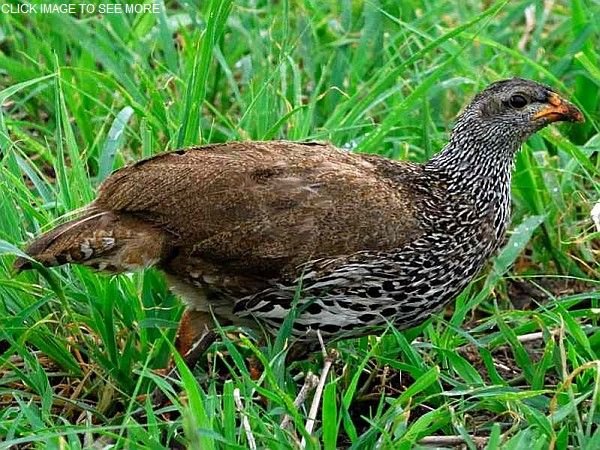
Hildebrandt's Spurfowl
Pternistis hildebrandtiA striking, sexually dimorphic francolin named for the naturalist Johann Maria Hildebrandt.
Hildebrandt's Spurfowl (Pternistis hildebrandti) is a species of bird in the family Phasianidae. Found in Burundi, Democratic Republic of the Congo, Kenya, Malawi, Mozambique, Rwanda, Tanzania, and Zambia, this species is named for the German naturalist Johann Maria Hildebrandt, who collected the first specimens in Kenya . The sexes differ markedly in their plumage, with males boldly marked in black and white and females smaller and more rufous .
Hildebrandt's Spurfowl Quick Facts
What Is Hildebrandt's Spurfowl?
Hildebrandt's Spurfowl (Pternistis hildebrandti) is a species of bird in the family Phasianidae . It is a mid-sized francolin, measuring about 33-37 cm in length and weighing between 430-645 g depending on sex .
The species is named for Johann Maria Hildebrandt, who collected the first specimens in Kenya . There are two recognized subspecies: P. h. hildebrandti found in Kenya, north and west Tanzania, southeast Democratic Republic of the Congo, and northeast Zambia; and P. h. johnstoni found in southeast Tanzania, north Mozambique, and Malawi .
It is locally distributed across a wide variety of habitats, including grassland, savanna, montane heath, and forest edge . In Tanzania, it is found in Ruaha National Park and the Ngorongoro Crater, among other locations .
How to Identify a Hildebrandt's Spurfowl
Hildebrandt's Spurfowl is notable for its striking sexual dimorphism – males and females look quite different :
- Male: Has a brown back and is boldly marked with black and white below .
- Female: Smaller and plainer, with rufous underparts .
- General: A mid-sized francolin with an orange-red bill and legs .
- Voice: The call is a quick series of raucous notes .
Distinguishing from Other Spurfowls
Hildebrandt's Spurfowl is most similar to the Grey-breasted Spurfowl but can be distinguished by its more prominent white markings on the underparts and its larger size. It is also distinguished from the Red-necked Spurfowl by its lack of a broad red throat patch and its preference for higher-altitude montane grassland .
Behavior & Social Life
Hildebrandt's Spurfowl is a shy and wary species, usually found in pairs or small family groups . It is generally sedentary, keeping close to cover and freezing or running before flushing .
Daily Activity
- Terrestrial: It spends its time on the ground, foraging by scratching in leaf litter and loose soil .
- Flight: Has an explosive take-off with short rapid wingbeats followed by a glide .
- Roosting: It roosts in trees or dense cover at night .
Communication
Pairs maintain territories and often duet at dawn from low perches or the ground. The call is a loud, carrying duet of harsh cackles and rasping notes, often delivered at first light and late afternoon .
Habitat & Distribution
Hildebrandt's Spurfowl is found locally in a wide variety of habitats :
- Grassland and dry savanna .
- Montane heath and grassland .
- Forest edge and bushland .
- Wooded grassland and thickets, often near watercourses or cultivation .
- Acacia and mixed woodland .
It occurs at altitudes from sea level to 2,400 m . The species is distributed from the eastern Democratic Republic of the Congo and Rwanda south through Burundi and western Tanzania, and east across Kenya to northern Mozambique and Malawi, reaching into northeastern Zambia .
Tanzania Distribution
In Tanzania, it is found in the northern and southern highlands, including the Ngorongoro Crater and Ruaha National Park . It is also recorded in the Iringa region at Mdonya in Ruaha NP .
Hildebrandt's Spurfowl in Tanzania
Hildebrandt's Spurfowl is a sought-after species for birders visiting Tanzania's southern and northern highlands. Here are the best places to look for it:
Ruaha National Park
One of the best locations in Tanzania, with confirmed sightings in the park's woodland and grassland mosaics .
Ruaha safariNgorongoro Crater
The crater floor and surrounding highlands support a population of this species .
Ngorongoro safariMikumi National Park
The southern circuit parks, including Mikumi, provide suitable habitat for this species .
Mikumi safariUdzungwa & Rift Valley
Woodland and montane grassland throughout the Eastern Arc Mountains and Rift Valley .
Explore DestinationsSafari Methods
- Game drives through woodland and grassland mosaics.
- Walking safaris where permitted, to flush them from cover.
- Birdwatching – they are shy but approachable during early morning and late afternoon.
- Wildlife photography – the male's bold plumage makes him a striking subject.
Best Time to See Them
Hildebrandt's Spurfowl are present year-round in suitable habitat. They are most active during the cooler morning and evening hours, when they call and forage in open areas .
Diet & Feeding
Hildebrandt's Spurfowl is omnivorous, with a diet that varies seasonally .
Food Sources
- Seeds and grasses .
- Fallen grain from agricultural fields .
- Insects: Termites, beetles, and ants .
- Shoots, bulbs and small fruits .
Foraging Behavior
It scratches vigorously in leaf litter and loose soil to uncover hidden food. During the wet season it takes more invertebrates, shifting toward seeds and plant matter as conditions dry .
Conservation Status
Hildebrandt's Spurfowl is assessed as Least Concern on the IUCN Red List .
It has an extremely large range (Extent of Occurrence of approximately 1,620,000 km²) and does not approach the thresholds for Vulnerable. The population trend appears to be stable, and although the global population size has not been quantified, it is not believed to be small .
Despite its secure status, it faces some local pressures:
- Habitat loss and conversion of grassland and savanna to agriculture.
- Hunting as a gamebird in some regions.
- Pesticide use in agricultural areas, which reduces insect prey .
The species is recorded from conservation sites across its entire range and is of interest for birding tourism .
Comparisons
Hildebrandt's Spurfowl is sometimes confused with other spurfowls found in Tanzania. Here are the key differences:
| Feature | Hildebrandt's Spurfowl | Grey-breasted Spurfowl | Red-necked Spurfowl |
|---|---|---|---|
| Male underparts | Boldly black and white spotted | Grey with chestnut, yellow and black bars | Reddish-brown |
| Female | Rufous underparts | Grey, less contrasting | Reddish-brown |
| Throat | No broad red patch | Red throat, narrow | Broad red patch |
| Range | E & SE Africa (8 countries) | Endemic to NW Tanzania | Sub-Saharan Africa (wider) |
| Habitat | Grassland, montane heath, forest edge | Dry thorn scrub, acacia woodland | Savanna, woodland |
Did You Know?
Named for a Naturalist
The species is named after Johann Maria Hildebrandt, who collected the first specimens in Kenya .
Sexual Dimorphism
Males and females differ markedly in plumage – a distinguishing feature among spurfowls .
Dawn Duets
Pairs perform loud duets at dawn from low perches or the ground .
Wide Range
The species is found in 8 countries across East and Southeast Africa .
Elevation Generalist
It can be found from sea level up to 2,400 m in elevation .
Ruaha Speciality
Ruaha National Park is one of the best places in Tanzania to see this species .
There is a boldness in the Hildebrandt's Spurfowl – the male's striking black-and-white plumage stands out against the dry gold of the savanna. It is a bird of the highlands, duetting across the grassland at dawn, a reminder that Africa's gamebird world is as diverse as its bigger mammals. To find one in the Ruaha or the Ngorongoro highlands is to see a piece of East Africa's rich bird heritage.
Gallery
Frequently Asked Questions
Hildebrandt's Spurfowl (Pternistis hildebrandti) is a species of bird in the family Phasianidae. It is found in Burundi, Democratic Republic of the Congo, Kenya, Malawi, Mozambique, Rwanda, Tanzania, and Zambia .
Males have a brown back and are boldly marked with black and white below. The smaller female is plainer, with rufous underparts. It is a mid-sized francolin, and the sexes differ markedly in plumage .
This species is found locally across Tanzania. Key locations include Ruaha National Park , the Ngorongoro Crater , and a wide variety of habitats including grassland, savanna, montane heath, and forest edge .
It feeds on seeds, grasses, and fallen grain, supplemented by insects such as termites, beetles, and ants, as well as shoots, bulbs, and small fruits .
No. Hildebrandt's Spurfowl is listed as Least Concern on the IUCN Red List, with an extremely large range and a stable population trend .
The species is named for Johann Maria Hildebrandt, who collected the first specimens in Kenya .
It measures approximately 33-37 cm in length and weighs between 430-645 g depending on sex .
Yes. Two subspecies are recognized: P. h. hildebrandti (Kenya, north and west Tanzania, southeast DRC, northeast Zambia) and P. h. johnstoni (southeast Tanzania, north Mozambique, Malawi) .
References & Further Reading
- BirdLife DataZone – Hildebrandt's Spurfowl: IUCN Least Concern, distribution, habitat, population trend .
- eBird – Hildebrandt's Spurfowl: identification, voice, habitat .
- Wikipedia – Hildebrandt's spurfowl: Taxonomy, description, subspecies .
- Oiseaux.net – Hildebrandt's Spurfowl: confirmed sightings from Ruaha National Park, Tanzania .
- FeatherScan – Hildebrandt's spurfowl: measurements, diet, behavior, altitude range .
- CCSF – Hildebrandt's Francolin: confirmed sighting from Ngorongoro Crater .
- Birds of the World – Species names, protonym, type locality .
- ResearchGate – Little 2016a: Weights and measurements .