

.png)
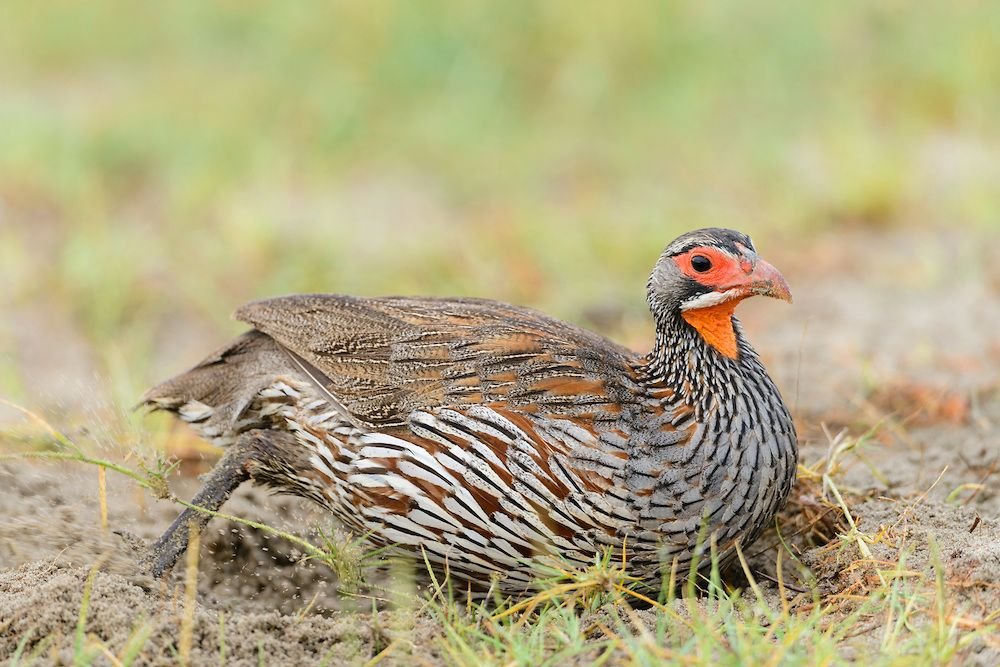
Grey-breasted Spurfowl
Pternistis rufopictusA Tanzanian endemic of the Serengeti's savannas – known as Kereng'ende Kidari-kijivu in Swahili.
The Grey-breasted Spurfowl (Pternistis rufopictus) is a species of gamebird in the family Phasianidae. It is found only in Tanzania, from the southeast shore of Lake Victoria east to the Serengeti and Ngorongoro, and south to the Wembere Plain. A bird of dry scrub and grassland, it is a target species for dedicated birders visiting the Serengeti ecosystem [citation:3][citation:4][citation:14].
Grey-breasted Spurfowl Quick Facts
What Is the Grey-breasted Spurfowl?
The Grey-breasted Spurfowl (Pternistis rufopictus), also known as the Grey-breasted Francolin, is a species of gamebird in the family Phasianidae. It is endemic to Tanzania, meaning it is found nowhere else on Earth [citation:3][citation:12].
The species was formally described by the German ornithologist Anton Reichenow in 1887 under the name Pternistes rufopictus. The specific epithet is a combination of the Latin rufus for "red" and pictus for "painted", likely referencing the bird's reddish-brown markings [citation:3]. A molecular phylogenetic study published in 2019 found that the Grey-breasted Spurfowl is most closely related to the Red-necked Spurfowl (Pternistis afer) [citation:3].
The species is monotypic, meaning no subspecies are recognized [citation:3].
How to Identify a Grey-breasted Spurfowl
The Grey-breasted Spurfowl is a large-bodied francolin, but its plumage and vivid facial skin make it distinctive among Tanzania's gamebirds:
- Breast: The gray breast from which the species gets its name [citation:4].
- Underparts: The belly and flanks have chestnut, pale yellow and black markings, giving a scaly appearance [citation:9].
- Head & face: It has bare red skin on the throat and around the eyes, and a red bill [citation:4][citation:9].
- Legs: Dark grey legs [citation:9].
- Size: A body length of 32-41 cm [citation:4].
- Sexing: The male is much heavier (779-964 g) than the female (400-666 g), making it one of the few Tanzanian spurfowls with a significant size difference between the sexes [citation:4].
Distinguishing from Other Spurfowls
The Grey-breasted Spurfowl is most similar to the Red-necked Spurfowl. It can be distinguished by its grey (rather than red) breast and its narrower, less continuous red band on the throat. It is also smaller than the Hildebrandt's Spurfowl, which has a more prominent red throat and red legs [citation:3].
Behavior & Social Life
The Grey-breasted Spurfowl is a somewhat inconspicuous but charming bird, often heard before it is seen. It is most active in the early morning and late afternoon, when it comes out of cover to feed in the open [citation:4][citation:9].
Daily Activity
- Terrestrial: It is a ground-dwelling bird that prefers to run rather than fly when in danger, darting through the grass and shrubbery [citation:4].
- Roosting: During the hottest hours of the day, it will often rest in trees to escape the heat [citation:9].
- Group size: It is typically found alone, in pairs, or in small family groups [citation:4][citation:14].
Communication
Although no specific call is widely documented for this species, it is known to be a relatively quiet member of the spurfowl family. Its most common vocalization is a brief, raspy call at dawn and dusk [citation:3][citation:4].
Habitat & Distribution
The Grey-breasted Spurfowl is restricted to northwest Tanzania. Its range extends from the southeastern shore of Lake Victoria east to the Serengeti and Ngorongoro and south to the Wembere Plain in the Singida Region [citation:3][citation:4][citation:14].
Preferred Habitats
- Dry thorn scrub and grassland [citation:4].
- Acacia woodland and bushland [citation:4][citation:14].
- Grassland edges with scattered trees [citation:9].
- Farmland and riverine margins in the vicinity of its core savanna habitat [citation:4].
It seems to prefer areas receiving 500-700 mm of annual rainfall, which shapes its distribution across the Serengeti ecosystem [citation:4].
Type Locality
The type specimen for this species was collected in 1885 at Wembere Plain in the Singida Region of Tanzania, and the holotype is stored at the Museum für Naturkunde in Berlin [citation:2][citation:7].
Grey-breasted Spurfowl in Tanzania
The Grey-breasted Spurfowl is a genuine Tanzanian endemic and a sought-after species for birders visiting the northern circuit. Here are the best places to look for it:
Serengeti National Park
Found throughout the park's savanna, especially in the southern and western regions. Confirmed sightings from the Serengeti [citation:11].
Serengeti safariNdutu Area
A key hotspot within the Serengeti ecosystem, with documented sightings of this species [citation:1][citation:6].
Ndutu safariNgorongoro Conservation Area
The species range extends into the Ngorongoro highlands and crater floor margins [citation:14].
Ngorongoro safariWembere Plain (Singida)
This is the type locality for the species, where the holotype was collected in 1885 [citation:2][citation:7].
Explore DestinationsSafari Methods
- Game drives through the savanna, especially in the early morning and late afternoon.
- Birdwatching focused on the Serengeti ecosystem's endemic species.
- Walking safaris where permitted, to flush them from scrub.
- Wildlife photography – their striking red face and grey breast make great subjects when they emerge from cover.
Best Time to See Them
Grey-breasted Spurfowl are present year-round in suitable habitat. They are most active during the cooler morning and evening hours, when they forage in open areas [citation:4][citation:9].
Diet & Feeding
The Grey-breasted Spurfowl is primarily a herbivore, but its diet is varied and adapted to the dry savanna environment [citation:4][citation:14].
Food Sources
- Sedge tubers and roots – especially of the genus Cyperus [citation:4][citation:9].
- Seeds of grasses and other plants [citation:4].
- Insects such as grasshoppers and termites [citation:4][citation:14].
- Small mollusks occasionally [citation:4].
Foraging Behavior
In the morning and evening, the bird forages on the ground, digging for tubers and scratching through leaf litter for seeds and insects [citation:4]. It is a relatively solitary forager, preferring to stay under cover [citation:9].
Breeding & Life Cycle
The Grey-breasted Spurfowl is a monogamous and territorial species. It breeds during the rainy season and the early dry season [citation:4].
Nesting
- Nest: A scrape in high grass, lined with grass and feathers [citation:4].
- Location: The nest is usually well-hidden in dense cover.
- Eggs: A clutch of 4-5 pale brown eggs [citation:4].
Incubation & Chicks
- Breeding season: February to April (late rains) and June to July (early dry season) [citation:4][citation:14].
- Precocial chicks: The chicks are precocial, leaving the nest soon after hatching and following the parents [citation:4].
Conservation Status
The Grey-breasted Spurfowl is assessed as Least Concern on the IUCN Red List [citation:1][citation:6][citation:8].
Its population is suspected to be stable. However, its status is significant because it is a Tanzanian endemic, meaning its entire global population is restricted to northwest Tanzania [citation:3][citation:12]. It is recorded from several Important Bird and Biodiversity Areas (IBAs/KBAs) across its range, which helps to protect its habitat [citation:15].
Despite its secure status, it faces some local pressures:
- Habitat loss and conversion of scrubland to agriculture.
- Hunting as a gamebird in some regions.
- Nest predation and local disturbance from grazing pressure.
The species is a key target for birding tourism in the Serengeti ecosystem, which provides an economic incentive for its conservation [citation:10][citation:15].
Comparisons
The Grey-breasted Spurfowl is sometimes confused with other spurfowls found in Tanzania. Here are the key differences:
| Feature | Grey-breasted Spurfowl | Red-necked Spurfowl | Hildebrandt's Spurfowl |
|---|---|---|---|
| Breast | Grey | Reddish-brown | Dark grey with spots |
| Throat | Red, narrow | Broad red | Red, prominent |
| Legs | Dark grey | Dark grey | Red |
| Size | 32-41 cm | ~35 cm | ~35-40 cm |
| Range | NW Tanzania (Endemic) | Widespread Africa | E Africa (Kenya, Tanzania) |
Did You Know?
Tanzania Only
This species is found nowhere else on Earth – a true Tanzanian endemic [citation:3].
Type from Wembere
The holotype was collected in 1885 at the Wembere Plain in the Singida Region [citation:2][citation:7].
Sedge Specialist
Its diet is heavily focused on the tubers of sedges (Cyperus spp.) [citation:4].
Size Difference
Males are nearly twice as heavy as females – 779-964 g vs 400-666 g [citation:4].
Close Cousin
It is most closely related to the Red-necked Spurfowl [citation:3].
Serengeti Birding Target
A key species for dedicated birders visiting the Serengeti and Ndutu [citation:10][citation:15].
There is a subtle pleasure in finding a Tanzanian endemic – a bird that exists nowhere else on the planet. The Grey-breasted Spurfowl, with its dusty grey chest and vivid red face, is such a treasure. It is a bird of the margins, skulking through the thorn scrub at dawn, reminding us that the Serengeti is not just about the big mammals, but also about the small, special creatures that call Tanzania home.
Gallery
Frequently Asked Questions
The Grey-breasted Spurfowl (Pternistis rufopictus) is a species of gamebird in the family Phasianidae. It is endemic to Tanzania, where it is found in the northwest, from the southeast shore of Lake Victoria east to the Serengeti and Ngorongoro, and south to northern Singida [citation:3][citation:4][citation:14].
It is a large-bodied francolin (32-41 cm) with a grey breast, dark grey upperparts, chestnut, pale yellow and black markings on the flanks, a red bill, dark grey legs, and bare red skin on the throat and around the eyes [citation:4][citation:9]. The male is significantly heavier (779-964 g) than the female (400-666 g) [citation:4].
This is a Tanzania endemic species. The best locations include the Serengeti National Park, especially around Ndutu [citation:1][citation:11], the Ngorongoro Conservation Area, and the Wembere Plain in the Singida Region, which is the type locality for the species [citation:2][citation:7].
It is primarily a vegetarian, feeding mainly on the tubers and roots of sedges (Cyperus spp.), along with seeds and insects such as grasshoppers and termites [citation:4][citation:9][citation:14].
No. The Grey-breasted Spurfowl is listed as Least Concern on the IUCN Red List, with a stable population across its restricted range in northwest Tanzania [citation:1][citation:6][citation:8].
In Tanzania, the Grey-breasted Spurfowl is known as Kereng'ende Kidari-kijivu in Swahili [citation:8].
It is distinguished by its grey breast, red throat, and dark grey legs, and it is endemic to Tanzania. It is most similar to the Red-necked Spurfowl, but has a grey (rather than reddish-brown) breast [citation:3].
Yes. As a Tanzania-endemic species found in the Serengeti ecosystem, it is a key target species for dedicated birders [citation:10][citation:15].
References & Further Reading
- Wikipedia – Grey-breasted spurfowl: Scientific name, description, taxonomy, distribution [citation:3].
- African Bird Club: Photos, scientific name, and status confirmed at Ndutu, Tanzania [citation:1][citation:6].
- Plazi / Zootaxa (Frahnert, Turner & Bracker, 2023): Type specimens and type localities of birds collected by Gustav Adolf Fischer; provides the exact type locality in the Wembere Plain [citation:2][citation:7].
- 百度百科 (Baidu Baike) / 关注森林 (isenlin.cn): Body measurements, habitat, diet, breeding details [citation:4][citation:9].
- Avibase – The World Bird Database: Taxonomy, alternative names, Swahili name [citation:8].
- GBIF Backbone Taxonomy (inbo.be): Scientific classification [citation:12].
- Wikipedia (Ukrainian): Distribution from Lake Victoria to Serengeti and Ngorongoro [citation:14].
- James Wolstencroft – Bird List Assist: Confirms it is among the endemic birds of Tanzania [citation:15].
- Aloyo Safaris: Recognizes it as a Tanzanian endemic target species for birding safaris [citation:10].
- Oiseaux.net: Confirmed sighting photo from Serengeti National Park [citation:11].