

.png)
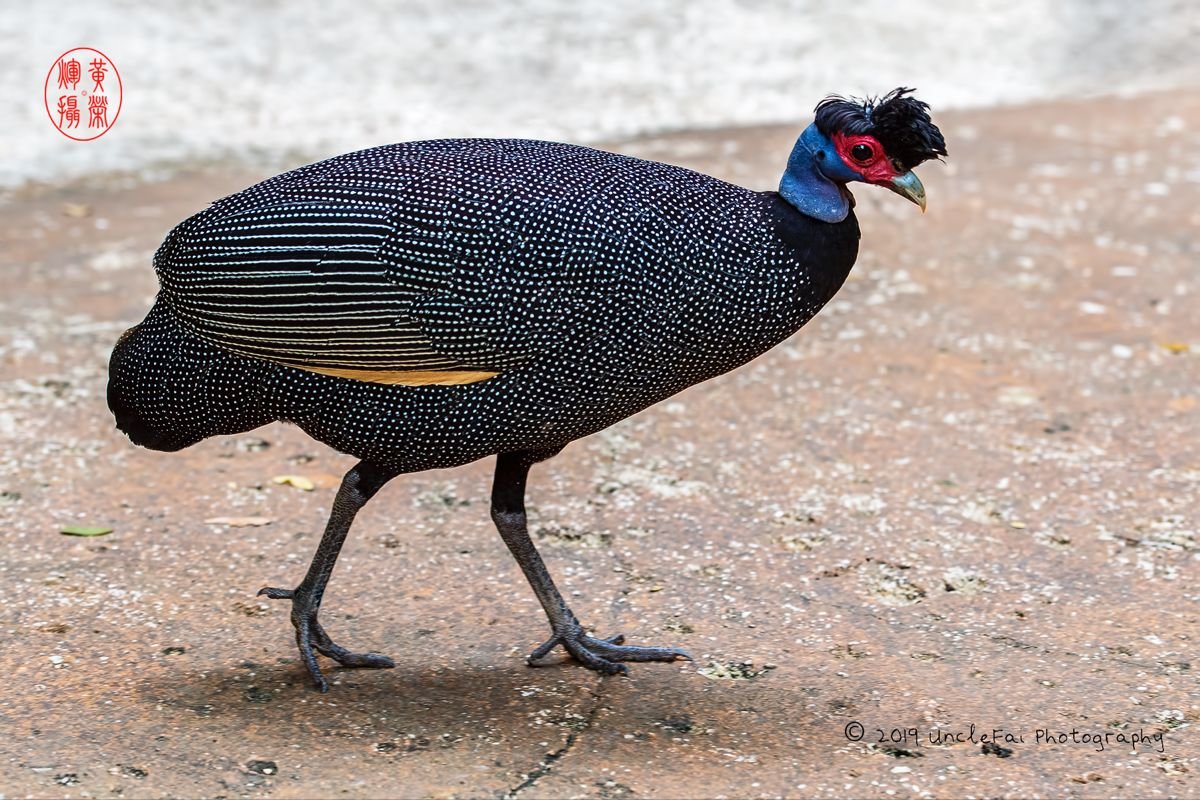
Crested Guineafowl
Guttera pucheraniA forest guineafowl with a distinctive black crest – known as Kororo wa Kenya in Swahili.
The Crested Guineafowl (Guttera pucherani) is a dark grey to black bird covered with whitish spots. Its most recognizable feature is the short curly mop of black feathers on the head. The rest of the head and neck are bare with blue skin, and there is red skin around the eye and on the neck. This species is found in scrub or dense thickets and grass across East Africa, including Tanzania [citation:1].
Crested Guineafowl Quick Facts
What Is the Crested Guineafowl?
The Crested Guineafowl (Guttera pucherani) is a species of guineafowl native to East Africa. It is found from Somalia to Tanzania, including the islands of Zanzibar and Tumbatu, where it inhabits open forest, woodland and forest-savanna mosaics [citation:1][citation:11].
It is one of three species that were formerly considered to be one and the same species, the crested guineafowl. In 2022, Clements and the IUCN split the species into three, with the eastern crested guineafowl being monotypic, comprising only the nominate subspecies [citation:11].
In Tanzania and Kenya, it is known by the Swahili name Kororo wa Kenya [citation:2]. It is a forest-loving guineafowl, less commonly seen on open savanna than the Helmeted Guineafowl, and more often encountered at the edges of woodland and thicket.
How to Identify a Crested Guineafowl
The Crested Guineafowl is a distinctive bird, though its forest habitat makes it less commonly seen than the Helmeted Guineafowl. Here are its key identification features:
- Crest: A short curly mop of black feathers on the head – the species' most recognizable feature [citation:1].
- Plumage: Dark grey to black, covered with whitish spots [citation:1].
- Head and neck: Bare with blue skin [citation:1].
- Face: Red skin around the eye and on the neck [citation:1].
- Eyes: Red [citation:1].
- Legs: Dark brown to black [citation:1].
- Sexes: Females are slightly smaller than males [citation:1].
Compared to Other Guineafowl
Unlike the Helmeted Guineafowl, which has a bony casque, the Crested Guineafowl has a curly black crest. The Vulturine Guineafowl has a cobalt-blue breast, while the Crested Guineafowl's breast is dark with white spots. The Crested Guineafowl is smaller than both these species [citation:1][citation:11].
Behavior & Social Life
The Crested Guineafowl is a monogamous bird with strong and long-lasting pair bonds [citation:1]. They are generally sedentary, but can cover considerable distances during daily wanderings [citation:1].
Daily Activity
- Terrestrial: They spend most of their day on the ground, scratching for food with their strong claws [citation:8].
- Flight: They prefer to run rather than fly when alarmed, but are strong fliers when they take to the air [citation:8].
- Roosting: At night they roost in trees, often flying up to their roosts [citation:8].
Communication
- Main call: They utter a variety of loud calls, both during the day and at dusk, as the birds are settling into roosts [citation:3].
- Alarm call: A large harsh call when disturbed [citation:8].
- Male call: "kek-kek-kek" or "chi-chi-chi" [citation:8].
- Female call: "buck-wheat buck-wheat" [citation:8].
Because of their noisy nature, people use them as "guard" birds for flocks of chickens to protect them from predators [citation:8].
Habitat & Distribution
The Crested Guineafowl is found in a variety of habitats:
- Scrub or dense thickets and grass [citation:1].
- Open forest, woodland and forest-savanna mosaics [citation:11].
- Forest edges and dense groups of trees or brush [citation:13].
Distribution: The range of the Eastern Crested Guineafowl is Somalia, Kenya, northeastern Tanzania, and on the islands of Zanzibar and Tumbatu [citation:1]. It extends south through Tanzania to the coastal lowlands and inland to the Uluguru Mountains [citation:12].
Subspecies in Tanzania
Tanzania hosts several subspecies of the Crested Guineafowl, each with distinct features [citation:12]:
- G. p. pucherani: Zanzibar, coastal lowlands south to the Rufiji River, inland to Kilimanjaro and the Uluguru Mountains. Sides of face and neck greyish blue, throat and orbital skin bright red. No black collar on lower neck. Red eyes [citation:12].
- G. p. granti: Inland Tanzania from Oldeani and Manyara south through Kondoa and Dodoma districts to Mikumi and Ruaha National Parks and the Udzungwa Mountains. Broad black collar on lower neck [citation:12].
- G. p. verreauxi: Western and northwestern Tanzania. Broad black collar on lower neck and upper breast. Dark brown eyes [citation:12].
- G. p. barbata: Extreme southern border areas and southeastern coastal lowlands north to the Rufiji River. Little or no trace of red on throat [citation:12].
Crested Guineafowl in Tanzania
The Crested Guineafowl is a forest and thicket specialist, found across much of Tanzania's woodland and forest habitats. Here are the best places to look for it:
Udzungwa Mountains NP
A haven for biodiversity, home to rare and endemic species including the Kenya Crested Guineafowl [citation:10].
Udzungwa safariMikumi National Park
The granti subspecies ranges through Mikumi, a key southern-circuit park [citation:12].
Mikumi safariRuaha National Park
The granti subspecies also extends into Ruaha, Tanzania's largest park [citation:12].
Ruaha safariZanzibar & Coastal Forests
The nominate pucherani subspecies is found on Zanzibar and the coastal lowlands [citation:1][citation:12].
Zanzibar safariSafari Methods
- Game drives through woodland and forest edges.
- Walking safaris where permitted, to watch them forage.
- Birdwatching – they are active and easy to observe in forest edge habitats.
- Wildlife photography – their spotted plumage and distinctive crest make great subjects.
Best Time to See Them
Crested Guineafowl are present year-round in suitable habitat. They are most active during the cooler morning and evening hours, when they come out to forage along forest edges.
Diet & Feeding
Crested Guineafowl are omnivorous, feeding on a variety of foods .
Food Sources
- Insects – including grasshoppers and beetles [citation:1][citation:13].
- Seeds and kernels of fallen corn [citation:13].
- Roots and tubers [citation:1][citation:13].
- Fruit and plant material [citation:13].
Foraging Behavior
In the morning, the flock forages for seeds, fruit, plant material, small snails, grasshoppers, termites, and beetles. They walk quickly along the ground and may follow monkeys that drop fruit and nuts. Each day, they may walk up to 6 miles (10 km) looking for food [citation:13]. In their crops, guineafowl keep bits of snail shells to help grind the seeds and nuts. In the dry season, the birds rely on fruits from the trees for moisture or dig up roots and bulbs, which contain moisture [citation:13].
Breeding & Life Cycle
Crested Guineafowl are monogamous with strong and long-lasting pair bonds [citation:1].
Nesting
- Nest: A scrape on the ground with sparse lining, mainly of dead leaves and grass, usually well hidden [citation:1].
- Location: The nest is a simple scrape in heavy cover [citation:3].
- Eggs: Females lay 4-5 eggs normally, but up to 7 [citation:1][citation:3].
- Egg color: Cream-brown or nearly white to buff [citation:3][citation:11].
Incubation & Chicks
- Incubation: 23-28 days [citation:1].
- Chicks: Chicks have down with dark longitudinal stripes. They can fly at about 12 days and are fledging at about 30 days [citation:1].
- Parental care: Incubation is thought to be performed by the female only, although both sexes participate in care of the young [citation:3].
Lifespan
Crested Guineafowl can live for 10 to 20 years [citation:13].
Conservation Status
The Crested Guineafowl is assessed as Least Concern on the IUCN Red List [citation:11].
Its population is suspected to be stable, and it has an extremely large range. The species has a large population size and is not believed to approach the thresholds for Vulnerable [citation:11].
Despite its secure status, it faces some local pressures:
- Habitat loss and fragmentation in some regions.
- Hunting as a gamebird in some areas.
- Trade – reported as used in trade at a low prevalence in some regions [citation:9].
The species is recorded from several Important Bird and Biodiversity Areas (IBAs/KBAs) across its range [citation:9].
Comparisons
The Crested Guineafowl is sometimes confused with other guineafowl species found in Tanzania. Here are the key differences:
| Feature | Crested Guineafowl | Helmeted Guineafowl | Vulturine Guineafowl |
|---|---|---|---|
| Head | Curly black crest on head [citation:1] | Bony casque (helmet) | Bare blue face, no helmet |
| Plumage | Dark grey to black with white spots [citation:1] | Slate-grey with white spots | Black with cobalt-blue breast and long hackles |
| Habitat | Forest, thicket, woodland [citation:1] | Open savanna, woodland, grassland | Dry acacia scrub, semi-desert |
| Size | ~50 cm [citation:11] | 53-58 cm | 61-71 cm |
| Range | East Africa, incl. Zanzibar [citation:1] | Widespread sub-Saharan Africa | NE Africa + N Tanzania |
Did You Know?
Forest Specialist
Unlike other guineafowl, the Crested Guineafowl prefers forest edges, thickets, and dense scrub rather than open savanna [citation:1][citation:13].
Monogamous
They form strong, long-lasting pair bonds and are monogamous [citation:1].
Guard Birds
Because of their noisy nature, people use them as "guard" birds for flocks of chickens to protect them from predators [citation:8].
Taxonomic Split
In 2022, the species was split into three separate species: Eastern, Western, and Southern Crested Guineafowl [citation:11].
Eggshell Mystery
Their eggs have very thick shells – a feature that may make them more fire-resistant [citation:3].
Snail Shell Grinders
They keep bits of snail shells in their crops to help grind seeds and nuts [citation:13].
There is a certain elusiveness in the Crested Guineafowl – a bird of the forest edge, more often heard than seen, its loud calls ringing through the trees as it settles into roosts at dusk. To glimpse one moving through the dappled light of the Udzungwa forest is to see a different side of Africa's gamebird world – quieter, more secretive, and no less fascinating than its savanna cousins.
Gallery
Frequently Asked Questions
The Crested Guineafowl (Guttera pucherani) is a dark grey to black bird covered with whitish spots. Its most recognizable feature is the short curly mop of black feathers on the head. The rest of the head and neck are bare with blue skin, and there is red skin around the eye and on the neck [citation:1].
The Crested Guineafowl is widely distributed across Tanzania. Key locations include Udzungwa Mountains National Park [citation:10], Mikumi National Park, Ruaha National Park, and the Zanzibar archipelago. It is also found in Ukami Forest, with specimens recorded from the region [citation:7].
They are omnivorous, feeding on insects, seeds, roots, and vegetation. They forage on the ground in flocks and may follow monkeys to eat dropped fruit and nuts [citation:1][citation:13].
No. The Crested Guineafowl is listed as Least Concern on the IUCN Red List, with a large range and stable population trend [citation:11].
They are monomorphic, meaning males and females look similar. However, females are generally slightly smaller than males [citation:1].
A clutch typically contains 4-5 eggs, but can be up to 7. The eggs are incubated for 23-28 days [citation:1].
In Tanzania and Kenya, the Crested Guineafowl is known as Kororo wa Kenya in Swahili [citation:2].
The Crested Guineafowl has a curly black crest on its head, while the Helmeted Guineafowl has a bony casque (helmet). The Crested Guineafowl prefers forest and thicket habitats, while the Helmeted Guineafowl is found in open savanna [citation:1].
References & Further Reading
- Cleveland Metroparks Resource Library – Eastern Crested Guineafowl: description, range, habitat, breeding, diet, conservation status [citation:1].
- Wikipedia – Eastern crested guinea fowl: Taxonomy, description, distribution, breeding [citation:11].
- University of Nebraska–Lincoln, School of Natural Resources – Game Birds of the World: Crested Guineafowl description, habitat, breeding [citation:3].
- Avibase – The World Bird Database: Crested Guineafowl, scientific name, synonyms, Swahili name [citation:2].
- Natural History Museum of Denmark: Specimen record from Ukami Forest, Tanzania [citation:7].
- SanParks Forums – Guineafowl, Crested: subspecies distributions in Africa, including Tanzania [citation:6].
- Birding Ecotours – Tanzania Birding: Udzungwa Mountains and Eastern Arc Mountains endemics, Kenya Crested Guineafowl [citation:10].
- Akron Zoo – Crested Guineafowl: description, behavior, calls, diet, lifespan [citation:8].
- EBSCO Research Starters – Crested Guineafowl: description, habitat, diet, behavior, reproduction, lifespan [citation:13].
- Core.ac.uk – Comments concerning the races of the Crested Guineafowl Guttera pucherani in Tanzania [citation:12].