

.png)
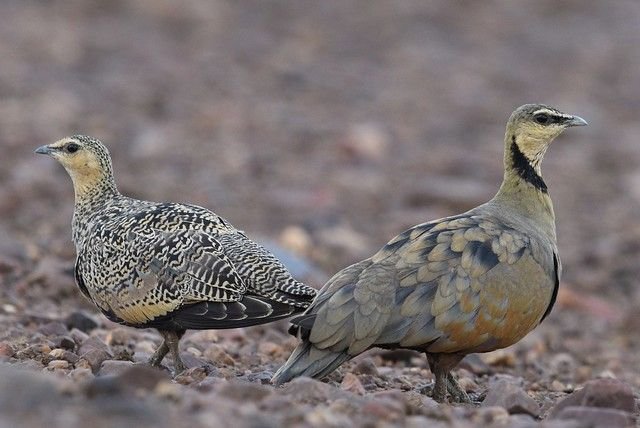
Yellow-throated Sandgrouse
Pterocles gutturalisA striking, bulky sandgrouse of dry grasslands, famous for the male’s yellow throat and extraordinary water-carrying behaviour.
The Yellow-throated Sandgrouse (Pterocles gutturalis) is a large sandgrouse of open grassland, dry country and seasonally arid landscapes. Males have a vivid yellow throat and eyebrow framed by a dark collar, while both sexes show cryptic, finely patterned plumage that blends with the ground.
Yellow-throated Sandgrouse Quick Facts
What Is the Yellow-throated Sandgrouse?
The Yellow-throated Sandgrouse (Pterocles gutturalis) is a large, sturdy sandgrouse in the family Pteroclidae. It is built for life on open country, with a compact body, pointed wings and cryptic plumage that helps it disappear into dry grass and bare ground.
The species occurs in a broad but discontinuous belt from eastern Africa south through parts of southern Africa. Two subspecies are recognised, with plumage variation across the range.
Its most remarkable adaptation is the male’s water-carrying behaviour: specialized breast feathers can soak up water at drinking sites and transport it back to chicks at the nest. This makes the species especially fascinating to birders and naturalists.
How to Identify a Yellow-throated Sandgrouse
The Yellow-throated Sandgrouse is a bulky, approximately 30 cm sandgrouse with strongly patterned upperparts and a distinctive flight profile. The male is especially recognizable by its yellow throat and supercilium framed by a dark collar and lores.
- Size: About 30 cm long, with a broad, bulky body.
- Male face: Bright yellow throat and supercilium, bordered by black around the lores and collar.
- Underparts: Grey chest with a rich chestnut belly.
- Upperparts: Greyish-yellow ground colour with darker subterminal markings giving a scaled appearance.
- Wings: Black flight feathers and underwing coverts, conspicuous in flight.
- Female: Plainer pale-yellow face with finer dark mottling on crown, nape and upperparts.
Distinguishing from Other Sandgrouse
In the field, compare its larger build, yellow throat pattern, chestnut belly and dark wings with other sandgrouse. The female is plainer-faced and more heavily mottled, but retains the species’ overall chunky shape and warm chestnut underparts.
Behavior & Social Life
Yellow-throated Sandgrouse can gather in flocks when feeding or visiting water, particularly where food and drinking opportunities are concentrated. It is generally cautious and relies on camouflage before taking flight in a rapid, direct burst.
Daily Activity
- Feeding flocks: Often forms groups where seed resources are concentrated.
- Drinking: Visits reliable water points, sometimes in large numbers.
- Flight: Fast, direct wingbeats with a strong, purposeful departure when disturbed.
Movement
Much of the day may be spent feeding, resting and moving between feeding areas and drinking sites. Around water, birds can become more conspicuous as they gather in groups, while at nesting sites they remain difficult to detect.
Habitat & Distribution
Yellow-throated Sandgrouse favours open, relatively dry landscapes where seeds and grain are available:
- Dry grassland and open plains with sparse cover.
- Seasonally dry savanna and thornveld.
- Cultivated landscapes where fallen grain and pioneer seeds provide food.
- Semi-arid country near reliable drinking sites.
Distribution: The species has a discontinuous range across eastern and southern Africa, extending from Ethiopia and Kenya southward to southern Africa. In Tanzania it is best associated with open grasslands, dry plains and suitable semi-arid country.
Tanzania Distribution
Tanzania is within the species’ East African range, and documented records include sites in northern Tanzania such as the Serengeti and Lark Plain–Engikaret, as well as Katavi.
Yellow-throated Sandgrouse in Tanzania
Yellow-throated Sandgrouse is a distinctive but locally unpredictable bird in Tanzania. The strongest documented locations are associated with open grassland and semi-arid plains rather than forest or dense woodland.
Serengeti National Park
The Serengeti holds documented records, including birds seen in the open plains where sandgrouse can gather to feed and drink.
Serengeti safariLark Plain–Engikaret
Lark Plain–Engikaret is a particularly important documented site, including a photographed nest record.
Lark Plain birdingKatavi National Park
Katavi has produced multiple documented photographs and records, making it another useful area for specialist birding.
Katavi safariNorthern Tanzania grasslands
Other suitable open country in northern Tanzania may produce the species when conditions are favourable, but local abundance can change substantially with rainfall and food availability.
Northern Tanzania birdingSafari Methods
- Game drives through woodland and savanna habitats.
- Birdwatching – watch for perched birds and soaring during the day .
- Wildlife photography – the long crest makes it a striking subject.
Best Time to See Them
Game drives and specialist birding excursions through open grasslands provide the best chance of finding this terrestrial sandgrouse.
Diet & Feeding
The Yellow-throated Sandgrouse is primarily a seed-eating sandgrouse. Its diet reflects the seasonal availability of grass seeds, crop grain and other small plant foods in open landscapes.
Food Sources
- Seeds of grasses and other dryland plants.
- Fallen grain in cultivated areas.
- Small plant material available in seasonally productive plains.
- Occasional other small edible items available around feeding grounds.
Feeding Behavior
Breeding & Life Cycle
Breeding is closely tied to local environmental conditions. The nest is a simple scrape on the ground, placed where camouflage helps conceal eggs and young from predators.
Nesting
- Nest: A shallow scrape or depression on bare or lightly vegetated ground.
- Eggs: Usually 2–3 eggs.
- Incubation: Roughly three weeks, with both sexes involved in parental duties.
Chicks
Conservation Status
The Yellow-throated Sandgrouse is assessed globally as Least Concern, although some regional populations are of greater conservation interest.
The species has a broad geographic range, but population size and trends are not well understood in several parts of Africa. BirdLife South Africa’s 2025 regional assessment lists the species as Near Threatened in South Africa, with a decreasing regional population.
Key pressures include changes in agricultural practices, loss of suitable open habitat, dependence on seasonal resources and disruption of dependable drinking points in dry landscapes.
- Habitat change in open grasslands and agricultural landscapes.
- Changes in farming and grazing practices that alter seed availability.
Comparisons
The Yellow-throated Sandgrouse is best separated from other sandgrouse by its bulky build, male’s bright yellow throat and eyebrow, black collar and rich chestnut belly.
| Feature | Yellow-throated Sandgrouse | Wahlberg's Eagle | Martial Eagle |
|---|---|---|---|
| Size | ~30 cm | ~28–30 cm | ~35 cm |
| Key mark | Male yellow throat and black collar | Strong facial pattern, orange-buff chest | Longer-tailed, larger body |
| Plumage | Grey-yellow, scaled upperparts; chestnut belly | More varied brown, chestnut and grey patterning | Generally plainer sandy tones |
| Habitat | Open grassland and dry plains | Dry open country, savanna and semi-arid areas | Open dry country and desert margins |
| Diet | Seeds, grain and plant matter | Seeds and grains | Seeds and plant matter |
| Diet | Rodent specialist | Reptiles, small mammals | Large gamebirds, mammals |
Did You Know?
Water Carrier
Male breast feathers can absorb water and carry it back to chicks at the nest.
Yellow Throat
The male’s yellow throat and supercilium stand out against a dark collar and lores.
Cryptic Plumage
The patterned upperparts help the birds blend into dry grass and bare ground.
Wide Range
The species occurs discontinuously across a large area of eastern and southern Africa.
Ground Nest
The nest is a simple ground scrape, relying on camouflage rather than a built structure.
Rain-linked Movements
Local numbers can change markedly with rainfall, seed availability and water conditions.
Few African birds demonstrate the connection between water and survival as vividly as the Yellow-throated Sandgrouse. A male can leave a distant drinking site with breast feathers saturated with water, then return across dry country so thirsty chicks can drink. Finding one in Tanzania is a reminder that even the quietest grassland birds can have extraordinary stories written into their behaviour.
Gallery
Frequently Asked Questions
The Yellow-throated Sandgrouse (Pterocles gutturalis) is a large sandgrouse of open grasslands and dry country, recognized especially by the male’s yellow throat and black collar.
Documented Tanzanian records include the Serengeti, Lark Plain–Engikaret and Katavi, although local abundance can vary with rainfall and food availability.
It mainly feeds on seeds, grain and other small plant foods collected on the ground.
Globally it is assessed as Least Concern, but the species is regionally Near Threatened in South Africa and has a decreasing regional population there.
Specialized breast feathers can soak up water while the male drinks, allowing him to transport water back to the nest for young chicks.
It lays its eggs in a shallow scrape on the ground. Typically 2–3 eggs are laid, and parental care continues after hatching.
Look for a bulky sandgrouse with strongly patterned upperparts; males show a bright yellow throat and eyebrow bordered by black, while females have a plainer face.
It is a highly mobile species whose occurrence and numbers can vary with rainfall and food conditions, so it is better described as locally resident and irruptive rather than uniformly common year-round.
References & Further Reading
- BirdLife South Africa – Yellow-throated Sandgrouse species account: current regional assessment, identification, distribution and ecology.
- Tanzania Birds – Yellow-throated Sandgrouse: documented photographs and records from Lark Plain–Engikaret, Serengeti and Katavi.
- BirdLife International – current global assessment for Pterocles gutturalis.
- Birds of Africa / regional field references – plumage, measurements, habitat and behaviour.
- Tanzania birding checklists – distribution and occurrence records.
- eBird and Macaulay Library – observation and photographic records where available.
- International ornithological references – sandgrouse taxonomy and natural history.