

.png)
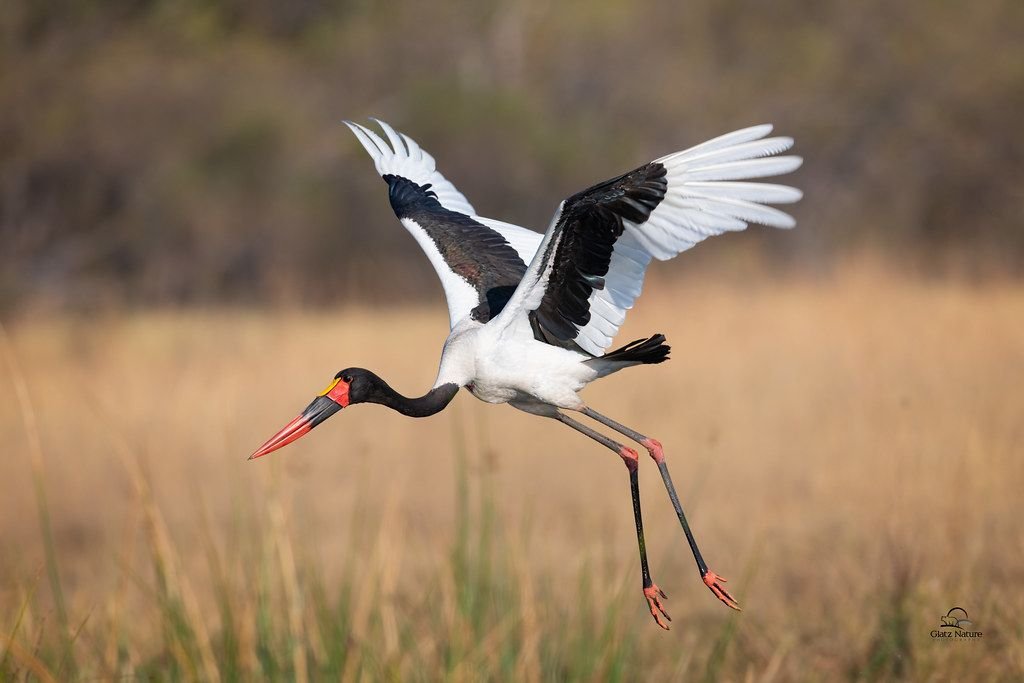
Saddle-billed Stork in Tanzania
Ephippiorhynchus senegalensis — Africa's tallest storkWhat Is the Saddle-billed Stork?
The Saddle-billed Stork (Ephippiorhynchus senegalensis) is Africa's tallest stork, recognized by its black-and-white plumage, enormous red-and-black bill, bright yellow saddle-shaped frontal shield and long red legs.
A specialist of extensive shallow wetlands and floodplains, it hunts by tactile contact — walking slowly through shallows with its bill partly immersed to detect fish and other aquatic prey. In Tanzania it is a solitary or pair-based bird of large wetland landscapes such as Nyerere, Usangu, Katavi and Ngorongoro.
Scientific Classification
How to Identify a Saddle-billed Stork
- Black-and-white body — glossy dark wings and back, white belly and underparts.
- Long black-and-white neck and very long red legs.
- Enormous red-and-black bill with a bright yellow frontal shield — the saddle-shaped plate at the base — as a primary field mark.
- Yellow facial shield/saddle and a red wattle beneath the bill.
- Overall impression is tall, stately and unmistakable among African storks.
Male and female are broadly similar; males can be larger. Field identification should not depend on invented colour or shape differences, and no mammal-style male-dominance interactions is described.
Why Is the Saddle-billed Stork Africa's Tallest Stork?
Standing up to about 1.5 m tall with a wingspan of up to approximately 2.7 m (around 9 ft) where properly sourced, the Saddle-billed Stork owes its height to very long red legs, a long neck and a massive bill — combined with large wings. It is Africa's tallest stork, though it is not claimed here as the largest stork in the world or the largest bird in Africa without direct support.
Pair Bonds and Territorial Behaviour
Pairs form strong bonds and defend large territories. See Daily Behaviour for social structure.
Habitat: Extensive Shallow Wetlands
Core requirements can be summarized as:
EXTENSIVE SHALLOW WATER + AQUATIC PREY + OPEN WETLAND + SUITABLE NEST TREE
- Floodplains, marshes, swamps and shallow lakes.
- River margins, lagoons, seasonal wetlands and wet grassland.
- Water-rich savanna with open views over shallows.
"Protected area" itself is not a habitat type — wetlands within parks are the habitat.
Global Distribution
The Saddle-billed Stork has a broad but fragmented distribution across sub-Saharan Africa and is tightly associated with extensive wetland and floodplain systems. Tanzania is an important range country, but the species is not described as found primarily in Tanzania, nor is any single country presented as the global centre. Uganda is not implied as the centre.
Saddle-billed Stork in Tanzania
Tanzania holds important wetland landscapes for this low-density stork. Recent Tanzania birding evidence includes:
- Nyerere National Park — 1 bird documented in recent records.
- Usangu Wetlands — 3 pairs / 6 birds reported.
- Katavi National Park — up to 3 individuals daily, plus a pair with 2 juveniles.
- Ngorongoro Conservation Area — documented Tanzania record.
These are recent records, not a national population estimate, and sites do not hold equal abundance. Ruaha is included only where current species-specific evidence supports it — otherwise it is not added as a card.
How Does the Saddle-billed Stork Hunt?
- Walks slowly through shallow water with the bill partly immersed.
- Probes water, mud and vegetation and uses contact/tactile detection to find prey.
- Strikes and handles fish with its massive bill.
Tactile/contact feeding is the signature behaviour.
Where to See Saddle-billed Storks in Tanzania
Nyerere National Park
Country: Tanzania | Region: Southern Tanzania
Extensive floodplains and river wetlands — recent record of 1 bird.
Specialist sighting — rewarding but unpredictable
Usangu Wetlands
Country: Tanzania | Region: Southern Tanzania
Vast seasonal floodplain — 3 pairs / 6 birds reported.
Specialist sighting — rewarding but unpredictable
Katavi National Park
Country: Tanzania | Region: Western Tanzania
Floodplain wetlands — up to 3 daily, pair with 2 juveniles.
Specialist sighting — rewarding but unpredictable
Ngorongoro Conservation Area
Country: Tanzania | Region: Northern Tanzania
Crater wetlands and lake margins — documented record.
Specialist sighting — rewarding but unpredictable
Specialist sighting — Saddle-billed Storks are often encountered singly or in pairs at relatively low densities. Sightings are never guaranteed.
Birding Methods
- Specialist birdwatching and guided birding.
- Game drives along wetland margins.
- Wetland observation and shoreline observation where legally permitted.
- Wildlife photography with long lenses.
Best Time to See Them
Saddle-billed Storks can be encountered year-round in suitable Tanzanian wetlands. Dry-season conditions may make some wetland viewing easier, but sightings depend on water levels, prey availability, wetland condition and local bird density. No June–October guarantee is made.
Saddle-billed Stork in Pictures
A closer look at the Saddle-billed Stork in its natural East African habitat — its striking appearance, habitat and behaviour are best appreciated up close.
Where to Spot the Saddle-billed Stork on Safari
Plan your trip around the destinations and safaris where the Saddle-billed Stork is easiest to see. Explore the parks, itineraries and tour packages by destination below.
What Does the Saddle-billed Stork Eat?
A primarily fish-eating wetland predator — not merely a generic carnivore:
Primary
- Fish
Additional
- Frogs
- Aquatic invertebrates
- Reptiles
- Small mammals
How Does the Saddle-billed Stork Find Prey in Mud and Water?
The bird uses its long bill to detect prey by contact while probing shallow water, mud and vegetation. Exact sensory mechanisms and numerical detection distances are not invented here.
Saddle-billed Stork Breeding and Nesting
No gestation, birth or parental feeding:
- Pair-based breeding with a solitary nest.
- Large stick nest built in a tall tree, often near wetlands — thorny acacias where suitable.
- Solitary nesting, not colonial.
- 1–5 eggs, usually 2–3; both parents incubate.
- Incubation approximately 30–35 days.
- Fledging approximately 70–100 days.
Where Does the Saddle-billed Stork Nest?
- Tall trees and thorny acacias where suitable, near wetlands.
- Large deep stick platform, built and defended by the pair.
- Solitary nesting — large colonial nesting is not claimed.
How Do Saddle-billed Stork Parents Raise Their Chicks?
- Both parents feed by regurgitated food; water may be provided by adults.
- Older chicks may take fish directly from the parent's bill.
- Fledging around 70–100 days, with young largely independent around 3.5 months in zoological references.
No parental feeding, birth or single-newborn language.
Natural Threats
Lions, leopards and hyenas are not described as routine adult predators — adults are large and formidable.
Egg, nest and chick threats are the focus: egg predators, nest predators, chick predation and disturbance where documented.
Why Are Saddle-billed Stork Sightings Unpredictable?
Unlike colonial storks, Saddle-billed Storks are:
- Solitary or pair-based with low population density.
- Defending large territories across wide wetland landscapes.
- Often far apart, so even in good habitat encounters remain unpredictable.
This section helps manage safari expectations — a specialist sighting that is rewarding but never guaranteed.
Conservation Status: Near Threatened
IUCN Red List Status: Near Threatened (NT) — current 2025 global assessment.
The species was previously listed as Least Concern but was reassessed to Near Threatened in the 2025 global assessment process. An exact population total is not invented here.
Threats include wetland degradation, agricultural conversion, irrigation and floodplain alteration, habitat loss, water extraction, hydrological changes, drought, disturbance at nests and uncertainty around small, fragmented populations. The account is not turned into an Endangered-species story.
Saddle-billed Stork Facts
Saddle-billed Stork vs Marabou Stork
| Feature | Saddle-billed Stork | Marabou Stork |
|---|---|---|
| Scientific name | Ephippiorhynchus senegalensis | Leptoptilos crumenifer |
| Height | Up to ~1.5 m — Africa's tallest | Up to ~1.5 m, bulkier |
| Bill | Red-and-black with yellow saddle | Massive dagger bill, pink gular sac |
| Social | Solitary/pairs, solitary nester | Colonial, scavenger flocks |
| Status | Near Threatened | Least Concern |
Saddle-billed Stork vs Yellow-billed Stork
| Feature | Saddle-billed Stork | Yellow-billed Stork |
|---|---|---|
| Bill | Red-and-black with yellow shield | Yellow with red facial skin |
| Size | Large — 1.5 m, 2.7 m wingspan | Smaller — ~1 m, ~1.5 m wingspan |
| Behaviour | Solitary/pair, tactile hunting | Often in flocks, tactile sweeping |
Saddle-billed Stork vs African Openbill
| Feature | Saddle-billed Stork | African Openbill |
|---|---|---|
| Bill | Long, closed red-and-black | Distinct open gap for snails |
| Diet | Fish, frogs, reptiles, invertebrates | Mainly snails/molluscs |
| Nesting | Solitary tree nest 1–5 eggs | Colonial tree nests |
Why the Saddle-billed Stork Matters to African Wetlands
- Wetland predator at the top of shallow-water food webs.
- Food-web role linking fish and aquatic invertebrates to terrestrial systems.
- Biodiversity indicator — its presence signals intact floodplains and wetlands.
- Ecotourism value as a sought-after specialist sighting.
- Importance of intact floodplains and wetlands for breeding and foraging.
Photographing the Saddle-billed Stork
- Standing profile showing height and long red legs.
- Yellow saddle-shaped frontal shield and red-and-black bill — the key portrait.
- Shallow-water feeding and fish capture.
- Pair, nest, parent feeding chick and flight/reflection.
Use long lenses and never disturb nests or feeding birds.
Frequently Asked Questions
The Saddle-billed Stork (Ephippiorhynchus senegalensis) is Africa's tallest stork — a black-and-white wetland bird with a massive red-and-black bill, yellow saddle-shaped frontal shield and long red legs.
Because it stands up to about 1.5 m tall, with very long legs, a long neck, large wings and an enormous bill — taller than any other African stork species.
Up to approximately 1.5 m, with a wingspan of up to about 2.7 m (around 9 ft) where properly sourced.
Verified recent records include Nyerere National Park (1 bird), Usangu Wetlands (3 pairs / 6 birds), Katavi National Park (up to 3 daily, pair with 2 juveniles) and Ngorongoro Conservation Area. Ruaha is included only where current evidence supports it.
Primarily fish, plus frogs, aquatic invertebrates, reptiles and small mammals — a fish-focused wetland predator rather than a generic carnivore.
By walking slowly through shallow water with the bill partly immersed, probing water, mud and vegetation and using tactile contact to detect and strike prey, handling fish with its massive bill.
It detects prey by contact while probing — tactile shallow-water hunting. Exact sensory mechanisms and detection distances are not invented here.
Usually solitary or seen in pairs, with a strong pair bond and large territory. It nests solitarily, not in colonies, unlike Marabou Storks.
A large deep stick platform built solitarily in a tall tree, often a thorny acacia, near wetlands.
1–5 eggs, usually 2–3.
Approximately 30–35 days, shared by both parents.
Fledging takes approximately 70–100 days, with young largely independent around 3.5 months in zoological references.
Both parents provide regurgitated food and may bring water; older chicks can take fish directly from the parent's bill.
It is generally resident / non-migratory, though local movements occur as wetlands change with water levels and prey.
Globally it is assessed as Near Threatened (NT) in the 2025 assessment — not Endangered, but facing pressures that warrant concern.
The species was previously Least Concern but was reassessed to Near Threatened in the 2025 global process, reflecting wetland degradation, fragmentation and small, scattered populations.
Wetland degradation, agricultural conversion, irrigation, floodplain alteration, habitat loss, water extraction, hydrological changes, drought, disturbance at nests and uncertainty around fragmented populations.
Because birds live at low density, solitarily or in pairs, holding large territories across wide wetland landscapes and often far apart — encounters remain specialist and never guaranteed.
Saddle-billed is tall, black-and-white with a red-and-black bill and yellow saddle, solitary and Near Threatened; Marabou is bulkier with a bare pink head and gular sac, colonial and gregarious, and Least Concern.
Year-round in suitable wetlands. Dry-season conditions can make viewing easier, but sightings depend on water levels, prey availability, wetland condition and local density — no June–October guarantee is made.
Related Safari Packages & Tours
Book a safari to see the Saddle-billed Stork and the rest of Africa's incredible wildlife with our expert guides.
References & Further Reading
- IUCN Red List / BirdLife (2025 assessment): Ephippiorhynchus senegalensis — Near Threatened (reassessed from Least Concern).
- Tanzania birding records: Nyerere (1), Usangu (3 pairs/6), Katavi (up to 3 daily, pair + 2 juveniles), Ngorongoro documented.
- Zoological literature: 1.5 m height, 2.7 m wingspan, tactile shallow-water hunting, 1–5 eggs (usually 2–3), 30–35 d incubation, 70–100 d fledging.
- About these facts: measurements and timings are approximate ranges varying with source and method.
Sightings are never guaranteed and depend on local conditions.

Daily Behaviour and Social Life
Saddle-billed Storks are primarily active during daylight. No diurnal label or rigid 6am–10am timetable is used. They may:
Activity varies with environmental conditions.
Social Structure
No safety-in-numbers, group defence, dominance interactions, bachelor groups or communal breeding is described.
Communication
Movement
Saddle-billed Storks are generally resident / non-migratory, though local movement can occur as wetlands change. They are not described as routine long-distance migrants.