

.png)
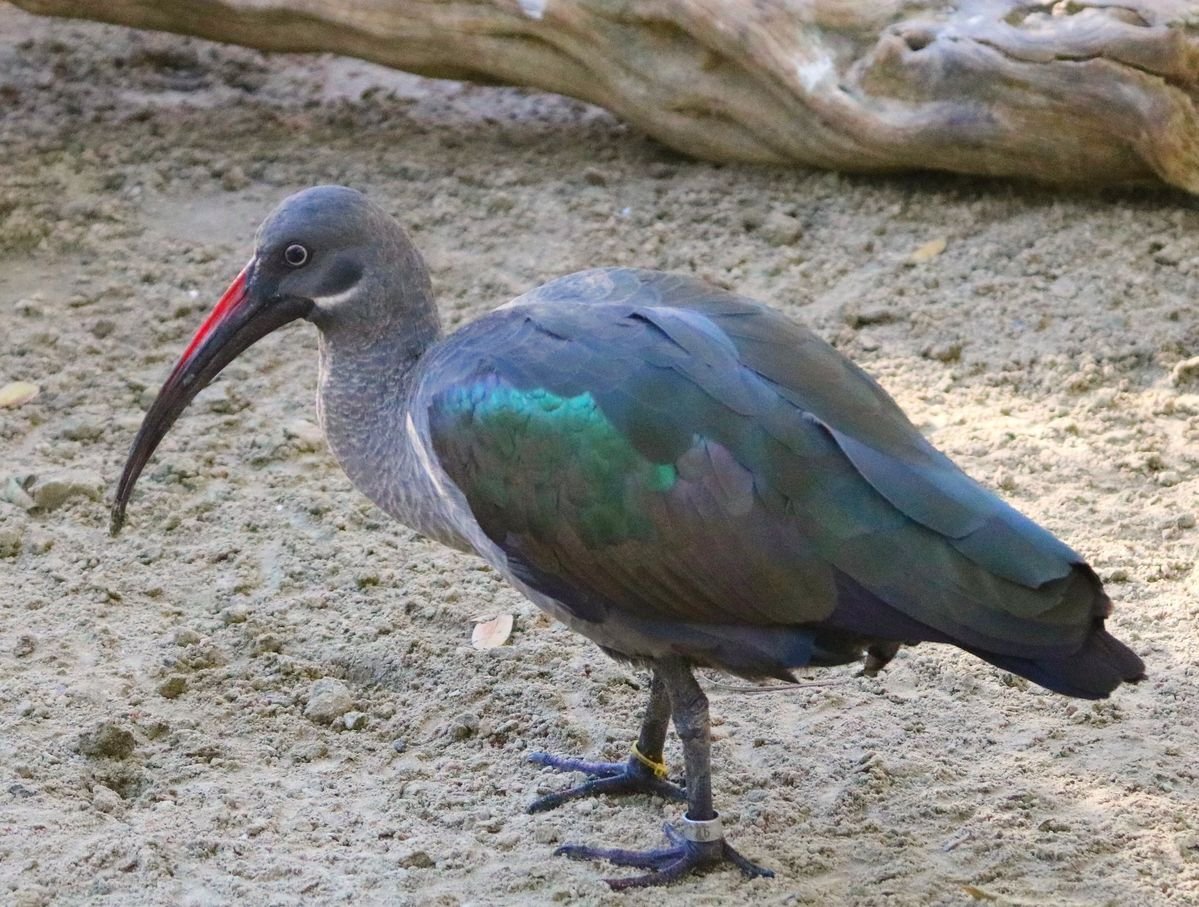
Hadada Ibis in Tanzania
Bostrychia hagedash - the bird that calls its own nameWhat Is the Hadada Ibis?
The Hadada Ibis (Bostrychia hagedash) is a distinctive African ibis - grey-brown in body, with a long down-curved bill, a narrow white cheek stripe and glossy green-purple wing coverts that flash colour in good light.
Its name is its voice: a loud three- or four-note "haa-daa" call fired off in flight, especially during morning departures and evening returns to communal roost trees.
Unlike wetland-specialist ibises, the Hadada is a creature of moist grassland, soft soil and woodland edges - and it thrives near people, probing lawns, gardens, sports fields and cultivated land for earthworms and insect larvae.
In Tanzania it is common throughout the country, especially in moister areas, from Tarangire to the Arusha area.
Scientific Classification
Four subspecies are generally recognized across the species’ sub-Saharan range, which stretches from Sudan and Senegal south to South Africa. The scientific name - originally Tantalus hagedash - echoes the same onomatopoeic "haa-daa" call that gave the bird its common name.
How to Identify a Hadada Ibis
- Grey-brown body plumage on a large ibis frame.
- Narrow white stripe across the cheeks - sometimes called a "moustache," though it does not reach the mouth corners.
- Long down-curved bill, greyish-black - with a diagnostic red culmen (ridge of the upper mandible) during the breeding season.
- Iridescent green/purple wing-coverts produced by microscopic feather structures rather than pigment.
- Stout black legs; upper toe surfaces also turn reddish as breeding begins.
- Broad, powerful wings enabling quick take-offs and manoeuvring through trees.
- Immatures are duller - lacking the full adult gloss and red bill markings.
Size Summary
- Length: approximately 65-76 cm
- Body mass: around 1.2 kg on average (source variation exists)
Why Is It Called the Hadada Ibis?
The name is pure onomatopoeia: the bird announces itself with a loud, raucous, trumpeting "haa-daa" (often rendered "haa-haa-haa-de-dah"), a three- or four-note call that carries far across valleys and suburbs alike.
The call is especially conspicuous at two moments of the day:
- Morning departures - flocks burst from their communal roost trees, calling as they fan out to feeding grounds.
- Evening returns - the same chorus greets their arrival back at the roost at dusk.
Birds also call loudly in group interactions and when startled. Few African birds are so reliably identified by ear first - many visitors hear the Hadada long before they see one.
What Does the Hadada Ibis Sound Like?
The signature voice is a coarse, repetitive, trumpeting series - loud enough to wake a safari camp. But the species has more than one note in its repertoire:
- Flight and roost calls: the famous loud "haa-daa" triple or quadruple phrase.
- Single roost call: a drawn-out "haaaa" uttered from perched birds.
- Contact call while foraging: an unexpected low growl - often compared to a young puppy - keeping scattered flock-mates in touch.
- Body displays: posture, bill orientation and wing positions communicate within groups alongside these voices.
No scent communication plays any recorded role; this is a bird that talks in sound and posture.
Male vs Female: Key Differences
Males and females are broadly similar externally - same grey-brown plumage, white cheek stripe and curved bill - with no major sex-specific field marks reported by reliable sources.
Both sexes participate fully in breeding:
- Nest construction - building the twig platform together.
- Incubation - shared shifts on the eggs.
- Chick care - both parents feed and guard young.
Daily Behavior and Communal Roosting
Hadada Ibises are active during daylight. Their day has a fixed soundtrack:
- Dawn: flocks leave communal roost trees together, calling loudly as they disperse to feeding areas.
- Daylight hours: substantial time spent foraging on the ground - probing lawns, grassland and soft soil, alone or in small groups.
- Dusk: the flock regathers and flies back to the roost, again announcing itself to the entire neighbourhood.
These synchronized roost movements are why so many people know the bird by voice alone - camp kitchens, hotel gardens and city suburbs alike get the dawn chorus whether they asked for it or not.
Habitat: Moist Grassland to City Lawns
The Hadada Ibis is emphatically not a wetland specialist like the Goliath Heron or African Spoonbill. Water matters, but soft soil matters more:
- Moist grassland and savanna - the core natural habitat.
- Open woodland, woodland edges and forest clearings - nesting cover.
- Gardens, lawns, parks and sports fields - superb artificial foraging.
- Cultivated fields and irrigated land - permanently soft ground.
- Wetlands, river margins and floodplains - used where available.
The common thread is moist, soft soil that yields to probing - plus trees for roosting and nesting. In parts of southern Africa the species’ range expanded dramatically during the twentieth century precisely because tree planting, irrigation and urban green space created more Hadada habitat.
Habitat and Global Distribution
Hadada Ibises have a broad sub-Saharan African distribution, occurring from Sudan and Senegal across East and Central Africa to southern Africa. Four subspecies are recognized across this range.
Tanzania is part of the species’ natural range - not its global center, but solidly within it, with common presence throughout the country’s moister regions.
Remarkably, the species’ range in southern Africa expanded nearly two-and-a-half-fold during the twentieth century as tree planting, irrigation and urban green space created new soft-soil habitat - one of few large African birds that has benefited from certain human landscape changes.
Hadada Ibis in Tanzania
The Hadada Ibis is common throughout Tanzania, especially in the moister parts of the country. Documented Tanzanian presences include:
- Tarangire National Park - recorded birds and imagery from the park’s swamps and riverine areas.
- Lake Manyara National Park - adult birds documented around the park’s moist margins.
- Arusha area - including gardens and green spaces in and around the city.
- Silale Swamp (Tarangire) - moist swamp-edge habitat.
- Burigi-Chato National Park - in Tanzania’s wetter northwest.
- Malagarasi Swamp - one of Tanzania’s great wetland systems.
Sightings vary by specific location and local conditions, but within suitable habitat this is one of the country’s more dependable birds.
Where to See Hadada Ibis in Tanzania
Tarangire National Park
Country: Tanzania | Region: Northern Tanzania
Documented Tanzanian occurrence and imagery; check swamp fringes and riverine woodland.
Common in suitable habitat; sightings vary by location.
Lake Manyara National Park
Country: Tanzania | Region: Northern Tanzania
Documented adult birds around moist grassland and wetland edges beneath the escarpment.
Common in suitable habitat; sightings vary by location.
Arusha National Park & Arusha Area
Country: Tanzania | Region: Northern Tanzania
On documented bird checklists - and often heard calling over Arusha’s own gardens at dawn.
Common in suitable habitat; sightings vary by location.
Malagarasi Wetlands
Country: Tanzania | Region: Western Tanzania
Documented habitat and imagery from one of Tanzania’s largest inland wetland systems.
Common in suitable habitat; sightings vary by location.
Saanane Island National Park
Country: Tanzania | Region: Lake Victoria, Mwanza
Listed on African Majestic Adventure’s own Saanane wildlife page - an easy add-on while in Mwanza.
Common in suitable habitat; sightings vary by location.
Safari & Birding Methods
- Game drives along swamp and riverine margins.
- Specialist birdwatching excursions.
- Walking birding where permitted - excellent for ground-foraging species.
- Garden and campus birding - no safari vehicle required for this bird.
- Wildlife photography during roost flights.
- General observation near wetland/grassland edges.
Best Time to See Them
Hadada Ibises can be encountered year-round in suitable Tanzanian habitats. Food availability, rainfall and local conditions shape daily activity - but there is no single "best month," and dry-season wildlife logic does not drive this species the way it does mammals. The most reliable spectacle is simply dawn and dusk at any roost tree.
Hadada Ibis in Pictures
A closer look at the Hadada Ibis in its natural East African habitat — its striking appearance, habitat and behaviour are best appreciated up close.
Where to Spot the Hadada Ibis on Safari
Plan your trip around the destinations and safaris where the Hadada Ibis is easiest to see. Explore the parks, itineraries and tour packages by destination below.
What Does the Hadada Ibis Eat?
The menu is dominated by soil-dwelling invertebrates, with opportunistic extras:
- Earthworms - a staple of soft, moist soil.
- Insect larvae - including beetle and moth larvae dug from lawns (the reason golf-course managers welcome them).
- Grasshoppers, crickets and other insects - including large species.
- Millipedes - taken readily despite their chemical defences.
- Snails.
- Spiders.
- Small lizards and other small prey where documented.
Plant material may be consumed opportunistically, but animal protein from the soil is what drives this bird’s daily search.
How Does the Hadada Ibis Find Food?
- Walks deliberately across lawns, grassland or soft cultivated ground.
- Probes the soil with the long scimitar-curved bill, sweeping it into the earth.
- Detects hidden prey with sensory pits clustered near the bill tip - touch receptors that sense buried worms and larvae without the bird ever seeing them.
- Extracts prey with a deft twist of the bill before swallowing.
- Works grazing landscapes, where livestock dung and trampled sward concentrate soil organisms.
This sensory probing puts Hadadas in elite company: spoonbills, certain sandpipers and even kiwis use comparable bill-tip pits to find unseen subterranean food - a remarkable case of evolutionary convergence.
Breeding, Nesting and Young
Hadada Ibises are egg-laying birds, monogamous and usually solitary nesters - pairs are thought to bond long-term.
- Nest: a platform of twigs and branches placed in a large tree or suitable elevated structure - sometimes surprisingly close to human habitation.
- Timing: breeding varies with rainfall and local habitat rather than a fixed calendar; in the south of the range it is often timed to the rains.
- Eggs: typical clutch of around 3-4 eggs (source variation exists).
- Incubation: roughly 26 days, shared by both parents.
- Chicks: dependent on adults in the nest; both parents feed the young.
- Fledging: young leave the nest at approximately 33-40 days old and become fully independent at roughly 60 days.
Breeding-season plumage tells the story too: the red culmen ridge and reddened toe surfaces appear as hormones surge - a temporary badge of the nesting season.
Hadada Ibis Beyond National Parks
You do not need a game-drive vehicle to meet this species. Hadada Ibises are among Africa’s most comfortable birds-around-people, regularly using:
- Gardens and lawns - probing flowerbeds for worms after rain.
- Golf courses and bowling greens - famously extracting moth and beetle larvae that feed on grass roots, a free pest-control service greens keepers appreciate.
- Farms and cultivated fields, especially under irrigation.
- School grounds, campuses and urban parks.
- Any green space with soft soil within reach of roost trees.
This adaptability explains why the species is doing so well across its range: where people water lawns and plant trees, Hadadas find food and housing. Listen for the dawn "haa-daa" over your lodge garden - it may be closer than any park.
Conservation Status: Least Concern
IUCN Red List Status: Least Concern. The species is widespread across sub-Saharan Africa, common in suitable habitat, and remarkably adaptable - even expanding in some regions thanks to tree planting and irrigation in human-modified landscapes.
Least Concern does not mean zero local pressures. Carefully framed threats include:
- Habitat conversion of moist grassland and woodland.
- Pesticide exposure - reducing soil invertebrate prey and posing direct toxicity risks.
- Wetland and grassland degradation.
- Loss of large nesting/roosting trees.
- Disturbance at sensitive sites.
The practical conservation story for this bird is landscape-level: healthy soils, sensible pesticide use, and keeping big trees standing. No species-specific programme claims are made here - the Hadada’s success is written in adaptable behaviour, not projects.
Hadada Ibis Facts
Hadada Ibis vs African Sacred Ibis
| Feature | Hadada Ibis | African Sacred Ibis |
|---|---|---|
| Scientific name | Bostrychia hagedash | Threskiornis aethiopicus |
| Plumage | Grey-brown body, green-purple iridescent wings | Mainly white body with black head/neck |
| Bill | Down-curved scimitar; red culmen in breeding | Long, straight, downward-curving black bill |
| Face marking | Narrow white cheek stripe | Bare black skin of head/neck |
| Calls | Loud "haa-daa" trumpeting | Generally quieter croaks/grunts |
| Feeding | Probes soft soil/lawns for worms & larvae | Wetlands, shores and rubbish tips; broad diet |
| Nesting style | Solitary pairs near roost flocks | Often colonial |
| Tanzania presence | Common, incl. gardens & farmland | Common around wetlands and lakes |
Hadada Ibis vs African Spoonbill
| Feature | Hadada Ibis | African Spoonbill |
|---|---|---|
| Family/genus | Threskiornithidae - Bostrychia | Threskiornithidae - Platalea |
| Bill shape | Curved, pointed scimitar with sensory pits | Flat spatulate tip swept side-to-side |
| Plumage | Grey-brown + iridescent coverts | All-white with red face and bill |
| Feeding method | Probe-and-extract on land and margins | Open-bill sweeping through shallow water |
| Habitat tilt | Moist grassland, gardens, cultivated land | Shallow wetlands proper |
| Voice | Loud "haa-daa" | Mostly silent grunts |
| Tanzania overlap | Both occur around Lake Manyara, Tarangire swamps and other moist Tanzanian wetlands - but only the Hadada raids your hotel lawn. | |
Why the Hadada Ibis Is an Iconic East African Bird
- An unforgettable voice: the "haa-daa" call is among the most instantly recognized sounds of African mornings - the bird introduces itself by name.
- Always nearby: few large birds live so comfortably alongside people, from safari lodges to city gardens.
- A distinctive look: bronze-grey body, flashing iridescent wings, white moustache stripe and that elegant curved bill.
- Genuine ground-foraging drama: watching one extract an earthworm from a lawn reveals a hidden world of soil life.
- Birder value: easy to see, easy to hear, fun to compare against Sacred Ibis and Spoonbill - a perfect gateway species.
Photographing the Hadada Ibis
- Bird calling in flight - open bill, spread wings, morning light.
- Morning roost departure - flocks bursting from treetops together.
- Evening roost return - silhouettes dropping into canopy at dusk.
- Probing soft ground - bill buried, worm extracted.
- Iridescent wing-coverts - catch angled light for the green-purple sheen.
- Close-up bill - the curve, the white moustache, red culmen in season.
- Garden and grassland scenes - the human-neighbour portrait.
- Tree-roost perches - birds settled for the night.
Ethics first: never disturb communal roosts or nesting trees; photograph from paths and follow your guide’s instructions.
Frequently Asked Questions
A medium-large African ibis (Bostrychia hagedash) with grey-brown plumage, a long down-curved bill, a narrow white cheek stripe and iridescent green-purple wing coverts. It is one of sub-Saharan Africa's most widespread and adaptable birds - common in Tanzania - and one of the most frequently heard, thanks to its loud "haa-daa" call.
The name is onomatopoeic: it imitates the bird's own loud three- or four-note trumpeting call, often rendered "haa-haa-haa-de-dah". The calls ring out most conspicuously when flocks leave their communal roost trees in the morning or return at dusk.
The signature voice is a loud, coarse, raucous "haa-daa" phrase fired off in flight. Perched roost birds give a single drawn-out "haaaa", and foraging birds keep in touch with a low growl surprisingly similar to a young puppy. Posture and wing displays round out a communication set built on sound rather than scent.
Documented locations include Tarangire National Park, Lake Manyara National Park, the Arusha area, Silale Swamp, Burigi-Chato National Park and the Malagarasi wetlands, plus Saanane Island NP on Lake Victoria. In suitable habitat it is among Tanzania's more dependable birds.
Mostly soil invertebrates: earthworms, insect and beetle larvae, grasshoppers, crickets, millipedes, snails and spiders, plus small lizards where documented. Plant material may be taken opportunistically but is secondary.
It walks across soft ground probing with its long curved bill, using sensory pits near the bill tip to detect hidden worms and larvae entirely by touch - the same principle as spoonbills and kiwis. Livestock-grazed land is especially productive for this technique.
No - wetlands are just one habitat among many. The species favours moist grassland and soft soil wherever found: open woodland edges, savanna, floodplains, river margins and, increasingly, human-made green spaces. It is far less water-dependent than herons or spoonbills.
Very much so. Gardens, lawns, golf courses, sports fields, school grounds, parks and irrigated farms all provide ideal soft-soil foraging, and trees supply roosts. The species' range actually expanded in southern Africa as tree planting and irrigation spread.
Flexibly. Birds may forage alone or in small groups, and they commonly gather into communal tree roosts overnight. Breeding pairs are monogamous solitary nesters, so big gatherings usually mean roosts or rich feeding, not family units.
In communal tree roosts - often tall trees near water or within towns. Flocks depart together at dawn calling loudly and return at dusk with the same chorus, making roost trees easy to locate by ear.
Monogamous pairs build a twig-platform nest in a large tree or elevated structure. Timing follows rainfall and local conditions; a typical clutch holds around 3-4 eggs, incubated by both parents for roughly 26 days. Chicks stay nest-dependent, are fed by both adults, leave at about 33-40 days and become independent around 60 days.
No - the IUCN lists it as Least Concern. It is widespread, common in suitable habitat and adaptable enough to benefit from some human landscape changes. Local pressures like pesticide use, habitat conversion and loss of large roost trees still matter, but nothing threatens the species globally.
Year-round wherever suitable habitat exists - food availability and rainfall shape activity rather than any calendar season. For reliably vocal drama, stand near a roost tree at dawn or dusk and simply listen.
Absolutely - gardens, lodge lawns, campuses and golf courses regularly host them. Dawn roost departures, probing behaviour and iridescent wing shots can all be taken without entering a park. Keep distance from roost and nest trees and let the bird behave naturally.
Related Safari Packages & Tours
Book a safari to see the Hadada Ibis and the rest of Africa's incredible wildlife with our expert guides.
References & Further Reading
- BirdLife DataZone: Bostrychia hagedash factsheet - Least Concern assessment.
- eBird / Merlin (Cornell Lab): Hadada Ibis species account - identification and vocalizations.
- Birds of the World (Cornell Lab): Matheu et al. - taxonomy, subspecies, distribution.
- Wikipedia (Hadada ibis): morphology, sensory bill pits, diet and range-expansion literature.
- BDI (Biodiversity & Development Institute): Southern African species text - breeding and habitat data.
- About these facts: measurements and timings are approximate ranges drawn from available sources; they vary with sex, age, region and method.

Social Life and Calls
Outside breeding, Hadada Ibises may forage alone or in small groups, and commonly form communal tree roosts that can gather many birds overnight.
There are no bachelor troops or hierarchies here - just flexible groups orbiting around faithful pairs and reliable roost trees.