

.png)
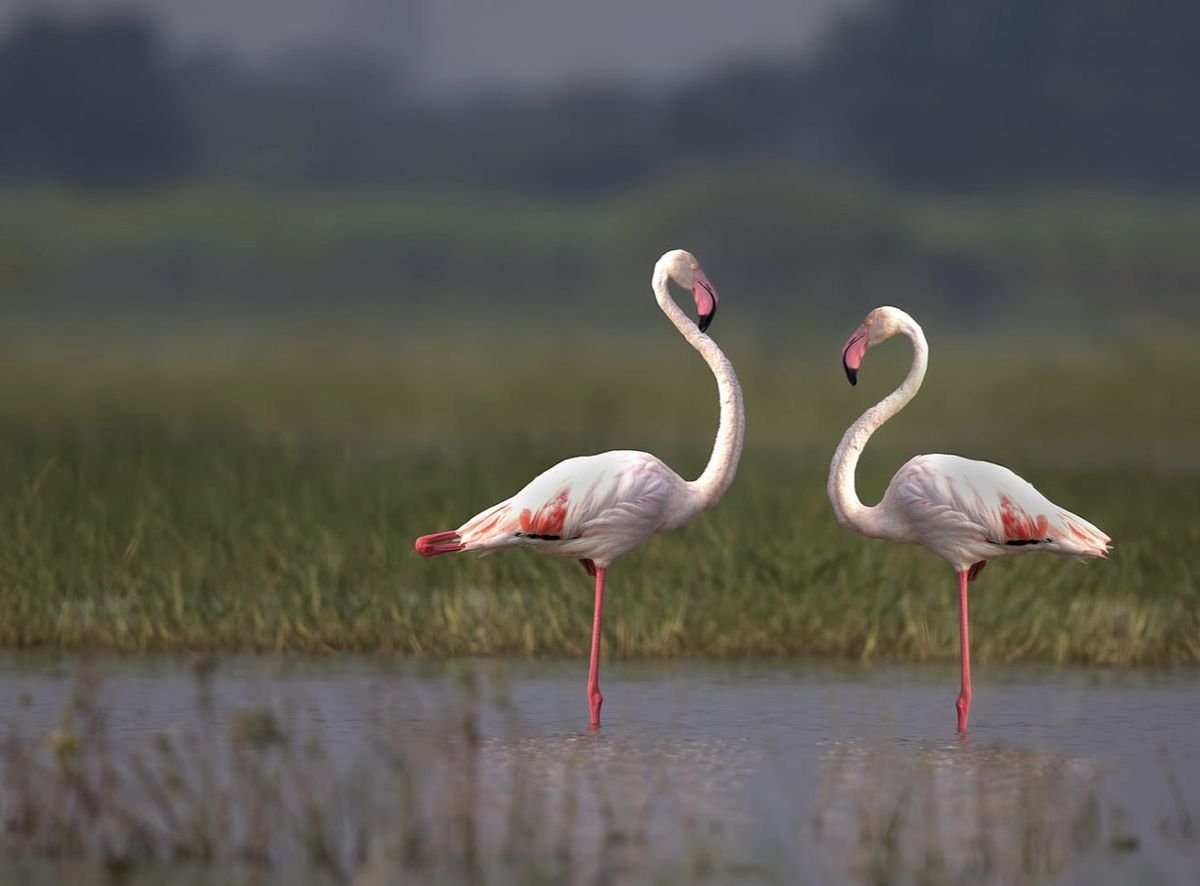
Greater Flamingo in Tanzania
Phoenicopterus roseus - the world's largest flamingoWhat Is the Greater Flamingo?
The Greater Flamingo (Phoenicopterus roseus) is the largest flamingo species in the world, recognized by its very long pink legs, pale pink plumage, long curved neck and pink bill with a black tip. Standing roughly 1.20-1.25 m tall, it is an unmistakable silhouette on any wetland horizon.
It thrives in shallow saline and alkaline wetlands, where its specialized filter-feeding bill strains aquatic invertebrates, algae and other small organisms from water and mud.
In Tanzania it is strongly associated with the Rift Valley lakes - including Lake Manyara and Lake Natron - and other suitable saline and alkaline wetlands, where it often feeds alongside its smaller relative, the Lesser Flamingo.
Scientific Classification
The Greater Flamingo is the only flamingo species of the Old World apart from the smaller Lesser Flamingo, and is treated as monotypic. It should not be confused with the American Flamingo (Phoenicopterus ruber) of the Caribbean and Galapagos.
How to Identify a Greater Flamingo
- Very long pink legs - among the longest relative to body size of any bird.
- Long, strongly curved neck with 19 cervical vertebrae.
- Pale pink to whitish body plumage; overall paler than the Lesser Flamingo.
- Darker flight feathers - conspicuous black flight feathers contrast with red/pink coverts in flight.
- Pink bill with a distinctive black tip, sharply bent downward.
- Webbed feet used for stirring up sediment while feeding.
- Large wings spanning approximately 1.40-1.87 m.
- Specialized filter-feeding bill lined with comb-like lamellae.
- Juveniles are grey-brown/whitish and only gradually acquire adult pink coloration.
Size Summary
- Height: approximately 1.20-1.25 m
- Wingspan: approximately 1.40-1.87 m
- Weight: approximately 2-4 kg (males heavier than females)
Why Are Greater Flamingos Pink?
The pink coloration comes from carotenoid pigments obtained in the diet. Food sources containing these pigments include small crustaceans (such as brine shrimp and their larvae), algae and other tiny organisms strained from saline and alkaline waters.
As flamingos metabolize these carotenoids, the pigments accumulate in feathers, skin and leg tissues, gradually turning grey juvenile plumage pink over time. Most birds acquire full adult coloration by around four years of age.
Fascinating detail: during the displaying period, Greater Flamingos rub uropygial (preen-gland) secretions rich in pigments such as canthaxanthin onto their neck, breast and back feathers - effectively applying make-up that makes displaying birds look brighter, a phenomenon researchers describe as cosmetic coloration.
The coloration is not camouflage: in most wetlands the pink actually makes colonies conspicuous, yet the caustic soda lakes they favor are so inhospitable to predators that being seen matters little.
Male vs Female: Key Differences
Males and females are broadly similar externally. Males are generally larger and heavier than females, but the sexes share the same pale pink plumage, black-tipped bill and long legs.
- Courtship: both sexes take part in the famous synchronized group displays.
- Nesting: both partners build the mud nest mound.
- Incubation: both parents share egg-warming duties.
- Chick care: both parents produce crop milk and feed the chick.
The defining social unit of this species is the colony - there are no separate bachelor groups or female-only family bands as sometimes described for mammals.
Colonies and Social Life
Greater Flamingos are genuinely highly social birds. They live, feed and breed in large colonies that may contain thousands of individuals - and in some locations more than 200,000 breeding pairs gather together.
This large-scale coloniality enables synchronized breeding, in which many pairs nest at the same time, as well as communal chick creches and coordinated movement between wetlands.
Colony Life
- Synchronized courtship: hundreds to thousands of birds perform coordinated head-flagging, wing-saluting and marching displays together.
- Shared space: nests sit closely packed on islands or secure shallows.
- Creche system: after about one week, chicks gather in large nurseries watched by a few supervising adults.
- Mate switching: pairs are seasonally monogamous; mates frequently change between breeding seasons.
Communication
Flamingos communicate through honking calls and colony vocalizations, synchronized group displays, deliberate head and neck movements and wing displays. Chicks and parents recognize each other by voice within the din of the creche - vital in colonies numbering tens of thousands of birds.
Habitat: Saline and Alkaline Wetlands
The Greater Flamingo is a wetland specialist with a strong preference for harsh, salty waters few other large birds tolerate:
- Saline and alkaline lakes - including soda lakes of the Rift Valley.
- Shallow lagoons and estuaries - coastal populations.
- Salt marshes and mudflats - rich in invertebrate prey.
- Shallow seasonal wetlands - used when water levels suit.
- Suitable reservoirs and other man-made wetlands where conditions verify.
These waters may be caustic to other animals, but they concentrate the brine shrimp, molluscs and algae flamingos strain from the mud - and provide island nest sites safe from ground predators.
Habitat and Global Distribution
The Greater Flamingo has a broad Old World distribution across Africa, southern Europe and parts of western and southern Asia - the widest range of any flamingo species. Populations occur around the Mediterranean, across sub-Saharan Africa, and from the Middle East through the Indian subcontinent.
Tanzania is one important portion of that African range thanks to its chain of Rift Valley lakes and other saline and alkaline wetlands - but the species is far from limited to Tanzania, and visitors to similar habitats elsewhere in Africa and southern Eurasia can encounter it too.
Greater Flamingo in Tanzania
Tanzania's Rift Valley lakes provide important feeding habitat for the Greater Flamingo, along with some breeding habitat in suitable years. The alkaline and saline waters concentrate the small crustaceans, molluscs and algae these birds filter from the mud.
Two sites stand out. Lake Manyara National Park is famed for its flamingo-flocked lakeshore, where historical counts record tens of thousands of Greater Flamingos feeding alongside vast flocks of Lesser Flamingos - at times nearly two million birds combined.
Lake Natron, further north near the Kenyan border, is a Ramsar-listed wetland of international importance. Its world-famous breeding colonies belong principally to the Lesser Flamingo, while Greater Flamingos use the fresher inflow zones and adjacent marshes to feed, and have nested in the region in some records. Sightings depend on local conditions - never guaranteed.
Where to See Greater Flamingos in Tanzania
Lake Manyara National Park
Country: Tanzania | Region: Northern Tanzania
The alkaline lakeshore is the park's visual centrepiece. Historical counts recorded roughly 40,000 Greater Flamingos here alongside huge Lesser Flamingo flocks - rose-pink lines visible from far away on clear days.
Good opportunity around suitable shallow water; numbers vary with lake conditions.
Lake Natron
Country: Tanzania | Region: Arusha Region (Rift Valley)
A Ramsar wetland and the world's most important Lesser Flamingo breeding site. Greater Flamingos feed in the fresher inflow zones and marshes; guided walks are available where permitted - never enter or disturb breeding colonies.
Good opportunity around suitable shallow water; sightings vary with season.
Other Rift Valley Wetlands
Country: Tanzania | Type: Saline/alkaline lakes & lagoons
Greater Flamingos move opportunistically between suitable saline and alkaline wetlands across the Rift Valley as water levels and food shift with the rains.
Presence changes seasonally; sightings are never guaranteed.
Safari & Birdwatching Methods
- Game drives along lake shores in national parks.
- Specialist birdwatching excursions focused on Rift Valley wetlands.
- Guided wetland walks where permitted - such as designated areas around Lake Natron.
- Photography from established viewpoints.
- Boat-based birding where officially available.
Best Time to See Them
Greater Flamingos can be encountered year-round at suitable Tanzanian wetlands. Their abundance and location change with water levels, salinity, food availability, rainfall, seasonal movements and breeding conditions. For Lake Natron, Lesser Flamingo breeding generally falls within an August-December window when water levels expose nesting pans; some historical records note Greater Flamingo breeding activity peaking around October-November, though conditions vary year to year.
Greater Flamingo in Pictures
A closer look at the Greater Flamingo in its natural East African habitat — its striking appearance, habitat and behaviour are best appreciated up close.
Where to Spot the Greater Flamingo on Safari
Plan your trip around the destinations and safaris where the Greater Flamingo is easiest to see. Explore the parks, itineraries and tour packages by destination below.
What Does the Greater Flamingo Eat?
The diet is a filter-fed buffet of small aquatic life, and it varies according to local wetland conditions:
- Crustaceans - including brine shrimp and amphipods.
- Molluscs - small snails and bivalves.
- Aquatic insect larvae - especially midge and fly larvae.
- Annelids - bristleworms and other worms.
- Microalgae and diatoms strained from water and mud.
- Seeds and other small aquatic food organisms.
Unlike the Lesser Flamingo - which depends heavily on microscopic cyanobacteria in soda lakes - the Greater Flamingo takes a broader, more varied catch across many wetland types.
How Does a Greater Flamingo Feed?
- Wades into shallow water on those stilt-like legs.
- Bends its long neck downward, often sweeping the bill side-to-side or upside-down through the water.
- Immerses the bill so the comb-like lamellae inside are submerged.
- Pumps the tongue rhythmically, drawing water and mud across the lamellae like a sieve.
- Retains food particles - crustaceans, larvae, molluscs, algae and diatoms.
- Expels excess water and sediment back out of the bill margins.
- Stirs the sediment with webbed feet to flush prey into the current.
This tongue-pump filtration runs almost continuously while feeding - and flamingos feed both day and night whenever conditions suit.
Daily Behaviour
Greater Flamingos divide their time among feeding, resting, preening, social displays, movement between wetland areas and colony activity. They may feed during the day or at night.
Daily activity varies with food availability, temperature, water conditions, breeding stage and local disturbance - there is no fixed timetable that holds across lakes or seasons.
Breeding, Eggs, Chicks and Creches
- Nest: a conical mound of mud built in shallow saline or alkaline wetlands, often on islands or secure flats safe from ground predators.
- Eggs: usually one chalky-white egg per breeding attempt; some authoritative references record 1-2 eggs, and a replacement egg may be laid if the first is lost early.
- Incubation: approximately 27-36 days, shared by both parents atop the nest mound.
- Crop milk: chicks are fed regurgitated secretions from the upper digestive tract - produced by BOTH parents, not just the mother.
- Leaving the nest: chicks depart the nest at around 7-10 days old.
- Creches: from about 10-12 days they join communal nurseries supervised by a few adults.
- Fledging: flight feathers develop at roughly 71-98 days (around 10-14 weeks).
- Departure: juveniles leave breeding areas at approximately 80-140 days old.
- Maturation: adult plumage develops by about four years; most birds first breed around five to six years old.
Colonies are highly sensitive to disturbance during this cycle - frightened adults can abandon nests en masse, causing total reproductive failure in a season.
Conservation Status: Least Concern
IUCN Red List Status: Least Concern. The global population is estimated at roughly 690,000-910,000 individuals, and the species occupies a vast range across Africa, southern Europe and Asia.
Least Concern does not mean local colonies face no threats. The main pressures are all tied to wetlands:
- Breeding disturbance - colony abandonment caused by human intrusion, aircraft or vehicles.
- Changing water levels - both flooding of nests and drying of feeding pans.
- Wetland degradation and habitat loss.
- Pollution and toxins in water supplies.
- Collisions with powerlines and other structures.
- Lead poisoning and hunting or harassment where documented.
Natural Predators
Healthy adults are rarely threatened thanks to their size and colony setting. Eggs and chicks, however, are vulnerable to aerial predators such as marabou storks, eagles and vultures, and to opportunistic ground predators when falling water levels expose nests.
Why Wetland Protection Matters
Successful breeding depends entirely on secure, undisturbed wetlands with stable water levels. Lake Natron's Ramsar designation (2001) recognizes exactly this - and past development proposals there have shown how quickly such irreplaceable sites can come under pressure. Responsible tourism, pollution reduction, water-level management and breeding-colony protection remain the species' real safeguards.
Greater Flamingo Facts
Greater Flamingo vs Lesser Flamingo
Both species share Tanzania's Rift Valley lakes, and visitors may see them side by side. Here is how to tell them apart:
| Feature | Greater Flamingo | Lesser Flamingo |
|---|---|---|
| Scientific name | Phoenicopterus roseus | Phoeniconaias minor |
| Size | Taller - approximately 120-125 cm; 2-4 kg | Smaller - around 80-90 cm; 1.2-2.7 kg |
| Colour | Paler pink overall, whitish body tones | Generally deeper, more intense pink |
| Bill pattern | Pink with a black tip only | Dark red/crimson with much more extensive black |
| Diet | Broader filter-feeding: crustaceans, molluscs, larvae, annelids, algae, diatoms | Strongly specialized on microscopic cyanobacteria (Spirulina) of soda lakes |
| Tanzania locations | Lake Manyara, Lake Natron inflow zones and other suitable wetlands | Lake Natron (major world breeding site) plus soda lakes such as Manyara |
| Conservation status | Least Concern | Near Threatened |
Important: the world-famous Lake Natron flamingo spectacle is dominated by Lesser Flamingos, whose only reliable large-scale East African breeding ground since 1962 is this lake. Greater Flamingos also occur there - mainly in fresher inflow zones and marshes - but do not assume every pink crowd at Natron is the Greater species. Visitors may well see both.
Greater Flamingo vs African Spoonbill
| Feature | Greater Flamingo | African Spoonbill |
|---|---|---|
| Scientific name | Phoenicopterus roseus | Platalea alba |
| Family | Phoenicopteridae (flamingos) | Threskiornithidae (ibises & spoonbills) |
| Colour | Pale pink with black flight feathers | All-white with red face and bill |
| Bill | Downward-bent, lamellae-lined filter | Flat, spatulate tip swept side-to-side |
| Feeding method | Tongue-pump filtration of mud & water | Open-bill sweeping through shallow water |
| Shared habitat | Shallow alkaline/saline wetlands - both occur around Lake Manyara and other Rift Valley waters | |
Why Greater Flamingos Are a Tanzania Birdwatching Icon
Few sights define Tanzanian wetland safari memories like a horizon rimmed pink. Three things earn this species its icon status:
- The pink lake spectacle: tens of thousands of flamingos packed along alkaline shores - visible from kilometres away - turn entire lakes rose.
- Living wetland ecology: their tongue-pump filter feeding processes tonnes of sediment, linking algae, crustaceans and open water into one visible food-web story.
- A conservation success story worth telling: from Lake Manyara's roadside flocks to the Ramsar-protected flats of Lake Natron - the nursery of most of the world's Lesser Flamingos - these birds show why protecting harsh little wetlands matters globally.
For photographers and birders alike, no northern-circuit itinerary feels complete without a flamingo day.
Photographing the Greater Flamingo
- Head-down feeding - the classic upside-down filtering pose, often in mirror-still shallows.
- Synchronized flight columns - long skeins crossing the lake at dawn or dusk.
- Colony landscapes - thousands of birds stretching to the horizon (from permitted distances).
- Reflections - pale-pink silhouettes doubled on soda-flat water.
- Courtship marches - groups head-flagging and wing-saluting in unison.
- Creche scenes - grey juveniles huddled in nurseries attended by adults.
- ID comparisons - frame Greater beside Lesser to show size and bill differences.
- Detail shots - the black-tipped bill curve and carotenoid-pink leg joints up close.
Ethics first: use long lenses, keep legal distances, never approach nests or drive toward flocks, avoid drones near colonies and always follow park rules and your guide's instructions - disturbed colonies abandon eggs and chicks.
Frequently Asked Questions
The largest of the world's six flamingo species, Phoenicopterus roseus stands about 1.20-1.25 m tall and is recognized by pale pink plumage, a long curved neck, stilt-like legs and a pink bill with a black tip. It has the widest range of any flamingo, spanning Africa, southern Europe and western/southern Asia.
The best-known sites are Lake Manyara National Park - where historical counts recorded tens of thousands feeding on the alkaline lakeshore - and Lake Natron, whose fresher inflow zones and marshes attract feeding birds. They also move opportunistically between other suitable saline and alkaline wetlands across the Rift Valley.
Yes, but in smaller numbers than Lesser Flamingos. Greater Flamingos use Lake Natron's fresher inflow zones, hot-spring seeps and adjacent marshes for feeding, and have nested in the region in some records. The world-famous mass breeding colonies at Natron belong principally to the Lesser Flamingo.
Greater: taller (120-125 cm vs 80-90 cm), paler overall, with a pink bill bearing only a black tip, and a broad filter-fed diet. Lesser: deeper pink, much more extensive black on a dark red bill, strongly specialized on microscopic cyanobacteria, and Near Threatened globally. Size difference is obvious when the two stand together.
A varied catch strained from water and mud: small crustaceans such as brine shrimp and amphipods, molluscs, aquatic insect larvae, annelid worms, microalgae, diatoms and seeds. Diet composition shifts with whatever each wetland produces.
Their coloration comes from carotenoid pigments in their food - small crustaceans, algae and similar organisms. These pigments accumulate in feathers, skin and legs. Chicks hatch grey-white and turn pink gradually as they grow; during courtship birds even apply pigment-rich preen-gland oils that boost their brightness.
It wades into shallow water, bends its long neck down and immerses its bent bill, then pumps its muscular tongue to draw water and mud across comb-like lamellae that trap food while excess water and sediment are expelled. It often stirs the bottom with its webbed feet to flush prey loose, feeding day or night.
Usually one chalky-white egg per breeding attempt; some authoritative references record 1-2 eggs, and a replacement clutch may follow early loss. The single egg sits atop a conical mud mound built by both parents in a shallow saline or alkaline wetland.
Approximately 27-36 days, shared by both parents, who take turns warming the egg on top of the nest mound.
Yes - both parents produce crop milk, a nutrient-rich secretion from the lining of the upper digestive tract, which they regurgitate to the chick. This continues after chicks leave the nest at 7-10 days and join communal creches supervised by a few adults.
Extremely. They live, feed and breed in colonies ranging from thousands to over 200,000 pairs in some locations. Colonial life enables synchronized breeding displays, shared creches for chicks and coordinated movement between wetlands.
No - it is listed as Least Concern on the IUCN Red List, with a global population estimated at roughly 690,000-910,000 individuals. That said, local colonies face real pressures: breeding disturbance, changing water levels, wetland degradation, pollution, collisions and hunting where documented.
They can be encountered year-round at suitable wetlands; numbers shift with water levels, salinity, food and seasonal movements rather than following a fixed calendar. Around Lake Natron, flamingo activity generally builds within the August-December window when conditions expose feeding pans and nesting sites.
Related Safari Packages & Tours
Book a safari to see the Greater Flamingo and the rest of Africa's incredible wildlife with our expert guides.
References & Further Reading
- BirdLife International (IUCN Red List): Phoenicopterus roseus factsheet - Least Concern assessment.
- Birds of the World (Cornell Lab of Ornithology): Salvador, Rendon, Amat & Rendon-Martos - breeding biology, 27-36 day incubation, creche timing, fledging 71-98 days, population estimate.
- EAZA Greater Flamingo species fact sheet: longevity exceeding 40 years.
- NASA Earth Observatory: Lake Natron - Ramsar site and East African flamingo breeding ecology.
- TAWIRI study: Mmassy et al., population status and trend of lesser flamingos at Lakes Natron and Manyara, Tanzania.
- About these facts: measurements and timings are approximate ranges drawn from available sources; they vary with sex, age, region and method.