

.png)
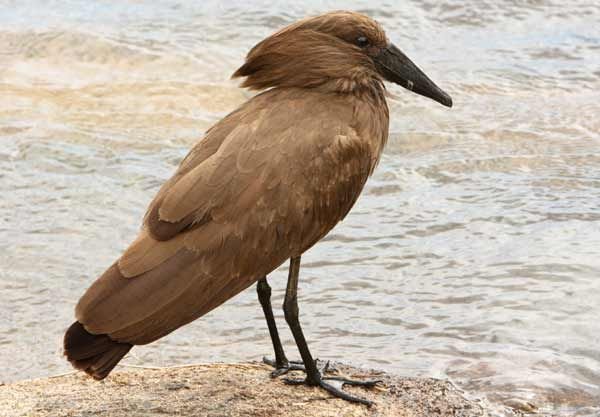
Hamerkop in Tanzania
Scopus umbretta - Africa's master nest builderWhat Is a Hamerkop?
The Hamerkop (Scopus umbretta) is one of Africa’s most distinctive waterbirds - named for its hammer-shaped head, cloaked in undistinguished brown plumage, and celebrated for building the largest domed nests of any bird on Earth.
It haunts freshwater: rivers, lakes, marshes, seasonal ponds and floodplains, where it stalks frogs, small fish, shrimp and insects in the shallows - sometimes spreading its wings like an umbrella to shade the water and draw fish close.
But it is the nest that made this bird famous: an enormous oven-shaped mass of sticks weighing up to 25-50 kg, complete with a mud-lined chamber and a fortified entrance tunnel - so sturdy a full-grown person can stand on it.
In Tanzania, Hamerkops are widespread in suitable freshwater habitats, from Tarangire’s swamps to Lake Duluti near Arusha.
Scientific Classification
The Hamerkop is the sole living member of both its genus and its family - a lineage with no close relatives alive today. Once placed among the storks (Ciconiiformes), modern classification puts it in the Pelecaniformes, where its nearest relatives are thought to be pelicans and the Shoebill. Two subspecies are generally recognized.
How to Identify a Hamerkop
- All-brown, dusky plumage - slightly paler throat and underparts; juveniles resemble adults.
- Hammer-shaped head silhouette - a square, blunt crest projecting backwards joins the long bill like a hammerhead.
- Broad, flattened, laterally compressed bill with a slight hook at the tip.
- Long legs (relatively short for a wader) with partially webbed toes.
- Large wings enabling soaring glides; compact body about the stature of a slim chicken.
- Unmistakable silhouette - no other African bird looks remotely similar.
Size Summary
- Length/height: approximately 47-56 cm
- Wingspan: approximately 90-94 cm
- Mass: approximately 415-430 g, depending on source/individual
Why Is It Called a Hamerkop?
The name comes from Afrikaans, meaning roughly "hammerhead." Viewed side-on, the bird’s combination of a long bill and a backward-projecting crest at the back of the skull traces the outline of a hammer - bill as handle, crest as head.
That is the entire story of the name: pure shape-based description, no hidden meaning required. Everything else extraordinary about this species lies in what it builds rather than what it is called.
Male vs Female: Key Differences
Males and females are broadly similar externally - alike in plumage, with no reliable field difference reported by major references.
Pairs work together through every breeding stage:
- Nest construction - both sexes weave the giant structure (sometimes helped by additional birds).
- Incubation - shared duties on the eggs.
- Feeding young - both parents deliver food.
- Territory defense - the pair holds its stretch of water together.
Hamerkop Calls and Courtship
For such a famous architect, the Hamerkop is surprisingly vocal and theatrical:
- Calls: a shrill "yip" in flight and a range of cackles used between partners and at nests.
- Group ceremonies: up to ten birds may gather to run circles around each other, hopping, raising crests, fluttering wings and calling in chorus.
- "False mounting": the most bizarre documented display - one bird stands on another’s back flapping for balance, often calling incessantly; groups may take turns, sometimes stacking a third bird on top. The true purpose is unknown.
- Mutual preening: allopreening reinforces pair bonds alongside these displays.
Tanzanian visitors who witness a full ceremony rarely forget it - equal parts dance, wrestling and comedy.
Hamerkop Habitat and Distribution
The Hamerkop is strongly associated with freshwater:
- Rivers and streams - forested and open reaches alike.
- Lakes, marshes and swamps - classic foraging waters.
- Seasonal ponds and floodplains.
- Reservoirs, dams and irrigation channels - readily adopted artificial waters.
- Riparian habitats - trees overhanging water double as nest sites.
Savanna landscapes are used too - but as backdrop, not requirement: what the Hamerkop needs is accessible shallow freshwater plus a sturdy tree fork or cliff ledge for its monumental nest. Some individuals range broadly across terrestrial landscapes provided water remains within reach; estuaries are avoided and open coastlines rarely visited.
Globally the species occurs across sub-Saharan Africa, Madagascar and a narrow strip of the southwestern Arabian Peninsula. Tanzania is an important part of that African range.
Global Distribution
Hamerkops occur broadly across sub-Saharan Africa, Madagascar and a narrow strip of the southwestern Arabian Peninsula, from Senegal and Sudan south to the Cape. Two subspecies are generally recognized; tropical populations are largely sedentary.
Tanzania is an important part of this African range - but the species belongs to the whole continent’s freshwaters, not one country alone.
Hamerkop in Tanzania
Hamerkops are widespread across Tanzania wherever suitable freshwater exists. Documented Tanzanian records include:
- Tarangire National Park - river pools and swamp margins below the great baobabs.
- Lake Duluti - this crater lake near Arusha is a well-known Hamerkop setting, with nests recorded around its forested shore.
- Kisema Ngeda - a documented site in Tanzanian birding records.
- Serengeti National Park - rivers and hippo pools across the ecosystem.
- Ruaha National Park - the Great Ruaha River and its tributaries.
Sightings are never guaranteed, but any patient scan of a quiet shoreline or bridge pool often turns up that familiar brown silhouette.
Where to See Hamerkops in Tanzania
Tarangire National Park
Country: Tanzania | Region: Northern Tanzania
Documented occurrence; scan river pools and Silale Swamp edges where frogs and small fish concentrate.
Good opportunity near suitable freshwater habitat.
Lake Duluti / Arusha Area
Country: Tanzania | Region: Arusha
This forested crater lake near Arusha is a classic Hamerkop locality - easy to combine with a city stay.
Good opportunity near suitable freshwater habitat.
Serengeti National Park
Country: Tanzania | Region: Northern Tanzania
Documented occurrence along rivers, oxbow pools and hippo pools throughout the ecosystem.
Good opportunity near suitable freshwater habitat.
Ruaha National Park
Country: Tanzania | Region: South-central Tanzania
Documented occurrence along the Great Ruaha River system and its sandy seasonal tributaries.
Good opportunity near suitable freshwater habitat.
Kisema Ngeda
Country: Tanzania | Type: Birding locality
A documented site in Tanzanian birding contexts - worth a stop for list-builders in the region.
Good opportunity near suitable freshwater habitat.
Safari & Birding Methods
- Game drives along rivers and lake shores.
- Specialist birdwatching excursions.
- Wetland birding sessions at pools and dams.
- Guided birding walks where permitted - Lake Duluti trails are ideal.
- Wildlife photography from bridges, hides and boat trips.
- Observation near lakes/rivers at lodges and camps.
Best Time to See Them
Hamerkops can be encountered year-round around suitable freshwater habitats. Visibility depends on water availability, prey, breeding activity, habitat and weather. In southern Africa breeding peaks around August-September, but that regional pattern should not be read as Tanzania’s universal calendar - local conditions rule here too.
Hamerkop in Pictures
A closer look at the Hamerkop in its natural East African habitat — its striking appearance, habitat and behaviour are best appreciated up close.
Where to Spot the Hamerkop on Safari
Plan your trip around the destinations and safaris where the Hamerkop is easiest to see. Explore the parks, itineraries and tour packages by destination below.
What Does a Hamerkop Eat?
The menu is wetland protein with opportunistic extras:
- Frogs and toads - a primary target; in some regions platanna frogs (Xenopus) are locally important prey.
- Small fish seized in shallows.
- Shrimp and other crustaceans.
- Insects - grasshoppers, beetles and termite alates when swarming.
- Earthworms and other aquatic/terrestrial invertebrates.
- Occasional small mammals and scavenged scraps, including roadkill.
No single prey species dominates everywhere - the Hamerkop takes what its local water produces.
How Does a Hamerkop Hunt?
- Forages in shallow water, probing around vegetation and mud with the flattened bill.
- Takes frogs and fish with quick jabs; prey is often beaten on the ground before swallowing.
- Captures small terrestrial prey along banks - grasshoppers flushed by passing herds of cattle, buffalo or even banded mongooses are snapped up as the birds use the animals as beaters.
- Spreads its wings to shade the water - like a portable umbrella - cutting glare and drawing fish into the cool patch within striking range.
- Even forages aerially, hawking low over the water surface, and has been observed hunting from the backs of hippos.
Few African waterbirds show such a flexible toolkit - ambusher, prober, flycatcher and follower all in one brown package.
The Extraordinary Hamerkop Nest
No African bird builds anything like it. The Hamerkop nest is an enormous, oven-shaped dome of sticks, reeds, grass and debris - the largest roofed nest of any bird species:
- Scale: up to ~2 m wide and tall, with a roof at least 1 m thick; completed nests can weigh 25-50 kg.
- Materials: several thousand interwoven sticks (one Ugandan study estimated over 8,000) plus reeds and aquatic vegetation - sometimes decorated with bright-coloured objects.
- Architecture: a central chamber roughly 30-50 cm across, plastered with mud by the female using mud delivered by her partner - and a steep entrance tunnel on the least accessible side, smoothly plastered to thwart intruders.
- Engineering: construction takes anywhere from three weeks to six months; the finished roof is strong enough to support the weight of a full-grown person.
- Location: sturdy tree forks overhanging water are preferred; cliff ledges and other structures also serve.
Pairs may build more than one nest - some never used for breeding - and a well-maintained nest can be reused for up to four years. Why so large? The true purpose remains debated; security, a stable warm microclimate and protection from usurpers are leading explanations.
Hamerkop Breeding and Nesting
Hamerkops are generally monogamous, solitary nesters - pairs typically raise about one brood per year, though timing varies geographically across the vast range (southern African populations show an egg-laying peak around August-September).
- Eggs: clutches of plain white eggs; sources record 3-7 per clutch, averaging approximately 4-5.
- Incubation: approximately 30 days, duties shared by both parents.
- Chicks: hatch with grey down; both parents feed them in the mud-lined chamber.
- Fledging: approximately 44-50 days in source-based records; fledglings remain agile around the nest and may roost on or in it for weeks more.
Both sexes build the nest equally - occasionally assisted by additional birds - and pairs famously construct multiple structures per territory, some never used for eggs at all.
What Animals Use Old Hamerkop Nests?
An abandoned Hamerkop nest is real estate too good to waste. Scientific literature across Africa has documented at least 20 other bird species using Hamerkop nests - plus bees, mammals and reptiles.
Documented users include:
- Egyptian Goose - the most notorious usurper, sometimes evicting builders mid-season.
- Western Barn Owl - takes over domes for its own broods.
- Kestrels and other owls - cavity-and-structure nesters that adopt the chamber.
- Assorted other birds that shelter or breed within the mass of sticks.
Nests may be usurped while still occupied or recycled after abandonment. In this way each Hamerkop masterpiece can become a small apartment block - housing generation after generation of entirely unrelated tenants.
Conservation Status: Least Concern
IUCN Red List Status: Least Concern. The species holds a broad range across sub-Saharan Africa, Madagascar and southwest Arabia, and its global population appears stable - even increasing locally as artificial wetlands such as dams and irrigation channels create new habitat.
Local pressures still matter:
- Wetland degradation and declining water quality (including pesticide impacts).
- Loss of large suitable nesting trees near water.
- Disturbance at nests and roosts.
- Changes to fish/amphibian prey availability and water regimes.
The conservation principles that protect Hamerkops are landscape-wide rather than species-specific: freshwater protection, wetland vegetation, nesting-tree retention, healthy amphibian and fish populations, and responsible wetland tourism. No species-specific programme claims are made here - the bird’s adaptability is its best defence.
Hamerkop Facts
Hamerkop vs African Spoonbill
| Feature | Hamerkop | African Spoonbill |
|---|---|---|
| Family | Scopidae - sole species in the family | Threskiornithidae - Platalea |
| Size | 47-56 cm; 415-430 g | Larger wader (~90 cm) |
| Bill | Broad, flattened, hooked tip - jabs prey | Flat spatula swept side-to-side |
| Nesting | Giant domed stick fortress, solitary pairs | Colonial stick nests in reeds/trees |
| Social behavior | Solitary/pair-based | Highly colonial |
| Tanzania distribution | Freshwater countrywide incl. Lake Duluti | Rift Valley lakes & wetlands |
Hamerkop vs Grey Heron
| Feature | Hamerkop | Grey Heron |
|---|---|---|
| Family | Scopidae (own family) | Ardeidae (herons) - Ardea cinerea |
| Size | 47-56 cm; ~420 g | 84-102 cm; 1.02-2.08 kg |
| Plumage | All-brown, hammerhead crest | Grey/white, black crest-stripe |
| Feeding technique | Probe, jab, wing-shade, aerial hawking, follows grazers | Stand-and-wait ambush + slow stalk strike |
| Prey focus | Frogs, tadpoles, small fish, shrimp, insects | Fish-dominated opportunist |
| Nest | Huge domed multi-season fortress | Open stick platform in heronries |
| Tanzania viewing | Tarangire, Lake Duluti, Serengeti, Ruaha | Manyara, Tarangire, Arusha NP, Wami River |
The Hamerkop in African Folklore
Across parts of Africa, the Hamerkop’s strange silhouette, raucous calls and colossal nests have earned it a place in numerous local legends and superstitions - some traditions treat the bird with respect bordering on reverence, others regard it as an omen, and recorded beliefs include dramatic responses to a Hamerkop flying directly overhead.
Details vary from community to community and are not uniform across Tanzania or the continent; rather than repeat any single tale as fact, travellers are best served by asking local guides what the bird means where they live. What is universal is the reaction the nest provokes: few birds anywhere inspire so much storytelling simply by building a home.
Photographing the Hamerkop
- Hammer-shaped head profile - the signature shot at water level.
- The giant nest itself - wide-angle context plus detail of the entrance tunnel.
- Birds carrying nesting material - stick-laden commutes to the fork.
- Frog capture and wing-shading - burst mode when the wings open.
- Pair interactions - mud delivery, allopreening.
- False-mounting ceremonies - if you are lucky enough to witness one.
- Wetland landscapes with the brown silhouette anchoring the frame.
- Old nests in use - photograph tenants (owls, geese) only from permitted distances.
Ethics first: never disturb nests - Hamerkop structures are multi-year assets for many species. Keep to tracks, use long lenses, follow park rules and your guide’s instructions.
Frequently Asked Questions
A medium-sized African waterbird (Scopus umbretta) with all-brown plumage and a hammer-shaped head, famous for building the largest roofed nests of any bird. It is so unique that it is the sole living member of its entire family, Scopidae, and it haunts freshwater habitats across sub-Saharan Africa, Madagascar and southwest Arabia - including Tanzanian rivers and lakes.
The name comes from Afrikaans, meaning roughly "hammerhead": viewed side-on, the long bill and backward-projecting crest at the back of the head trace the outline of a hammer. It is pure shape-based description of the bird's most distinctive feature.
Documented locations include Tarangire National Park, Lake Duluti near Arusha (a classic Hamerkop locality), Kisema Ngeda, Serengeti National Park's rivers and hippo pools, and Ruaha's Great Ruaha River system. Any quiet freshwater shoreline may hold one.
Wetland protein: frogs and toads (including Xenopus platannas in some regions), small fish, shrimp and other crustaceans, grasshoppers, beetles, swarming termites, earthworms and other invertebrates - plus occasional small mammals and scavenged scraps. No single prey dominates everywhere; local waters dictate the menu.
It probes shallows around vegetation and mud, jabs frogs and fish, captures insects flushed by grazing animals (using them as beaters), hawks prey aerially over water, has been seen hunting from hippos' backs - and famously spreads its wings to shade the surface, drawing fish into the cool patch within strike range.
Up to about 2 metres wide and tall, with a roof at least a metre thick, weighing 25-50 kg built from thousands of interwoven sticks - one Ugandan study estimated over 8,000. The central chamber measures 30-50 cm and is mud-plastered; the finished roof can support a person's weight.
Nobody knows for certain - the true purpose remains debated. Leading explanations include security from intruders, a stable warm microclimate allowing bigger clutches and longer unattended nestling periods, and defence against usurpers. The extravagance may simply have no single cause.
Sources record clutches of plain white eggs ranging from 3 to 7, averaging approximately 4-5 per nesting attempt. Pairs typically raise one brood per year, though timing varies geographically across the range.
Approximately 30 days, with both parents sharing incubation duties on the mud-lined chamber inside the dome.
Approximately 44-50 days in source-based records. Fledglings become agile flyers but often continue roosting in or on the nest for weeks afterwards while perfecting their skills.
Generally solitary or pair-based. Small groups of 4-5 occur, and up to ~50 birds may gather at exceptionally rich feeding sites - but large concentrations are contextual exceptions, not a default social structure. The mated pair is the social core.
Yes - scientific literature documents at least 20 other bird species using Hamerkop nests across Africa. Egyptian Geese and Western Barn Owls are the most notorious usurpers, with kestrels, other owls and assorted structure-nesters among documented users; bees, mammals and reptiles also move in. Not every species uses every nest, of course.
No - it is listed as Least Concern on the IUCN Red List. The range is vast and the population appears stable or increasing locally, aided by artificial wetlands like dams and irrigation channels. Local pressures include wetland degradation, pesticide effects and loss of large nesting trees.
Year-round wherever suitable freshwater exists. Visibility depends on water availability, prey and breeding activity rather than any fixed calendar; southern Africa's August-September laying peak is a regional pattern, not Tanzania's universal rule. Dawn at a known nest site is always productive.
Related Safari Packages & Tours
Book a safari to see the Hamerkop and the rest of Africa's incredible wildlife with our expert guides.
References & Further Reading
- BirdLife DataZone: Scopus umbretta factsheet - Least Concern assessment; nest description.
- BDI (Biodiversity & Development Institute): Hamerkop species text - nest architecture, false-mounting displays, breeding data.
- Birds of the World (Cornell Lab): Hamerkop account - taxonomy, subspecies, distribution.
- Uganda behaviour observations (ResearchGate): stick-count estimates of 8,000+ per nest.
- Oiseaux-Birds / Avibase / zoo references: biometrics, wing-shading foraging, courtship descriptions.
- About these facts: measurements and timings are approximate ranges drawn from available sources; they vary with sex, age, region and method.
Sightings are never guaranteed and depend on local conditions.

Daily Behavior and Social Life
Hamerkops are diurnal birds - active by day (with some crepuscular-adjacent dusk activity noted by regional authorities), spending daylight hours feeding, resting, preening, holding territories and maintaining nests.
There are no bachelor troops or hierarchies here - the pair bond is the social core of Hamerkop life.