

.png)
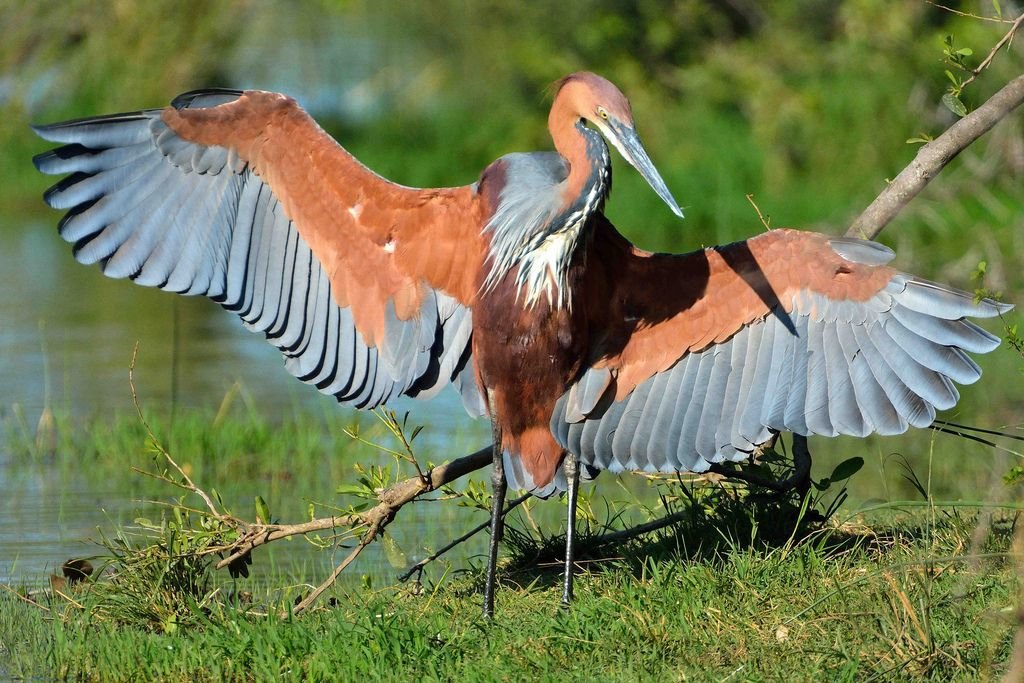
Goliath Heron
Ardea goliath - the world's largest heronIntroduction to the Goliath Heron
The Goliath Heron (Ardea goliath) is the world’s largest living heron, standing up to 152 cm tall with a wingspan exceeding 230 cm. Its slate-grey back, chestnut head and neck, massive dagger-like bill and long dark legs create one of Africa’s most imposing wetland silhouettes.
Highly aquatic and rarely far from water, it hunts alone in the shallows of lakes, rivers and swamps across sub-Saharan Africa. In Tanzania, its enormous presence is felt at Nyerere National Park, Lake Manyara, Ruaha, Tarangire and Serengeti - a prized sighting for any birdwatcher.
Scientific Classification
The genus name Ardea is Latin for heron; 'goliath' references the biblical giant, reflecting its enormous size relative to all other herons worldwide.
How to Identify a Goliath Heron
- Enormous size: height 120-152 cm; wingspan 185-230 cm; weight 4-5 kg.
- Chestnut head, crest and neck with black streaks on foreneck and upper breast.
- Slate-grey back and upper wings.
- Pale throat and upper breast streaked with black.
- Massive dark dagger-like bill: 18-20 cm long.
- Long dark legs adapted for wading in water up to ~40 cm deep.
- Chestnut shoulder patch visible when wings folded.
- Juveniles: rustier upperwings than adults.
Male vs Female: Key Differences
Male and female Goliath Herons are broadly similar in appearance. Males are slightly larger. During breeding, pairs cooperate in nesting and parental care.
Goliath Heron Chicks and Nestling Development
Both parents share incubation and chick-rearing duties. Siblicide is common in this species - older chicks may out-compete or attack their nest mates - so despite clutches of 3-4 eggs, often only 1-2 young survive to fledge.
- Hatching: Chicks hatch asynchronously (at intervals), covered in down.
- Feeding: Parents feed chicks by regurgitation, delivering fish and other wetland prey.
- Growth: Young grow quickly on a protein-rich fish diet.
- Leaving the nest: Around 5 weeks after hatching, young leave the nest but remain nearby.
- Extended care: Parents continue tending fledged young for another 40-80 days as they learn to hunt.
- Independence: Juveniles gradually disperse once fully self-sufficient.
Habitat: Lakes, Rivers and Wetlands
The Goliath Heron is highly aquatic - even by heron standards - rarely venturing far from water:
- Lakes and rivers - primary foraging habitat.
- Swamps, marshes and floodplains - shallow-water hunting grounds.
- Mangrove wetlands and river deltas - coastal populations.
- Shallow water with aquatic vegetation - ideal feeding depth ~20-40 cm.
The species is highly aquatic and rarely ventures far from water sources.
Distribution Across Africa and Beyond
The Goliath Heron is found across sub-Saharan Africa wherever large water bodies exist, with smaller declining populations extending into Southwest Asia (Iraq, Oman) and South Asia (India, Sri Lanka). It avoids dense forest and extreme deserts but occupies nearly every other aquatic habitat type within its range.
Goliath Heron in Tanzania
Tanzania contains extensive freshwater and wetland habitat ideal for this species. The Rufiji River system in Nyerere National Park, the lake shallows of Lake Manyara National Park, the Great Ruaha River in Ruaha National Park and the wetland margins of the Serengeti all provide suitable habitat. Boat safaris on the Rufiji offer particularly good opportunities to observe this enormous heron at close range.
Sightings depend on local conditions, water levels and guide knowledge - never guaranteed.
Where to See Goliath Herons in Tanzania
Nyerere National Park
Region: Southern Tanzania
The Rufiji River and its oxbow lagoons are prime Goliath Heron habitat; boat safaris offer close encounters.
Good opportunity around suitable water; sightings are not guaranteed.
Lake Manyara National Park
Region: Northern Tanzania
Lake shallows and groundwater-fed marshes attract this species year-round.
Good opportunity around suitable water; sightings are not guaranteed.
Ruaha National Park
Region: South-central Tanzania
The Great Ruaha River provides permanent shallow-water habitat.
Good opportunity around suitable water; sightings are not guaranteed.
Tarangire National Park
Region: Northern Tanzania
Silale Swamp and river pools attract this species during dry-season concentrations.
Good opportunity around suitable water; sightings are not guaranteed.
Best Time to See Them
Goliath Herons can be encountered year-round in suitable Tanzanian wetlands. Dry-season concentration around remaining water can sometimes make wetland birds easier to locate, but visibility varies with water level, fish abundance, local habitat, weather and guide knowledge.
Goliath Heron in Pictures
A closer look at the Goliath Heron in its natural East African habitat — its striking appearance, habitat and behaviour are best appreciated up close.
Where to Spot the Goliath Heron on Safari
Plan your trip around the destinations and safaris where the Goliath Heron is easiest to see. Explore the parks, itineraries and tour packages by destination below.
What Does the Goliath Heron Eat?
The diet is primarily fish, specialising in relatively large prey averaging 30 cm and 500-600 g:
- Fish (primary): tilapia, bream, catfish, mullet, carp and barbel.
- Opportunistic extras: frogs, rodents and other small mammals, crabs, prawns, lizards, snakes, insects and even carrion.
The species catches approximately 2-3 large fish per day, ignoring small prey in favour of substantial meals.
Daily Behaviour and Territoriality
Goliath Herons are primarily diurnal, though some nocturnal activity may occur. They may spend long periods standing motionless while waiting for fish. Activity varies with prey, water conditions, weather and disturbance.
Social Structure
- Feeding: solitary and strongly territorial while feeding - drives away other herons entering its stretch of shoreline.
- Breeding: pairs form during breeding season; colonies possible depending on location.
- Kleptoparasitism: African Fish Eagles frequently steal their catch.
Goliath Heron Calls and Communication
- Deep croaking "kowoork": audible up to 2 km - territorial advertisement.
- Sharper "arrk": emitted when disturbed.
- Posture displays: neck extension, bill pointing and crouched postures communicate intent.
Breeding, Eggs and Nesting
- Eggs: clutch of 2-5 pale blue eggs, usually 3-4.
- Incubation: approximately 24-30 days, shared by both parents.
- Nest: large stick/reed platform, 1-1.5 m diameter, built in trees, bushes or reeds near water.
- Nesting style: may be solitary or colonial depending on location.
- Chicks: fed by regurgitation; leave nest at ~5 weeks; parents tend them for another 40-80 days.
Conservation Status: Least Concern
IUCN Red List Status: Least Concern. Global population estimated at 6,700-67,000 mature individuals with a stable overall trend.
Threats
- Wetland destruction: drainage and conversion remove critical foraging habitat.
- Water pollution: pesticides and industrial run-off contaminate fish stocks.
- Loss of nesting sites: island breeding sites vulnerable to erosion and human encroachment.
- Overfishing: reduces prey availability near breeding colonies.
- Disturbance: the species prefers pristine wetlands and avoids areas with regular human disturbance.
Goliath Heron Fact Sheet
Goliath Heron vs Similar Birds
Goliath Heron vs Grey Heron
| Feature | Goliath Heron | Grey Heron |
|---|---|---|
| Scientific name | Ardea goliath | Ardea cinerea |
| Height | 120-152 cm | ~98 cm |
| Wingspan | 185-230 cm | ~175 cm |
| Weight | 4-5 kg | ~1.5-2 kg |
| Prey size | Large fish 15-50 cm | Smaller fish and amphibians |
| Wading depth | Deeper water (~40 cm) | Shallower water |
Goliath Heron vs African Fish Eagle
| Feature | Goliath Heron | African Fish Eagle |
|---|---|---|
| Scientific name | Ardea goliath | Haliaeetus vocifer |
| Type | Wading bird (Pelecaniformes) | Raptor (Accipitriformes) |
| Body type | Long-legged wader | Soaring raptor with hooked bill |
| Feeding method | Spears fish with dagger bill while standing | Swoops to snatch fish from surface |
| Diet | Primarily large fish | Primarily fish plus waterbirds |
| Interaction | Fish Eagles steal prey from Goliath Herons (kleptoparasitism) | |
Why the Goliath Heron Is a Signature African Wetland Bird
Three qualities make this heron iconic: its sheer size dwarfing every other wetland bird in sight, its extraordinary patience standing motionless for minutes at a time waiting for fish, and its preference for pristine wetlands that signals healthy aquatic ecosystems. For birdwatchers in Tanzania, encountering the world’s largest heron standing motionless in the golden light of a Rufiji River sunset is an unforgettable moment that defines why wetland conservation matters.
Photographing the Goliath Heron
- Standing motionless in shallows - the classic fishing pose.
- Fish capture - the explosive spear strike after minutes of stillness.
- Takeoff and flight - slow, ponderous wingbeats with legs trailing.
- Reflections - grey-and-chestnut mirror images in calm water.
- Pair interaction - two birds together during breeding season.
- Silhouette - unmistakable profile at dawn/dusk.
Ethics first: maintain safe distance, never approach nests, follow park rules, do not disturb feeding birds, do not chase birds for photographs.
The world’s largest living heron (Ardea goliath), standing 120-152 cm tall with a wingspan of 185-230 cm. Found in sub-Saharan Africa near large water bodies, it feeds primarily on large fish caught by patient ambush in shallow water.
Named after the biblical giant Goliath because of its enormous size relative to all other heron species worldwide. No other living heron comes close to its height and weight.
Along major rivers and lakes throughout the country. Key destinations include Nyerere National Park (Rufiji River), Lake Manyara, Ruaha (Great Ruaha River), Tarangire (Silale Swamp) and Serengeti. Good opportunity around suitable water; sightings are not guaranteed.
Standing 120-152 cm tall with a wingspan of 185-230 cm and weighing 4-5 kg, it is the largest living heron species globally.
Approximately 4-5 kg depending on sex and condition - heavier than most domestic cats.
Primarily large fish such as tilapia, bream, catfish, mullet and carp (averaging 30 cm / 500-600 g). Opportunistically takes frogs, rodents and other small mammals, crabs, prawns, lizards, snakes, insects and even carrion. Typically catches 2-3 fish per day.
It stands nearly motionless in shallow water, watches closely, moves extremely slowly (sometimes only a few steps per minute), coils its neck, then rapidly spears prey with its massive dagger-like bill. May carry struggling prey to shore before swallowing whole.
No - adults are generally solitary and strongly territorial while feeding. Two birds together are likely a breeding pair. Breeding may occur solitarily or in small colonies depending on location.
A clutch of 2-5 pale blue eggs, usually 3-4, laid at intervals of about 2 days. Incubation lasts 24-30 days shared by both parents.
Approximately 24-30 days. Both parents share incubation duties. Siblicide is common, so typically only 1-2 chicks survive per nest despite larger clutches.
No - it is listed as Least Concern on the IUCN Red List with a global population estimated at 6,700-67,000 mature individuals. However, localized declines occur due to wetland destruction, pollution, overfishing and human disturbance.
Related Safari Packages & Tours
Book a safari to see the Goliath Heron and the rest of Africa's incredible wildlife with our expert guides.
References & Further Reading
- IUCN Red List / BirdLife DataZone: Ardea goliath factsheet
- Animal Diversity Web: Breeding biology and measurements from University of Michigan.
- About these facts: Measurements and breeding figures are approximate ranges drawn from available sources; they vary with sex, age, region and method.