

.png)
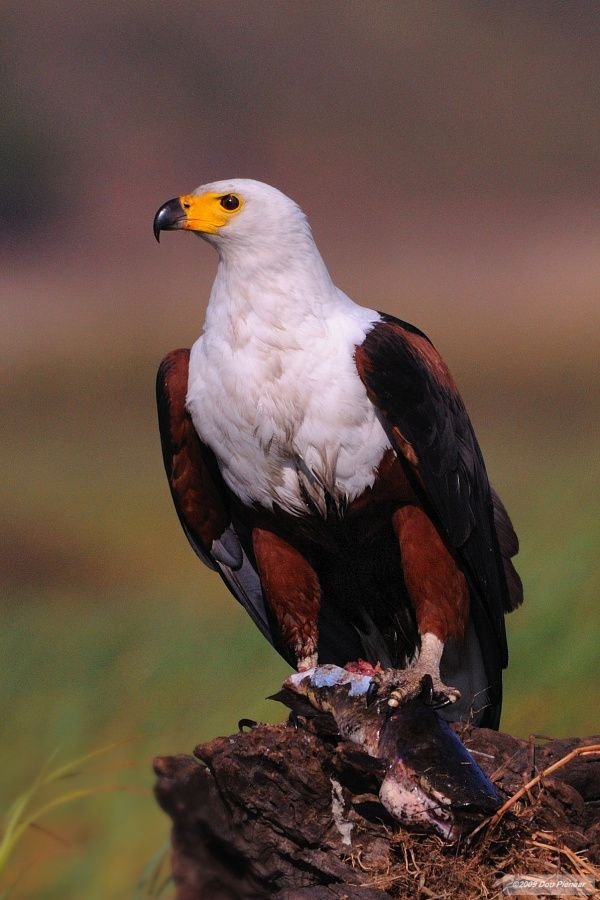
African Fish Eagle
Haliaeetus vocifer - the iconic voice of Africa's lakes and riversIntroduction to the African Fish Eagle
The African Fish Eagle (Haliaeetus vocifer) is a large raptor of African freshwater - lakes, rivers, wetlands and floodplains across sub-Saharan Africa. With its white head and chestnut body it is often mistaken for the American Bald Eagle at first glance, but its famous far-carrying duet is unlike any other sound on safari.
Almost everything about this eagle revolves around water: it perches in tall trees overlooking lakes and rivers, feeds primarily on fish snatched from the surface, and defends a shoreline territory together with its mate all year round. In Tanzania it is one of the signature sightings of Lake Manyara, Nyerere, Tarangire and Ruaha - and one of the most rewarding birds for photographers and birdwatchers.
Scientific Classification
Some modern bird taxonomies, including eBird, place this species in the genus Icthyophaga as Icthyophaga vocifer, while IUCN/BirdLife references use Haliaeetus vocifer. This page follows the Haliaeetus vocifer convention throughout.
Physical Characteristics
Few birds are as unmistakable as an adult African Fish Eagle:
- White head, breast and tail - contrasting sharply with the rest of the body.
- Chestnut-brown body with dark, almost black wings.
- Bare yellow facial skin around the eyes and base of the bill.
- Powerful hooked bill, yellow with a dark tip, suited to gripping slippery prey.
- Strong yellow talons with rough spicules on the soles that help grip fish.
- Wingspan of approximately 175-210 cm; females are generally larger than males (up to about 3.6 kg versus about 2.5 kg).
- A body plan built for water-associated hunting: broad wings for soaring over lakes and short, strong legs for striking at the surface.
Juveniles look very different - streaked brown and buff - and take several years to gain full adult plumage.
Male vs Female: Key Differences
Adult sexes share the same striking plumage; the main differences are size and breeding roles:
| Characteristic | Male | Female |
|---|---|---|
| Size & weight | Smaller - typically up to about 2.5 kg | Larger (roughly 10-15% bigger) - up to about 3.6 kg |
| Territory | Defends shoreline territory alongside the female | Also territorial; often the more aggressive defender |
| Nest building | Contributes sticks and material | Contributes sticks and arranges the platform |
| Incubation | Takes short shifts so the female can hunt | Does the majority of incubating |
| Chick rearing | Provides most of the family's food | Broods and feeds the chicks at the nest |
| Voice | Slightly higher-pitched calls | Deeper calls |
Both sexes cooperate closely through every stage of breeding, and pairs frequently duet together.
African Fish Eagle Nesting and Breeding
- Monogamous pairs: African Fish Eagles generally pair for life and hold a shoreline territory year-round.
- Large stick-platform nests: built by both sexes in tall trees near water - acacias, euphorbias and other big trees are favoured.
- Close to water: nests may sit less than 100 m from the shore where suitable trees allow.
- More than one nest: a pair often maintains two or more nests within its territory.
- Reused for years: nests are added to season after season and can grow enormous over time.
Habitat: Where They Thrive
The African Fish Eagle is inseparable from freshwater. Its core habitat is:
- Lakes - from vast rift lakes to smaller crater and man-made lakes.
- Rivers - slow-flowing reaches and river mouths with surface-feeding fish.
- Wetlands, swamps and floodplains - shallow water rich in fish and waterbirds.
- Shorelines with tall trees or high perches - essential for nesting, roosting and scanning for prey.
Woodland matters only where it fringes these waterways as riparian cover and nesting habitat. Wherever there is open water with fish and a good vantage tree, this eagle can make a home.
Distribution Map
The African Fish Eagle is widespread across sub-Saharan Africa wherever substantial freshwater occurs - from the Sahel's rivers southward to the Cape, and from Atlantic coasts to the Horn of Africa. It is not limited to East Africa, though the region's great lakes and rivers hold strong populations.
Present along virtually every major lake and river system south of the Sahara.
African Fish Eagle in Tanzania
Tanzania is outstanding fish-eagle country. The country's network of large lakes, river systems, wetlands and seasonal floodplains provides extensive suitable habitat, so the species is widespread wherever freshwater and fish occur together. Resident pairs hold territories along the shores of the northern parks' lakes, along the Rufiji River in the south, and on the Great Ruaha River system - meaning many Tanzania safaris pass through good fish-eagle habitat even on standard game-drive routes.
Where to See African Fish Eagles in Tanzania
Verified destinations where freshwater habitat reliably supports the species:
Lake Manyara National Park
Region: Northern Tanzania
Groundwater forest along the lakeshore; resident pairs patrol the shallows.
Good opportunity in suitable habitat; sightings depend on local conditions and guide knowledge.
Nyerere National Park / Rufiji River
Region: Southern Tanzania
The Rufiji's channels and oxbow lagoons are classic fish-eagle water; boat-based viewing where officially offered.
Good opportunity in suitable habitat; sightings depend on local conditions and guide knowledge.
Tarangire National Park
Region: Northern Tanzania
The Tarangire River and Silale Swamp system attract fish and waterbirds year-round.
Good opportunity in suitable habitat; sightings depend on local conditions and guide knowledge.
Ruaha National Park
Region: South-central Tanzania
The Great Ruaha River runs through the park, drawing fish-eagles to its pools and sandbanks.
Good opportunity in suitable habitat; sightings depend on local conditions and guide knowledge.
Best Time to See Them
African Fish Eagles can be seen year-round in suitable Tanzanian habitats - they are sedentary territorial residents, not migrants. The dry season may provide particularly good general wildlife and birdwatching conditions around dependable water, but sightings vary with location and conditions.
Safari Types
Game drives, dedicated birdwatching safaris and photography-focused safaris all work well; boat or river safaris add a water-level perspective where the destination officially permits them (for example on designated Rufiji boat trips) - they are not available everywhere.
African Fish Eagle in Pictures
A closer look at the African Fish Eagle in its natural East African habitat — its striking appearance, habitat and behaviour are best appreciated up close.
Where to Spot the African Fish Eagle on Safari
Plan your trip around the destinations and safaris where the African Fish Eagle is easiest to see. Explore the parks, itineraries and tour packages by destination below.
Diet: A Fish-Dominated Piscivore
The African Fish Eagle's name tells the story: fish form the bulk of its diet. Typical prey includes:
- Primary - fish: tilapia, catfish, lungfish, mullet and other surface-swimming species.
- Opportunistic extras: waterbirds such as ducks, ibises and flamingo chicks, plus reptiles, frogs, small mammals like hyraxes, and carrion.
This piscivorous diet is exactly why the species never strays far from clean, fish-bearing water - and why healthy fish-eagle populations are a good sign for a lake or river ecosystem.
Daily Behaviour & Social Life
Diurnal Rhythm
The African Fish Eagle is strictly diurnal - active during daylight hours. Much of the day is spent perched on a lookout branch surveying the water for both prey and intruding neighbours; hunting effort depends on prey availability and local conditions, and long periods of quiet watching between flights are normal.
Territorial Pairs
African Fish Eagles are primarily territorial and usually occur as breeding pairs. The pair defends a stretch of shoreline together and may remain mated for life. Soaring displays over the territory, often accompanied by calling, advertise ownership. Juveniles and non-breeding birds can sometimes gather where food is concentrated, away from territorial adults.
African Fish Eagle Call and Communication
The African Fish Eagle's voice is one of the defining sounds of African waterways - a loud, far-carrying cry that carries over extraordinary distances and has earned the species its scientific name, vocifer ('loud-voiced').
- Territorial declaration: head thrown back, the pair announces ownership of its stretch of shoreline.
- Pair duets: male and female call together in coordinated duets, strengthening the pair bond; duetting peaks early in the breeding season.
- Dawn chorus: the birds are at their most vocal around dawn.
- Sex differences: males give slightly higher-pitched calls than females.
- Threat response: calling and display also warn off intruding eagles.
For many visitors, hearing this call drift across the water at sunrise is the moment a Tanzania safari becomes unforgettable - no invented folklore needed; the sound itself is the legend.
Eggs, Incubation and Fledging
- Eggs: usually two are laid, although clutches of one to four have been recorded; eggs are laid 2-3 days apart.
- Incubation: approximately 42-45 days, performed mainly by the female with the male taking shorter shifts.
- Siblicide: the older chick commonly outcompetes its younger sibling, so often only one eaglet survives - although pairs sometimes successfully raise two or three.
- Fledging: young leave the nest at approximately 64-75 days old.
- Post-fledging care: parents continue feeding the fledgling for weeks afterwards while it learns to hunt for itself.
- Lifespan: those that survive their first year may live roughly 12-24 years in the wild.
Conservation Status
IUCN Red List Status: Least Concern - the species remains widespread across sub-Saharan Africa. Least Concern does not mean every local population is thriving; it means the global risk of extinction is currently low.
Pressures That Matter Locally
- Freshwater degradation: damming, water extraction and shoreline development alter lakes and rivers.
- Pollution: agricultural run-off and pesticides contaminate water systems and can reduce fish stocks or thin eggshells.
- Loss of nesting trees: large shoreline trees are critical for nests and are easily cleared.
- Changes in fish availability: overfishing or declining water levels directly affect breeding success.
- Human disturbance: repeated disturbance near nests can cause breeding failure.
Healthy protected freshwater systems remain the species' most important safeguard.
African Fish Eagle Fact Sheet
African Fish Eagle vs Similar Raptors
African Fish Eagle vs African Hawk-Eagle
| Feature | African Fish Eagle | African Hawk-Eagle |
|---|---|---|
| Scientific name | Haliaeetus vocifer | Aquila spilogaster |
| Length | 63-77 cm | About 55-62 cm |
| Wingspan | 175-210 cm | Roughly 130-160 cm |
| Plumage | White head/breast, chestnut body, black wings | Black above, heavily barred white below |
| Habitat | Freshwater lakes, rivers, wetlands | Woodland and forest edge |
| Diet | Primarily fish, plus waterbirds and carrion | Small mammals and gamebirds |
| Status | Least Concern | Vulnerable |
African Fish Eagle vs Osprey
| Feature | African Fish Eagle | Osprey |
|---|---|---|
| Scientific name | Haliaeetus vocifer | Pandion haliaetus |
| Family | Accipitridae | Pandionidae |
| Length | 63-77 cm | About 52-60 cm |
| Wingspan | 175-210 cm | Roughly 150-180 cm |
| Plumage | White head, chestnut body | White below, dark eye-stripe, brown above |
| Hunting style | Swoops from a perch, snatches at surface | Hover-dives feet-first into deep water |
| Diet breadth | Fish plus waterbirds, reptiles, carrion | Almost exclusively live fish |
| Status | Least Concern | Least Concern |
Why the African Fish Eagle Is a Safari Icon
Three things make this eagle instantly iconic: its unmistakable white-and-chestnut silhouette over water, its habit of perching in plain view on shoreline trees, and above all that famous call - a ringing duet so evocative it is widely known as 'the Voice of Africa'. Add its dependence on beautiful freshwater landscapes and it becomes a natural flagship for birdwatching safaris and wildlife photography alike. Its status is formally recognised too: it is the national bird of Zambia, Zimbabwe and South Sudan.
Photographing the African Fish Eagle
Subjects worth waiting for:
- Perched adults scanning the water from a favourite snag or branch.
- The fishing strike - talons-out moments at the surface (fast shutter speeds help).
- Flight shots of broad black wings against sky or water.
- Pair interaction - duetting with heads thrown back is the classic frame.
- Nesting behaviour - stick-carrying adults in the breeding season.
- Juveniles - streaky brown immatures tell a different visual story to adults.
Ethics first: keep legal viewing distances, never approach active nests, do not disturb breeding birds, and always follow your guide's and the park's instructions.
A large African raptor (Haliaeetus vocifer) of the Accipitridae family, found beside freshwater across sub-Saharan Africa. Adults show a white head and breast, chestnut body and dark wings, and are famous for a loud, far-carrying duet often called the Voice of Africa. It feeds mainly on fish and usually lives in monogamous, territorial pairs.
Along any substantial lake or river with fish. Inside national parks, Lake Manyara, Nyerere (Rufiji River), Tarangire (river and swamps) and Ruaha (Great Ruaha River) are all reliable freshwater habitats where resident pairs hold territories. Good opportunity in suitable habitat; sightings depend on local conditions and your guide's knowledge.
Primarily fish - tilapia, catfish, lungfish and mullet are typical prey. It opportunistically takes waterbirds, reptiles, amphibians, small mammals and carrion, and regularly steals catches from other birds.
Body length is approximately 63-77 cm with a wingspan of roughly 175-210 cm. Females run noticeably larger than males.
Approximately 2.1-3.6 kg depending on sex and individual - males toward the lower end, females approaching 3.6 kg.
No. It is listed as Least Concern on the IUCN Red List and remains widespread. Local pressures - wetland degradation, pollution, loss of nesting trees, changing fish availability and disturbance - can still affect individual populations.
Across sub-Saharan Africa wherever freshwater and fish coincide: lakes, rivers, swamps, floodplains and lake-shore woodlands with tall trees for perching and nesting. It is a resident, not a migrant.
It watches from a perch or circles above the water, then swoops to snatch surface prey in its talons, which have rough spicules for grip. Attempts may fail before one succeeds; oversized fish are dragged across the surface to shore. It also pirates catches from other birds.
Chiefly by voice: loud, far-reaching cries that declare territory, often delivered as coordinated duets by the pair, especially around dawn and early in the breeding season. Males call slightly higher than females. Posture and soaring display reinforce the message.
Yes - they are generally monogamous and typically pair for life, jointly defending a shoreline territory and cooperating in nest building, incubation and chick rearing.
Usually two eggs, laid 2-3 days apart (clutches of one to four are recorded). Incubation lasts about 42-45 days; because siblicide is common, often only one eaglet survives to fledge at 64-75 days.
Yes - perched adults are frequently cooperative subjects. Prioritise flight and fishing sequences, dawn duets, and nesting behaviour where visible. Keep legal distances, never approach nests or disturb breeding birds, and follow your guide's instructions.
Related Safari Packages & Tours
Book a safari to see the African Fish Eagle and the rest of Africa's incredible wildlife with our expert guides.
References & Further Reading
- IUCN Red List: Haliaeetus vocifer
- Animal Diversity Web (University of Michigan): Haliaeetus vocifer account - measurements, reproduction and behaviour.
- The Peregrine Fund: African Fish-eagle species profile.
- eBird / Clements taxonomy note: genus placement varies between Haliaeetus and Icthyophaga across modern checklists.
- About these facts: Measurements and breeding figures are approximate ranges drawn from the sources above; they can vary with sex, age, region and method. Conservation status should be checked against the current IUCN assessment.