

.png)
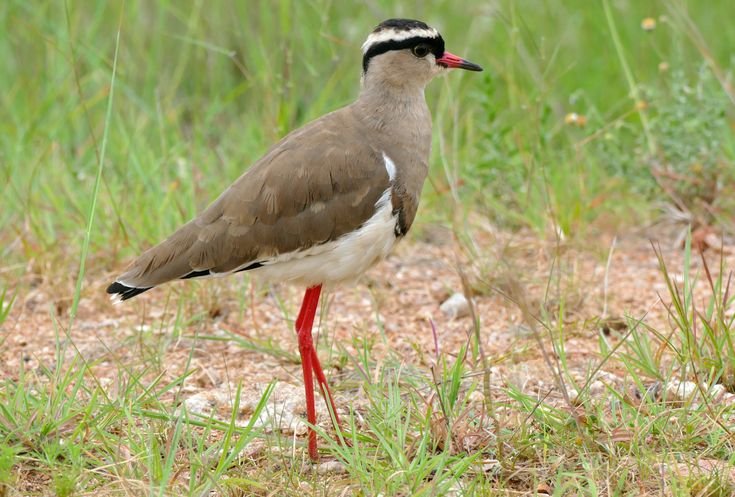
Crowned Lapwing
Vanellus coronatus - the crowned plover of Africa's open plainsIntroduction to the Crowned Lapwing
The Crowned Lapwing (Vanellus coronatus) is a distinctive open-country bird of dry grassland and short-grass savanna across East and Southern Africa. Also known as the Crowned Plover, it is named for its striking black crown surrounded by a white halo - a pattern visible even at distance.
Loud, alert and terrestrial, it feeds mainly on termites and ants picked from the ground in recently burned or closely grazed grassland. In Tanzania it is widespread in suitable open habitats, including the short-grass plains of Serengeti and Ndutu, the open woodland of Tarangire, and dry country around Moshi and Lake Chala.
Scientific Classification
Also called the Crowned Plover in older literature. The genus name Vanellus refers to the lapwing group; 'coronatus' means crowned in Latin.
How to Identify a Crowned Lapwing
- Black crown with a contrasting white halo encircling it.
- Brown upperparts and clean white underparts.
- Red bill with dark/black tip.
- Red legs - long and suited to walking and running on open ground.
- Length approximately 28-31 cm; weight approximately 150-300 g.
- Alert upright posture - often seen running then pausing erect on open ground.
- Noisy calls: sharp, scratchy "kirre-kirre" repeated frequently - one of the most heard sounds of short-grass plains.
- Immature birds: duller overall but retain the crown-and-halo pattern.
Physical Characteristics
The Crowned Lapwing is instantly recognisable and wonderfully adapted to its environment. Here are the key physical traits that make it so special:
- Body & Weight: Adults typically weigh around 150-300 g. Size can vary between individuals and regions.
- Size: Individuals typically reach 28-31 cm long.
- Speed: Despite its build, It runs swiftly across open ground when alarmed.
- Colouration: Its colouration and markings help it blend into the wetlands landscape, offering both camouflage and protection from predators.
- Senses: Keen senses of smell and hearing, combined with excellent awareness, help it detect danger early.
- Adaptations: Every feature — from its limbs to its senses — is finely tuned for survival in wetlands habitats.
Male vs Female: Key Differences
Crowned Lapwings show limited obvious external sex differences. During breeding, pairs defend nesting territories together. Both adults share incubation and chick-guarding responsibilities.
Breeding, Nesting and Chicks
- Ground-nesting bird: nests are shallow scrapes in bare ground or short grass, relying on camouflage rather than concealment.
- Territorial pairs: breeding pairs defend nesting areas against intruders.
- Mostly solitary nesting, though loose breeding aggregations can occur in high-quality habitat.
Habitat: Dry Grassland and Short Grass
The Crowned Lapwing is primarily an open-country species, not a wetland specialist:
- Dry open grassland - the core habitat across its range.
- Recently burned grassland - freshly exposed ground attracts insects and provides clear visibility.
- Short-grass savanna - heavily grazed or naturally short swards are preferred.
- Sparse woodland and open scrub.
- Human-modified open habitats - airfields, sports fields and overgrazed pasture can be used.
The species generally avoids tall grass and dense vegetation. It is not primarily water-dependent, unlike many other lapwing species.
Distribution Across Africa
The Crowned Lapwing has a broad East and Southern African distribution extending from the Horn of Africa through eastern Africa (Ethiopia, Somalia, Kenya, Tanzania) southward through Mozambique, Zambia, Zimbabwe and into South Africa. It occupies suitable dry open habitats throughout this range.
Widespread across eastern and southern Africa in open dry habitats.
Crowned Lapwing in Tanzania
Tanzania contains extensive dry grassland and open savanna habitat ideal for this species. The short-grass plains of the Serengeti ecosystem, particularly around Ndutu, provide prime habitat. Open country around Moshi and Lake Chala also supports populations, as does the drier woodland-savanna mosaic of Tarangire National Park and Mikumi National Park. The species is a familiar sight on northern-circuit game drives where short grass prevails.
Where to See Crowned Lapwings in Tanzania
Suitable short-grass destinations with documented records:
Serengeti National Park
Region: Northern Tanzania
Short-grass plains, especially the southeastern Serengeti and Ndutu area, hold reliable populations.
Good opportunity in suitable short-grass habitat; sightings are not guaranteed.
Tarangire National Park
Region: Northern Tanzania
Open savanna and short-grass clearings within the park support territorial pairs.
Good opportunity in suitable short-grass habitat; sightings are not guaranteed.
Ndutu / Ngorongoro Conservation Area
Region: Northern Tanzania
The Ndutu short-grass plains are classic Crowned Lapwing habitat during the calving season.
Good opportunity in suitable short-grass habitat; sightings are not guaranteed.
Moshi Area / Lake Chala
Region: North-eastern Tanzania
Open country and semi-arid grassland around Kilimanjaro foothills supports resident birds.
Good opportunity in suitable open habitat; sightings are not guaranteed.
Best Time to See Them
Crowned Lapwings can be encountered year-round in suitable Tanzanian habitats. Visibility depends heavily on grass height, recently burned or open areas, rainfall, local prey availability, location and guide knowledge.
Safari Types
Game drives across open plains, specialist birdwatching safaris and wildlife photography all work well for this species - it is particularly suitable for observing on open plains where shape, crown pattern and loud calls aid identification.
Crowned Lapwing in Pictures
A closer look at the Crowned Lapwing in its natural East African habitat — its striking appearance, habitat and behaviour are best appreciated up close.
Where to Spot the Crowned Lapwing on Safari
Plan your trip around the destinations and safaris where the Crowned Lapwing is easiest to see. Explore the parks, itineraries and tour packages by destination below.
What Does the Crowned Lapwing Eat?
An open-ground insectivore with a strong preference for social insects:
- Termites - especially alates (flying termites) during emergence events.
- Ants - another major food source, picked from the ground surface.
- Beetles and other ground-dwelling insects.
- Grasshoppers and crickets.
- Spiders and other small invertebrates.
Daily Behaviour, Calls & Social Life
Crowned Lapwings are alert terrestrial birds that spend much of their active time walking and running through open ground while scanning for prey. Activity varies with weather, habitat and breeding stage.
Social Behaviour
- Outside breeding: loose flocks or small groups may form, sometimes mixing with other open-country plovers.
- During breeding: pairs become strongly territorial and defend nesting areas aggressively.
Voice
- Loud repetitive calls: a sharp, scratchy "kirre-kirre" given frequently - one of the characteristic sounds of short-grass plains.
- Territorial calling: proclaims ownership from elevated perches or prominent ground positions.
- Alarm calls: rapid, urgent versions alert mates and chicks to approaching danger.
- Posture: upright stance, raised wings and exaggerated posturing used in territorial display.
How Does a Crowned Lapwing Find Food?
- Run-and-stop technique: walks or runs across open ground, stops abruptly, visually scans, then pecks prey from the surface.
- Foot-trembling: vibrates feet against the ground to flush hidden invertebrates - a behaviour shared with some other waders.
- Termite exploitation: congregates at termite emergence sites when winged alates appear en masse after rain.
- Dung-following: may feed around dung piles of large mammals where insects concentrate.
This visual, ground-level feeding strategy is completely different from the tactile bill-sweeping of wetland spoonbills - the Crowned Lapwing is a runner, not a wader.
Eggs, Incubation and Chick Development
- Eggs: laid in shallow ground scrapes; both parents share incubation duties.
- Precocial chicks: mobile within hours of hatching, following parents immediately.
- Adult defence: loud alarm calling, distraction displays and aggressive dive-bombing protect eggs and chicks from predators such as snakes, mongooses and jackals.
- Chick camouflage: chicks crouch motionless in vegetation when parents give warning calls.
- Breeding timing varies geographically and with rainfall patterns.
Conservation Status
IUCN Red List Status: Least Concern. The Crowned Lapwing remains widespread and relatively common across much of its East and Southern African range.
Maintaining suitable open grassland and short-grass habitats remains important. Changes in burning regimes, grazing pressure and agricultural conversion can alter habitat suitability locally, though the species has shown adaptability to some human-modified landscapes.
Habitat Threats
- Grassland conversion to agriculture reduces available open habitat.
- Changes in burning and grazing can make grass too tall or too dense for preferred foraging.
- Settlement expansion fragments open-country habitat.
Crowned Lapwing Fact Sheet
Crowned Lapwing vs Other Tanzanian Lapwings
Crowned Lapwing vs Blacksmith Lapwing
| Feature | Crowned Lapwing | Blacksmith Lapwing |
|---|---|---|
| Scientific name | Vanellus coronatus | Vanellus armatus |
| Crown | Black crown with white halo | Black head/throat, no halo |
| Habitat | Dry short-grass savanna | Wetland margins, mudflats, water edges |
| Diet emphasis | Termites and ants | Aquatic invertebrates |
| Voice | Scratchy "kirre-kirre" | Metallic "tink-tink" like a hammer |
| Tanzania viewing | Serengeti, Ndutu, Tarangire short grass | Lake edges, rivers, dams nationwide |
Crowned Lapwing vs African Spoonbill
| Feature | Crowned Lapwing | African Spoonbill |
|---|---|---|
| Scientific name | Vanellus coronatus | Platalea alba |
| Body type | Small ground-running plover | Large long-legged wader |
| Bill | Short red bill with dark tip | Spoon-shaped grey bill swept sideways |
| Habitat | Dry short-grass savanna | Shallow freshwater marshes and lake margins |
| Feeding method | Visual run-and-peck on open ground | Tactile side-to-side bill sweeping in water |
| Sociality | Pairs/loose flocks | Colonial breeder (5-250+ pairs) |
| Shared parks | Both found at Lake Manyara, Tarangire and other Tanzanian wetland-edge destinations | |
Why Birdwatchers Notice Crowned Lapwings
Three qualities make this lapwing impossible to miss on an open-country safari: the bold black-crown-with-white-halo pattern that gives away its identity instantly, its constant noisy calling that announces its presence before you see it, and its habit of occupying exactly the short-grass habitats that game-drive vehicles traverse. For photographers, the combination of striking plumage, open setting and expressive posture creates rewarding subjects. Its reliance on healthy short-grass ecosystems makes it a useful indicator of well-managed rangeland.
Photographing the Crowned Lapwing
Subjects worth pursuing:
- Adult in short grass - the classic open-ground portrait showing crown, halo and red legs.
- Calling bird - open-billed vocalisation with neck extended.
- Pair defending territory - interaction shots between mates.
- Flight - broad rounded wings with contrasting flight-feather pattern.
- Feeding close-ups - pecking at termites or foot-trembling behaviour.
- Chicks - fluffy precocial young following parents through grass.
- Nest from respectful distance only - never disturb nesting birds.
Ethics first: maintain appropriate distance, do not approach nesting birds, do not block feeding birds, follow park rules and your guide's instructions.
An open-country wading bird (Vanellus coronatus) of the plover family Charadriidae, found in dry grassland and short-grass savanna across East and Southern Africa. It is named for its striking black crown surrounded by a white halo, and is also called the Crowned Plover.
Vanellus coronatus. The genus name Vanellus refers to the lapwing group; coronatus is Latin for crowned, referring to the black cap surrounded by a white ring.
Charadriidae - the plover and lapwing family, within the order Charadriiformes which includes gulls, auks and sandpipers.
In dry open grassland and short-grass habitats across the country. Key destinations include the Serengeti short-grass plains (especially Ndutu), Tarangire National Park, Mikumi National Park and open country around Moshi and Lake Chala. Good opportunity in suitable short-grass habitat; sightings are not guaranteed.
Dry open grassland with short grass - including recently burned areas and heavily grazed swards. It avoids tall grass and dense vegetation. It is not primarily water-dependent despite being classified among the waders.
Mainly termites and ants, supplemented by beetles, grasshoppers, spiders and other small invertebrates picked from the ground surface while walking and running across open ground.
Yes - termites are a major food source, especially winged reproductive alates that emerge en masse after rain. Large numbers of lapwings may gather at emergence sites to feed on these protein-rich insects.
Using a run-and-stop technique: walking or running across open ground, pausing to scan visually, then pecking prey from the surface. It may also use foot-trembling to flush hidden invertebrates and feeds around large-mammal dung where insects gather.
Outside the breeding season, loose flocks or small groups may occur. During breeding, pairs become territorial and defend nesting areas. It does not form the dense colonial flocks typical of some other bird species.
On the ground - in a shallow scrape in bare ground or short grass. The nest relies on camouflage of eggs and sitting adult rather than physical concealment. Both parents share incubation and chick-guarding duties.
Through loud alarm calling, aggressive dive-bombing displays toward intruders and distraction behaviours. Chicks are precocial - mobile within hours of hatching - and crouch motionless in vegetation when parents give warning calls.
No - it is listed as Least Concern on the IUCN Red List and remains widespread and relatively common across much of East and Southern Africa. Maintaining open grassland and short-grass habitats supports continued population health.
Year-round in suitable habitat. Visibility depends on grass height, recent burning or grazing, rainfall and location. Recently burned areas and short-grass plains offer the clearest viewing opportunities regardless of season.
Related Safari Packages & Tours
Book a safari to see the Crowned Lapwing and the rest of Africa's incredible wildlife with our expert guides.
References & Further Reading
- IUCN Red List / BirdLife DataZone: Vanellus coronatus factsheet
- eBird / Cornell Lab: Species account and observation data for Vanellus coronatus in East Africa.
- About these facts: Measurements and behavioural data are approximate ranges drawn from available sources; they vary with sex, age, region and method.