

.png)
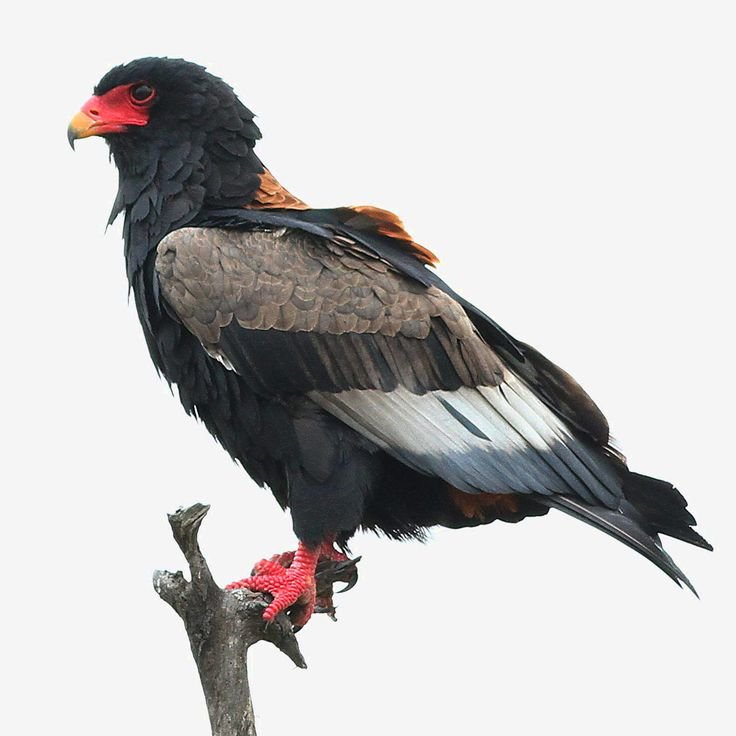
Bateleur Eagle
Terathopius ecaudatus - the rocking flight of the African savannaIntroduction to the Bateleur Eagle
The Bateleur Eagle (Terathopius ecaudatus) is a medium-sized eagle of open African savanna, instantly recognisable in flight by its extraordinarily short tail, broad wings and characteristic side-to-side rocking motion. Its glossy black head, chestnut mantle and brilliant red face and feet complete one of the most striking profiles of any African raptor.
The name 'Bateleur' comes from the French word for a tightrope walker or street performer, referring to the bird's seemingly precarious aerial balance. Both an active hunter and an opportunistic scavenger, it covers vast distances across savanna and open woodland in Tanzania's Serengeti, Tarangire, Ruaha and Nyerere national parks.
Scientific Classification
The Bateleur is the only living species in its genus Terathopius, making it monotypic - one of Africa's most evolutionarily distinct raptors. The name derives from the French 'bateleur' meaning performer or tightrope walker.
How to Identify a Bateleur Eagle
- Very short tail: so reduced that the feet extend almost to the tail tip - unique among African raptors.
- Broad wings with a distinctive rounded outline in flight.
- Glossy black head, neck and body in adult males.
- Chestnut mantle, back and rump - rich reddish-brown shoulder patch.
- Red facial skin and cere: bare, brightly coloured skin around the eyes and base of the bill.
- Red legs and feet: vivid scarlet, matching the face.
- Grey wing panels: pale grey flight feathers contrast with black coverts.
- Females are generally larger and have browner secondary feathers on the upper wing.
- Juveniles are much browner than adults, with longer tails and wings for flight stability; they take 7-8 years to acquire full adult plumage.
Why Does the Bateleur Rock in Flight?
The Bateleur's most famous behaviour is its distinctive rocking, side-to-side flight - tilting from side to side as if balancing on a tightrope:
- Name origin: 'Bateleur' is French for a street performer or tightrope walker, directly referencing this wobbling flight style.
- Cause: the extremely short tail and disproportionately broad wings create less inherent stability than longer-tailed raptors, producing the exaggerated rocking motion.
- Hunting advantage: the rocking profile allows rapid changes of direction when prey or carrion is spotted below during long, low gliding searches.
- Easier to identify in flight than perched: the silhouette alone - short tail, protruding head, bulging secondaries - is diagnostic even at great distance.
Male vs Female: Key Differences
Adult males and females are broadly similar but females are generally larger. Female upper-wing coloration can differ subtly from males - females show more brown on the secondary feathers while males show grey. Both adults participate fully in territorial defence and breeding responsibilities.
Breeding, Nesting and the Single Egg
- Monogamous territorial pairs: Bateleurs pair for life and defend large territories containing suitable nesting trees and hunting grounds.
- Solitary nesting: unlike colonial birds, each pair nests alone in a large stick platform placed high in a mature tree (often acacias).
- A single egg is laid - not two. This is one of the lowest reproductive rates of any African raptor.
- Incubation approximately 52-59 days (averaging about 55) - possibly the longest incubation of any African bird of prey.
- Female performs most incubation; the male supplies food and nesting material, and may occasionally take short incubation shifts.
- Prolonged dependency: the young eagle remains dependent on parents long after fledging - post-fledging care may last over 100 additional days.
- Territory reuse: pairs may reuse the same territory and nest area for many consecutive breeding seasons.
Habitat: Open Savanna and Woodland
The Bateleur inhabits broad, open landscapes where it can soar and scan for food over vast distances:
- Open savanna - grasslands with scattered trees providing perches and nest sites.
- Thornveld and dry woodland - Acacia-dominated landscapes with mature trees.
- Semi-arid landscapes - the species tolerates very dry conditions.
- Open bushland with mature trees - essential for nesting platforms.
Water is used opportunistically for drinking and bathing but is not the defining habitat requirement - the Bateleur is a landscape-scale hunter of open country, not a water-dependent species.
Distribution Across Sub-Saharan Africa
The Bateleur has a broad sub-Saharan African distribution across suitable savanna and open woodland landscapes - from Senegal and Ethiopia in the north to South Africa in the south, with scattered records extending into southwestern Arabia. It avoids dense equatorial forest and extreme desert.
Widespread/common in suitable Tanzanian habitats.
Bateleur Eagle in Tanzania
Tanzania provides extensive savanna and open woodland habitat ideal for this wide-ranging raptor. The species is widely recorded across the country's protected areas and is often one of the most frequently seen eagles on game drives through open habitat. Birdwatchers and photographers encounter Bateleurs soaring low over plains, perched on dead snags, or walking on the ground near carcasses. Sightings vary by location, weather, prey availability and guide knowledge.
Where to See Bateleur Eagles in Tanzania
Verified destinations where open savanna habitat supports resident populations:
Serengeti National Park
Region: Northern Tanzania
Vast open plains provide prime soaring habitat; frequently seen on game drives.
Good opportunity in suitable habitat; sightings are not guaranteed.
Tarangire National Park
Region: Northern Tanzania
Open acacia woodland and savanna support territorial pairs.
Good opportunity in suitable habitat; sightings are not guaranteed.
Ruaha National Park
Region: South-central Tanzania
Expansive miombo woodland and savanna provide extensive hunting territory.
Good opportunity in suitable habitat; sightings are not guaranteed.
Nyerere National Park
Region: Southern Tanzania
Vast wilderness with open savanna and riverine habitats supporting Bateleurs.
Good opportunity in suitable habitat; sightings are not guaranteed.
Best Time to See Them
Bateleurs can be encountered year-round in suitable Tanzanian habitats. Dry-season safari conditions may improve general wildlife visibility in some parks, but there is no universal single best Bateleur month.
Safari Types
Game drives, specialist birdwatching safaris, wildlife photography and guided birding walks where permitted all offer opportunities to observe this species.
Bateleur Eagle in Pictures
A closer look at the Bateleur Eagle in its natural East African habitat — its striking appearance, habitat and behaviour are best appreciated up close.
Where to Spot the Bateleur Eagle on Safari
Plan your trip around the destinations and safaris where the Bateleur Eagle is easiest to see. Explore the parks, itineraries and tour packages by destination below.
What Does the Bateleur Eagle Eat?
The Bateleur is both an active hunter and an opportunistic scavenger:
- Small mammals: rodents, hares, dikdiks and other small antelope.
- Birds: doves, pigeons, hornbills, ground birds and their eggs.
- Reptiles: lizards and snakes - including venomous species such as puff adders.
- Insects: especially termite alates during emergence events, when large numbers gather.
- Carrion: frequently among the first scavengers to locate carcasses, flying at low level to detect them.
- Roadkill: documented feeding on road-killed animals along tracks and roads.
This dual hunting-scavenging strategy allows the Bateleur to exploit a wider range of food sources than most pure hunters.
Daily Activity and Flight Behaviour
Bateleurs are strictly diurnal. They spend long periods in flight searching for food, sometimes remaining airborne for hours while covering enormous distances. Activity varies with weather, prey availability and habitat conditions.
Social Structure
- Generally solitary or encountered as monogamous breeding pairs.
- Territorial: breeding pairs maintain large territories defended through aggressive attack displays against intruding eagles.
- Non-breeding adults can occur away from established breeding territories, wandering widely.
- Occasional gatherings: more than 20 individuals have been recorded together where food is concentrated (such as termite emergences).
Voice and Communication
Bateleurs are generally silent outside the breeding season, communicating primarily through aerial display and posture:
- Aggressive barks when defending the nest against intruders.
- Aerial territorial displays: aggressive attack-flight patterns shown to intruding conspecifics.
- Courtship: impressive aerial displays with the male diving toward the female in mid-air.
- Posture: raising crest feathers when threatened, appearing larger and more intimidating.
Egg, Incubation and Development
- A single large egg is laid per breeding attempt - among the smallest clutches of any African eagle.
- Incubation lasts approximately 52-59 days (averaging about 55) and may be the longest of any African raptor.
- The female usually performs most incubation, though the male has been observed taking occasional shifts.
- The male provides food to the incubating female throughout the incubation period.
- The chick remains dependent on parents for months after fledging, receiving supplemental feeding for up to 100 additional days.
- Juveniles take 7-8 years to develop full adult plumage, passing through several intermediate brown plumage stages.
Conservation Status: Near Threatened
IUCN Red List Status: Near Threatened. The Bateleur is experiencing a moderately rapid population decline driven by human pressures across its range. Protected areas and intact savanna and woodland habitats remain critically important.
Threats to Bateleur Eagles
- Poisoning: deliberate poisoning of carcasses targeting predators kills Bateleurs indirectly; agricultural chemicals also pose risks.
- Habitat loss: conversion of savanna and woodland to farmland removes nesting trees and hunting habitat.
- Nest disturbance: human activity near nests can cause desertion - Bateleurs are particularly prone to abandoning nests when disturbed.
- Infrastructure hazards: electrocution on power lines and drowning in man-made reservoirs.
- Persecution and trapping: hunted for feathers used in traditional practices and trapped for international trade.
- Reduced prey availability: declining populations of small mammals and birds reduce food resources.
Bateleur Eagle Fact Sheet
Bateleur vs Other African Raptors
Bateleur vs African Fish Eagle
| Feature | Bateleur Eagle | African Fish Eagle |
|---|---|---|
| Scientific name | Terathopius ecaudatus | Haliaeetus vocifer |
| Tail shape | Extremely short - unique among raptors | Medium-length white tail |
| Plumage | Black body, chestnut mantle, red face/feet | White head/breast, chestnut body, black wings |
| Habitat | Open savanna, thornveld, semi-arid | Lakeshores, rivers, wetlands |
| Feeding strategy | Active hunter AND scavenger | Primarily fish-hunter |
| Diet | Mammals, birds, reptiles, carrion | Primarily fish plus waterbirds |
| Social system | Solitary/territorial pairs | Territorial monogamous pairs |
| Conservation | Near Threatened | Least Concern |
Bateleur vs African Hawk-Eagle
| Feature | Bateleur Eagle | African Hawk-Eagle |
|---|---|---|
| Scientific name | Terathopius ecaudatus | Aquila spilogaster |
| Length | 55-70 cm | 55-65 cm |
| Wingspan | 168-190 cm | 130-160 cm |
| Tail | Extremely short | Normal proportioned tail |
| Flight | Low rocking glide over savanna | Fast canopy-flushing pursuit |
| Habitat | Open savanna/thornveld | Dry woodland/wooded hills |
| Scavenging | Regular scavenger of carrion | Active hunter only |
| Clutch size | One egg | One or two eggs |
Why the Bateleur Is a Signature African Raptor
The Bateleur combines three qualities that make it unmistakably iconic: a silhouette no other African bird shares, a name that captures its performing-artist spirit, and a conservation story that matters. For birdwatchers in Tanzania, spotting a Bateleur rocking low over the Serengeti plains or perched on a dead acacia snag is a highlight of any safari checklist. Ecologically, its role as both predator and scavenger places it at the centre of the savanna food web - and its dramatic decline serves as a warning about the health of Africa's open ecosystems. Protecting Bateleurs means protecting the vast landscapes they patrol.
Photographing the Bateleur Eagle
Subjects worth pursuing:
- Soaring and rocking flight - the definitive Bateleur image against open sky.
- Perched adults on dead snags showing red face, chestnut mantle and grey wings.
- Feeding/scavenging - on carcasses or roadkill at ground level.
- Pair interactions - two birds together on territory.
- Juvenile plumage - completely different brown appearance worth documenting.
- Distant nesting activity - viewed responsibly from afar only.
Ethics first: never disturb nesting sites - Bateleurs are prone to deserting nests when approached. Maintain appropriate distance, follow park rules and your guide's instructions.
A medium-sized eagle (Terathopius ecaudatus) of open African savanna, named after the French word for a tightrope walker because of its distinctive rocking flight. It has an extraordinarily short tail, broad wings, red facial skin and feet, and glossy black-and-chestnut plumage. It is the only living member of its genus.
The extremely short tail and disproportionately broad wings create less natural stability than longer-tailed raptors, producing the exaggerated side-to-side rocking motion. This instability actually aids rapid direction changes when prey or carrion is spotted during low gliding searches.
In open savanna and woodland habitats across the country. Serengeti, Tarangire, Ruaha and Nyerere national parks all support resident populations frequently seen on game drives. Good opportunity in suitable habitat; sightings are not guaranteed.
Small mammals (rodents, hares, dikdiks), birds (doves, hornbills), reptiles including venomous snakes, insects (especially termite alates) and carrion. It is both an active hunter and an opportunistic scavenger, often among the first raptors to find fresh carcasses.
Both. It actively hunts live prey using low-level searching flights followed by rapid strikes, and it readily scavenges carcasses. Its low-altitude searching technique makes it one of the first predators to detect fresh kills.
Generally solitary or found as monogamous breeding pairs that defend large territories. Non-breeding adults wander widely. Occasional gatherings of 20+ individuals occur where food is concentrated, such as termite emergences.
A single egg per breeding attempt - one of the smallest clutches of any African eagle. This extremely low reproductive rate makes the species particularly vulnerable to population decline.
Approximately 52-59 days, averaging about 55 days - possibly the longest incubation period of any African raptor. The female performs most incubation, fed by the male, who occasionally takes short shifts.
It is listed as Near Threatened on the IUCN Red List, reflecting a moderately rapid population decline. Key threats include poisoning, habitat loss, nest disturbance, persecution and infrastructure hazards. It has become scarce outside protected areas in parts of its range.
Open savanna, thornveld, dry woodland and semi-arid landscapes with mature trees for nesting and perching. It avoids dense forest and extreme deserts, requiring broad open landscapes for its soaring hunting technique.
Yes - soaring flight shots against open sky, perched adults showing the red face and chestnut mantle, feeding at carcasses and pair interactions all make excellent subjects. Keep legal distances and never approach active nests - Bateleurs are prone to nest desertion when disturbed.
Bateleurs can be encountered year-round in suitable Tanzanian habitats. Dry-season safari conditions may improve general visibility in some parks, but there is no single universal best month specifically for this species.
Related Safari Packages & Tours
Book a safari to see the Bateleur Eagle and the rest of Africa's incredible wildlife with our expert guides.
References & Further Reading
- IUCN Red List / BirdLife DataZone: Terathopius ecaudatus factsheet
- The Peregrine Fund: Bateleur Eagle species profile.
- Animal Diversity Web / Birds of the World: Measurements, breeding biology and distribution data.
- About these facts: Measurements and breeding figures are approximate ranges drawn from the sources above; they vary with sex, age, region and method. Conservation status should be checked against the current IUCN assessment.