

.png)
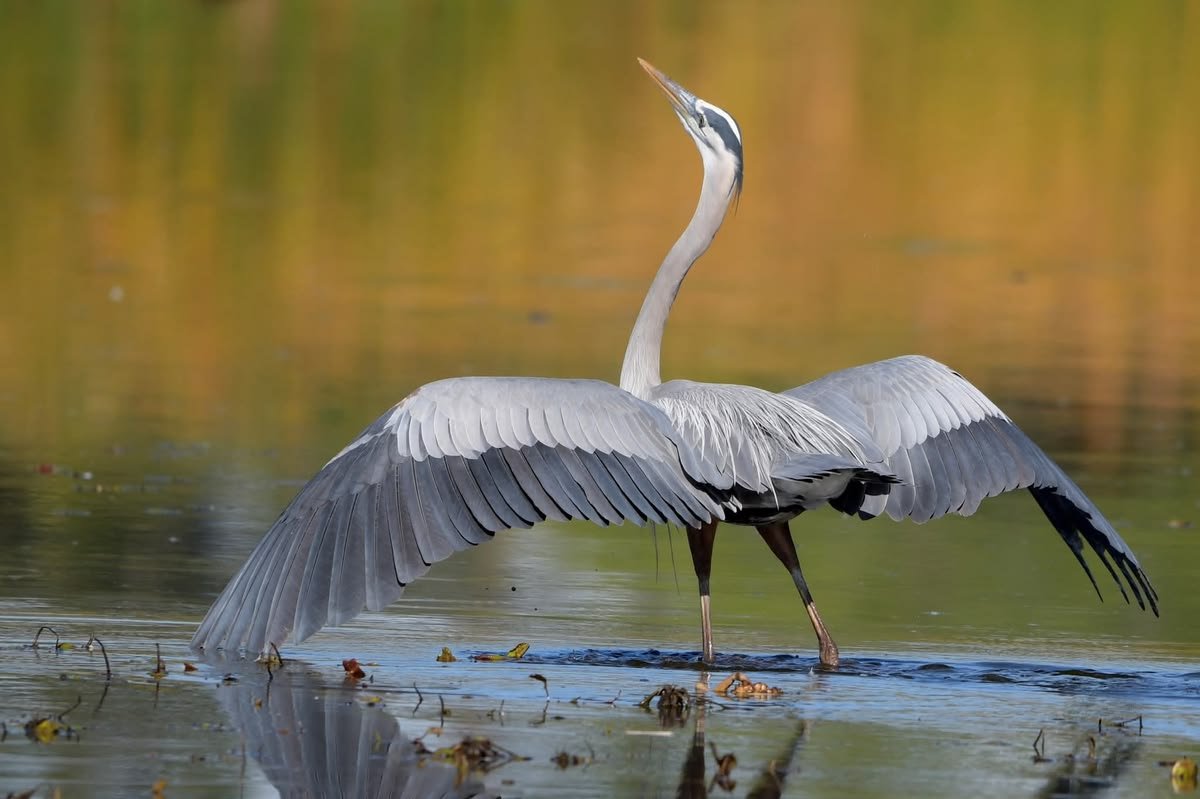
Grey Heron in Tanzania
Ardea cinerea - the patient hunter of shallow waterWhat Is the Grey Heron?
The Grey Heron (Ardea cinerea) is a tall, elegant wading bird of the Old World - ashy-grey above and whitish below, with a white head and neck marked by a broad black stripe running above the eye into an elongated black crest, and a long, pointed dagger bill.
It is the patient hunter of shallow water. A Grey Heron may stand motionless at a lake edge for minutes on end before launching a lightning-fast bill strike at an unsuspecting fish.
Fish dominate its opportunistic menu, but frogs, crustaceans, insects, reptiles, small mammals and even small birds are all taken when the chance arises.
In Tanzania it is a familiar figure along lakes, rivers, marshes and estuaries - from Lake Manyara to the Tarangire river and the Wami River on the coast.
Scientific Classification
Four subspecies are generally recognized, including the nominate A. c. cinerea of Europe, Africa and western Asia, and A. c. firasa of Madagascar and the Comoros. Its closest look-alike in Africa is the Black-headed Heron, which has an almost entirely black head instead of the Grey Heron’s white face with black stripe.
How to Identify a Grey Heron
- Ashy-grey back and wings with grey-white underparts.
- White head and neck, broadened by a black stripe from above the eye trailing into a long dangling crest.
- Long pointed bill - yellow or pinkish-yellow depending on condition.
- Long grey legs built for wading.
- S-shaped retracted neck in flight - a key separator from cranes and storks, which fly with necks outstretched.
- Breeding birds show brighter bare-part coloration and extra plumes.
- Juveniles are duller grey, lacking the crisp adult head pattern.
Size Summary
- Length: approximately 84-102 cm
- Wingspan: approximately 155-195 cm
- Weight: approximately 1.02-2.08 kg
Why Does the Grey Heron Stand Motionless?
That famous statue-stillness is not idleness - it is a hunting technique refined over millions of years:
- Waiting in shallow water where fish and amphibians move within reach.
- Minimizing movement so prey approaches without recognizing danger - ripples and motion give a hunter away.
- Watching intently, head angled, both eyes triangulating distance below the surface.
- Striking in an instant when prey drifts inside range: specialized neck vertebrae let the folded S-curve spring open in one explosive extension, driving the dagger bill onto the target.
The alternative strategy is slow stalking through shallows, but either way the kill comes from that sudden, coiled-neck strike rather than any chase.
Male vs Female: Key Differences
Males and females are similar in appearance, sharing the same grey-and-white plumage and black crest pattern. Males are generally larger than females, but the difference is subtle in the field.
Both sexes share every stage of breeding work:
- Nest building - male gathers sticks, female arranges them.
- Incubation - both parents take shifts.
- Chick care - both feed and guard the young.
Habitat: Almost Any Shallow Water
The Grey Heron is one of Africa’s most adaptable wetland birds, occurring wherever shallow water concentrates prey:
- Lakes, rivers and streams - classic foraging waters.
- Marshes, swamps and floodplains - including seasonal wetlands.
- Riparian zones along wooded rivers.
- Estuaries, coastal mudflats and brackish lagoons.
- Temporary pools after rains - opportunistically exploited before they dry.
Tall trees nearby provide nesting sites for heronries and night roosts, but the species is defined by its waters, not by woodland.
Habitat and Global Distribution
Grey Herons have a broad Old World distribution across Europe, Africa and Asia. Northern populations are migratory, moving south in winter, while African and tropical Asian birds are largely resident or local nomads.
In Africa the species occurs widely south of the Sahara, with Palearctic migrants joining resident birds during the northern winter. Tanzania is one part of this vast African range - not a global stronghold, simply good heron country.
Grey Heron in Tanzania
Grey Herons occur widely across suitable Tanzanian wetlands and waterways, from the Rift Valley lakes to coastal rivers. Documented locations include:
- Lake Manyara National Park - lake shallows, Silale-style swamps and groundwater-forest streams.
- Tarangire National Park - the Tarangire River and seasonal pools hold herons through the dry season.
- Arusha National Park - the Momella lakes and Ngurdoto Crater wetlands.
- Wami River - this mangrove-fringed coastal river, flowing through Saadani National Park, is classic Grey Heron water.
- Katavi National Park - the Katuma river and floodplains in the remote west.
Sightings are never guaranteed - presence shifts with water levels and prey - but a patient scan of any shoreline usually turns one up.
Where to See Grey Herons in Tanzania
Lake Manyara National Park
Country: Tanzania | Region: Northern Tanzania
Documented occurrence along the alkaline lake margins, forest streams and swamp edges beneath the escarpment.
Good opportunity around suitable water; sightings vary.
Tarangire National Park
Country: Tanzania | Region: Northern Tanzania
Documented occurrence along the perennial Tarangire River, Silale Swamp fringes and dry-season pools.
Good opportunity around suitable water; sightings vary.
Arusha National Park
Country: Tanzania | Region: Northern Tanzania
Documented occurrence at the Momella lakes and Ngurdoto Crater wetlands, minutes from Arusha city.
Good opportunity around suitable water; sightings vary.
Wami River (Saadani)
Country: Tanzania | Region: Coast - Saadani National Park
Documented occurrence along the brackish, mangrove-lined Wami River, where boat safaris officially operate.
Good opportunity around suitable water; sightings vary.
Safari & Birdwatching Methods
- Game drives along rivers, lakeshores and swamp edges.
- Specialist birdwatching excursions.
- Wetland birding sessions on foot where permitted.
- Guided birding walks in designated areas.
- Wildlife photography from vehicles and hides.
- Boat-based birding where officially available - notably the Wami River.
Best Time to See Them
Grey Herons can be encountered year-round in suitable Tanzanian wetlands. Local visibility depends on water conditions, prey availability, breeding activity, wetland habitat, weather and guide knowledge rather than any fixed calendar period.
Grey Heron in Pictures
A closer look at the Grey Heron in its natural East African habitat — its striking appearance, habitat and behaviour are best appreciated up close.
Where to Spot the Grey Heron on Safari
Plan your trip around the destinations and safaris where the Grey Heron is easiest to see. Explore the parks, itineraries and tour packages by destination below.
What Does the Grey Heron Eat?
The diet is dominated by fish, but the species is an opportunistic predator that takes whatever vulnerable prey comes within strike range:
- Fish (primary): small to medium fish seized in shallows.
- Amphibians: frogs and tadpoles.
- Crustaceans: crabs and prawns.
- Aquatic insects and their larvae.
- Reptiles: lizards and small snakes.
- Small mammals: rodents and shrews in grassy margins.
- Small birds and chicks: ducklings and nestlings taken occasionally.
Prey is turned head-first and swallowed whole; oversized items are shaken, stabbed or simply abandoned.
How Does a Grey Heron Hunt?
- Stands motionless in shallows or at the water’s edge, sometimes for long stretches.
- Scans the water, tracking movement below the surface with forward-facing eyes.
- Stalks slowly when needed, lifting legs with exaggerated care or wading belly-deep.
- Launches the strike: the coiled neck extends in one rapid thrust - no chase, no warning.
- Grasps or spears prey crosswise with the dagger bill.
- Adjusts and swallows whole, flipping fish head-first before a jerking gulp.
Some birds also hunt away from water - taking rodents and insects in open grass - and a few have learned to dive at fish from perches, submerging completely.
Grey Heron Calls and Communication
- Harsh croaking "fraank" calls - the classic flight and alarm voice.
- Colony calls - continuous chatter at busy heronries.
- Territorial calls - advertising occupancy of a feeding stretch.
- Pair greetings - softer calls and displays between mates at the nest.
- Chick begging calls - persistent rasping from hungry nestlings.
- Posture displays - crest-raising, bill-pointing and slow stalking postures communicate intent without sound.
Most herons are heard before they are seen: the croak betrays the bird flapping out of a swamp long after it spotted you first.
Breeding, Eggs and Heronries
Grey Herons breed in colonies known as heronries - though some pairs nest singly or in small groups. Nests are large stick platforms, commonly built high in tall trees near water (occasionally in reedbeds, on cliffs or even on the ground), often reused and enlarged year after year.
- Eggs: clutch commonly 3-5 pale green-blue eggs in Africa; wider regional variation exists - clutches from 1 to as many as 7 have been recorded.
- Laying: eggs are laid at roughly two-day intervals.
- Incubation: approximately 23-28 days, shared by both parents - beginning before the full clutch is complete.
- Asynchronous hatching: because incubation starts early, chicks hatch staggered - the first-hatched enjoys a size advantage.
- Sibling competition: nestmates compete fiercely for regurgitated food; the oldest chick often dominates, and weaker chicks may not survive - a natural factor influencing brood survival.
- Fledging: juveniles leave the nest after several weeks (around 45-55 days) and become independent a few weeks later.
Both parents feed the young by regurgitation throughout the nestling period.
Conservation Status: Least Concern
IUCN Red List Status: Least Concern. The species has an enormous Old World range and a large overall population - estimated globally at somewhere between several hundred thousand and a few million mature individuals.
Least Concern does not mean without concerns. Local colonies can still be hit hard by:
- Wetland degradation and habitat loss.
- Pollution and poisoning of waterways.
- Shooting and persecution, particularly at fish farms where herons are seen as competitors.
- Fish-farm conflict driving illegal killing in some regions.
- Disturbance at breeding colonies - causing nest abandonment.
- Changes in water quality and availability.
Natural Threats to Eggs and Young
Aerial predators and nest predators take eggs and chicks, severe weather floods nests, and sibling competition naturally culls some broods. Adults, thanks to their size and vigilance, have few predators.
What Protects Grey Herons
The species benefits directly from protection of wetlands, shallow fish-rich waters, riparian trees, breeding colonies and water quality - measures that safeguard whole wetland communities rather than one species alone.
Grey Heron Facts
Grey Heron vs Goliath Heron
| Feature | Grey Heron | Goliath Heron |
|---|---|---|
| Scientific name | Ardea cinerea | Ardea goliath |
| Height / length | 84-102 cm | 120-152 cm - world’s largest heron |
| Wingspan | 155-195 cm | 185-230 cm |
| Weight | 1.02-2.08 kg | 4-5 kg |
| Plumage | Ashy grey with white head/neck, black stripe & crest | Chestnut head and neck, slate-grey back, black-streaked foreneck |
| Prey scale | Small-medium fish, frogs, insects, small vertebrates | Specializes in LARGE fish (~30 cm, 500-600 g) |
| Social feeding | Solitary; colonial at breeding | Solitary and strongly territorial at feeding grounds |
| Tanzania viewing | Widespread: Manyara, Tarangire, Arusha, Wami River | Nyerere (Rufiji), Manyara, Ruaha, Tarangire wetlands |
Grey Heron vs African Spoonbill
| Feature | Grey Heron | African Spoonbill |
|---|---|---|
| Family | Ardeidae - Pelecaniformes | Threskiornithidae - Pelecaniformes |
| Bill | Dagger-pointed spear | Flat spatulate sweep |
| Plumage | Grey and white with crest | All-white with red face/bill |
| Feeding technique | Stand-and-strike ambush | Side-to-side open-bill sweeping in shallows |
| Breeding | Colonial heronries in trees; 3-5 eggs | Colonial nests in reeds/trees; 2-5 eggs |
| Shared waters | Lake Manyara margins, Tarangire swamps and other Tanzanian shallows host both species | |
Why Birdwatchers Notice Grey Herons
Some birds hide; the Grey Heron simply stands still and lets you look:
- The elegant silhouette - upright grey statue fringing almost any African shoreline.
- Patient hunting theatre - watching one stalk and strike is free drama that never gets old.
- The characteristic flight - slow deep wingbeats with folded S-neck, instantly separable from cranes and storks.
- Wetland association - a reliable marker bird around healthy fish-rich water.
- Accessibility - close views from roadsides, bridges and boat trips make it an ideal gateway species for new birders.
For many Tanzania visitors, the first Grey Heron croaking out of the swamp is the moment the holiday checklist begins.
Photographing the Grey Heron
- Motionless hunting pose - the classic mirror-still profile in glassy shallows.
- The strike - burst-mode the neck extension; it lasts fractions of a second.
- Flight with retracted neck - distinctive silhouette against dawn mist.
- Breeding plumage - fine plumes and brighter bill colours at heronries (from permitted distance).
- Colony scenes - heronry activity framed with long lenses only; never approach active nests.
- Reflections - grey-on-grey doubles at calm dawn water.
- Verified settings: Lake Manyara shorelines, Tarangire river pools, Arusha NP Momella lakes and Wami River boat trips offer reliable subjects.
Ethics first: keep distance from nesting colonies, never bait birds for action shots, follow park rules and your guide’s instructions.
Frequently Asked Questions
A large, elegant wading bird of the Old World - ashy-grey above and whitish below, with a white head and neck, a black stripe above each eye trailing into a long crest, and a long pointed bill. It is the patient ambush hunter of shallow waters across Europe, Africa and Asia, including Tanzanian wetlands from Lake Manyara to the Wami River.
Ardea cinerea (Linnaeus, 1758). It belongs to family Ardeidae, order Pelecaniformes, genus Ardea - the group of great herons that also includes the Goliath Heron of African rivers.
Documented locations include Lake Manyara National Park, Tarangire National Park (river pools and Silale Swamp edges), Arusha National Park (Momella lakes), the Wami River in Saadani National Park, and Katavi's floodplains. Any suitable shoreline or river margin may hold one.
Fish dominate the menu, but it is an opportunistic predator: frogs and tadpoles, crabs and prawns, aquatic insects, lizards and small snakes, rodents, and even small birds such as ducklings are all taken when within reach. Prey is swallowed whole, head-first.
It stands motionless in shallows scanning for movement, or stalks with exaggerated slowness, then extends its folded neck in one rapid strike, grasping or spearing prey with the dagger bill. Fish are flipped head-first and swallowed whole; oversized items are shaken, stabbed or abandoned.
Stillness is strategy: without ripples or motion, fish and frogs fail to recognize the predator and drift within range. The heron watches intently while waiting, then converts its coiled S-neck into an instant strike when prey comes close - patience is the weapon.
It splits its life between two systems. While feeding it is usually solitary and territorial, defending a stretch of shoreline. When breeding it becomes colonial, joining heronries - sometimes mixed with egrets, cormorants and storks - where dozens of pairs nest together.
In heronries or as single pairs, most often building bulky stick platforms high in tall trees near water; reedbeds, cliffs and even ground sites are used occasionally. Nests are frequently reused and enlarged over multiple years.
Commonly 3-5 pale green-blue eggs in Africa, laid at two-day intervals; regional variation is wide - clutches from 1 up to 7 have been recorded depending on locality and conditions.
Approximately 23-28 days, shared by both parents. Incubation typically begins before the clutch is complete, so chicks hatch asynchronously - giving older nestlings a head start in the competition for food.
No - it is listed as Least Concern on the IUCN Red List thanks to an enormous range and large population (hundreds of thousands to millions of mature individuals). Local birds still face wetland degradation, pollution, persecution at fish farms and colony disturbance.
Size first: the Goliath is the world's largest heron at 120-152 cm and 4-5 kg versus the Grey's 84-102 cm and 1.02-2.08 kg. Colour differs too - chestnut head/neck on the Goliath versus white with a black crest-stripe on the Grey - and the Goliath specializes in much larger fish along big rivers like the Rufiji.
Year-round wherever suitable water exists. Visibility depends on water conditions, prey availability and breeding activity rather than calendar months - early mornings around lake margins and river pools are often the most rewarding sessions.
Related Safari Packages & Tours
Book a safari to see the Grey Heron and the rest of Africa's incredible wildlife with our expert guides.
References & Further Reading
- BirdLife International (IUCN Red List): Ardea cinerea factsheet - Least Concern assessment.
- Animal Diversity Web (University of Michigan): Ardea cinerea account - measurements, breeding biology.
- Birds of the World (Cornell Lab): Gray Heron species account.
- Biodiversity & Development Institute (Southern Africa): Grey Heron species text - identification, breeding ecology.
- About these facts: measurements and timings are approximate ranges drawn from available sources; they vary with sex, age, region and method.
Sightings are never guaranteed and depend on local conditions.

Daily Behaviour and Social Life
Grey Herons are primarily active during daylight - though some individuals also hunt after dark on moonlit nights. A typical day involves long periods of feeding, standing, resting, preening and moving patiently through shallow water; some populations show morning and evening activity peaks, but there is no universal timetable.
Solitary Feeder, Colonial Breeder
Large gatherings therefore mean one of two things: rich feeding, or a nearby heronry - not any herd-style social system.