

.png)
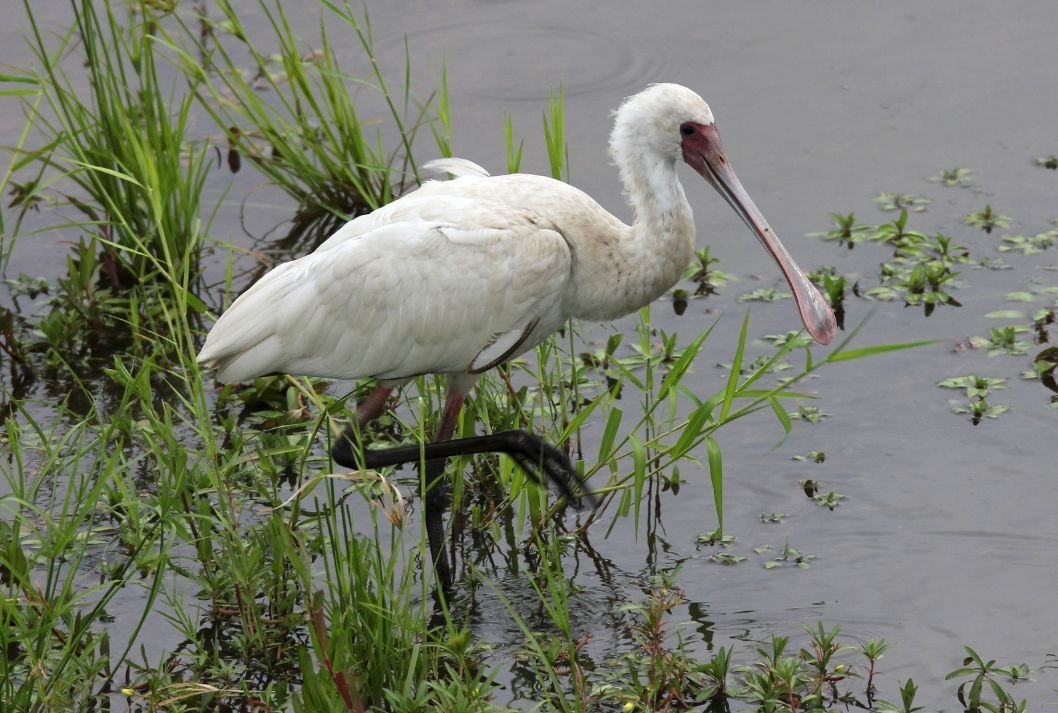
African Spoonbill
Platalea alba - sweeping its spoon-shaped bill through shallow waterIntroduction to the African Spoonbill
The African Spoonbill (Platalea alba) is a long-legged wading bird of shallow freshwater wetlands across sub-Saharan Africa and Madagascar, instantly recognisable by its extraordinary spoon-shaped bill. Pure white plumage, red legs and red facial skin complete the picture of one of Africa's most distinctive wetland birds.
It feeds by sweeping its bill side-to-side through shallow water, detecting prey by touch alone - a feeding strategy few other African birds share. In Tanzania, it frequents the lake margins, marshes and floodplains of Lake Manyara, Tarangire, Arusha and Nyerere national parks, making it a prized target for birdwatchers on any Tanzania wetland itinerary.
Scientific Classification
Family Threskiornithidae includes ibises and spoonbills worldwide. The genus name Platalea derives from Greek meaning 'broad', referring to the flattened bill tip.
How to Identify an African Spoonbill
- Pure white plumage: all-white body plumage in adults.
- Spoon-shaped bill: long, grey, flattened at the tip into a broad spatula - the species' defining feature.
- Red legs and bare red facial skin: vivid pink-red legs and a bare red face patch between bill and eye.
- Long neck and legs: classic wading-bird proportions adapted for shallow water.
- Length approximately 85-92 cm; wingspan roughly 120-135 cm.
- Weight approximately 1.4-2 kg.
- Juveniles: the bill is not spoon-shaped at hatching - it develops gradually, resembling a normal pointed bill until well after fledging. Juveniles also show darker feather tips on the wings.
Male vs Female: Key Differences
Male and female African Spoonbills are broadly similar in appearance. Males are slightly larger than females, but this is difficult to judge in the field. Both sexes participate fully in courtship, nest building, incubation and chick care.
Breeding, Nesting & Young
- Colonial breeder: nests in colonies of 5 to 250+ pairs, often alongside herons, egrets and ibises.
- Nest sites: stick-and-reed platforms built in trees or reedbeds, typically over or near water.
- Nest construction: both parents participate - the male collects material while the female arranges it.
Habitat: Shallow Wetlands
The African Spoonbill is entirely dependent on shallow freshwater and brackish wetlands:
- Lake margins and mudflats - prime sweeping habitat where fish and invertebrates concentrate.
- Freshwater marshes and swamps - including papyrus and reed-dominated wetlands.
- Seasonal floodplains - exploited when water levels are shallow enough for wading.
- River banks and estuaries - including man-made wetlands such as sewage works and dams.
The key requirement is shallow water deep enough for wading but shallow enough for the bird's bill to sweep through the substrate effectively.
Distribution Across Africa and Madagascar
The African Spoonbill is widely distributed across sub-Saharan Africa and Madagascar, wherever suitable wetland habitats occur. Its range extends from West Africa (Senegal, Mali) eastward through Sudan and Ethiopia, southward through East Africa to South Africa, and westward again to Namibia and Botswana.
Widespread resident across sub-Saharan Africa wherever suitable wetlands exist.
African Spoonbill in Tanzania
Tanzania contains numerous lakes, rivers, marshes, floodplains and seasonal wetlands that provide ideal habitat for the species. The country sits within the heart of the species' East African range, where Rift Valley lakes and seasonal wetland systems support both resident and nomadic populations. Birdwatching destinations such as Lake Manyara, Tarangire, Arusha and Nyerere national parks all contain suitable shallow-water habitats where the species may be encountered - particularly around lake margins, river deltas and seasonal pans during the wet season.
Where to See African Spoonbills in Tanzania
Suitable wetland destinations frequently visited on safari:
Lake Manyara National Park
Region: Northern Tanzania
The alkaline lake shallows and groundwater-fed marshes attract spoonbills year-round.
Good opportunity in suitable wetland habitat; sightings are not guaranteed.
Tarangire National Park
Region: Northern Tanzania
Silale Swamp and the Tarangire River provide extensive shallow-water feeding habitat.
Good opportunity in suitable wetland habitat; sightings are not guaranteed.
Arusha National Park
Region: Northern Tanzania
The Momella Lakes and Ngurdoto Crater wetlands attract wading birds including spoonbills.
Possible in suitable wetland habitat.
Nyerere National Park / Rufiji River
Region: Southern Tanzania
Oxbow lagoons and river channels along the Rufiji system hold spoonbill-friendly shallows.
Possible in suitable wetland habitat.
Best Time to See Them
African Spoonbills can be encountered year-round in suitable Tanzanian wetlands. Viewing conditions vary with water levels, local prey availability, rainfall, breeding activity and habitat conditions.
Safari Types
Game drives, specialist birdwatching safaris, wildlife photography and guided birding walks where permitted all work well; boat or wetland viewing adds perspective where officially available at specific destinations.
African Spoonbill in Pictures
A closer look at the African Spoonbill in its natural East African habitat — its striking appearance, habitat and behaviour are best appreciated up close.
Where to Spot the African Spoonbill on Safari
Plan your trip around the destinations and safaris where the African Spoonbill is easiest to see. Explore the parks, itineraries and tour packages by destination below.
What Does the African Spoonbill Eat?
An aquatic predator with a varied wetland diet:
- Aquatic insects and insect larvae - especially water beetles and fly larvae.
- Crustaceans: crayfish, shrimp and other small crustaceans.
- Molluscs: small snails and bivalves sifted from soft mud.
- Small fish: surface-swimming and shallow-water species caught by rapid pursuit.
- Amphibians: frogs and tadpoles taken opportunistically.
Daily Behaviour & Social Life
African Spoonbills spend substantial time feeding and moving through wetlands, with activity influenced by water level, prey availability, breeding stage, weather and disturbance.
Social Structure
- Foraging: may forage alone or in loose groups; gathers where food is abundant, sometimes forming coordinated feeding lines in knee-deep water.
- Roosting: rests along shorelines in groups when not feeding.
- Breeding: strongly colonial, nesting in mixed-species colonies alongside herons, egrets and ibises.
- Voice: usually silent; produces loud grunts when alarmed. During breeding, pairs engage in bill-clattering and guttural hooting displays.
Voice and Communication
The African Spoonbill is generally a quiet bird outside the breeding season:
- Alarm calls: loud grunts when disturbed or threatened.
- Courtship displays: during breeding, pairs perform synchronized head bobbing, bill clattering and low hooting calls ("rroooh...rroooh").
- Colony communication: a range of postures, bill movements and vocalizations coordinate interactions within dense colonies.
Eggs, Incubation and Fledging
- Eggs: usually 2-4 (most commonly 3), smooth glossy white with reddish-brown spots; laid at 2-3 day intervals.
- Incubation: approximately 25-29 days, shared by both parents; incubation begins with the first egg, so hatching is asynchronous.
- Chicks: hatch with white down; fed regurgitated food by both adults directly into their bills.
- Fledging: young leave the nest at approximately 46 days old and become independent shortly after.
- Breeding timing: varies geographically - dry season in West Africa, rainy season in East Africa, winter/spring in Southern Africa.
Conservation Status
IUCN Red List Status: Least Concern. The global population is estimated at roughly 20,700-46,700 mature individuals but shows a decreasing trend.
Least Concern does not mean every local population is secure. Protecting healthy wetlands, breeding sites and productive shallow-water habitats remains essential for maintaining the species across its range.
Threats to African Spoonbills
- Wetland loss: drainage for agriculture and development removes critical feeding habitat.
- Habitat conversion: floodplains and seasonal wetlands converted to farmland.
- Pollution: agricultural run-off and industrial discharge contaminate shallow feeding waters.
- Disturbance at breeding sites: human presence near colonies can cause nest abandonment.
- Water-level changes: dam construction and drought alter the shallow-water conditions the species depends on.
- Climate change: shifting rainfall patterns affect seasonal wetland availability.
The species is listed under the Agreement on the Conservation of African-Eurasian Migratory Waterbirds (AEWA).
African Spoonbill Fact Sheet
African Spoonbill vs Other Wetland Birds
African Spoonbill vs African Fish Eagle
| Feature | African Spoonbill | African Fish Eagle |
|---|---|---|
| Scientific name | Platalea alba | Haliaeetus vocifer |
| Body type | Long-legged wading bird | Powerful soaring raptor |
| Bill | Spoon-shaped, grey, tactile | Hooked, yellow with dark tip, gripping |
| Feeding method | Sweeps bill through shallow water/mud | Swoops to snatch fish at surface |
| Diet | Aquatic insects, crustaceans, molluscs, small fish | Primarily fish plus waterbirds and carrion |
| Habitat | Shallow wetlands, mudflats, lake margins | Lakeshores with tall trees, rivers, swamps |
| Shared parks | Both found at Lake Manyara, Nyerere and other Tanzanian wetland destinations | |
African Spoonbill vs Yellow-billed Stork
| Feature | African Spoonbill | Yellow-billed Stork |
|---|---|---|
| Scientific name | Platalea alba | Mycteria ibis |
| Size | ~90 cm tall | Larger, up to 105 cm tall |
| Bill | Spoon-shaped, grey, swept sideways | Long, thick, down-curved yellow bill |
| Feeding technique | Tactile sweeping in shallow water | Foot-stirring then rapid snapping strike |
| Plumage | All-white with red face/legs | White with pink/orange wash, black wing/tail edges |
| Sociality | Loose groups; colonial nester | Often solitary or small groups |
Why the African Spoonbill Matters to Tanzania Birdwatchers
The African Spoonbill is one of those species that separates casual wildlife viewers from genuine birdwatchers. Its unmistakable silhouette - long white neck, red legs and that extraordinary spatulate bill - is instantly recognisable once learned, yet finding one actively feeding requires visiting the right wetland at the right water level. For photographers, the bill-sweeping motion, reflections in still shallows and the contrast of pure white against dark mud make for striking images. Beyond aesthetics, the species' presence indicates healthy shallow-wetland ecosystems - making it a natural flagship for wetland conservation in Tanzania.
Photographing the African Spoonbill
Subjects worth waiting for:
- Bill sweeping through water - the signature behaviour, best captured at water level.
- Standing/wading portraits - full-body frames showing the red legs and white plumage.
- Flight shots - long neck extended, spoon bill leading, broad white wings.
- Landing - dramatic wing-spreading moments at the water edge.
- Feeding close-ups - the bill tip submerged with ripples spreading outward.
- Pair behavior - mutual preening and billing during breeding season.
- Colony scenes - multiple birds nesting in trees over water.
- Juveniles - showing the gradual development of the spoon-shaped bill.
- Reflections - white-on-water mirror compositions in calm shallows.
Ethics first: maintain appropriate distance, follow park rules, do not disturb nests, do not block feeding birds, and do not approach breeding colonies unnecessarily.
A long-legged wading bird (Platalea alba) of the ibis and spoonbill family Threskiornithidae, found in shallow freshwater wetlands across sub-Saharan Africa and Madagascar. It is instantly recognisable by its large spoon-shaped bill, which it sweeps side-to-side through shallow water to catch aquatic prey by touch.
Platalea alba, described by Scopoli in 1786. The genus name Platalea comes from the Greek for 'broad', referring to the flat bill tip. The species epithet 'alba' means 'white' in Latin.
Threskiornithidae, which encompasses all ibises and spoonbills worldwide. The order is Pelecaniformes, which also includes pelicans, herons and hammerkops.
In shallow freshwater wetlands across the country. Key birdwatching destinations include Lake Manyara National Park, Tarangire National Park (especially Silale Swamp), Arusha National Park (Momella Lakes) and the Rufiji River system in Nyerere National Park. Good opportunity in suitable wetland habitat; sightings are not guaranteed.
Aquatic insects and larvae, crustaceans (crayfish, shrimp), molluscs, small fish and amphibians. Prey is detected by touch rather than sight, so the diet reflects whatever lives in the soft substrate of shallow wetlands where the bird sweeps its bill.
The bill is held slightly open and swept from side to side through water and soft mud. Highly sensitive nerve endings inside the flattened tip detect prey by contact, triggering an instantaneous snap shut. This tactile feeding method allows the bird to catch prey in murky water where visibility is zero.
It may forage alone or in loose groups, sometimes forming coordinated feeding lines. When breeding, it is strongly colonial - nesting alongside herons, egrets and ibises in mixed colonies that can exceed 200 pairs.
In stick-and-reed platform nests built in trees, bushes or reedbeds, typically positioned over or near water to deter ground predators. Both parents construct the nest, with the male gathering materials and the female arranging them.
No - it is listed as Least Concern on the IUCN Red List, with a global population estimated at roughly 20,700-46,700 mature individuals. However, numbers appear to be declining due to wetland drainage, pollution and disturbance at breeding sites.
It is primarily a sedentary resident with some nomadic and partially migratory movements in response to changing water levels and food availability rather than predictable long-distance migration.
African Spoonbills can be encountered year-round in suitable Tanzanian wetlands. Viewing conditions vary with water levels, local prey availability, rainfall and breeding activity. Shallow-water conditions during the dry season may concentrate prey and improve viewing opportunities.
Focus on the signature bill-sweeping motion at water level, standing portraits showing red legs and white plumage, flight shots with neck extended and landing moments. Reflections in calm shallows create powerful compositional opportunities. Maintain distance, follow park rules and never disturb feeding or nesting birds.
Related Safari Packages & Tours
Book a safari to see the African Spoonbill and the rest of Africa's incredible wildlife with our expert guides.
References & Further Reading
- IUCN Red List / BirdLife DataZone: Platalea alba factsheet
- Animal Diversity Web / AVONET: Morphology, diet and breeding data via Birds of the World.
- Kahl, M.P. (1983): Displays of the African Spoonbill Platalea alba. Ibis 125: 324-338.
- About these facts: Measurements and breeding figures are approximate ranges drawn from the sources above; they vary with sex, age, region and method. Conservation status should be checked against the current IUCN assessment.