

.png)
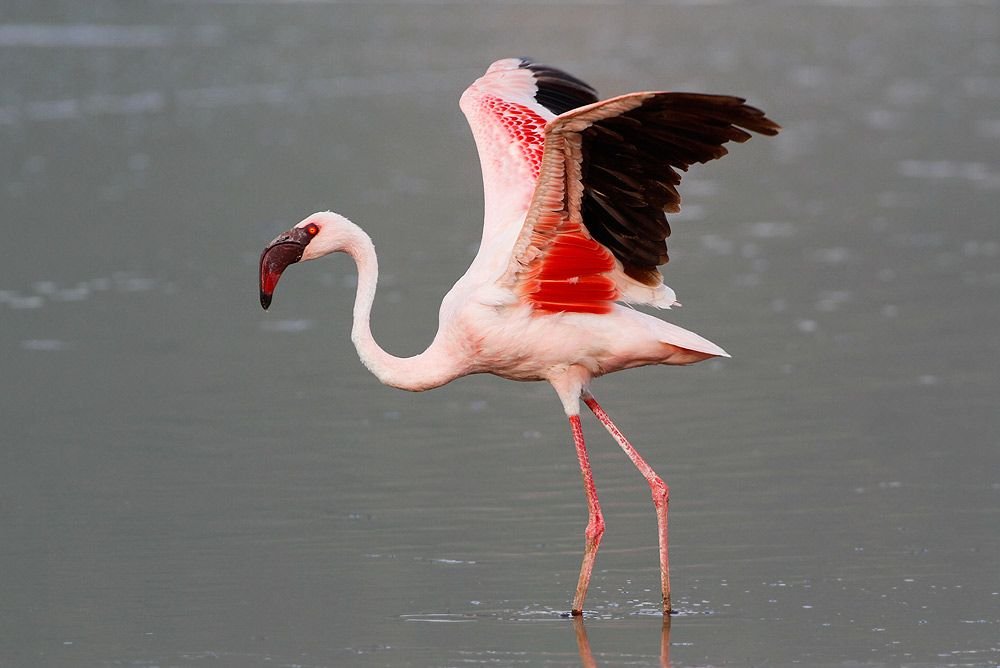
Lesser Flamingo in Tanzania
Phoeniconaias minor - the soda-lake flamingo of Lake NatronWhat Is the Lesser Flamingo?
The Lesser Flamingo (Phoeniconaias minor) is the smallest of the world’s flamingo species and one of East Africa’s most specialized soda-lake birds. Its deep pink plumage, dark red-to-black bill and highly specialized filter-feeding system allow it to exploit microscopic cyanobacteria and other organisms in alkaline and saline lakes that few other large birds can tolerate.
In Tanzania, Lake Natron is the species’ most important breeding site - one of the most significant flamingo nurseries on Earth - while lakes such as Manyara, Bahi and Eyasi form part of its wider feeding and movement network across the Rift Valley.
Globally the species is listed as Near Threatened, because its fortunes depend entirely on a small number of fragile soda lakes.
Scientific Classification
The Lesser Flamingo belongs to Phoenicopteridae, the flamingo family, and is the sole member of its genus - specialized for feeding in shallow alkaline and saline wetlands where its closest relative, the Greater Flamingo, feeds alongside it but takes broader prey.
How to Identify a Lesser Flamingo
- Smallest flamingo species worldwide.
- Deep pink to magenta coloration - usually noticeably richer than the Greater Flamingo.
- Very dark red-to-black bill - deep-based, without the Greater’s contrasting pink-and-black-tip look.
- Long pink legs and a long curved neck.
- Black flight feathers visible in flight.
- Narrow, highly specialized filter-feeding bill.
- Juveniles are grey-brownish, gaining pink plumage gradually as carotenoid-rich food accumulates.
Size Summary
- Height: approximately 80-90 cm
- Body mass: approximately 1.2-2.7 kg, depending on source/individual
Lesser Flamingo vs Greater Flamingo: First-Look Identification
When both species feed together - as they often do at Lake Manyara or Natron - size and colour separate them quickly:
- Lesser Flamingo: smaller; deeper overall pink; darker bill; strongly tied to alkaline/soda lakes; cyanobacteria-specialized diet.
- Greater Flamingo: larger; paler overall; pink bill with a prominent black tip; broader filter-feeding diet; wider wetland tolerance.
Important caution: colour alone is not always sufficient - plumage varies with age, diet, condition and light. Combine size, bill pattern and posture for confident identification.
Why Are Lesser Flamingos Pink?
The intense pink coloration of Lesser Flamingos is linked to carotenoid pigments obtained from their food. Because their diet is so strongly centred on microscopic algae and cyanobacteria - especially species like Arthrospira fusiformis - these pigments are deposited in feathers, skin and leg tissues as the birds metabolize their food.
Juveniles hatch grey and only develop the famous deep pink as they accumulate pigment. Food quality and availability therefore influence not just survival but literally the colour of the bird - making a vivid flock a visible sign of a productive soda lake.
The coloration is not camouflage: on a caustic soda flat, being conspicuous costs nothing, and display value likely matters far more than hiding.
Male vs Female: Key Differences
Males and females are broadly similar externally, with males slightly larger on average - no reliable field mark separates the sexes.
Both partners take part in every nesting stage:
- Mound construction - both build the mud nest turret.
- Incubation - shared shifts on the single egg.
- Chick feeding - both parents produce crop milk (a nutrient-rich secretion from the upper digestive tract - not mammalian milk) and guard the young.
Habitat: A Soda-Lake Specialist
This is not a generalist wetland bird - the Lesser Flamingo is bound to a very specific kind of water:
- Alkaline and soda lakes - hypersaline caustic waters hostile to most life.
- Saline lakes and pans.
- Shallow lagoons - often less than a metre deep.
- Mudflats and saline shorelines - rich in benthic diatoms.
- Rift Valley wetland networks linking feeding and breeding sites.
Woodland, dry savanna and forest are irrelevant as habitat: what matters is shallow, salty, algae-rich water - plus safe muddy islands or flats for nesting.
Habitat and Global Distribution
Lesser Flamingos occupy a discontinuous distribution across alkaline and saline wetlands in eastern, southern and western Africa, with a smaller population in western India. The East African Rift Valley supports the world’s most important concentrations.
Tanzania is a critical range country because its alkaline lakes form part of the species’ East African network - not because the species exists nowhere else, but because the network’s key breeding anchor lies here.
Lesser Flamingo in Tanzania
Tanzania is a critical range country for this species: its alkaline lakes form part of the East African network that supports one of the world’s most important Lesser Flamingo populations.
Lake Natron, in northern Tanzania at the Kenyan border, is the key breeding site - by far the most important regular nesting location for the species anywhere. Around it, a chain of soda lakes provides the feeding and staging grounds the population depends on between breeding events.
Sightings and flock sizes vary seasonally and with water conditions - never guaranteed - but in suitable lake conditions the spectacle can be extraordinary.
Why Is Lake Natron So Important to Lesser Flamingos?
Lake Natron’s harsh chemistry is precisely what makes it priceless:
- Extreme alkalinity and salinity - the caustic water and trona crusts are physically difficult for many organisms (and predators) to access, protecting breeding birds.
- Shallow lagoons - ideal feeding depth for filter-feeding flamingos.
- Abundant microscopic food - cyanobacterial blooms in some lagoons; benthic diatoms in others.
- Mud and trona nesting substrate - perfect raw material for nest turrets on isolated flats.
- Enormous breeding concentrations - the lake regularly hosts very large gatherings and is one of the world’s most important breeding sites for the species; Nature Tanzania describes it as supporting a very large share of the global population.
The balance is delicate. When water levels rise too high, suitable nesting substrate disappears; when they fall too low, predators such as hyenas can reach breeding flats. Breeding success is written by hydrology - which is why the lake’s natural water regime is everything.
Lesser Flamingo Movement Across Tanzania’s Rift Valley Lakes
Lesser Flamingos do not live permanently at Lake Natron. Satellite tracking has documented an interconnected East African network of alkaline lakes used in shifting combinations:
- Lake Natron - breeding anchor.
- Lake Manyara - repeatedly used feeding site.
- Lake Bahi and Lake Eyasi - documented Tanzanian nodes.
- Empakai Crater Lake - highland stopover.
- Major Kenyan alkaline lakes - Bogoria, Nakuru, Elmenteita, Logipi.
Different lakes serve different roles - feeding sites, staging posts, movement stopovers, breeding grounds - and not every bird visits every lake. Birds track algal blooms across the network, sometimes relocating astonishing distances when food shifts; movements are nomadic responses to conditions rather than fixed migration. Tanzania’s lakes are therefore not isolated ponds but one living system.
Where to See Lesser Flamingos in Tanzania
Lake Natron
Country: Tanzania | Region: Arusha Region (Rift Valley)
Primary breeding location. The most important Lesser Flamingo site on the page - Ramsar-listed, globally significant, and the heart of East African flamingo conservation.
Potentially excellent in suitable lake conditions; never disturb breeding colonies.
Lake Manyara National Park
Country: Tanzania | Region: Northern Tanzania
Important feeding/staging wetland within the East African network; satellite tracking documented repeated use of the lake.
Feeding/staging significance; flock size varies with conditions.
Momella Lakes / Arusha National Park
Country: Tanzania | Region: Northern Tanzania
Tanzanian research identifies the Momella lakes among important Lesser Flamingo feeding sites - easily combined with an Arusha stay.
Feeding significance; sightings vary with lake conditions.
Lake Bahi
Country: Tanzania | Region: Central Tanzania
Part of the wider East African alkaline-lake network used by tagged Lesser Flamingos; a specialist destination for list-builders.
Network/feeding significance; presence shifts with conditions.
Safari & Birding Methods
- Specialist birdwatching focused on soda-lake systems.
- Wetland observation from shorelines and viewpoints.
- Guided lake excursions where permitted.
- Game drives where relevant (Manyara, Arusha NP).
- Wildlife photography - flocks, flight, reflections.
Best Time to See Them
Lesser Flamingos can be encountered in Tanzania throughout the year at suitable lakes. Large concentrations and breeding events depend on water level, salinity, food availability, weather and seasonal movement. For Lake Natron, historical breeding peaks often fall around October-November - but timing varies by year, and unfavourable seasons can see breeding skipped entirely.
Lesser Flamingo in Pictures
A closer look at the Lesser Flamingo in its natural East African habitat — its striking appearance, habitat and behaviour are best appreciated up close.
Where to Spot the Lesser Flamingo on Safari
Plan your trip around the destinations and safaris where the Lesser Flamingo is easiest to see. Explore the parks, itineraries and tour packages by destination below.
What Does the Lesser Flamingo Eat?
This is a dietary specialist, not a generalized filter-feeder. The menu is microscopic:
- Cyanobacteria - above all Arthrospira fusiformis, a protein-and-lipid-rich spiral bacterium that forms the dietary backbone (research records individuals consuming roughly 72 g of cyanobacteria per day).
- Other microscopic algae - including Synechococcus and related species.
- Benthic diatoms - scraped from shallow flats.
- Copepods such as Lovenula africana and other planktonic organisms.
Tanzania detail worth savouring: different Lake Natron lagoons offer different food resources - some dominated by benthic diatoms, others hosting cyanobacterial blooms - which helps explain why flocks shift around the lake and across the whole Rift Valley network.
How Does a Lesser Flamingo Filter Food?
- Head inverted - the bill is lowered upside-down into the water, often floating at the surface or sweeping just above soft mud.
- The tongue pumps, drawing water rhythmically through the bill like a piston.
- Fine lamellae filter the flow: comb-like plates inside the specialized narrow bill retain microscopic particles - cyanobacteria, algae, diatoms, tiny copepods.
- Food is scraped forward and swallowed; filtered water is expelled back out.
The whole system is optimized for harvesting organisms almost too small to see - Tanzanian research documents the specialized bill structure enabling very high-volume filtering of these soda-lake waters. Feeding happens day and night, with studies recording the majority of daylight hours spent at the task.
Daily Behaviour
Lesser Flamingos spend large portions of the day feeding, resting, preening, flying between lakes and interacting within vast flocks. Research records the majority of daylight hours spent feeding - and activity continues at night when conditions suit.
Activity varies with food distribution, wind, water conditions, temperature and breeding stage rather than following any fixed hourly schedule. Some East African movements even track wind-driven algal concentration across a lake surface.
Breeding at Lake Natron: Colonies, Eggs and Timing
Lesser Flamingos are colonial breeders, synchronizing their nesting so vast numbers of chicks hatch together. At Lake Natron, pairs build conical mud turrets - typically 6-40 cm tall - from wet soda mud on shallow flats or isolated trona islands.
- Eggs: one egg per breeding attempt is typical (rarely two) - a single chalky-white egg incubated on the parents’ feet beneath the brood patch.
- Incubation: approximately 28 days, shared by both parents in alternating shifts.
- Chicks: hatch in grey down (~50 g), remain near the nest for the first days, then join crèches at around three weeks old.
- Crop milk: both parents feed chicks a nutrient-rich secretion from the upper digestive tract - flamingo crop milk, not mammalian milk.
- Fledging: approximately 65-75 days, with Lake Natron research literature citing around 70 days; independence follows at roughly 90 days.
When Do Lesser Flamingos Breed at Lake Natron?
Breeding is strongly seasonal but does not follow one guaranteed calendar. Historical studies have recorded egg-laying across several months, with peaks often occurring around October-November. Water level, salinity, food availability and disturbance shift timing and success - and unfavourable years can see breeding skipped entirely. Individual birds may even go years between breeding attempts.
Conservation Status: Near Threatened
IUCN Red List Status (global): Near Threatened. Regional assessments can differ - for example, BirdLife’s 2025 southern African regional assessment categorizes the species as Vulnerable in that region. The global figure, however, remains Near Threatened.
The biggest conservation issue is not poaching: it is the health of the alkaline and saline lake systems themselves.
Natural & Breeding Threats
- Hydrological extremes - too much water removes nesting substrate; too little lets predators such as hyenas reach breeding flats.
- Egg and chick predation when sites become accessible.
- Disturbance - research documents mass abandonment of clutches after intrusion.
- Food shortages when blooms fail or lakes dilute.
Human Pressures
- Habitat and catchment degradation - agriculture, deforestation, pollution.
- Infrastructure and development pressure at key lakes.
- Historical pressures including hunting, wild-bird trade and egg collection.
- Climate-driven changes to lake hydrology and food productivity.
In welcome news, BirdLife reported in August 2025 that a controversial soda-ash mining project at Lake Natron had been halted - a significant safeguard for one of the world’s most important Lesser Flamingo breeding sites.
Lesser Flamingo Conservation in Tanzania
Tanzania carries exceptional responsibility for this species because Lake Natron sits within its borders. The conservation toolkit centres on:
- Ramsar protection of Lake Natron - international recognition of its wetland value.
- Breeding-site protection - keeping nesting flats undisturbed through sensitive access management.
- Hydrological monitoring - tracking the water levels that decide breeding success.
- Catchment management - protecting rivers and woodlands that regulate the lake.
- Community conservation - local stewardship initiatives around Natron supported by organizations including the IUCN Flamingo Specialist Group network and national partners.
- Preventing damaging development - as the 2025 mining decision showed, vigilance matters.
- Responsible ecotourism - valuing live flamingos over short-term extraction.
Because East African Lesser Flamingos function as one network population spanning Kenya and Tanzania, cross-border site protection multiplies the value of every Tanzanian safeguard.
Lesser Flamingo Facts
Lesser Flamingo vs Greater Flamingo
| Feature | Lesser Flamingo | Greater Flamingo |
|---|---|---|
| Size | Smaller - 80-90 cm; 1.2-2.7 kg | Larger - 120-125 cm; 2-4 kg |
| Colour | Usually deeper pink/magenta | Usually paler pink |
| Bill | Dark red to almost black throughout | Pink with a prominent black tip |
| Main diet | Strong cyanobacteria/algae specialization (Arthrospira) | Broader filter-feeding diet incl. larger invertebrates |
| Habitat | Alkaline/saline soda lakes especially important | Wider range of wetlands incl. fresher waters |
| Tanzania locations | Natron breeding; Manyara, Momella, Bahi network | Manyara, Natron inflow zones and other wetlands |
| Conservation | Near Threatened globally | Least Concern globally |
Remember: colour alone is not always sufficient for identification - age, diet, light and condition all shift plumage tone. Check size, bill pattern and habitat together.
Lesser Flamingo vs African Spoonbill
| Feature | Lesser Flamingo | African Spoonbill |
|---|---|---|
| Family | Phoenicopteridae - Phoenicopteriformes | Threskiornithidae - Pelecaniformes |
| Bill | Downcurved filter with lamellae; inverted-head pumping | Straight flat spatula swept side-to-side |
| Plumage | Deep pink, dark bill | All-white, red face and bill |
| Diet focus | Microscopic cyanobacteria & diatoms | Small aquatic animals stirred from bottom |
| Shared habitat | Shallow alkaline wetlands such as Lake Manyara margins host both species | |
Why Lesser Flamingos Matter to Tanzania
- Global ecological significance: Lake Natron’s flats host one of the most important breeding events in the bird world - a natural spectacle of international consequence.
- Birdwatching crown jewel: a pink horizon of ten thousand flamingos is the single image that sells Tanzanian wetlands worldwide.
- Wetland conservation flagship: protecting Natron protects water quality, catchments and countless lesser-known species alongside the flamingos.
- Scientific research hub: hydrology, algae ecology and satellite-tracking studies here shape global flamingo conservation.
- Sustainable ecotourism: community-guided visits around Natron and Manyara turn living flocks into lasting local income.
- International biodiversity value: as a Ramsar site within a cross-border East African network, Lake Natron is Tanzania’s contribution to a global responsibility.
Photographing the Lesser Flamingo
- Enormous feeding flocks spread across alkaline shallows.
- Synchronized takeoff and flight - dense pink skeins crossing soda horizons.
- Courtship displays - head-flagging and wing-salute marches.
- Nesting colonies from legal, safe distance only.
- Chicks and crèches - grey down among pink adults.
- Pink-on-white reflections across mirror-flat soda pans.
- ID pairs - Lesser beside Greater for bill-and-size comparisons.
Critical ethics: never approach or disturb breeding colonies. Lake Natron flamingos are exceptionally sensitive - research documents mass abandonment of clutches after disturbance. Keep legal distances, follow site rules and your guide’s instructions, and let the flock come to you.
Frequently Asked Questions
The Lesser Flamingo (Phoeniconaias minor) is a remarkable African wildlife species, classified within the Birds group. The smallest, brightest flamingo - over a million gather on Lake Natron to breed.
The best places to see the Lesser Flamingo include Lake Natron, Tanzania. Its key range countries are Tanzania.
The Lesser Flamingo is a filter feeder, feeding mainly on a specialised diet found in its wetlands habitat.
Adults typically reach 80-90 cm tall.
Adults can weigh up to around 1.2-2.7 kg.
Lesser Flamingos are powerful fliers, relocating between lakes as food and water conditions shift.
In the wild, the Lesser Flamingo typically lives 20-40 yrs.
The Lesser Flamingo is currently listed as Vulnerable on the IUCN Red List. Conservation efforts across Tanzania aim to keep populations healthy.
The Lesser Flamingo is most at home in Wetlands environments, including Lake Natron, Tanzania.
Key threats include habitat loss, climate change, and human-wildlife conflict.
The Lesser Flamingo is often active in the cooler hours of dawn and dusk, spending much of the day resting. It is highly alert and well adapted to its wetlands home.
Yes — the Lesser Flamingo is often found in groups, where shared awareness and cooperation improve survival.
Large predators such as lions, leopards and hyenas may threaten the Lesser Flamingo, especially young or weak individuals.
The dry season (June to October) is generally best for wildlife viewing, when animals gather around reliable water sources.
Across Tanzania, the Lesser Flamingo symbolises strength, resilience and the untamed spirit of the African wilderness.
Mothers give birth to a single young and raise it with intense care, teaching it to find food and avoid danger.
It communicates using a combination of calls, scent and body language.
As a birds species, the Lesser Flamingo helps maintain the balance of its ecosystem, influencing vegetation, prey and predator populations.
Absolutely — early-morning and late-afternoon drives in Lake Natron, Tanzania offer superb photography opportunities.
Classic game drives in national parks and reserves offer the best and most reliable encounters.
Choose responsible safari operators, support conservation organisations, and respect wildlife rules while on safari.
Yes — protected parks, anti-poaching units and organisations like African Parks and WWF work to secure its future.
From its size and behaviour to its role in the ecosystem, the Lesser Flamingo is one of the most fascinating animals on an African safari.
Tanzania is a world-class safari destination with exceptional wildlife viewing — ideal for seeing the Lesser Flamingo and much more.
Accurate numbers vary by region, but protected populations across Tanzania remain the focus of active conservation monitoring.
Related Safari Packages & Tours
Book a safari to see the Lesser Flamingo and the rest of Africa's incredible wildlife with our expert guides.
References & Further Reading
- IUCN Red List: Phoeniconaias minor
- African Parks: Conservation efforts for large mammals in Africa.
- Tanzania Wildlife Research Institute (TAWIRI): Monitoring wildlife populations in Tanzania.
- Kenya Wildlife Service (KWS): Wildlife conservation in Kenyan parks.
- Uganda Wildlife Authority (UWA): Protection of wildlife in Ugandan reserves.
- Estes, R. (1991). The Behavior Guide to African Mammals. University of California Press.
- Kingdon, J. (2015). The Kingdon Field Guide to African Mammals. Bloomsbury.
- About these facts: Weight, speed and lifespan are approximate adult ranges. They can vary with sex, age, season, location and the measurement method; conservation status should be checked against the current IUCN assessment.
Sightings are never guaranteed and depend on local conditions.

Colonies and Social Life
Lesser Flamingos are among the most colonial birds on Earth. Large flocks feed together, roost together and move together, and breeding colonies can contain enormous numbers of nests packed across soda flats.
Flock sizes range from hundreds to gatherings exceeding a million birds at prime sites - among the largest bird congregations anywhere.