

.png)
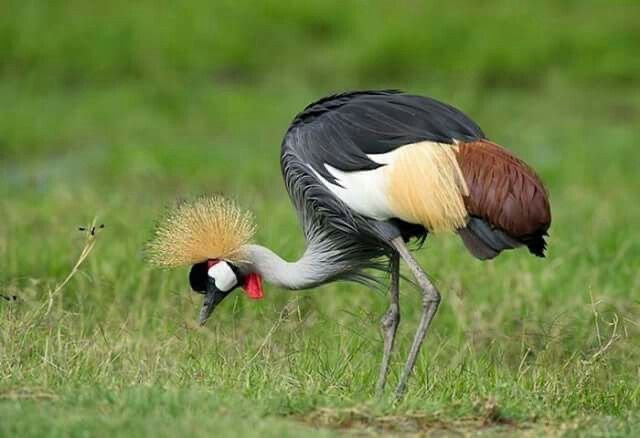
Grey Crowned Crane in Tanzania
Balearica regulorum - the dancing crane with the golden crownWhat Is the Grey Crowned Crane?
The Grey Crowned Crane (Balearica regulorum) is one of Africa’s most striking birds - a stately crane with a pearly grey body, stiff golden crown tipped with black, white cheek patches and a bright red inflatable throat pouch.
Unlike most cranes, it is equally at home in open grassland and savanna as it is in wetlands, breeding in marshes and foraging across grasslands, pastures and even farmland near water. It is famous for its exuberant courtship dance - bowing, jumping and wing-spreading displays performed by both partners - and is one of only two crane species that regularly roosts in trees.
In Tanzania it graces wetland-grassland mosaics from Tarangire and Arusha National Park to Ngorongoro and the Serengeti. Globally it is listed as Endangered, making every sighting special.
Scientific Classification
Two subspecies are recognized: the East African Crowned Crane (B. r. gibbericeps), found from Uganda and Kenya south through Tanzania to northern Mozambique, and the South African Crowned Crane (B. r. regulorum) of southern Africa. Together with the Black Crowned Crane, these are the most ancient living crane lineages.
How to Identify a Grey Crowned Crane
- Pearly grey body plumage - pale grey across neck, breast and body.
- Golden/yellow stiff crown - a spray of bristle-like feathers on the head, each tipped with black.
- White cheek patches with a smaller red patch above, bare-skinned.
- Red inflatable gular sac under the chin - expanded during the booming call.
- Short grey bill relative to other cranes.
- Black legs and a long hind toe that lets the foot grip branches.
- Black-and-white/golden wing pattern - predominantly white wings with coloured feathers and a distinctive black patch at the top.
- Juveniles are greyer than adults, with a feathered buff face and browner crown that develops with age.
Size Summary
- Length: approximately 100-110 cm tall
- Weight: approximately 3-4 kg
- Wingspan: approximately 180-200 cm
Why Does the Grey Crowned Crane Have a Golden Crown?
The crown is a halo of stiff, golden-yellow feathers, each ending in a neat black tip. Unlike a crest of soft plumes, these bristles stand permanently upright - giving the species its name and its unmistakable silhouette.
- The golden bristles frame white bare cheek patches set against darker head markings.
- Beneath the chin hangs the red inflatable gular sac, which puffs out when the bird gives its booming, honking call.
- A small red patch above the white cheek adds further colour to the face.
The crown’s role is primarily display: during courtship dances and pair-bonding rituals, head-bobbing and bowing movements show off the crown, cheeks and sac together, letting partners read each other’s posture and intent. The brighter, fuller crown of a healthy adult is part of what makes these displays so arresting.
Male vs Female: Key Differences
Males and females are similar in appearance, sharing the grey body, golden crown, white cheeks and red gular sac. Males are slightly larger on average, but the difference is hard to judge in the field.
Both sexes participate fully in every stage of the breeding cycle:
- Courtship - both partners dance.
- Nest construction - both build the platform.
- Incubation - both parents share egg duties.
- Parental care - both guard and feed chicks.
Grey Crowned Crane Courtship Dance
Few wildlife performances rival a dancing pair of crowned cranes. The display combines:
- Deep bowing - often with mutual preening of each other’s feathers.
- Head-bobbing - showing off the golden crown and cheek patterns.
- Wing spreading - flashing the black-and-white-and-golden wing pattern.
- Jumping and short running bursts - wings flared, legs springing off the ground.
- Vocal duetting - booming calls produced by inflating the red gular sac, plus honking notes quite unlike the trumpeting of other cranes.
Both partners participate - and immature birds often join adult dances too. While dancing is an integral part of courtship, pairs also dance at other times of year, apparently reinforcing the pair bond; mated birds are typically monogamous and may remain together for life.
Habitat: A Wetland + Grassland Mosaic
The Grey Crowned Crane is not a wetland-only species. Its true requirement is a mosaic of two habitats used for different purposes:
- Wetlands for breeding: marshes, floodplains, shallow seasonal water and wetland margins with tall vegetation - reed beds and sedges around 1 m high conceal the nest from predators.
- Open grassland/savanna for foraging: short to medium grasslands, pastures, fallow fields and cropland where the birds walk and pick up food.
- Scattered trees nearby provide safe night-time roosts.
This dual need makes the species sensitive to changes on either side of the equation: drained wetlands remove nesting sites, while overgrazed or ploughed grasslands remove feeding grounds.
Habitat and Global Distribution
Grey Crowned Cranes occur across eastern and southern Africa wherever suitable wetland and open-grassland habitats coincide - from Uganda, Kenya and eastern DR Congo in the north, through Tanzania, Rwanda and Zambia, to Namibia, Botswana, Zimbabwe, Mozambique and South Africa in the south.
Tanzania is one important portion of the species range. Tropical populations are largely resident, with localized seasonal movements in drier regions rather than true migration.
Grey Crowned Crane in Tanzania
Tanzania holds a healthy share of the East African Crowned Crane population (B. r. gibbericeps), with birds present in suitable wetland and grassland landscapes across the northern circuit and beyond.
- Tarangire National Park - wetland margins, swamps and open grassland hold resident pairs and flocks.
- Arusha National Park - the Momella lakes area and surrounding grasslands are reliable crane habitat.
- Lake Manyara National Park - groundwater forests edge onto open flats and lake margins where cranes forage.
- Ngorongoro Conservation Area - the crater floor combines seasonal marshes with short grassland.
- Serengeti National Park - cranes occur in suitable savanna and wetland areas of the ecosystem.
Sightings vary by location, season and local conditions - never guaranteed. Historical research on East African crowned crane breeding ecology in northern Tanzania dates back decades, and community-level conservation work continues today (see below).
Where to See Grey Crowned Cranes in Tanzania
Tarangire National Park
Country: Tanzania | Region: Northern Tanzania
Seasonal swamps, Silale Swamp margins and open grassland attract pairs and non-breeding flocks year-round.
Good opportunity in suitable wetland/grassland habitat.
Lake Manyara National Park
Country: Tanzania | Region: Northern Tanzania
Open flats and wetland edges beneath the Rift Valley escarpment provide classic crane foraging ground.
Good opportunity in suitable wetland/grassland habitat.
Arusha National Park
Country: Tanzania | Region: Northern Tanzania
Momella lakes and surrounding grassland mosaics make this one of the most accessible parks for crane sightings near Arusha city.
Good opportunity in suitable wetland/grassland habitat.
Ngorongoro Conservation Area
Country: Tanzania | Region: Northern Tanzania
The crater floor mixes seasonal marshes with short grasses - ideal combined breeding and feeding habitat.
Good opportunity in suitable wetland/grassland habitat.
Serengeti National Park
Country: Tanzania | Region: Northern Tanzania
Cranes occupy suitable savanna and wetland patches across the ecosystem, away from the densest migration crowds.
Good opportunity in suitable wetland/grassland habitat.
Safari & Birding Methods
- Game drives through park wetlands and grasslands.
- Specialist birdwatching excursions targeting crane sites.
- Wetland birding sessions at lake margins and swamp edges.
- Guided birding walks where permitted.
- Wildlife photography from established tracks and viewpoints.
Best Time to See Them
Grey Crowned Cranes can be encountered year-round in suitable Tanzanian habitats. Breeding is strongly linked to rainfall patterns, so activity levels shift with the seasons. Visibility also depends on water levels, grass height, flock movements, wetland conditions, local disturbance and agricultural activity - there is no single guaranteed month.
Grey Crowned Crane in Pictures
A closer look at the Grey Crowned Crane in its natural East African habitat — its striking appearance, habitat and behaviour are best appreciated up close.
Where to Spot the Grey Crowned Crane on Safari
Plan your trip around the destinations and safaris where the Grey Crowned Crane is easiest to see. Explore the parks, itineraries and tour packages by destination below.
What Does the Grey Crowned Crane Eat?
The species is a true generalist omnivore, taking both plant and animal foods according to season and habitat:
Plant Foods
- Grass seeds and sedge seeds
- Grains from harvested and planted cereal fields
- Maize where available
- Fresh grass shoots and other plant material
Animal Foods
- Grasshoppers, crickets and locusts
- Caterpillars and other insects
- Worms and other invertebrates (including crabs)
- Frogs and lizards
- Other small animals taken opportunistically
No fixed percentages apply - diet composition shifts with what each wetland-grassland mosaic produces through the year.
How Does a Grey Crowned Crane Find Food?
- Walks steadily through grasslands on those long dark legs.
- Probes and picks at seeds, shoots and small animals in the sward and soil surface.
- Stamps its feet as it walks, disturbing vegetation and flushing hidden insects into the open.
- Snaps up flushed prey with quick bill strikes.
- Follows cattle and other large grazers - antelopes, gazelles, livestock - to catch the insects their hooves disturb. This association with grazing animals is a signature feeding behaviour.
- Feeds across both habitat halves of its range - picking through wetland shallows as readily as dry grassland and stubble fields.
Cranes essentially spend much of the day looking for food in this deliberate, methodical way before flying to roost trees at dusk.
Daily Behaviour
Grey Crowned Cranes are primarily diurnal. Their day divides among feeding, socializing, displaying, moving between wetland and grassland habitats - and finally flying up to roost in trees around nightfall. They leave the roost between dawn and about an hour after dawn.
Breeding, Eggs, Chicks and Nesting
- Pairs: monogamous; pairs may mate for life, with breeding timed to rainfall and local wetland conditions rather than a fixed calendar.
- Nest site: in or at the edge of standing water, within tall reedy vegetation (around 1 m high) that conceals the nest - pairs often trample a cleared circular area up to ~20 m wide around the site.
- Nest: a large platform built from surrounding plant material - pulled-up grasses, sedges and rushes.
- Eggs: clutch of 2-4 pale bluish-white eggs (some references record up to 5).
- Incubation: approximately 28-31 days, shared by both parents.
- Chicks: precocial - running soon after hatching, able to swim shortly after, beginning to feed within about a day and following parents within about two days.
- Fledging: approximately 56-100 days.
- After fledging: juveniles later join groups of other young cranes until they pair up themselves.
Breeding pairs are sensitive to disturbance; repeated intrusion can cause nest failure.
Tree Roosting: A Unique Crane Adaptation
Most of the world’s fifteen crane species sleep on the ground. The Grey Crowned Crane - together with its cousin the Black Crowned Crane - is one of only two cranes known for regular tree roosting and perching.
The secret is anatomical: crowned cranes retain a long hind toe (hallux) that can curl around branches, giving a grip the other cranes lack. This ancestral trait lets them:
- Roost in tall trees near wetlands each night, safe from ground predators.
- Perch on posts and structures - including, unfortunately, power infrastructure.
- Escape flooding when wetland water levels rise suddenly.
Look upward at dusk around Tanzanian wetlands and you may spot silhouetted cranes settling into the canopy - a behaviour no other Tanzanian crane can match.
Conservation Status: Endangered
IUCN Red List Status: Endangered - uplisted from Vulnerable in the 2012 assessment after data showed an estimated decline of roughly 65-80% over three generations. Recent estimates put the global population at around 29,500-36,000 individuals and decreasing.
Main Threats
- Wetland drainage, loss and degradation - removing nesting habitat.
- Habitat fragmentation and agricultural expansion - shrinking the grassland half of the mosaic.
- Overgrazing by livestock degrading both wetlands and grassland.
- Poisoning (including pesticide pollution) and persecution where cranes are blamed for crop damage.
- Hunting, trapping and egg collection for food.
- Illegal live-bird trade - chicks are taken for captive display, a severe pressure on wild populations.
- Power-line collisions and electrocution - especially for a crane that flies between roost trees daily.
- Breeding disturbance at nest sites.
The species is listed on CITES Appendix II and is protected under the African-Eurasian Waterbird Agreement (AEWA).
Grey Crowned Crane Facts
Grey Crowned Crane vs Black Crowned Crane
| Feature | Grey Crowned Crane | Black Crowned Crane |
|---|---|---|
| Scientific name | Balearica regulorum | Balearica pavonina |
| Neck & body | Pearly grey neck and body | Darker, mostly black body plumage |
| Crown | Golden bristles, black tips | Similar golden crown, yellow cheek patch larger |
| Face | White cheek patch, red gular sac | White face with red patch; smaller sac |
| Habitat | Wetland + open grassland/savanna mosaic | Drier savanna margins of the Sahel and NE Africa |
| Tanzania range | Present - northern parks and wetlands | Absent as a resident (Sahel to Sudan zone) |
| Conservation status | Endangered | Vulnerable |
Grey Crowned Crane vs Wattled Crane
| Feature | Grey Crowned Crane | Wattled Crane |
|---|---|---|
| Scientific name | Balearica regulorum | Bugeranus carunculatus |
| Appearance | Pale grey body, golden crown, white cheeks, red gular sac | Largest African crane; grey-black body, white neck with bare red-and-white wattles hanging from the chin |
| Crown | Stiff golden bristles | No crown - bare wattled throat instead |
| Habitat | Wetland + grassland mosaic, tolerant of farmland edges | Large undisturbed inland wetlands and floodplains |
| Diet focus | Omnivore - seeds, insects, frogs, lizards | Mainly aquatic - tubers, roots, grasses, insects |
| Breeding | 2-4 eggs, ~28-31 day incubation | Usually 1-2 eggs, longer interval between breeding attempts |
| Tanzania range | Present in suitable habitats countrywide | Rare/absent - mainly southern-central Africa populations |
| Conservation status | Endangered | Critically Endangered (Africa) / Vulnerable (global treatment) |
Grey Crowned Crane vs African Spoonbill
| Feature | Grey Crowned Crane | African Spoonbill |
|---|---|---|
| Family | Gruidae (cranes) - Gruiformes | Threskiornithidae - Pelecaniformes |
| Bill | Short, straight, grey - picks and probes | Long flat spatulate bill swept through water |
| Feeding | Walks grassland stamping feet, follows grazers | Sweeps shallow water side-to-side filtering small prey |
| Shared habitat | Both use shallow Tanzanian wetlands such as Lake Manyara margins | |
Why Birdwatchers Value the Grey Crowned Crane
Beyond its single famous cultural role - the Grey Crowned Crane is the national bird of Uganda, appearing on that country’s flag and coat of arms - birdwatchers prize this species for what it does, not what it symbolizes:
- The courtship dance: bowing, jumping, wing-spreading duets that rank among Africa’s finest wildlife performances.
- The golden crown: no other bird wears anything like it.
- Tree roosting: watching cranes fly up to canopy roosts at dusk is a behaviour unique among Tanzanian cranes.
- Flock spectacle: groups of dozens to hundreds wheeling between wetland and grassland.
- Ecological storytelling: each sighting ties together wetland health, grassland condition and community conservation.
- Conservation significance: an Endangered species whose Tanzanian strongholds make every record valuable.
Photographing the Grey Crowned Crane
- Golden crown close-ups - bristle feathers with black tips against white cheeks.
- Courtship dance sequences - bows, jumps and wing spreads in burst mode.
- Pair displays - synchronized head-bobbing between bonded birds.
- Flight shots - slow, deep wingbeats with neck and legs outstretched.
- Flock scenes - groups moving between roost and feeding grounds at dawn/dusk.
- Chicks with parents - downy young trotting through grass (from distance).
- Tree roosts - silhouettes settling into canopies at last light.
- Wetland reflections and grassland scenes - cranes within their mosaic landscape.
Ethics first: never approach nests or chick-rearing pairs, keep to tracks, use long lenses, avoid playback near breeding territories and follow your guide’s instructions - this species cannot afford disturbance.
Frequently Asked Questions
A large, stately crane of eastern and southern Africa, famous for a stiff golden crown tipped with black, white cheek patches, a red inflatable throat pouch and a pearly grey body. It lives in a mosaic of wetlands and open grassland and performs one of Africa's most spectacular courtship dances. Globally it is listed as Endangered.
Balearica regulorum (Bennett, 1834). Two subspecies are recognized: B. r. gibbericeps in East Africa - the subspecies found in Tanzania - and B. r. regulorum in Southern Africa.
It belongs to the crane family Gruidae, order Gruiformes, class Aves. Within Gruidae it sits in the genus Balearica, whose crowned cranes represent the most ancient living crane lineage.
Reliable areas include Tarangire National Park, Arusha National Park (Momella lakes area), Lake Manyara National Park, the Ngorongoro crater floor and suitable wetland-grassland patches of the Serengeti ecosystem. Sightings vary by location, season and local conditions.
It is an omnivore: plant foods include grass seeds, sedge seeds, grains and maize; animal foods include grasshoppers, crickets, locusts, caterpillars, worms, frogs and lizards. Diet shifts with whatever each season and habitat provides.
The crown is a spray of stiff golden-yellow feathers, each tipped with black. Its primary role is display: during dances and pair interactions, head movements showcase the crown, cheeks and red gular sac together, signalling posture and intent to partners and rivals.
Dancing - bowing, head-bobbing, wing-spreading, jumping and duet calling with gular-sac inflation - is central to courtship, but pairs also dance outside breeding to reinforce their bond; even immature birds join in. Both partners participate fully.
Yes - uniquely among Tanzanian cranes. Together with the Black Crowned Crane it is one of only two crane species known for regular tree roosting. A long hind toe lets the foot grip branches, so birds sleep safely in tall trees near wetlands and return to feed each morning.
Typically 2-4 pale bluish-white eggs per clutch (some references record up to 5), laid on a platform nest built from wetland vegetation within or beside standing water.
Approximately 28-31 days, with both parents sharing incubation duties on the nest mound.
Chicks are precocial: they can run soon after hatching, swim shortly afterwards, begin feeding themselves within about a day and follow their parents within about two days. They fledge at roughly 56-100 days and later form groups with other young cranes.
Populations have collapsed across much of the range - an estimated 65-80% decline over three generations led to the 2012 Endangered uplisting. Habitat loss is the root cause, compounded by direct pressures on birds and nests. The global population is now estimated at roughly 29,500-36,000 individuals and decreasing.
Wetland drainage and degradation, habitat fragmentation, agricultural expansion, overgrazing, poisoning and pesticide pollution, hunting, trapping and egg collection, illegal live-bird trade in chicks, power-line collisions and electrocution, and disturbance at breeding sites.
They can be encountered year-round in suitable habitats. Activity and visibility shift with water levels, grass height, flock movements and rainfall-linked breeding cycles rather than any fixed calendar month - early mornings around wetland margins are often productive.
Related Safari Packages & Tours
Book a safari to see the Grey Crowned Crane and the rest of Africa's incredible wildlife with our expert guides.
References & Further Reading
- BirdLife International (IUCN Red List): Balearica regulorum factsheet - Endangered assessment.
- International Crane Foundation: Grey Crowned Crane species page and Crane Conservation Strategy (2019) - population estimates, threats, nesting ecology.
- Birds of the World (Cornell Lab): Archibald, Meine & Garcia - taxonomy, subspecies, biology.
- Animal Diversity Web (University of Michigan): Balearica regulorum account.
- Nature Tanzania: community crane surveys, monitoring and conservation work in Kagera, Arusha, Kilimanjaro and Malagarasi-Muyovozi landscapes.
- About these facts: measurements and timings are approximate ranges drawn from available sources; they vary with sex, age, region and method.

Social Life and Flock Behaviour
Social structure changes with the breeding cycle:
Pairs frequently live within these wider groups, dancing together even while surrounded by fellow cranes.