

.png)
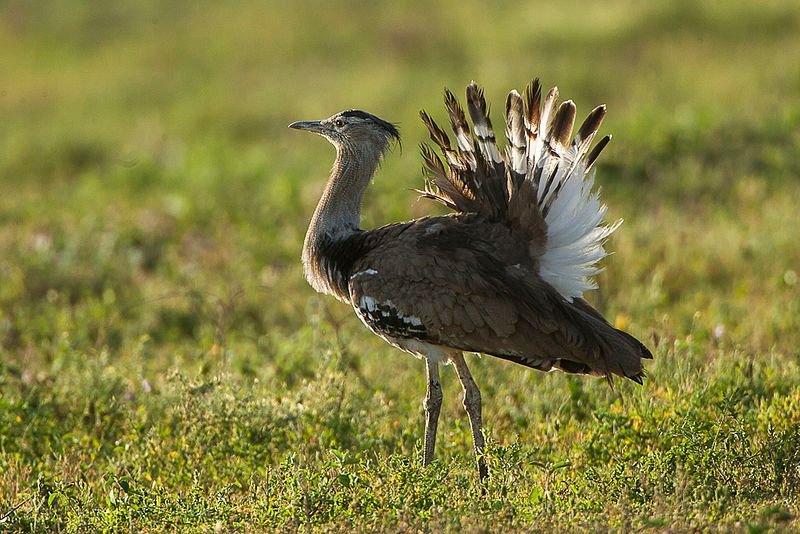
Kori Bustard in Tanzania
Ardeotis kori - Africa's heaviest flying birdWhat Is the Kori Bustard?
The Kori Bustard (Ardeotis kori) is Africa’s heaviest flying bird and one of the most impressive animals of the open savanna. Males can reach extraordinary body weights - roughly 11-19 kg in large individuals - while still remaining capable of flight.
The species is recognized by its tall stature, long neck, crested head, mottled brown-and-white plumage and dramatic breeding displays, in which displaying males inflate their throats into enormous white balloons and boom across the plains.
This is a bird of open country: grassland, dry savanna, thornveld and lightly wooded plains - never dense woodland, and not a wetland species. In Tanzania, Kori Bustards occur in open landscapes including the Serengeti, Ngorongoro and Tarangire. The species is currently listed as Near Threatened.
Scientific Classification
Current taxonomy places bustards in their own order, Otidiformes - older pages listing them under Gruiformes are outdated. Two subspecies are recognized: the Southern African A. k. kori and the East African Somali kori (A. k. struthiunculus), the race found in Tanzania. Only the male Great Bustard of Eurasia rivals the Kori among flying birds for sheer mass.
How to Identify a Kori Bustard
- Enormous upright body on long powerful legs - built for walking, not perching.
- Very long neck patterned with alternating white and sandy-buff bands.
- Prominent black crest; whitish face patch above each eye.
- Grey-brown/buff upperparts
- Intricate black-and-white patterning on flanks and folded wings.
- Broad wings spanning up to ~2.75 m in big males.
- Yellowish bill and yellowish legs.
The strongest field summary: size + long neck + upright posture + crest + brown-and-white patterning + unhurried walking across open ground. Nothing else in Tanzania’s grasslands combines all six.
Size Summary
- Body length: approximately 105-135 cm (males larger)
- Male mass: typically 7-18 kg; exceptional birds 16-19 kg+
- Female mass: roughly half the male - about 5-6 kg on average
Why Is the Kori Bustard Africa’s Heaviest Flying Bird?
The Kori Bustard is exceptionally heavy for an animal capable of sustained flight. Authoritative references such as the Smithsonian give adult males at approximately 11-19 kg and about 1.5 m tall; birds weighed in Serengeti National Park averaged an impressive 12.2 kg.
- Females weigh roughly half the male’s mass - one of the most extreme sexual size differences of any flying bird.
- Large males sit right at the theoretical weight limit for avian flight; take-off is effortful and flight is used sparingly.
- Only the ostrich - a flightless ratite - outweighs it among African birds.
So the correct claim is precise: the heaviest flying bird in Africa - and arguably, together with the Great Bustard, the heaviest living flying animal anywhere. Not the world’s heaviest bird overall; that title belongs to the flightless ostrich.
Male vs Female: A Genuine Difference
Most bird pages can say "sexes alike" - the Kori Bustard cannot. This species shows extreme sexual size dimorphism:
- Males reach roughly twice the female’s mass - averaging around 11 kg and reaching 16-19 kg or more, at up to ~1.3-1.5 m tall.
- Females average roughly 5.5-6 kg and stand about 20% shorter.
- Males are far more conspicuous - performing the spectacular courtship displays described below.
- Females are discreet, uncrested-looking in profile and entirely responsible for nesting and chick rearing.
In the field: any huge Kori Bustard is almost certainly a male; a slim, alert individual slipping quietly through grass is likely a female with chicks nearby.
Habitat: An Open-Country Specialist
Forget wetlands - the Kori Bustard is a creature of flat, arid, mostly open terrain. Current assessment descriptions cite grassland, bushveld, thornveld, scrubland and dry savanna as core habitat:
- Open grassland - short and medium swards for visibility.
- Dry savanna and semi-arid plains.
- Thornveld and scrub with scattered trees.
- Lightly wooded country - but never dense woodland, which the species actively avoids.
- Open plateaus, firebreaks and some cultivated fields.
The common requirements are space and sightlines: a bird this size needs to see predators coming and prefers to walk out of trouble rather than launch its heavy body skyward.
Habitat and Global Distribution
The Kori Bustard occurs across eastern and southern Africa - from Ethiopia and Somalia south through East Africa to South Africa and Namibia - wherever flat, arid, mostly open country remains. Two subspecies divide the range at roughly the Zambezi: the Southern African A. k. kori and the East African Somali kori (A. k. struthiunculus) found in Tanzania.
Tanzania is one important portion of that East African range - protected northern parks hold some of the species’ most secure populations anywhere.
Kori Bustard in Tanzania
Tanzania is an important part of the Kori Bustard’s East African range, where the Somali kori subspecies (A. k. struthiunculus) occurs. Tanzanian birding checklists include the species, and males weighed in the Serengeti averaged 12.2 kg - among the heaviest recorded anywhere.
Protected open landscapes in northern Tanzania - including the Serengeti, Ngorongoro Conservation Area, Tarangire and Arusha National Park, with Mkomazi also relevant - provide long-term strongholds. Outside protected areas the picture is soberer: assessment information notes that encounter rates in Tanzania declined substantially after the 1970s and that occupied range contracted more than expected.
Sightings vary with rainfall, food availability and local conditions - never guaranteed.
Where to See Kori Bustards in Tanzania
Serengeti National Park
Country: Tanzania | Region: Northern Tanzania
A long-term stronghold on the open plains; Serengeti males average a remarkable 12.2 kg.
Good opportunity in suitable open grassland; sightings vary.
Ngorongoro Conservation Area
Country: Tanzania | Region: Northern Tanzania
Displaying males photographed on the crater floor - classic struthiunculus country.
Good opportunity in suitable open grassland; sightings vary.
Tarangire National Park
Country: Tanzania | Region: Northern Tanzania
Dry savanna and open scrub along the river system hold resident birds year-round.
Good opportunity in suitable open grassland; sightings vary.
Arusha National Park
Country: Tanzania | Region: Northern Tanzania
Open grassy patches within the park suit this bustard; listed among its birdlife.
Good opportunity in suitable open grassland; sightings vary.
Mkomazi National Park
Country: Tanzania | Region: Northeastern Tanzania
Semi-arid thornveld plains; African Majestic Adventure’s own Mkomazi guide lists the Kori Bustard among its birdlife.
Good opportunity in suitable open grassland; sightings vary.
Safari & Birding Methods
- Game drives across open plains - the primary method.
- Specialist birdwatching excursions targeting grassland species.
- Slow scanning of short-grass plains and firebreaks.
- Wildlife photography from vehicles on established tracks.
- Guided walks where permitted in appropriate habitat.
Best Time to See Them
Kori Bustards can be encountered year-round in suitable Tanzanian grasslands. Local movements may follow rainfall and food availability, so the best viewing period varies by park and season. Breeding timing also differs between the two subspecies, so no single month range applies nationwide - ask guides about current displaying activity.
Kori Bustard in Pictures
A closer look at the Kori Bustard in its natural East African habitat — its striking appearance, habitat and behaviour are best appreciated up close.
Where to Spot the Kori Bustard on Safari
Plan your trip around the destinations and safaris where the Kori Bustard is easiest to see. Explore the parks, itineraries and tour packages by destination below.
What Does the Kori Bustard Eat?
An omnivore with a pronounced taste for animal protein - more predatory than many smaller bustards when insects abound:
Animal Foods
- Grasshoppers, locusts, beetles, ground crickets
- Termites and caterpillars
- Solifuges and scorpions
- Snails
- Lizards and chameleons - even small snakes
- Small rodents
- Birds, eggs and nestlings where taken
- Carrion
Plant Foods
- Seeds and berries
- Roots, bulbs and flowers
- Leaves, fruits and pods
- Grass tips
- Acacia gum - a famous favourite (the Afrikaans name Gompou means "gum peacock")
Diet composition shifts with season and rainfall - insects dominate when hatches erupt, plant matter fills the gaps.
How Does a Kori Bustard Find Food?
- Walks slowly and deliberately across open ground, head high, scanning constantly.
- Pecks and gleans insects and seeds from the sward and soil surface.
- Digs for roots and bulbs, and picks Acacia gum from tree trunks at eye height - tall enough to feed from shrubs other animals cannot reach.
- Follows fire and grazers: recently burned patches and areas trampled by herds expose or flush insects, creating temporary feeding bonanzas.
- Drinks by suction: unusually among birds, Kori Bustards suck up water rather than scooping and tilting the head back - a memorable quirk worth waiting for at a waterhole.
Daily Behavior and Flight
Kori Bustards are diurnal. A typical day involves walking long distances while foraging on open ground, resting under scattered trees in the heat, dust-bathing to maintain plumage (supplemented by powder down), and making local movements tied to rainfall and food.
They usually live alone or in small groups; during breeding season, males assemble at traditional display grounds where females come to inspect them.
Does the Kori Bustard Fly?
Yes - but reluctantly. This bird prefers walking and avoids unnecessary flight because of its enormous body mass. When it does take off, flight is powerful and heavy-looking: strong, slow wingbeats carrying a body right at the edge of what avian physics allows. It flies when it must - crossing rivers or escaping real danger - never for sport.
The Kori Bustard Courtship Display
One of Africa’s great wildlife performances. Displaying males gather at traditional display grounds - loose, lek-like arenas - usually in mornings and evenings, where females visit and choose. The routine:
- Throat inflation: the male holds his head back, cheeks bulging, and inflates the gular region - the oesophagus swells to as much as four times normal size, forming a white throat "balloon" visible up to a kilometre away.
- Feathers raised: frontal neck feathers splay upward, revealing their white undersides.
- Tail fanned: the tail is lifted forward over the back like a turkey’s, rectrices vertical, white undertail coverts fluffed into view.
- Wings drooped, planed downward like an aircraft’s wingtips.
- Bowing toward females with an exaggerated bouncing gait while strutting.
- Deep booming - a resonant "woum-woum-woum" produced at maximum inflation, often carrying far before dawn - ending in a bill snap audible only nearby.
Dominant males suppress rivals: subordinate males rarely display near a top performer and drift away instead. Females presumably select the most impressive display - after mating, the male departs to court again, playing no further role.
Breeding, Eggs and Chicks
Kori Bustards are polygynous: displaying males may mate with multiple females and provide no parental care. All nesting work falls to the female:
- Nest: a shallow scrape on bare open ground, usually beside a grass clump for cover.
- Eggs: one or two eggs per clutch.
- Incubation: approximately 23-24 days (some sources allow a slightly longer window), handled entirely by the female - the male does not incubate.
- Chicks: hatch relatively well developed and camouflaged; the female leads them from the nest almost immediately, feeding soft prey items at first.
- Development: young can fly at about five weeks but remain with the mother until roughly one year old - an unusually long dependency for a precocial bird.
Are Kori Bustards monogamous? No - not in the classic pair-bond sense. Males mate with several females each season and continue displaying afterwards. Some literature notes the exact mating system is not fully resolved, so absolutes are best avoided - but female-only chick care is consistent across sources.
Conservation Status: Near Threatened
IUCN Red List Status: Near Threatened - uplisted from Least Concern in 2013 after evidence showed worrying declines, with population reductions estimated at up to around 29% over the multi-decade period to 2016 in parts of the range.
Range-Wide Threats
- Power-line collisions - identified as a major threat in current assessments.
- Hunting and bushmeat take, including capture for trade.
- Traditional-medicine use of body parts in some regions.
- Habitat fragmentation, agricultural conversion and rangeland degradation, plus shrub/bush encroachment of open plains.
- Fencing and wind-energy infrastructure in parts of the range.
The pattern is consistent: large, slow-breeding birds of open country lose ground as landscapes fill with infrastructure and intensify in use.
Kori Bustard Conservation in Tanzania
Tanzania’s story mirrors the continental picture. Assessment information records that encounter rates outside protected areas declined substantially since the 1970s, and that occupied range contracted more than expected between comparison periods. Historical trade contributed to these declines alongside broader habitat and range pressures.
The good news: long-term protected populations persist in Serengeti, Ngorongoro, Tarangire, Arusha and Mkomazi according to bustard conservation literature - making Tanzania’s northern circuit parks genuine refuges.
Wider conservation priorities include habitat protection, reducing hunting pressure, monitoring population trends and addressing infrastructure-related collisions. A national Kori Bustard action plan has been identified as a conservation need in IUCN SSC material - noted there as proposed rather than initiated at the time of that report, so visitors should not assume an operational programme exists today.
Visitors contribute by supporting parks that keep grasslands open, reporting collisions or persecution, and valuing bustards as living heritage rather than photo-trophies to chase off-road.
Kori Bustard Facts
Kori Bustard vs Secretarybird
| Feature | Kori Bustard | Secretarybird |
|---|---|---|
| Scientific name | Ardeotis kori - Otididae/Otidiformes | Sagittarius serpentarius - Sagittariidae |
| Size | Males 11-19 kg - heaviest flying bird in Africa | ~3.5-4.3 kg - tall, crane-like raptor |
| Legs | Thick walking legs; no talons | Long crane-like legs built for stomping prey |
| Diet | Omnivore: insects, reptiles, rodents, seeds, gum | Raptor: snakes, lizards, rodents, insects |
| Display | Booming lek display with throat balloon | Aerial courtship; pairs nest in thorny trees |
| Status | Near Threatened | Endangered |
| Tanzania viewing | Serengeti, Ngorongoro, Tarangire open plains | Same open savannas - often seen walking together in lists |
Kori Bustard vs Ostrich
| Feature | Kori Bustard | Ostrich |
|---|---|---|
| Size | ~105-135 cm; males 11-19 kg | Up to ~2.8 m tall; 100 kg+ |
| Flight | Capable of flight - Africa's heaviest flying bird | Completely flightless ratite |
| Neck | Feathered, banded neck | Bare, sparsely feathered long neck |
| Diet | Omnivore with strong animal component | Mainly plants, seeds, invertebrates |
| Breeding | 1-2 eggs, female-only care | Communal nests, male-dominant incubation |
| Shared habitat | Both patrol Tanzania's open savanna - the ostrich towering above, the bustard striding below | |
Kori Bustard vs Denham's Bustard
| Feature | Kori Bustard | Denham's Bustard |
|---|---|---|
| Scientific name | Ardeotis kori | Neotis denhami |
| Male size | Larger - averages ~11-12 kg in Tanzania | Smaller (~8 kg class) |
| Plumage | Grey-brown back, black crest, white belly panel | Black-and-white wing pattern in flight; rufous nape patch |
| Crown | Prominent black crest | Less prominent crest |
| Tanzania presence | Northern parks: Serengeti, Ngorongoro, Tarangire, Arusha, Mkomazi | Mainly upland grasslands; scarcer and localized |
Why the Kori Bustard Matters to Tanzania’s Grasslands
- A giant terrestrial omnivore: as it walks the plains, the Kori regulates insect outbreaks, disperses seeds and recycles carrion - a heavyweight link in the grassland food web.
- An open-country indicator: where Kori Bustards thrive, grasslands are still open, connected and healthy. Their decline outside parks signals shrub encroachment, fragmentation and pressure.
- World-class birdwatching value: few sightings stop a safari vehicle faster than a displaying male with his white throat balloon inflated.
- A reason protected savannas matter: Tanzania’s northern parks hold some of the most secure Kori populations anywhere - conservation here has global significance for the species.
Photographing the Kori Bustard
- Adult male standing tall in grass - the classic savanna portrait.
- Courtship display sequence - throat balloon, tail fan over the back, drooped wings.
- The inflated white neck catching first light on a display ground.
- Female with chick - subtle, rewarding, keep distance.
- Walking across open savanna - motion against short-grass plains.
- Heavy take-off and flight - slow, powerful wingbeats worth waiting for.
- Feeding close-ups - Acacia gum picking, insect snatching.
- Beside large mammals - classic Serengeti scale shots.
Ethics first: never drive toward displaying males or brooding females; ground nests are nearly invisible. Stay on tracks, use long lenses, follow your guide’s instructions.
Frequently Asked Questions
The Kori Bustard (Ardeotis kori) is a remarkable African wildlife species, classified within the Birds group. The world's heaviest flying bird, a stately ground dweller of the short-grass plains.
The best places to see the Kori Bustard include Serengeti plains, Tanzania. Its key range countries are Tanzania.
The Kori Bustard is a omnivore, feeding mainly on a varied mix of plant and animal matter found in its savannah habitat.
Adults typically reach Up to 1.4 m tall.
Adults can weigh up to around 5-19 kg.
Kori Bustards prefer walking; flight is powerful but used sparingly.
In the wild, the Kori Bustard typically lives 20-27 yrs.
The Kori Bustard is currently listed as Vulnerable on the IUCN Red List. Conservation efforts across Tanzania aim to keep populations healthy.
The Kori Bustard is most at home in Savannah environments, including Serengeti plains, Tanzania.
Key threats include habitat loss, climate change, and human-wildlife conflict.
The Kori Bustard is often active in the cooler hours of dawn and dusk, spending much of the day resting. It is highly alert and well adapted to its savannah home.
Yes — the Kori Bustard is often found in groups, where shared awareness and cooperation improve survival.
Large predators such as lions, leopards and hyenas may threaten the Kori Bustard, especially young or weak individuals.
The dry season (June to October) is generally best for wildlife viewing, when animals gather around reliable water sources.
Across Tanzania, the Kori Bustard symbolises strength, resilience and the untamed spirit of the African wilderness.
Mothers give birth to a single young and raise it with intense care, teaching it to find food and avoid danger.
It communicates using a combination of calls, scent and body language.
As a birds species, the Kori Bustard helps maintain the balance of its ecosystem, influencing vegetation, prey and predator populations.
Absolutely — early-morning and late-afternoon drives in Serengeti plains, Tanzania offer superb photography opportunities.
Classic game drives in national parks and reserves offer the best and most reliable encounters.
Choose responsible safari operators, support conservation organisations, and respect wildlife rules while on safari.
Yes — protected parks, anti-poaching units and organisations like African Parks and WWF work to secure its future.
From its size and behaviour to its role in the ecosystem, the Kori Bustard is one of the most fascinating animals on an African safari.
Tanzania is a world-class safari destination with exceptional wildlife viewing — ideal for seeing the Kori Bustard and much more.
Accurate numbers vary by region, but protected populations across Tanzania remain the focus of active conservation monitoring.
Related Safari Packages & Tours
Book a safari to see the Kori Bustard and the rest of Africa's incredible wildlife with our expert guides.
References & Further Reading
- IUCN Red List: Ardeotis kori
- African Parks: Conservation efforts for large mammals in Africa.
- Tanzania Wildlife Research Institute (TAWIRI): Monitoring wildlife populations in Tanzania.
- Kenya Wildlife Service (KWS): Wildlife conservation in Kenyan parks.
- Uganda Wildlife Authority (UWA): Protection of wildlife in Ugandan reserves.
- Estes, R. (1991). The Behavior Guide to African Mammals. University of California Press.
- Kingdon, J. (2015). The Kingdon Field Guide to African Mammals. Bloomsbury.
- About these facts: Weight, speed and lifespan are approximate adult ranges. They can vary with sex, age, season, location and the measurement method; conservation status should be checked against the current IUCN assessment.

Kori Bustard Social Life
Kori Bustards are usually seen alone or in small groups while feeding - a mother with her chick is the most common "group" outside breeding season.
During breeding, males may gather at loose, lek-like display areas spread across suitable plains, competing visually and acoustically for female attention. These are not flocks in any herd sense: each male holds his own patch of the arena, dominant birds suppress nearby rivals, and females simply visit the performers they prefer.