

.png)
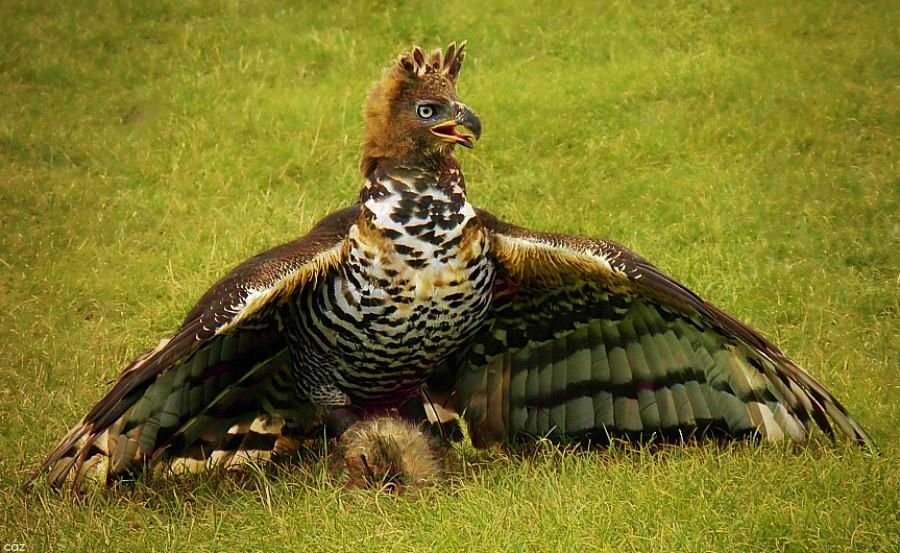
Crowned Eagle
Stephanoaetus coronatus - Africa's most powerful forest eagleIntroduction to the Crowned Eagle
The Crowned Eagle (Stephanoaetus coronatus) is a powerful forest and woodland raptor distinguished by a prominent crown of feathers, massive talons and a diet dominated by mammals - including primates in many forest habitats. It is one of Africa's most formidable aerial predators.
In Tanzania, Crowned Eagles have been documented in Arusha National Park, Lake Manyara National Park and Mahale Mountains National Park. Their dependence on mature forest and dense woodland makes them sensitive to habitat change and a prized sighting for serious birdwatchers on any Tanzanian forest itinerary.
Scientific Classification
The Crowned Eagle is the only living species in its genus Stephanoaetus. A second species (S. mahery) from Madagascar went extinct after human colonisation of the island.
Why Is It Called the Crowned Eagle?
The common name refers directly to the prominent crest or 'crown' of pointed, dark-tipped feathers on the top and rear of the head. When raised - as during alarm or display - this crown creates a dramatic, almost regal appearance that distinguishes the species from all other African forest eagles.
How to Identify a Crowned Eagle
- Prominent crown/crest: a distinctive bushy crest of dark-tipped feathers gives the species its name.
- Powerful legs and very large talons: among the most powerful grips of any raptor relative to body size.
- Dark upperparts: blackish-grey back, wings and tail.
- Barred/patterned underparts: white to rufous breast with bold black barring.
- Broad wings and long tail: adapted for manoeuvring through forest canopy.
- Length approximately 81-92 cm; weight approximately 3.4-4.1 kg (Tanzania research data).
- Females substantially larger than males - among the greatest size differences of any eagle pair.
- Juveniles differ markedly: pale head, scaled upperparts and buff underparts without the adult's strong barring; take several years to reach full adult plumage.
Male vs Female: Key Differences
Females are substantially larger than males - one of the most pronounced size differences between sexes of any African eagle pair. Both sexes participate in territorial defence and breeding duties. The female normally performs most incubation while the male provides food and nesting material.
Breeding, Eggs and Nesting
- Territorial breeding pairs: pairs defend large territories containing suitable nesting trees and prey populations.
- Large stick nest: constructed high in mature trees, often added to over successive breeding attempts.
- Eggs: 1-2 are laid, usually two.
Habitat: Forests and Dense Woodland
The Crowned Eagle is primarily a forest raptor, requiring mature trees for nesting and sufficient cover for ambush hunting:
- Mature forest - both lowland and montane, where canopy provides hunting cover.
- Riparian forest - riverine tree corridors extending through drier landscapes.
- Dense woodland and forest-savanna mosaic - transitional habitats supporting arboreal prey.
- Wooded hills and forest edge - hunting perches overlooking clearings.
Water may occur within riparian habitat but is not itself the defining requirement - mature trees and prey-rich forest are essential.
Distribution Across Africa
The Crowned Eagle has a broad sub-Saharan African distribution extending across West, Central, East and Southern Africa in suitable forest and densely wooded habitat. Its range follows the belt of mature forest and woodland from Senegal and Ghana eastward through the Congo Basin to Ethiopia, and southward through East Africa to South Africa.
Distributed across forested sub-Saharan Africa wherever mature trees and prey coexist.
Crowned Eagle in Tanzania
Tanzania contains significant Crowned Eagle habitat within its national parks and forest reserves. The species has been documented at Arusha National Park around Ngurdoto Crater, at Lake Manyara National Park where encounters with olive baboons have been recorded, and at Mahale Mountains National Park where dedicated research has studied breeding biology and prey deliveries. These locations represent some of the best opportunities to encounter this secretive forest raptor in East Africa.
Where to See Crowned Eagles in Tanzania
Evidence-backed destinations with documented observations:
Arusha National Park
Region: Northern Tanzania
Documented observations around Ngurdoto Crater and surrounding forest; forest-edge walks offer chances to spot this canopy hunter.
Possible to good opportunity in suitable forest/woodland habitat; sightings are not guaranteed.
Lake Manyara National Park
Region: Northern Tanzania
Documented encounters involving Crowned Eagles and olive baboons; groundwater forest provides ideal hunting cover.
Possible to good opportunity in suitable forest/woodland habitat; sightings are not guaranteed.
Mahale Mountains National Park
Region: Western Tanzania
Research has documented a nesting pair and prey deliveries; remote forest setting requires dedicated visits.
Possible in suitable forest habitat; sightings require patience and local guide knowledge.
Best Time to Look
Crowned Eagles can be encountered year-round in suitable habitats. Breeding activity and prey availability vary by location and season. In western Tanzania specifically, research documented eggs laid in the dry season with fledging in the rains - though this timing should be treated as study-specific rather than universal.
Safari Types
Game drives along forest edges, specialist birdwatching safaris, forest-edge observation walks and wildlife photography all work well. Guided birding walks provide the best chance in dense forest habitat where permitted.
Crowned Eagle in Pictures
A closer look at the Crowned Eagle in its natural East African habitat — its striking appearance, habitat and behaviour are best appreciated up close.
Where to Spot the Crowned Eagle on Safari
Plan your trip around the destinations and safaris where the Crowned Eagle is easiest to see. Explore the parks, itineraries and tour packages by destination below.
What Does the Crowned Eagle Eat?
Mammals dominate the Crowned Eagle's diet - making it one of Africa's most important avian predators of medium-sized mammals:
- Primates: monkeys including red-tailed monkeys, vervet monkeys and colobus species are primary prey in forest habitats.
- Hyraxes: tree hyraxes are frequently taken where available.
- Small antelope: young duikers and bushbuck fawns.
- Rodents and other small-to-medium mammals.
- Birds and reptiles: secondary prey depending on availability and habitat type.
Prey selection varies significantly with habitat - primates dominate in closed forest while hyraxes and small antelope become more important in more open woodland.
Daily Behaviour & Territorial Behaviour
Crowned Eagles are strictly diurnal. Activity varies with prey availability, weather, breeding stage and local conditions.
Territorial Pairs
- Generally solitary outside breeding relationships.
- Territorial pairs maintain large territories centred on nest sites and productive hunting areas.
- Pairs perform aerial displays including soaring together and calling to advertise territory ownership.
- Long-term residency: established pairs may occupy the same territory for many years.
Voice and Communication
The Crowned Eagle is generally quiet but becomes vocal during breeding displays and when defending territory:
- High-pitched calls: piercing whistles and screams carry long distances through forest.
- Display calling: paired soaring accompanied by vocalisations advertises territory.
- Nest defence: aggressive calling and diving at intruders near the nest.
Eggs, Incubation and Development
- Incubation: approximately 49-51 days; the female performs most incubation while the male supplies food.
- Nestling period: extended; a western Tanzania study recorded approximately 106 days before the young eagle left the nest.
- Tanzania breeding cycle: research in western Tanzania documented seasonal breeding with eggs laid in the dry season and fledging occurring in the rainy period - a location-specific finding rather than a universal pattern.
- Nest reuse: nests may be reused across multiple seasons with additional material added each attempt.
- Long dependency: juveniles remain dependent on parents well beyond fledging while learning to hunt independently.
Conservation Status and Threats
IUCN Red List Status (global): Near Threatened. The population is declining due to ongoing habitat loss across its range. In South Africa, a regional assessment classifies the species as Vulnerable at the national level.
Primary Threats
- Forest loss: logging, agricultural expansion and settlement remove critical nesting and hunting habitat.
- Woodland degradation: selective timber extraction removes mature trees needed for nests.
- Habitat fragmentation: isolates territorial pairs and reduces genetic connectivity.
- Reduced prey availability: bushmeat hunting depletes primate and small antelope populations.
- Human disturbance: activity near nests can cause breeding failure.
- Persecution: sometimes killed because of perceived threats to domestic animals.
Crowned Eagles and Tanzania's Monkeys
Tanzania offers some of the best-documented evidence of Crowned Eagle predation on primates anywhere in Africa:
- Mahale Mountains: research identified 46 prey deliveries at a single nest, of which 26 were primates and 16 specifically red-tailed monkeys - demonstrating the importance of primates in this eagle's diet in forest habitats.
- Lake Manyara: researchers documented Crowned Eagle encounters with olive baboons and recorded anti-predator responses from the baboon troop.
These findings come from specific studies in specific locations and should not be generalised into universal percentages across all habitats. They do, however, confirm the Crowned Eagle's status as a genuine primate predator capable of taking surprisingly large mammalian prey.
Crowned Eagle Fact Sheet
Crowned Eagle vs Other African Raptors
Crowned Eagle vs African Fish Eagle
| Feature | Crowned Eagle | African Fish Eagle |
|---|---|---|
| Scientific name | Stephanoaetus coronatus | Haliaeetus vocifer |
| Habitat | Forest, riparian woodland, forest edge | Lakeshores, rivers, wetlands |
| Diet | Mammals (especially primates), plus birds/reptiles | Primarily fish plus waterbirds |
| Hunting strategy | Canopy ambush and arboreal pursuit | Surface snatching from soaring flight |
| Social system | Territorial pairs in dense habitat | Territorial monogamous pairs at water |
| Conservation | Near Threatened | Least Concern |
Crowned Eagle vs African Hawk-Eagle
| Feature | Crowned Eagle | African Hawk-Eagle |
|---|---|---|
| Scientific name | Stephanoaetus coronatus | Aquila spilogaster |
| Size | Larger (~81-92 cm) | Smaller (~55-65 cm) |
| Plumage | Barred underparts, prominent crown | Black above, white below with bold black bars |
| Habitat | Mature forest and riparian woodland | Dry open woodland/savanna woodland |
| Diet emphasis | Mammals especially primates | Birds (francolins), mammals, reptiles |
| Hunting style | Canopy ambush, powerful grip | Fast pursuit flights through trees |
Why the Crowned Eagle Matters to Tanzania's Forest Wildlife
The Crowned Eagle sits at the apex of the forest food web, preying on primates and other mammals that themselves shape vegetation patterns. Its presence indicates an intact forest ecosystem with healthy prey populations and mature nesting trees. For birdwatchers, it represents one of Tanzania's most challenging and rewarding raptor sightings. For conservationists, protecting Crowned Eagle territories means protecting entire forest ecosystems - from the canopy primates to the ground-dwelling duikers that sustain this powerful aerial predator.
Photographing the Crowned Eagle
Subjects worth pursuing:
- Adult perched in canopy showing the crown/crest and barred underparts.
- Crown raised during display or alarm - the defining image.
- Soaring over forest - broad wings and short tail visible against sky.
- Prey carrying - delivering monkeys or other mammals to the nest.
- Pair behaviour - mutual preening or display flights over territory.
- Juvenile plumage - pale-headed immatures look completely different.
- Nest views from respectful distance only - never disturb breeding birds.
Ethics first: maintain appropriate distance, never approach active nests, do not disturb breeding birds, and always follow park rules and your guide's instructions.
A powerful forest raptor (Stephanoaetus coronatus) named for its distinctive crown of dark-tipped feathers. It is one of Africa's most formidable avian predators, specialising in mammalian prey including primates, and is the only living member of its genus.
In mature forest and dense woodland habitats. Documented locations include Arusha National Park (Ngurdoto Crater area), Lake Manyara National Park and Mahale Mountains National Park. Possible to good opportunity in suitable habitat; sightings require patience and local guide knowledge.
Primarily mammals - especially primates (monkeys) in forest habitats, plus hyraxes, young duikers, bushbuck and rodents. Birds and reptiles are secondary prey. Diet composition varies with habitat type and local prey availability.
Yes. Research at Mahale Mountains National Park documented 46 prey deliveries at a single nest, of which 26 were primates including 16 red-tailed monkeys. At Lake Manyara, encounters with olive baboons have been recorded. This confirms the Crowned Eagle's role as a genuine primate predator.
Across sub-Saharan Africa in mature forest, riparian woodland, dense woodland and forest-savanna mosaics. It requires large trees for nesting and sufficient canopy or woodland cover for its ambush-style hunting technique.
Globally it is listed as Near Threatened on the IUCN Red List, reflecting ongoing population decline driven by deforestation. In South Africa it is classified regionally as Vulnerable, highlighting how severe local pressures can become even when global status remains NT.
Usually two eggs are laid, though sometimes only one. Incubation lasts approximately 49-51 days, performed mainly by the female while the male supplies food and nesting material.
Approximately 49-51 days. After hatching, the nestling period is extended - a western Tanzania study recorded approximately 106 days before the young eagle left the nest.
No. Crowned Eagles are generally solitary outside breeding contexts. Territorial breeding pairs maintain large territories and are aggressively defended against intruding eagles.
Focus on forest-edge habitats and listen for alarm calls from monkeys - which often indicate a Crowned Eagle is nearby. Forest-edge game drives, guided birding walks and patient observation at known territories in Arusha, Manyara or Mahale offer the best chances.
Habitat and diet are fundamentally different: Crowned Eagles hunt mammals in forests while Fish Eagles catch fish at lakes and rivers. Crowned Eagles have barred underparts, a prominent crest and much more powerful talons; Fish Eagles have white heads, chestnut bodies and yellow hooked bills.
A combination of immense grip strength, broad wings for manoeuvring through canopy, a long tail for balance during arboreal pursuit, and a body size capable of overpowering prey approaching its own weight. Its mammal-heavy diet and ability to take primates distinguish it from all other African forest raptors.
Related Safari Packages & Tours
Book a safari to see the Crowned Eagle and the rest of Africa's incredible wildlife with our expert guides.
References & Further Reading
- IUCN Red List / BirdLife DataZone: Stephanoaetus coronatus factsheet
- Western Tanzania breeding study: Nestling period ~106 days, seasonal breeding cycle data from dedicated field research.
- Mahale Mountains research: Prey delivery analysis documenting primate predation frequency.
- About these facts: Measurements and breeding figures are approximate ranges drawn from available sources; they vary with sex, age, region and method.