

.png)
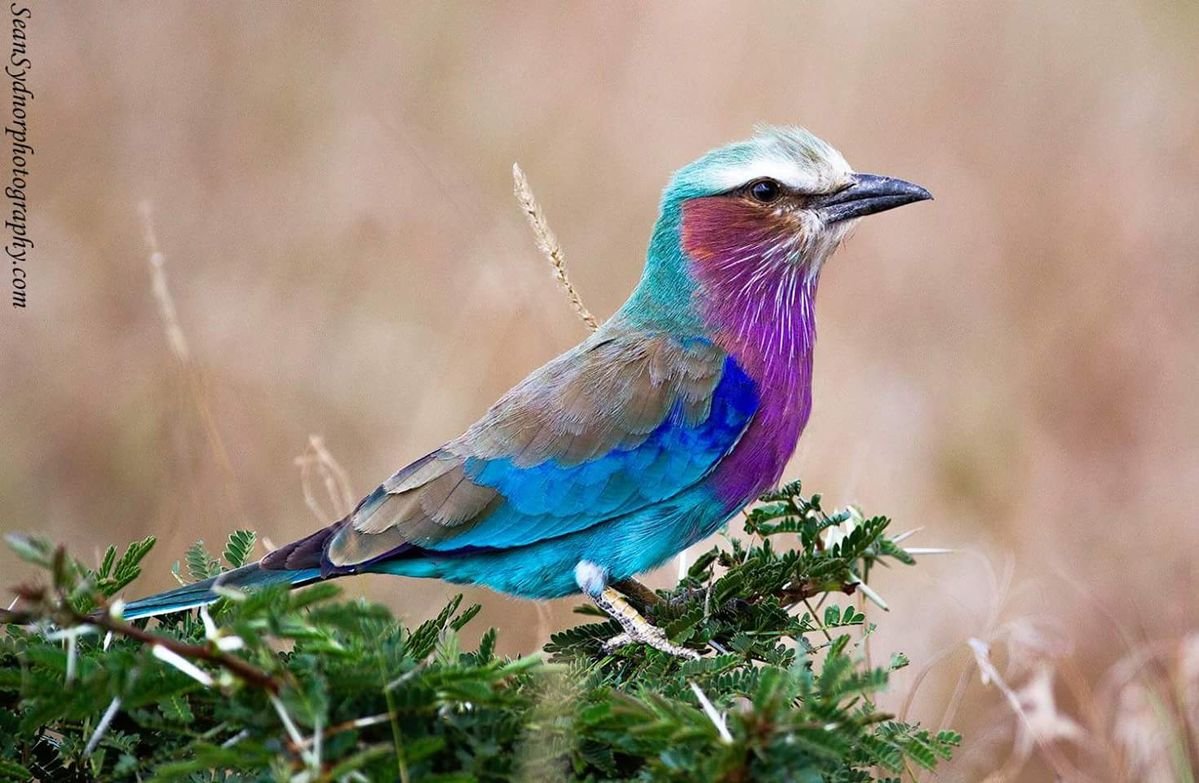
Lilac-breasted Roller in Tanzania
Coracias caudatus - the turquoise flash of the savannaWhat Is the Lilac-breasted Roller?
The Lilac-breasted Roller (Coracias caudatus) is one of East Africa’s most striking birds. Its lilac breast shades into turquoise underparts, while the head and shoulders are chestnut, the wings flash blue-green and black, and the long tail trails elegant streamers. No other Tanzania bird combines these colours in one silhouette.
This is a bird of open woodland and savanna, not of wetlands. It spends long periods upright on a high perch - a dead tree-top, pole or fence post - scanning the ground below before launching in a short, swooping flight to snatch prey.
In Tanzania, it is a familiar sight along game-drive routes through Tarangire, Serengeti and Lake Manyara, where a lilac flash on a bare branch often betrays its presence.
Scientific Classification
Two subspecies are recognised. C. c. caudatus - the race present in Tanzania - ranges across eastern and southern Africa, while C. c. lorti occurs from Ethiopia and Somalia to north-eastern Kenya. The roller family is famous for its acrobatic aerial displays, which give the group its name.
How to Identify a Lilac-breasted Roller
- Lilac/mauve breast grading into turquoise-blue underparts.
- Chestnut/rust head and shoulders contrasting with the pastel body.
- Long tail streamers in adults - absent or short in juveniles.
- Blue/green wings with black primary feathers.
- Strong, slightly hooked black bill built for gripping insects and small vertebrates.
- Upright perch posture - long periods motionless on an exposed branch.
Juveniles are noticeably duller, with greyish-brown tones where adults show lilac and turquoise, and with less developed streamers. At about 19-20 days after hatching chicks are fully feathered. Use the whole combination - breast, wings, streamers and posture - rather than any single colour feature alone.
Size Summary
- Length: approximately 28-36 cm (up to 36-38 cm including the 8-9 cm streamers)
- Mass: average around 104 g; published figures vary from 92-160 g by source and age
Male vs Female: Minimal Difference
Males and females are broadly similar externally - lilac, turquoise and chestnut are shared by both sexes, with no reliable plumage difference in the field. Juveniles, however, are duller and lack the adults’ elongated streamers. Both parents share incubation and chick feeding.
Why Does the Lilac-breasted Roller Perch So High?
The bird’s hunting method explains its favourite seat. From an elevated perch it commands a wide view of the ground - tree tops, dead branches, poles, fence posts and other exposed points are all regularly used.
From there it can:
- Scan for insects and small vertebrates moving on the ground.
- Launch instantly in a short, direct swoop.
- Return to the same perch to handle prey, often beating it on the branch before swallowing it whole.
Breeding pairs are highly defensive of that perch and the surrounding territory, and will drive off much larger intruders.
Habitat: Open Woodland & Savanna
The Lilac-breasted Roller favours country with scattered trees and good visibility:
- Open woodland and savanna - the classic habitat.
- Thornveld and lightly wooded grassland.
- Open bush country and parkland with scattered trees.
It is largely absent from completely treeless landscapes - it needs perches. And it is not a wetland, river or reliable-water specialist: those habitats belong to herons, cranes and kingfishers, not to this dry-country roller.
Habitat and Global Distribution
The Lilac-breasted Roller is broadly distributed across eastern and southern Africa, from Eritrea through East Africa to South Africa, with vagrancy to the southern Arabian Peninsula. In East Africa it occupies open country from sea level to about 2,000 m.
Tanzania is an important range country within this eastern African core - the species is resident and familiar from Tarangire’s baobab savanna to Serengeti’s plains - but it is far from a Tanzania exclusive.
Lilac-breasted Roller in Tanzania
Tanzania is a classic country for this species. The Lilac-breasted Roller is a characteristic bird of the country’s open savanna and woodland landscapes, encountered along Savanna bird of East Africa.
The strongest verified example is Tarangire National Park, where rollers are conspicuous on roadside perches. Verified records also place the species in Serengeti National Park, Lake Manyara National Park and Mikumi National Park - all open-woodland/savanna landscapes where bare perches and termite mounds provide hunting platforms.
Where to See Lilac-breasted Rollers in Tanzania
Tarangire National Park
Country: Tanzania | Region: Northern Tanzania
Open savanna with scattered baobabs - textbook Lilac-breasted Roller perching habitat.
Good opportunity in suitable open woodland and savanna.
Serengeti National Park
Country: Tanzania | Region: Northern Tanzania
Grassland and lightly wooded plains with abundant termite mounds and low perches.
Good opportunity in suitable open woodland and savanna.
Lake Manyara National Park
Country: Tanzania | Region: Northern Tanzania
Woodland edges and floodplain with prominent dead branches for hunting.
Good opportunity in suitable open woodland and savanna.
Mikumi National Park
Country: Tanzania | Region: Southern Tanzania
Southern-circuit savanna - rollers regularly seen on roadside poles and acacia tops.
Good opportunity in suitable open woodland and savanna.
Safari Methods
- Game drives - most sightings are from the vehicle along open roads.
- Birdwatching and specialist birding - rollers are cooperative subjects.
- Wildlife photography - perch-hunting sequences are the classic shot.
- Guided birding where permitted - walking in the right habitat can produce close views.
Best Time to See Them
Lilac-breasted Rollers can be encountered year-round in suitable savanna and open woodland. Breeding displays are most frequent near nesting time, but no single nationwide season guarantees them. Outside display periods, dry-season visibility can be good simply because birds sit more conspicuously on bare perches.
Lilac-breasted Roller in Pictures
A closer look at the Lilac-breasted Roller in its natural East African habitat — its striking appearance, habitat and behaviour are best appreciated up close.
Where to Spot the Lilac-breasted Roller on Safari
Plan your trip around the destinations and safaris where the Lilac-breasted Roller is easiest to see. Explore the parks, itineraries and tour packages by destination below.
What Does the Lilac-breasted Roller Eat?
Primarily arthropods and small vertebrates, taken on or near the ground:
- Grasshoppers and beetles - staple insect prey.
- Spiders, scorpions, centipedes and millipedes.
- Snails.
- Lizards, small birds, small rodents and amphibians - snatched when the opportunity arises.
The roller is no aquatic hunter - water is not the foundation of its feeding. It will beat larger prey on a perch before swallowing it whole, and it will take advantage of bush fires, hawking insects fleeing the flames.
How Does the Lilac-breasted Roller Hunt?
- Perches high on a tree top, pole or dead branch where the ground below is clearly visible.
- Visually scans the ground for movement - grasshoppers, beetles, lizards and other prey.
- Launches a short, direct flight when prey is detected.
- Captures prey on or near the ground with a strong bill.
- Returns to a perch where appropriate, often carrying prey to beat it against the branch before swallowing.
- Repeats from the next vantage point along its territory.
Strong, syndactyl feet - with the second and third toes fused - help it grip while handling prey aloft.
Daily Behavior and Social Life
Lilac-breasted Rollers are primarily diurnal, most active in the early morning. The day divides among perching, hunting, calling, preening and defending territories alongside a mate. Outside breeding, they hold temporary hunting territories but do not form flocks.
How Social?
- Usually solitary or in pairs.
- Breeding pairs are territorial and chase intruders.
- No bachelor groups, family hierarchies or group leadership - just neighbours.
Lilac-breasted Roller Courtship Display
One of Africa’s most theatrical aerial performances. During breeding and territory advertisement the male:
- Rises high into the air - published descriptions place display heights at roughly 69-144 metres.
- Descends in a series of swoops and dives with wings closed, then flaps to regain height.
- At high speed, rolls to the left and right four or five times in a couple of seconds while uttering harsh, discordant, sawing calls - a loud "zaaak" and chuckling cries.
- Repeats the sequence several times before swooping up again.
The display demonstrates fitness and claims territory - intruding males are chased and may fight in mid-air. Not every display reaches the same height; the spectacle matters more than the altimeter.
Breeding, Eggs and Tree-Cavity Nests
Lilac-breasted Rollers are cavity nesters - they do not excavate their own holes, but take over natural tree cavities, often those previously hollowed out by woodpeckers or kingfishers, and occasionally the side of a termite mound. The nest itself is usually unlined or holds only a thin, flat pad of grass.
- Clutch: generally 2-4 white eggs (regional variation 2-4; Somali birds often 3-4).
- Incubation: approximately 22-24 days, by both parents.
- Chicks: hatch altricial - blind, naked and fully dependent. Both parents feed the young, which become fully feathered after roughly 19 days.
Monogamous pairs nest solitarily and may defend the cavity aggressively for much of the year.
How Does the Lilac-breasted Roller Defend Its Nest?
Breeding adults are highly aggressive toward intruders. They will dive at, chase and even physically attack larger birds that approach the cavity, including raptors and other rollers.
This ferocity helps explain why the species can nest in relatively exposed hollows without elaborate concealment - the parents themselves are the nest’s best protection. They do not, however, attack large mammals; avian predators and rival birds are the real targets.
Conservation Status: Least Concern
IUCN Red List Status: Least Concern. The species is widespread across eastern and southern Africa and, despite local pressures, its global population remains large and its range extensive.
Where local declines occur they are linked to:
- Habitat conversion of savanna and open woodland.
- Loss of mature nesting trees - fewer old trees mean fewer cavities.
- Agricultural expansion reducing hunting perches and insect diversity.
- Local pesticide impacts depressing arthropod prey.
- Breeding-site disturbance too close to cavities.
No species-specific TAWIRI monitoring programme or generic "African Parks + WWF" scheme is cited here - conservation for this bird is landscape conservation: keep old trees standing and savanna open.
Lilac-breasted Roller Facts
Lilac-breasted Roller vs Other Rollers
| Feature | Lilac-breasted Roller | European Roller |
|---|---|---|
| Plumage | Lilac breast, turquoise underparts, chestnut head | Predominantly turquoise-blue with chestnut back |
| Streamers | Long, narrow, blackish tail streamers in adults | No elongated streamers |
| Habitat | Resident of East/Southern African savanna/woodland | Long-distance migrant: breeds Eurasia, winters Africa |
| Nesting | Natural tree cavity 2-4 eggs | Also cavity-nesting; often uses nest boxes where available |
| Tanzania presence | Resident and widespread | Non-breeding migrant, present only seasonally |
Lilac-breasted Roller vs Purple Roller
| Feature | Lilac-breasted Roller | Purple Roller |
|---|---|---|
| Breast colour | Bright lilac | Duller, streaked purple-brown |
| Wings | Blue/green with black primaries | Darker, more uniform purple-brown wings |
| Habitat overlap | Both use savanna - Lilac favours more open country; Purple prefers denser thornveld | |
Lilac-breasted Roller vs Broad-billed Roller
| Feature | Lilac-breasted Roller | Broad-billed Roller |
|---|---|---|
| Bill | Strong, slightly hooked black bill | Broad, bright yellow bill - much wider gape |
| Activity | Perch-and-pounce terrestrial hunter | More aerial - hawks insects in flight |
| Feeding | Ground prey beaten on perch | Catches flying insects on the wing |
Why Safari Travellers Love the Lilac-breasted Roller
Among all East African birds, this one photographs itself:
- Vivid colours - lilac, turquoise, chestnut and cobalt in one frame make every record shot a keeper.
- Easy field recognition - even a first-time birder can learn this bird in one sighting.
- Exposed perching behaviour - it sits in the open, on the tallest point available, waiting to be noticed.
- Dramatic courtship flight - swoops, dives and rolls provide the best action sequence of any Tanzanian roller.
- Frequent safari visibility - on a typical northern-circuit game drive, this is often the first truly colourful bird the vehicle stops for.
National-bird note: The Lilac-breasted Roller is widely associated with Kenya as an unofficial national bird. It has no official status as a pan-African or Tanzania national bird, and there is no single "national bird of Africa."
Photographing the Lilac-breasted Roller
- Side-profile on a perch - lilac breast and turquoise belly fully visible against the savanna.
- Long streamers trailing - telephoto compression emphasises the forked tail.
- Bright breast in direct light - early morning soft sun brings out the pastel gradient.
- Takeoff burst - wings snapping open to reveal the black primaries.
- Courtship dives - use continuous autofocus during swooping displays.
- Insect capture - a grasshopper or lizard in the bill.
- Pair displays - two birds on communicating perches.
- Open-savanna context - a roller dwarfed by an acacia horizon tells the habitat story.
Ethics first: use long lenses from the vehicle, never approach an active cavity, keep noise low during displays and follow your guide’s instructions.
Frequently Asked Questions
A small, spectacularly colourful African roller of open woodland and savanna - lilac breast, turquoise underparts, chestnut head, blue-green wings and long tail streamers. Widespread across eastern and southern Africa, it is one of Tanzania's most familiar roadside birds.
The pastel lilac of the breast, the turquoise of the belly, the chestnut of the head and the cobalt of the wings each come from different feather pigments and structures - together they make one of Africa's most instantly recognizable plumages. Juveniles are duller, acquiring the full palette with maturity.
Reliable savanna/woodland parks include Tarangire (a strong documented example), Serengeti, Lake Manyara and Mikumi - all open landscapes with prominent perches. Tarangire's baobab savanna is particularly famous for cooperative roller sightings.
Open woodland, savanna, thornveld and lightly wooded grassland or bush country with scattered trees. It is largely absent from completely treeless places - perches are essential. Wetlands and rivers are not core habitat.
Mainly arthropods: grasshoppers, beetles, spiders, scorpions, centipedes and millipedes, plus snails, lizards, small birds, small rodents and amphibians. Water-based prey is not the foundation of its diet.
It perches high, visually scans the ground, launches a short swooping flight when prey is spotted, captures it on or near the ground and often returns to a perch to beat larger prey against the branch before swallowing. Strong syndactyl feet help it grip while handling prey.
Height gives it a panoramic view of its hunting ground. A tall perch lets it detect insects and small vertebrates over a wide radius and strike quickly - the whole perch-and-pounce strategy depends on that vantage point. Breeding pairs also use high perches to advertise territory.
The male rises high into the air - published descriptions cite roughly 69-144 metres - then descends in a series of swoops and dives with wings closed, rolling side to side while uttering harsh, discordant "zaaak" and chuckling calls. The display advertises fitness and territory; intruding males are chased and may fight in mid-air.
In natural tree cavities, often those previously hollowed out by woodpeckers or kingfishers, and occasionally in the side of a termite mound. Rollers do not excavate the cavity themselves; a flat pad of grass may be the only lining. The hole is usually a few metres above the ground.
Generally 2-4 white eggs per clutch (regional variation: 2-4 in southern Africa, 3-4 reported from Somalia). Not every pair lays every year with the same count.
Approximately 22-24 days, shared by both parents.
They are usually found alone or in pairs and breeding pairs defend territories - often chasing away much larger intruders. Outside breeding there are no flocks or bachelor groups; they are territorial, not group-living birds.
No. It is assessed as Least Concern on the IUCN Red List; its range and population remain large and relatively stable. Local pressures such as loss of nesting trees, agricultural expansion and pesticides can affect birds regionally, but global numbers are not currently threatened.
There is no official national bird of Africa. The Lilac-breasted Roller is, however, widely associated with Kenya as an unofficial national bird - one of the best-known examples of a country-linked bird identity on the continent.
Year-round in suitable savanna and open woodland. Breeding displays are seasonal and most frequent when nesting activity is underway, but even outside display periods the species is easy to find sitting conspicuously on exposed perches during game drives - dry-season roads often give the clearest views.
Related Safari Packages & Tours
Book a safari to see the Lilac-breasted Roller and the rest of Africa's incredible wildlife with our expert guides.
References & Further Reading
- BirdLife DataZone / IUCN: Coracias caudatus factsheet - Least Concern assessment.
- Wikipedia / African Bird Club: Coracias caudatus account - taxonomy, size (36-38 cm, ~104 g), display heights, nesting biology.
- Animal Diversity / ornithological references: roller morphology, cavity-nesting ecology, syndactyl feet.
- Tanzania bird/park sources: Tarangire, Serengeti and Manyara park records.
- About these facts: measurements and timings are approximate ranges drawn from available sources; they vary with sex, age, region and method.