

.png)
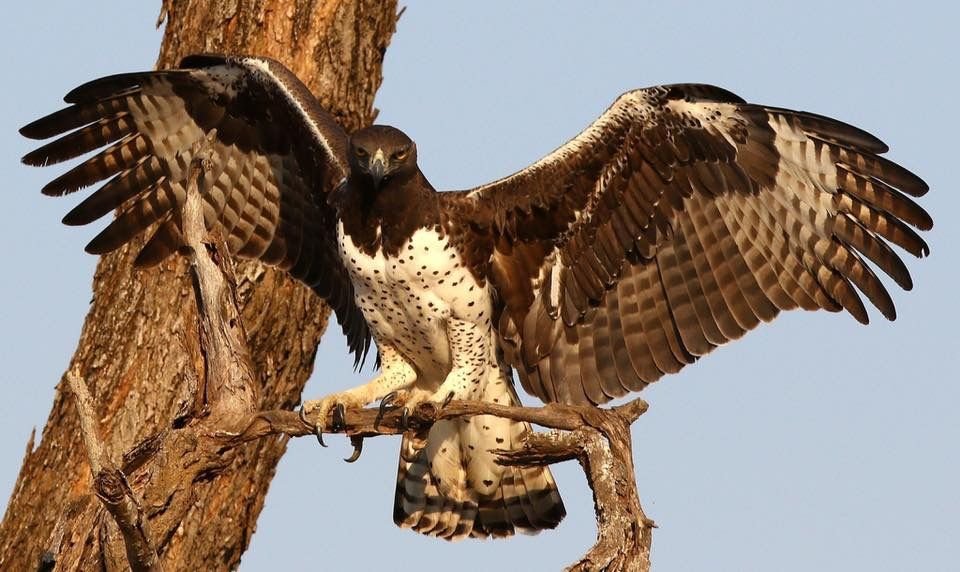
Martial Eagle in Tanzania
Polemaetus bellicosus - Africa's largest eagleWhat Is the Martial Eagle?
The Martial Eagle (Polemaetus bellicosus) is Africa’s largest eagle - a massive raptor of the open savanna with dark brown upperparts, white underparts boldly spotted with brown, a large head, a massive hooked bill and powerful yellow feet and talons.
It hunts from high above. A Martial Eagle rises into a soaring glide, scans kilometres of country, then launches a powerful stooping attack - talons first - onto mammals, birds and reptiles below.
In Tanzania it is widespread in suitable habitats, with documented records from Tarangire and Mkomazi to Ruaha, Serengeti and Ngorongoro. Globally it is listed as Vulnerable.
Scientific Classification
The Martial Eagle is the only living species in the genus Polemaetus. It is one of the largest members of Accipitridae and, together with the Crowned Eagle, the most powerful eagle in Africa.
How to Identify a Martial Eagle
- Dark brown to grey-brown upperparts and wings.
- White underparts heavily spotted with dark brown.
- Large head with a short dark crest.
- Very powerful hooked black bill.
- Yellow eyes in adults; paler in juveniles.
- Massive yellow feet and talons - among the largest of any African eagle.
- Feathered legs (tarsi).
- Broad wings spanning over two metres (often cited at about 2.6 m) and a relatively short barred tail.
- Juveniles are paler above and below, lacking the full adult spotting, and only gradually acquire adult plumage over several years.
Size Summary
- Length: approximately 78-86 cm (range to ~96 cm in some measurements)
- Wingspan: over 2 m; approximately 2.6 m often cited
- Mass: 3.1-6.2 kg; females larger than males
Why Is the Martial Eagle Africa’s Largest Eagle?
Three measures together earn the title:
- Very large body - up to about six kilograms in big females, with a deep chest and muscular build.
- Broad wings - long, slightly pointed wings built for efficient soaring and heavy stoops.
- Massive bill and talons - tools large enough to subdue hares, hyraxes, mongooses and even small antelope.
Territory size underscores the scale: a single pair may require hundreds of square kilometres. It is not the world’s largest eagle - several Asian eagles rival it - but within Africa nothing else in Accipitridae matches it for combined bulk and power.
Male vs Female: Reversed Size
Martial Eagles show reverse sexual size dimorphism: females are generally larger and heavier than males - the reverse of many non-raptor birds.
Otherwise the sexes are alike in plumage, differing subtly in spotting density rather than colour. There are no bachelor groups, female family groups or male-leadership hierarchies - the pair bond and territory are the social units.
Habitat: Open Country With Big Trees
The Martial Eagle needs a simple combination - open hunting ground plus scattered large trees:
- Open woodland and wooded savanna.
- Dry savanna, thornveld and bushveld.
- Wooded grassland and semi-arid open country.
- Open farmland with scattered trees in parts of the range - though not preferred habitat.
Dense woodland is not its core habitat. Waterholes can improve hunting because prey concentrates around water, but water itself is not the primary requirement - this is emphatically not a wetland bird.
Global Distribution
The species occurs widely across sub-Saharan Africa, from Senegal to Ethiopia and south to South Africa, avoiding dense forest and extreme desert. Tanzania is an important range country, but populations have declined substantially in many parts of the range.
Habitat and Global Distribution
The Martial Eagle occurs widely across sub-Saharan Africa, from Senegal to Ethiopia and south to South Africa, avoiding dense forest and extreme desert.
Tanzania is an important range country. Populations have declined substantially in many parts of the range, making protected open landscapes increasingly significant.
Martial Eagle in Tanzania
Tanzania is a stronghold within the species’ East African range. Verified records cited by Tanzania Birds include:
- Tarangire National Park / Kikoti - documented occurrence.
- Mkomazi National Park - documented occurrence.
- Yaida Valley, Mufindi and Mwiba - additional documented localities.
- Ruaha National Park, Serengeti and Ngorongoro also provide suitable raptor landscapes.
Exact nest coordinates are never published.
Where to See Martial Eagles in Tanzania
Tarangire National Park
Country: Tanzania | Region: Northern Tanzania
Open woodland and savanna with large nesting trees - documented occurrence including Tarangire/Kikoti records.
Potentially rewarding; low density, large territories.
Ruaha National Park
Country: Tanzania | Region: South-central Tanzania
Vast open country with suitable large trees; one of the best places to scan high thermals for soaring raptors.
Potentially rewarding; low density, large territories.
Mkomazi National Park
Country: Tanzania | Region: Northeastern Tanzania
Documented occurrence; thornveld and bushveld with scattered nest trees.
Potentially rewarding; low density, large territories.
Serengeti National Park
Country: Tanzania | Region: Northern Tanzania
Open plains and wooded grassland - scan high perches and soaring birds over the savanna.
Potentially rewarding; low density, large territories.
Ngorongoro Conservation Area
Country: Tanzania | Region: Northern Tanzania
Crater rim woodlands and open floor provide hunting and perching habitat for this wide-ranging eagle.
Potentially rewarding; low density, large territories.
Safari & Birding Methods
- Game drives with frequent sky scanning - most sightings are of soaring birds.
- Specialist raptor birding focused on open-country perches and nest trees.
- Wildlife photography with long lenses from vehicles.
- Open-country scanning from viewpoints and crests.
- Guided birding where available.
Best Time to See Them
Martial Eagles can be encountered year-round. In some parks dry-season visibility may improve because prey concentrates near water, vegetation thins and thermals provide good soaring conditions - but this is not promised everywhere.
Martial Eagle in Pictures
A closer look at the Martial Eagle in its natural East African habitat — its striking appearance, habitat and behaviour are best appreciated up close.
Where to Spot the Martial Eagle on Safari
Plan your trip around the destinations and safaris where the Martial Eagle is easiest to see. Explore the parks, itineraries and tour packages by destination below.
What Does the Martial Eagle Eat?
An opportunistic large predator. The menu is dictated by what its huge territory produces:
Mammals
- Hares and hyraxes
- Mongooses
- Small antelope
- Small primates
- Young livestock where documented
Birds & Reptiles
- Guineafowl and francolins
- Other medium and large birds; domestic poultry where available
- Monitor lizards, snakes and other reptiles
Guineafowl and small antelope are often mentioned, but no single prey dominates every territory - breadth is the point.
How Does a Martial Eagle Hunt?
The signature method is the high-soaring stoop:
- Rises into a high soar, circling on thermals and covering a large area.
- Scans the ground with exceptional eyesight.
- Identifies prey - often from hundreds of metres up.
- Launches a powerful stoop - a direct, steep dive.
- Attacks with talons - striking with enormous force.
- Kills or subdues prey on impact.
- Carries smaller prey or feeds at the kill site as appropriate.
Courtship and Pair Bonding
Pair formation centres on aerial displays:
- Circling and soaring together, sometimes for long periods.
- Vocalization - territorial and courtship calls advertising occupancy.
- Territorial advertisement - display flights mark the pair’s airspace to rivals.
- Pair interaction at and around the nest site.
Pairs are monogamous and may remain together across multiple breeding seasons where territories persist.
Breeding, One Egg and Nesting
- Pair: monogamous, territorial breeding pair.
- Nest: a large stick platform in a tall mature tree, often in a strong fork below the canopy; the structure often becomes very large and is commonly reused for multiple seasons, sometimes also on pylons.
- Eggs: one egg is normally laid.
- Incubation: approximately 48-53 days; the female performs most incubation while the male supplies food during incubation and the early chick stage.
- Nestling period: chick remains in the nest approximately 90-109 days.
- Dependence: young remain dependent on parents for many months after fledging - an unusually long post-fledging association.
The low reproductive output means adult survival is critical to population persistence.
How Many Eggs Does a Martial Eagle Lay?
Usually one. Single-egg clutches are the norm for this species, which invests heavily in a single chick rather than many. The strategy maximises the quality of parental care per offspring, but it also means that loss of breeding adults has outsized effects on recovery.
Where Does a Martial Eagle Build Its Nest?
In a tall mature tree - often one of the tallest locally available - placed in a substantial fork below the canopy. The stick platform is massive and, with reuse, becomes even larger. Alternative sites such as pylons have been reported where large trees are scarce.
Nests are sited for a commanding view and a clear flight line, and pairs may maintain more than one structure within the territory.
How Long Does a Martial Eagle Chick Stay in the Nest?
Approximately 90-109 days in commonly cited breeding observations, before the young makes its first flight.
Importantly, post-fledging dependence continues for many additional months. Do not imply independence immediately after first flight - the young may beg from parents, return to the nest tree and remain within the territory for a prolonged learning period.
Conservation Status: Vulnerable
IUCN Red List Status: Vulnerable. The species has suffered significant population declines across parts of its range and is assessed as Vulnerable with a decreasing trend.
Key Threats
- Persecution, shooting and poisoning - including secondary poisoning via poisoned carcasses.
- Poisoned predator-control and indiscriminate poisoning campaigns.
- Power-line electrocution and collision - a serious risk for a large raptor with a wide wingspan.
- Habitat loss, agricultural expansion, prey depletion and loss of nesting trees.
- Habitat fragmentation and disturbance at nest sites.
Livestock are only occasional prey, yet perceived predation can trigger persecution - an important nuance. Prey depletion through overhunting and habitat conversion compounds the problem.
Martial Eagles and Power-Line Electrocution
Large raptors are disproportionately vulnerable around electrical infrastructure because of their large wingspan and habit of perching and flying from pylons. Martial Eagles - among the heaviest and widest-winged eagles in Africa - are at particular risk of bridging conductors and being electrocuted, especially where new lines cross open savanna and woodland.
Source-backed mitigation includes insulated perches, line marking and careful routing - but the threat persists where infrastructure expands faster than safeguards.
Poisoning and Martial Eagle Declines
Poisoning operates at two levels:
- Direct poisoning - targeted killing of perceived problem birds.
- Secondary poisoning - scavenging or predation on poisoned carcasses, including livestock or predator-control baits.
- Indiscriminate predator control - broad poisoning campaigns that kill non-target raptors.
Because Martial Eagles reproduce so slowly, even modest additional adult mortality from poisoning has population-level consequences far beyond the loss of a single bird.
Martial Eagle Conservation in Tanzania
In Tanzania, conservation hinges on:
- Protected areas that keep territories and prey bases intact.
- Large nesting trees - retaining the emergent trees Martial Eagles require.
- Prey-base protection - healthy hare, hyrax, mongoose and bird populations.
- Poisoning reduction through community engagement and enforcement.
- Power-line mitigation - perch guards, insulation and careful routing in raptor country.
- Community education and raptor monitoring that builds local ownership of sightings.
- Responsible land-use planning - keeping open savanna open.
Organizations are named here only where current species-specific evidence supports them.
Martial Eagle Facts
Martial Eagle vs African Hawk-Eagle
| Feature | Martial Eagle | African Hawk-Eagle |
|---|---|---|
| Scientific name | Polemaetus bellicosus | Aquila spilogaster |
| Size | Africa’s largest eagle; 78-86 cm, >2.6 m wingspan | Medium eagle; ~55-65 cm, ~1.5 m wingspan |
| Plumage | Dark brown above, white spotted below | Dark brown with white belly streaked black, rufous legs |
| Habitat | Open savanna/woodland specialist | Denser woodland and forest edge |
| Prey | Large mammals, hares, hyraxes, antelope; large birds | Primarily birds and small mammals |
| Hunting | High soaring stoop from thermals | More ambush from perches within cover |
| Status | Vulnerable | Least Concern |
Martial Eagle vs Crowned Eagle
| Feature | Martial Eagle | Crowned Eagle |
|---|---|---|
| Habitat | Open savanna/woodland | Dense forest and forest edge |
| Prey | Open-country mammals/birds/reptiles | Forest primates and small antelope; primate specialist |
| Hunting | Soaring stoop | Powerful short stoop through canopy |
| Nest | Large stick nest in open woodland emergent | Massive nest in forest emergent; ~500 kg+ |
| Status | Vulnerable | Near Threatened |
Martial Eagle vs Bateleur
| Feature | Martial Eagle | Bateleur |
|---|---|---|
| Size | Africa’s largest eagle | Medium eagle; ~55-60 cm, short tail |
| Plumage | Brown/white spotted | Black, chestnut and white; adult red face/bill |
| Flight style | High soaring, powerful stoop | Distinctive rocking flight, tight tail |
| Diet | Large live prey specialist | Scavenger-predator mix; carrion important |
| Status | Vulnerable | Near Threatened |
Why the Martial Eagle Matters to Tanzania’s Ecosystems
- Upper-level predator: regulates prey populations from hyraxes to guineafowl.
- Prey regulation keeps open-country food webs in balance.
- Indicator of intact savanna: where Martial Eagles hold territories, the ecosystem retains large prey, large trees and connectivity.
- Large territory requirements make the species a flagship for landscape-scale conservation - protecting one pair protects hundreds of square kilometres.
- Cultural weight: as Africa’s largest eagle, its presence alone signals wildness.
Photographing the Martial Eagle
- Soaring high on thermals - long lens, fill the frame with wings fully spread.
- The stoop itself - rare and fast, but the most dramatic sequence.
- Adult perched in a tall emergent tree - yellow eye, massive talons, spotted underparts.
- Yellow eye and talons in tight portrait.
- Prey capture - hares, hyraxes or guineafowl if you are fortunate.
- Pair courtship - soaring together in display.
- Nest tree from a respectful, legal distance - never approach an active nest.
- Juvenile and immature plumages - paler birds are often overlooked.
Ethics first: never disturb nests. Stick to roads and tracks, use long lenses, follow park rules and your guide’s instructions. The long dependency of chicks means disturbance has outsized costs.
Frequently Asked Questions
Africa's largest eagle (Polemaetus bellicosus) - a massive dark-and-white raptor of savanna and open woodland that hunts by high soaring and powerful stooping attacks. It is the only living species in its genus and is listed as Vulnerable.
Because no other African eagle combines the same bulk, wingspan and prey-carrying power. Very large females can exceed six kilograms with a wingspan over two and a half metres, supported by broad wings and enormous talons - a combination that exceeds other African Accipitridae.
Potentially rewarding sites include Tarangire National Park (including Tarangire/Kikoti), Mkomazi National Park, Ruaha National Park, Serengeti National Park and the Ngorongoro Conservation Area - all documented or strongly supported Tanzania landscapes for this species.
Mammals such as hares, hyraxes, mongooses, small antelope and small primates; birds including guineafowl, francolins and other medium or large species; and reptiles including monitor lizards and snakes. It is an opportunistic large predator, not a single-prey specialist.
It rises into a high soar on thermals, scans large areas, identifies prey from great height, launches a steep stoop and strikes with talons - killing or subduing prey on impact before carrying smaller items or feeding at the kill site. The high-soaring stoop is the signature behavior.
Yes. Like many raptors, the species shows reverse sexual size dimorphism: females are generally larger and heavier than males, with slightly denser spotting below. Color differences are minor.
Usually one egg per clutch. Single-egg breeding is the norm, which makes the species' low reproductive rate a conservation concern - every adult lost represents a large share of future recruitment.
Approximately 48-53 days, with the female performing most incubation while the male supplies food during incubation and the early chick stage.
Approximately 90-109 days before first flight in commonly cited breeding observations. Importantly, young remain dependent on parents for many additional months after fledging, continuing to beg and return to the nest area.
In a tall mature tree, usually in a strong fork below the canopy; the large stick platform often becomes very substantial with reuse across seasons and may also appear on pylons where large trees are scarce.
Adults are generally solitary outside territorial breeding pairs. Breeding pairs maintain large territories that they defend vigorously; juveniles disperse widely as they mature. No flocks or group-living behaviours occur.
Yes. The species is assessed as Vulnerable on the IUCN Red List, having suffered significant declines across parts of its range. It was previously considered less threatened.
Major drivers include persecution, shooting and poisoning (including secondary poisoning), electrocution and collision with power lines, habitat loss and agricultural expansion, prey depletion, loss of large nesting trees, fragmentation and disturbance - compounded by its inherently slow reproduction.
Large wingspans make large raptors prone to bridging conductors when perching or taking off from pylons. Martial Eagles, among the heaviest and widest-winged eagles in Africa, are especially vulnerable to electrocution where lines cross open savanna and woodland.
Both directly (targeted killing) and secondarily, when eagles scavenge poisoned carcasses or prey on poisoned animals. Indiscriminate predator-control poisoning kills non-target raptors and, because adults reproduce so slowly, even low additional mortality depresses populations.
Year-round in suitable habitats. Dry-season conditions in some parks may improve visibility as vegetation thins, prey concentrates near water and thermals provide ideal soaring weather - but no single season guarantees sightings of this low-density, wide-ranging eagle.
Habitat separates them: Martial Eagles hunt open savanna and woodland with high soaring stoops for ground mammals and open-country birds, while Crowned Eagles hunt dense forest and forest edge with short, powerful stoops for primates. Crowned Eagles build even more massive nests and are Near Threatened, versus the Martial's Vulnerable status.
Related Safari Packages & Tours
Book a safari to see the Martial Eagle and the rest of Africa's incredible wildlife with our expert guides.
References & Further Reading
- BirdLife DataZone / IUCN: Polemaetus bellicosus factsheet - Vulnerable assessment.
- Animal Diversity Web / BOW: Polemaetus bellicosus - size, dimorphism, breeding biology.
- Tanzania Birds: Tarangire/Kikoti, Mkomazi, Yaida, Mufindi, Mwiba and other Tanzania records.
- Peer-reviewed Martial Eagle research / conservation sources: poisoning, power-line and habitat-threat literature.
- About these facts: measurements and timings are approximate ranges drawn from available sources; they vary with sex, age, region and method.
Sightings are never guaranteed and depend on local conditions.

Social Life and Territory
Martial Eagles are generally solitary outside territorial breeding pairs.
There are no flocks, bachelor groups, safety-in-numbers or group-defence behaviours here - the pair and its airspace define the social world.