

.png)
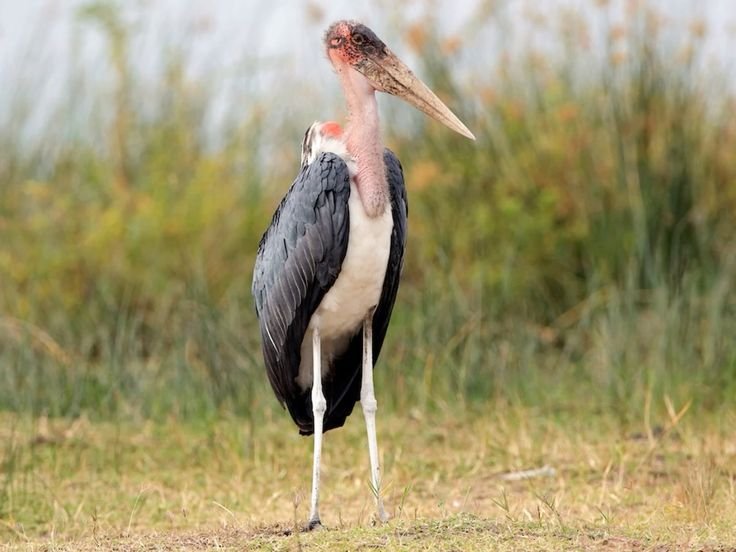
Marabou Stork in Tanzania
Leptoptilos crumenifer - Africa's largest storkWhat Is the Marabou Stork?
The Marabou Stork (Leptoptilos crumenifer) is Africa’s largest stork and one of its most distinctive scavenging birds. Standing up to about 1.5 m tall with a wingspan that can reach three metres, it is instantly recognizable by its bare head and neck, massive wedge-shaped bill and hanging throat pouch.
Where most birds avoid carcasses, the Marabou thrives on them - feeding alongside vultures while also hunting live fish, frogs, insects, reptiles and rodents. That opportunistic breadth lets it live equally in wild savanna and beside fishing villages.
In Tanzania it is widespread in suitable habitats, from the Serengeti plains to Ngorongoro Crater and the lakeshores of Eyasi and Manyara.
Scientific Classification
Monotypic and unmistakable. The genus Leptoptilos contains three Old World storks; the Marabou is the only one to reach sub-Saharan Africa, with a native range covering most of the region south of the Sahara.
How to Identify a Marabou Stork
- Enormous body - standing up to approximately 1.5 m; typical weight 4.5-8 kg, large birds up to about 9 kg.
- Very long grey legs and a giant wedge-shaped bill (26-35 cm).
- Bare head and bare neck - dark, featherless skin rather than plumage.
- White and grey body plumage contrasting with black flight feathers and back.
- Very long, broad wings spanning up to about three metres.
- Hanging throat pouch (pink gular sac) plus two additional inflatable air sacs on the neck in displaying birds.
- Upright, undertaker-like posture - cloak-wings and skinny white legs viewed from behind.
Why Does the Marabou Stork Have a Bare Head and Neck?
The featherless head and neck are hygiene adaptations for a scavenger that feeds head-first inside animal carcasses. Bare skin does not trap blood, viscera or bacteria the way feathers would, and it is easily cleaned and sun-dried.
The same principle explains vultures: the barer the head, the cleaner the bird after a carcass meal. This is not camouflage - it is functional anatomy for an undertaking lifestyle.
What Is the Marabou Stork’s Throat Pouch For?
The pendulous pink throat pouch (gular sac) is not a food-storage crop. Tanzania Birds documents two inflatable air sacs on displaying birds of this species.
The pouch and sacs function in:
- Courtship display - inflation during bill-clattering ceremonies.
- Dominance display - signalling condition to rivals and mates.
- Communication - associated grunts and croaks are amplified by the inflated sac.
- Thermoregulation - blood flow through inflated skin helps dump heat.
How Does Such a Large Stork Fly?
The Marabou relies heavily on soaring. It uses thermals to gain height with minimal flapping, then glides efficiently for kilometres. Unlike most storks, Leptoptilos flies with the neck folded like a heron, legs extended straight behind the body.
No maximum speed is presented here - soaring efficiency matters far more than sprint numbers for a bird this size.
Male vs Female: Similar Partners
Males and females are alike in plumage, with males averaging slightly larger. Both sexes share all breeding duties: building the stick platform, incubating the eggs and feeding the chicks. Pairs may remain together across seasons.
Habitat: Open Country That Meets Water
The Marabou’s core ecology is: open land + water-associated food + carrion/live prey + roosting/nesting trees.
- Dry savanna, grassland and open plains.
- Wetlands, swamps, riverbanks, lake shores and receding pools.
- Fishing areas and open human-modified landscapes, including urban and rubbish sites where food is available.
The species is not a wetland exclusive; equally it is not a forest bird. What it needs is the juxtaposition of open roosting/nesting trees with either wetland or carcass resources within soaring distance.
Habitat and Global Distribution
The Marabou Stork is widespread across sub-Saharan Africa, from Senegal and Ethiopia south to South Africa.
Tanzania is an important part of its African range - a stronghold of savanna, wetlands and open human-modified landscapes where the species thrives.
Marabou Stork in Tanzania
The Marabou Stork is widespread in suitable Tanzanian habitats and described as one of Tanzania’s largest storks.
Verified records include:
- Tarangire National Park - marsh and riverine stork habitat.
- Lake Eyasi - alkaline lake-shore and surrounding plains.
- Ngorongoro Crater - crater floor scavenging alongside predators.
- Usa River - nesting records from this northern Tanzania locality near Arusha.
Other destinations such as Serengeti may be referenced where current site-specific evidence supports them; otherwise the Tanzanian story is already strong with the four verified examples above.
Where to See Marabou Storks in Tanzania
Serengeti National Park
Country: Tanzania | Region: Northern Tanzania
Open plains and riverine areas - scavenger flocks gather near predator kills and seasonal pools.
Good opportunity in suitable open habitat, near water and large-animal activity.
Tarangire National Park
Country: Tanzania | Region: Northern Tanzania
Wetland margins and riverine woodland hold territorial pairs and communal roosts.
Good opportunity in suitable open habitat, near water and large-animal activity.
Ngorongoro Conservation Area
Country: Tanzania | Region: Northern Tanzania
Crater-floor scavenging with vultures around carcasses; Usa River nesting nearby.
Good opportunity in suitable open habitat, near water and large-animal activity.
Lake Eyasi
Country: Tanzania | Region: Northern Tanzania
Lake-shore and surrounding dry savanna - documented occurrence and regional records.
Good opportunity in suitable open habitat, near water and large-animal activity.
Safari & Birding Methods
- Game drives across open savanna and around wetlands.
- Specialist birdwatching - Marabous are conspicuous but worth dedicated scanning.
- Wildlife photography - soaring, feeding and colony nests.
- Wetland birding at receding pools and fishing areas.
- Observation around open savanna and guided birding where permitted.
Best Time to See Them
Marabou Storks can be encountered year-round. Local concentrations vary with rainfall, water levels, food availability, carcasses, fishing activity and breeding cycles. Breeding itself varies geographically.
Marabou Stork in Pictures
A closer look at the Marabou Stork in its natural East African habitat — its striking appearance, habitat and behaviour are best appreciated up close.
Where to Spot the Marabou Stork on Safari
Plan your trip around the destinations and safaris where the Marabou Stork is easiest to see. Explore the parks, itineraries and tour packages by destination below.
What Does the Marabou Stork Eat?
An opportunistic feeder - not a strict scavenger. Both carrion and live prey matter:
Scavenged Food
- Carrion and carcass scraps
- Fish remains and offal
- Discarded food and slaughter waste
Live Prey
- Fish and frogs
- Insects and termites
- Snakes and lizards
- Rodents, small birds, eggs and young animals
Why Does the Marabou Stork Feed With Vultures?
Both groups exploit the same carcass resource - but differently. Vultures arrive first with superior olfaction and soaring, Marabous arrive with bulk and bill strength to tear what vultures cannot. The bare head and neck let Marabous feed deep inside carcasses without fouling plumage, while size lets them displace smaller scavengers. The association is competition as much as cooperation.
Marabou Storks Around Human Settlements
Marabous are bold exploiters of human food sources:
- Fish-processing areas and fishing villages.
- Slaughter waste and offal.
- Landfills and food waste.
- Fishing communities and urban environments.
The risks are real: contaminated food, plastics ingestion, human conflict, disease, poisoning and persecution when birds are seen as dirty or threatening near abattoirs. This is not glorified landfill feeding - it is adaptation with costs.
Marabou Stork Courtship Display
Colony courtship is a noisy, visual affair at the nest tree:
- Bill clattering - rapid rattling of the huge bill.
- Throat-pouch and air-sac inflation - the pink sac and two additional neck sacs swell impressively.
- Head movements, wing postures and mate interactions around the nest site.
- Throat-sac grunts, croaks and whistles amplified by inflated skin.
Tanzania Birds imagery of displaying birds shows the sacs at full inflation - one of the stork’s most photographed moments.
Breeding, Eggs, Chicks and Colonial Nests
- Colonial breeding in trees - large stick platforms built in the canopy.
- Nest: substantial stick platform, commonly 10-30 m above ground where suitable trees allow; some urban birds may use buildings.
- Eggs: usually 2-3 chalky-white eggs per clutch.
- Incubation: approximately 29-31 days, shared by both parents.
- Parental care: both parents feed the chicks; young develop slowly.
- First flight: can take around 116 days in an East African study - do not reduce the post-hatch period to a few weeks.
Breeding is colonial and can be ly synchronous; colonies are sensitive to disturbance.
Where Does the Marabou Stork Nest?
Nests are large stick platforms in trees, commonly near water and reliable food. Heights of approximately 10-30 m are typical where tall trees are available; lower nests occur where trees are shorter. Some urban-associated populations have adopted buildings and other structures. Nest sites can be reused across seasons where colonies persist.
How Long Do Marabou Stork Chicks Stay in the Nest?
An East African study found young remained in the nest for an average of approximately 116 days before first flight. Fledging to independence takes longer still; full maturity is not reached for several years. Do not compress development into a few weeks - this is a long-nest species.
Conservation Status
Global status: Least Concern (some populations) - a broad distribution and large overall population keep the species secure globally.
2025 Southern African regional assessment: Near Threatened regionally. The global and regional assessments must not be confused: the species is LC worldwide, NT in southern Africa under the 2025 review.
Threats Where They Matter
- Loss of nesting trees - removal of large colony trees.
- Wetland degradation and pesticide/poisoning exposure.
- Disturbance at breeding colonies.
- Local hunting and traditional-medicine use.
- Contaminated waste at landfills and fish-processing sites.
- Reduced food availability as wetlands and fisheries change.
Effective measures are habitat-based: breeding-colony protection, wetland and nesting-tree protection, clean waste management, poisoning prevention, responsible tourism and monitoring - not generic "African Parks + WWF + TAWIRI" claims.
Marabou Stork Facts
Marabou Stork vs Saddle-billed Stork
| Feature | Marabou Stork | Saddle-billed Stork |
|---|---|---|
| Scientific name | Leptoptilos crumenifer | Ephippiorhynchus senegalensis |
| Size | Up to 1.5 m; wingspan up to 3 m; up to 9 kg | Slightly smaller and more slender; ~1.5 m tall, ~2.7 m wingspan |
| Head/neck | Bare, dark-skinned head and neck | Black head with red bill, yellow wattles, feathered neck |
| Bill | Huge, wedge-shaped, pale | Long, red-and-black saddle-billed, with yellow frontal shield |
| Plumage pattern | Black back, white underparts, bare skin | Black-and-white with striking red legs |
| Feeding | Carrion + live prey; scavenger flocks | Live fish, frogs, crustaceans - solitary wader |
| Tanzania viewing | Serengeti, Tarangire, Ngorongoro, Eyasi | Occupies similar wetlands but less gregarious |
Marabou Stork vs Yellow-billed Stork
| Feature | Marabou Stork | Yellow-billed Stork |
|---|---|---|
| Scientific name | Leptoptilos crumenifer | Mycteria ibis |
| Size | Massive - 1.5 m, 3 m wingspan | Medium stork - ~95 cm, ~1.5 m wingspan |
| Head/neck | Bare, dark | Bare pink face, feathered neck |
| Bill | Huge, wedge-shaped | Long, decurved yellow bill - tactile feeder |
| Feeding method | Tearing carrion, jabbing fish | Sweeping bill through water feeling for prey |
| Social | Large colonies, gregarious | Smaller colonies, less urban |
Why the Marabou Stork Matters to African Ecosystems
- Scavenging service: removes carcasses that would otherwise spread disease.
- Carcass recycling: nutrients are returned to the food web.
- Food-web link: ties large-mammal mortality to wetland and urban bird communities.
- Association with vultures illustrates niche partitioning among scavengers.
- Opportunistic feeding breadth buffers ecosystems against single-prey collapse.
- Wetland and savanna indicator: where Marabous gather, productive open country remains.
Photographing the Marabou Stork
- Massive wingspan soaring on thermals - fill the frame from below.
- Group feeding with vultures - the classic carcass context.
- Throat-pouch displays and bill clattering at the nest.
- Colonial nests - stick platforms in trees.
- Nest building and parent-chick interactions.
Ethics first: never disturb breeding colonies. Keep distance, use long lenses and follow your guide’s instructions - colony abandonment is a real risk.
Frequently Asked Questions
Africa's largest stork (Leptoptilos crumenifer) - a massive scavenging bird up to about 1.5 m tall with a wingspan to three metres, a bare head and neck, and a hanging throat pouch. It lives across sub-Saharan Africa wherever open land meets water and carrion.
Large birds can reach about 1.5 m in height and weigh up to around 9 kg, with typical adults at 4.5-8 kg. The wingspan often measures 2.3-2.9 m, among the largest of any land bird. Females average slightly smaller than males.
It takes carrion and carcass scraps as a major resource, plus live fish, frogs, insects including termites, snakes, lizards, rodents, small birds, eggs and young animals, and opportunistically fish remains and discarded food near human settlements.
No. It is an opportunistic feeder, not a strict scavenger. Carrion is important where available, but the species actively hunts live prey in shallow water and on land. Calling it a pure scavenger understates its hunting breadth.
Widespread in suitable habitats: Serengeti National Park, Tarangire National Park, Ngorongoro Conservation Area and Lake Eyasi are all verified Tanzanian examples, with additional sightings around lake shores, riverbanks and fishing areas countrywide.
ly gregarious. They feed in groups - often with vultures - gather at communal roosts in large trees and breed in colonies that can contain dozens to very large concentrations of nests.
In large stick platforms in trees, commonly 10-30 m above ground where tall trees allow. Some urban-associated birds may adopt buildings or other structures. Colonies are usually near water and reliable food, and nest sites can be reused.
Usually two to three chalky-white eggs per clutch, placed in the stick platform. Clutches outside that range are uncommon.
Approximately 29-31 days, with both parents sharing incubation duties.
Young develop slowly. An East African study found chicks remained in the nest for an average of about 116 days before first flight - far longer than most birds, reflecting the species' large size and prolonged parental care by both adults.
The hanging pink gular sac, plus two additional inflatable air sacs documented on displaying birds, functions in courtship and dominance display, communication and thermoregulation - not as a food-storage pouch.
Bare skin stays cleaner when the bird feeds head-first inside carcasses. Feathers would trap blood and bacteria; bare skin is quickly cleaned and dries in the sun - a classic scavenger adaptation shared with vultures.
By soaring. It uses thermals to gain height with minimal flapping, then glides long distances efficiently. Like Leptoptilos storks generally, it flies with the neck folded like a heron and the long legs trailing behind. No sprint speed is needed.
No. Globally it is Least Concern on the IUCN Red List thanks to a broad range and large population. The 2025 southern African regional assessment lists it as Near Threatened regionally - a distinct, more severe regional status that must not be presented as the global status.
Where pressures exist they are habitat-based: loss of large nesting trees, wetland degradation, pesticide and poisoning exposure, disturbance at colonies, local hunting and traditional-medicine use, contaminated waste at landfills, reduced fish prey and infrastructure hazards.
The Marabou is larger and bulkier with a bare dark head, wedge bill and scavenger ecology; the Saddle-billed is slightly smaller and more elegant with a black head, red-and-black saddle bill, yellow wattles and a live-fish hunting ecology - a wader rather than a carcass bird.
Year-round in suitable habitats. Local concentrations shift with rainfall, water levels, food availability, carcass abundance and breeding cycles, so no single nationwide season guarantees them - early mornings at communal roosts and midday thermals for soaring are reliably productive.
Related Safari Packages & Tours
Book a safari to see the Marabou Stork and the rest of Africa's incredible wildlife with our expert guides.
References & Further Reading
- BirdLife DataZone / IUCN: Leptoptilos crumenifer factsheet - Least Concern global; 2025 southern African Near Threatened regional.
- Tanzania Birds: distribution, throat air sacs and Tanzania records for Tarangire, Eyasi, Ngorongoro and Usa River.
- East African reproductive biology literature: incubation 29-31 days; chick period average ~116 days to first flight.
- Ornithological references / Tanzania park sources: Serengeti, Tarangire, Manyara and Ngorongoro occurrence.
- About these facts: measurements and timings are approximate ranges drawn from available sources; they vary with sex, age, region and method.

Daily Behavior and Social Life
Marabou Storks are primarily diurnal. They spend the day walking, standing, feeding, resting, preening, soaring and maintaining colony and nest sites.
They are ly gregarious:
There is no leadership hierarchy or mammal-style family decision-making - just numbers, and the safety and signaling that numbers provide.