

.png)
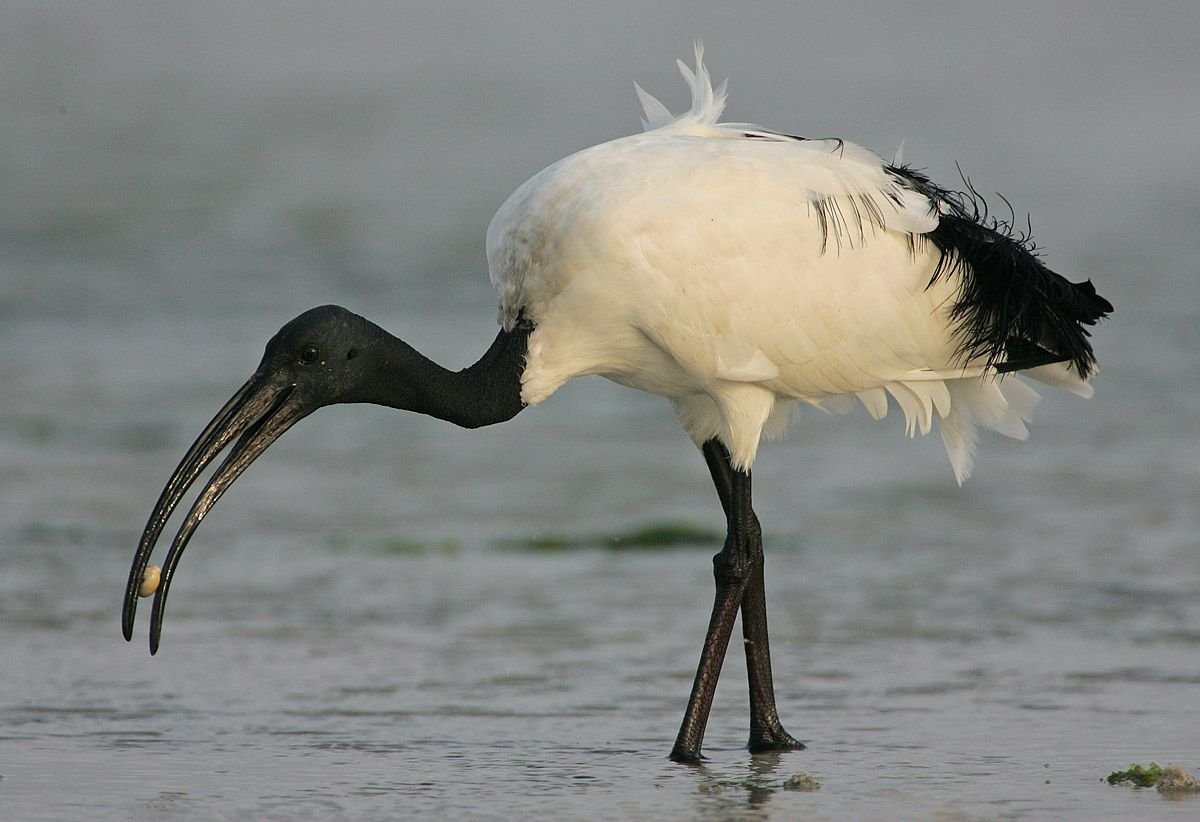
African Sacred Ibis in Tanzania
Threskiornis aethiopicus — tactile wetland foragerWhat Is the African Sacred Ibis?
The African Sacred Ibis (Threskiornis aethiopicus) is a distinctive white-and-black wetland bird recognized by its bare black head and neck, long curved bill, black legs and white body.
It feeds by tactile mud probing — walking through shallow water and seeping its bill into mud to detect invertebrates by touch — and lives in highly social colonies that feed, roost and breed together. In Tanzania it is a familiar bird of marshes, shallow lakes and waterlogged areas from Tarangire to Zanzibar.
Scientific Classification
How to Identify an African Sacred Ibis
- White body with black bare head and neck — no feathers on head/neck.
- Long curved, downward-pointing bill specialised for probing mud.
- Black legs and feet.
- Black wing tips and trailing edges visible in flight.
- Immatures duller — brownish-black with white flecks rather than crisp black-and-white.
How Does the African Sacred Ibis Find Food?
This is the bird's signature behaviour — tactile foraging:
- Walks through shallow water and mud, often in groups.
- Probes with the long curved bill into soft substrate.
- Uses tactile sensory structures in the bill to detect prey on contact.
- Captures prey by touch as well as sight — effective in muddy or turbid environments where visibility is low.
Colonial Breeding & Pair Formation
How Do Sacred Ibis Colonies Work?
- Large nesting colonies with many pairs.
- Male territory establishment and female choice leading to pair formation.
- Nesting territories with defensive interactions among neighbors.
No rigid mammal hierarchy is described.
No mammal hierarchy is described.
Habitat: Wetlands — and Beyond
The African Sacred Ibis is fundamentally a wetland bird, but it is adaptable:
- Marshes, shallow lakes, ponds, rivers, streams and temporary pools.
- Estuaries, coastal wetlands and meadows.
- Cultivated fields, agricultural landscapes and urban/suburban wetlands.
- Waterlogged areas — a key habitat phrase in Tanzania research.
Wetlands are central, yet the species also uses human-modified habitats — a flexibility that helps explain its broad range.
Global Distribution
The African Sacred Ibis has a broad sub-Saharan African distribution and occurs also in Madagascar. Tanzania lies within its natural range. It is not correctly described as "found primarily in Uganda" with Uganda as the best place, and largest-population claims centred on Uganda are not used here.
African Sacred Ibis in Tanzania
In Tanzania, the African Sacred Ibis is documented across a string of wetland landscapes:
- Tarangire National Park — seasonal marshes and Silale Swamp surrounds.
- Arusha National Park — Momella lakes and associated wetlands.
- Ngorongoro Conservation Area — crater wetlands and lake margins.
- Lake Manyara National Park — alkaline lake and shoreline flats.
- Lake Eyasi — a classic shallow-lake basin.
- Zanzibar wetlands (including Bwawani) and Dar es Salaam waterlogged sites studied in 2023.
Not every site holds equal abundance or breeding importance — presence varies with water levels, prey and local conditions.
Where to See Sacred Ibises in Tanzania
Tarangire National Park
Country: Tanzania | Region: Northern Tanzania
Seasonal marshes and Silale surrounds — wading and probing on mudflats.
Good opportunity in suitable wetlands & wet grassland
Arusha National Park
Country: Tanzania | Region: Northern Tanzania
Momella lakes — often seen patrolling shallow margins.
Good opportunity in suitable wetlands & wet grassland
Ngorongoro Conservation Area
Country: Tanzania | Region: Northern Tanzania
Crater wetlands — social feeding groups.
Good opportunity in suitable wetlands & wet grassland
Lake Manyara National Park
Country: Tanzania | Region: Northern Tanzania
Alkaline lake flats — shoreline probing.
Good opportunity in suitable wetlands & wet grassland
Lake Eyasi
Country: Tanzania | Region: Northern Tanzania
Shallow basin lake — wet-season gatherings.
Good opportunity in suitable wetlands & wet grassland
Zanzibar / Bwawani Wetland
Country: Tanzania | Region: Coastal / Islands
Coastal wetlands and island waterlogged sites.
Good opportunity in suitable wetlands & wet grassland
Dar es Salaam's eight waterlogged study sites provide Tanzania-specific research context rather than a safari destination. Sightings vary by habitat and local conditions.
Birding Methods
- Specialist birdwatching and wetland birding.
- Game drives where wetlands border tracks.
- Guided nature walks where permitted.
- Lake and shoreline observation where permitted.
- Wildlife photography — low angle on mudflats is productive.
Best Time to See Them
African Sacred Ibises can occur year-round in suitable Tanzanian habitats. Visibility depends on water levels, prey, habitat, rainfall and local bird abundance. No single June–October universal season is imposed.
Sacred Ibis in Pictures
A closer look at the Sacred Ibis in its natural East African habitat — its striking appearance, habitat and behaviour are best appreciated up close.
Where to Spot the Sacred Ibis on Safari
Plan your trip around the destinations and safaris where the Sacred Ibis is easiest to see. Explore the parks, itineraries and tour packages by destination below.
What Does the Sacred Ibis Eat?
A generalist animal feeder — the diet is invertebrate-heavy rather than merely "omnivore":
Invertebrates
- Insects and insect larvae
- Worms
- Snails and molluscs
- Crustaceans
- Spiders and other arthropods
Vertebrates & Other
- Frogs and tadpoles
- Small fish
- Reptiles
- Eggs
- Carrion and other animal food
Sacred Ibis Feeding Ecology in Tanzania
A 2023 Tanzania Journal of Science study investigated Sacred Ibis feeding at eight waterlogged sites in Dar es Salaam and found substantial association with snail prey and other invertebrates among birds using urban wetlands.
This Tanzania-specific research is presented as a local case study — valuable for understanding urban-wetland feeding ecology — not exaggerated as representative of every Sacred Ibis population in Africa.
African Sacred Ibis Breeding and Nesting
No gestation, birth or parental feeding — this is colonial bird breeding:
- Seasonal breeding with seasonally monogamous pairs and territorial pairing.
- Breeding colonies — often large.
- Twig and stick nests built in trees; some ground nesting on islands where documented.
- 1–5 eggs (average around 2).
- Both parents incubate for approximately 21–29 days, usually about 28 days.
How Many Eggs Does a Sacred Ibis Lay?
1–5 eggs per clutch, with an average of approximately 2 eggs.
Eggs are dull white, sometimes bluish, and may have dark reddish markings.
Sacred Ibis Chicks
- Chicks hatch dependent and are fed by regurgitation by both parents.
- One parent may guard the nest early while the other forages.
- Young recognize parental calls — a key species trait.
- Young leave the immediate nest area after roughly 2–3 weeks.
- First flight around 35–40 days and independence around 44–48 days where cited.
No standing immediately after birth or mammal single-young language.
How Do Sacred Ibis Parents Recognize Their Young?
Adults and chicks use distinctive vocal recognition. Parents feed their own chicks and reject unrelated young attempting to take food — a documented species-specific behaviour, not a generic claim.
Sacred Ibises in Human-Modified Landscapes
They can use:
- Agricultural fields, urban wetlands and waterlogged areas.
- Rubbish, food-waste areas and drainage sites.
Tanzania-specific context is Dar es Salaam. Rubbish feeding is noted without glorification.
Predators and Threats
Large predators are not a primary threat to adults, but eggs and chicks face predation.
For eggs and chicks, threats are restricted to verified nest predators, predatory birds and mammals that can reach colonies.
Human and environmental pressures:
- Wetland drainage and degradation.
- Disturbance of breeding colonies.
- Pollution, agricultural chemicals and contaminated food.
- Local persecution.
The species remains widespread and adaptable.
Conservation Status: Least Concern
IUCN Red List Status: Least Concern. The African Sacred Ibis has a broad range and adaptability, including use of human-modified wetlands.
Local conservation priorities: protect wetlands, feeding grounds and breeding colonies; reduce pollution; retain communal roost sites; and practice responsible waste management. No invented African Parks / WWF / TAWIRI monitoring program is claimed.
African Sacred Ibis Facts
African Sacred Ibis vs Hadada Ibis
| Feature | African Sacred Ibis | Hadada Ibis |
|---|---|---|
| Scientific name | Threskiornis aethiopicus | Bostrychia hagedash |
| Plumage | White body, black head/neck | Grey-brown with green wing gloss |
| Bill | Long curved for probing | Long curved, similar probing |
| Voice | Colony calls, parent-chick recognition | Loud "hadada" calls, especially at dawn/dusk |
| Habitat | Wetlands, co-adapted to urban wetlands | More terrestrial, farmland and grassland near water |
African Sacred Ibis vs Glossy Ibis
| Feature | African Sacred Ibis | Glossy Ibis |
|---|---|---|
| Plumage | White/black | Rich chestnut with green gloss |
| Distribution | Sub-Saharan + Madagascar | Widespread Old World, including Tanzania wetlands |
| Feeding | Tactile mud probing, invertebrate-heavy | Similar tactile probing in shallow water |
African Sacred Ibis vs African Spoonbill
| Feature | African Sacred Ibis | African Spoonbill |
|---|---|---|
| Bill | Long curved ibis bill | Flat, spatulate spoonbill |
| Feeding | Probing mud for invertebrates | Sweeping bill side-to-side through water |
| Plumage | White/black | White with pink legs and red facial skin, yellow bill |
Why Was the Sacred Ibis Important in Ancient Egypt?
The Sacred Ibis was associated with Thoth, the Egyptian deity of wisdom and writing. Votive ibis mummies and archaeological evidence attest to its religious significance.
The phrase "symbol of African wisdom" is not used as a generic claim, and ancient Egyptian history is not mixed with Tanzania ecology.
Photographing the Sacred Ibis
- Black head and white body contrast — the signature portrait.
- Bill probing mud — low angle on mudflats and shallows.
- Feeding groups and communal roosts.
- Breeding colony — from a respectful, legal distance; never disturb.
- Flight and chicks, including breeding adult red underwing skin where visible.
Ethics first: never disturb breeding colonies; use long lenses and follow your guide.
Frequently Asked Questions
The African Sacred Ibis (Threskiornis aethiopicus) is a white-and-black wetland bird with a bare black head and neck, long curved bill and black legs. It feeds by tactile mud probing and lives in social colonies across sub-Saharan Africa and Madagascar.
Tarangire National Park, Arusha National Park, Ngorongoro Conservation Area, Lake Manyara, Lake Eyasi, Zanzibar wetlands and Dar es Salaam waterlogged sites are all documented. Presence varies with water levels and local conditions.
Mainly invertebrates — insects, larvae, worms, snails, molluscs, crustaceans, spiders — plus frogs, tadpoles, small fish, reptiles, eggs and carrion. It is an invertebrate-heavy generalist animal feeder.
By walking through shallow water and mud and probing with its long curved bill, using tactile sensory structures to detect prey on contact — effective in muddy or turbid water.
Yes. It captures prey by touch as well as sight, using tactile foraging to find invertebrates hidden in mud.
Highly social — they forage in groups, roost communally and breed in colonies. Large groups can form at feeding and roosting sites.
In breeding colonies, building twig/stick nests in trees; some ground nesting on islands is documented where suitable.
1–5 eggs per clutch, average around 2. Eggs are dull white, sometimes bluish, and may have dark reddish markings.
Approximately 21–29 days, usually about 28 days, with both parents incubating.
First flight around 35–40 days after hatching, with independence around 44–48 days where cited. Chicks leave the immediate nest area after roughly 2–3 weeks.
Through distinctive vocal recognition. Parents feed their own chicks and reject unrelated young that attempt to take food.
Yes. While wetlands are core habitat, they also use meadows, farmland, cultivated fields and other human-modified habitats.
They can. Urban and suburban wetlands, waterlogged areas, drainage sites and food-waste areas may be used, as documented in Dar es Salaam research.
Least Concern (LC) globally — a broad range and adaptability support this status, though local wetlands still need protection.
It was associated with Thoth, the deity of wisdom and writing, and appears as votive ibis mummies in the archaeological record — a religious significance distinct from Tanzania ecology.
Sacred Ibis is white with a black bare head/neck and long curved bill for mud probing; Hadada Ibis is grey-brown with a green gloss and is known for its loud 'hadada' calls, preferring more terrestrial grassland and farmland near water.
Year-round in suitable Tanzanian wetlands. Visibility depends on water levels, prey, habitat, rainfall and local abundance. No single June–October universal season is imposed — specialist wetland birding is recommended and sightings are never guaranteed.
Related Safari Packages & Tours
Book a safari to see the Sacred Ibis and the rest of Africa's incredible wildlife with our expert guides.
References & Further Reading
- ITIS / MNHN: Threskiornis aethiopicus — Threskiornithidae, Pelecaniformes.
- Tanzania Birds & park checklists: Tarangire, Arusha, Ngorongoro, Lake Manyara, Lake Eyasi, Zanzibar records.
- Tanzania Journal of Science (2023): Sacred Ibis feeding at eight waterlogged sites in Dar es Salaam — snail association.
- IUCN Red List / BirdLife: African Sacred Ibis — Least Concern.
- About these facts: measurements and timings are approximate ranges that vary with population and method.
Sightings are never guaranteed and depend on local conditions.

Daily Behaviour and Social Life
Primarily active during daylight. There is no diurnal or rigid 6am–10am timetable. Typical activities:
Social Structure
No dominance interactions, experienced-adult decision-making, group alpha system or mammal-style structure is described.
Communication