

.png)
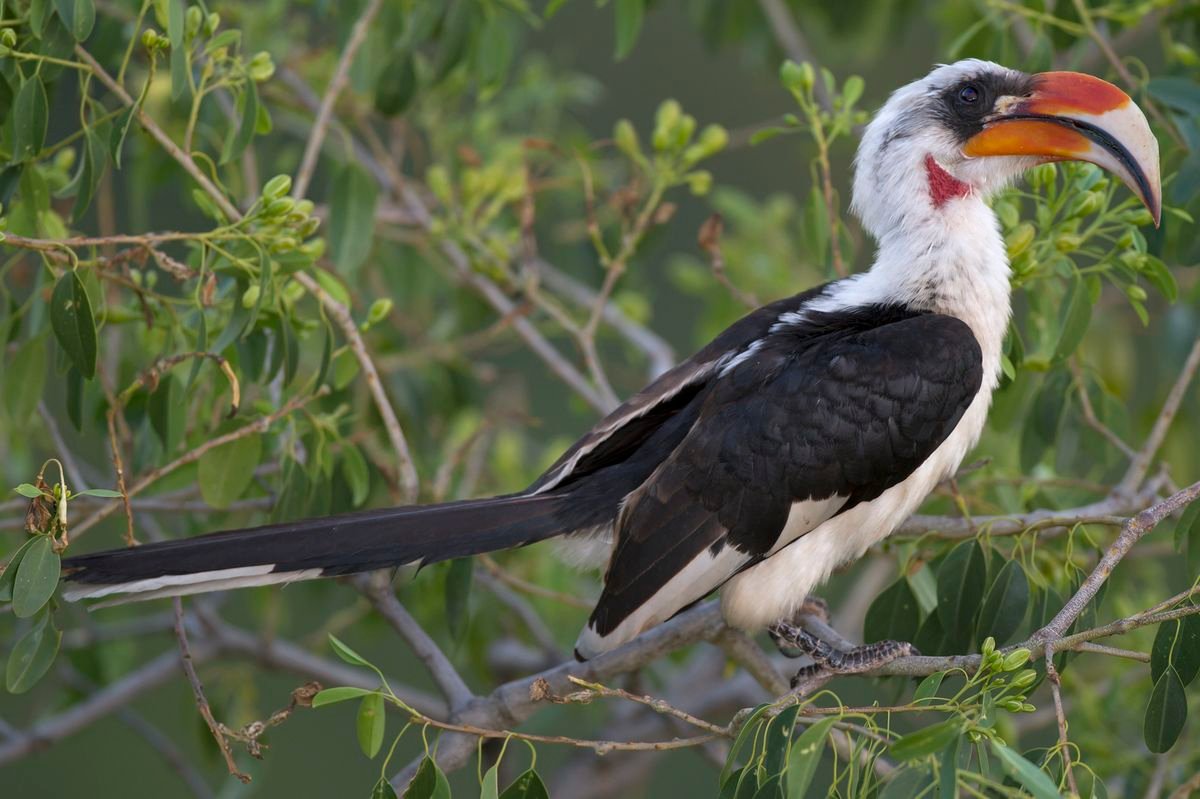
Von der Decken's Hornbill in Tanzania
Tockus deckeni — East Africa's dry-savanna hornbillWhat Is Von der Decken's Hornbill?
Von der Decken's Hornbill (Tockus deckeni) is a small, slender East African hornbill adapted to dry savanna, thorn scrub and open woodland.
Highly terrestrial for its size, it forages on foot for an insect-rich diet and is often seen in resident pairs or small family groups near thorn trees. The most reliable field mark is bill colour — the male shows a reddish bill with a yellow outer half while the female has a black bill. In Tanzania it is common in arid bush and wooded grassland such as Tarangire and Ruaha.
Scientific Classification
How to Identify Von der Decken's Hornbill
- Dark/black upperparts, whitish head and underparts and a long tail with a slender curved bill.
- Male: broad reddish/orange bill with yellow outer half.
- Female: predominantly black bill and casque area.
- Juvenile: duller bill with yellow patches.
Bill colour is the primary diagnostic feature — not to be used alone for absolute certainty, but highly visual in the field.
Male vs Female
Male is larger and heavier with a broad reddish bill and yellow outer section; female is smaller and lighter with a shorter, predominantly black bill and casque area. No bachelor groups or sex-specific lifespan claims are used.
Why Is the Bill So Useful for Identification?
The male red/yellow versus female black contrast makes the bill visually diagnostic, though species identification should also consider body size, wing pattern, habitat and behaviour.
Why Does Von der Decken's Hornbill Spend So Much Time on the Ground?
The bird perches in small savanna trees, drops to the ground, walks and runs while searching for insects and small prey and captures prey with its bill. One survey found approximately 93% of recorded food was taken on the ground — presented here as one survey found, not as a universal value for every population.
Daily Behaviour and Social Life
Von der Decken's Hornbills are diurnal and engage in ground foraging, walking and running, feeding, perching, social interactions and territorial behaviour. No diurnal or rigid hourly timetable is used.
Social Life
The species is commonly seen in resident pairs or small family flocks — no safety-in-numbers, generic leadership, bachelor groups or artificial hierarchy is described.
Communication
- Clucking calls used for territorial, pair and group communication and alarm — including the documented "wuk-wuk-wuk" description. No scent communication.
Movement
Generally resident and sedentary; occasional local movements can occur during dry spells. Not a routine long-distance migrant.
Why Does Von der Decken's Hornbill Follow Dwarf Mongooses?
Dwarf Mongooses disturb insects and other small prey as they move, and hornbills exploit the flushed prey. In turn, hornbill alarm calls can benefit mongooses. The association is ecological, not permanent dependency — they do not live together.
Von der Decken's Hornbill Habitat
- Dry savanna, thorn scrub, open bush, open woodland and wooded grassland in arid and semi-arid landscapes with scattered thorn trees.
It avoids dense forest, wetland specialization and mountain-forest specialization. Water may be used when available, but the hornbill is not wetland-dependent — core needs are open habitat, prey, thorny trees and nesting cavities.
Global Distribution
Von der Decken's Hornbill occurs in East Africa from Ethiopia and Somalia south through Kenya to northern Tanzania. It is not a Southern African species and is not described as found primarily in Tanzania.
Von der Decken's Hornbill in Tanzania
Tanzania Birds describes pairs and families as common throughout Tanzania in arid bush and wooded grassland. Key documented strongholds include Tarangire National Park and Ruaha National Park. No population totals or "best country" claims are made.
Where to See Von der Decken's Hornbill in Tanzania
Tarangire National Park
Country: Tanzania | Region: Northern Tanzania
Dry savanna and thorn scrub with scattered thorn trees.
Good opportunity in dry bush & wooded grassland
Ruaha National Park
Country: Tanzania | Region: Southern Tanzania
Arid wooded grassland and open bush.
Good opportunity in dry bush & wooded grassland
Good opportunity in suitable dry bush and wooded-grassland habitat, especially where thorn trees and open ground occur — never guaranteed.
Birding Methods
- Game drives, specialist birdwatching, wildlife photography and birding in dry bush and wooded grassland.
Best Time to See Them
The species is resident and can be encountered year-round in suitable Tanzanian habitat. Dry-season conditions may improve visibility in some landscapes. No June–October universal rule is imposed.
Von der Decken's Hornbill in Pictures
A closer look at the Von der Decken's Hornbill in its natural East African habitat — its striking appearance, habitat and behaviour are best appreciated up close.
Where to Spot the Von der Decken's Hornbill on Safari
Plan your trip around the destinations and safaris where the Von der Decken's Hornbill is easiest to see. Explore the parks, itineraries and tour packages by destination below.
What Does Von der Decken's Hornbill Eat?
Omnivorous but strongly ground-foraging and invertebrate-rich:
Invertebrates
- Grasshoppers and crickets
- Mantids and beetles
- Cicadas, ants and termites
- Larvae, caterpillars and snails
Vertebrates & Plant Foods
- Tree frogs and lizards
- Young birds and mice
- Fallen fruit, berries and seeds
Daily Behaviour & Social Life
Von der Decken’s Hornbills are diurnal, foraging actively during daylight hours. They perch in small savanna trees, drop to the ground, walk and run while searching for insects and small prey, then return to low perches between bouts. At midday in hot conditions they may rest in shade, but there is no rigid hourly timetable.
Social Life
- Resident pairs or small family groups — not large flocks or bachelor groups.
- Territorial around nesting and foraging areas, with pairs maintaining contact through clucking calls.
- No scent communication — all communication is vocal and visual.
Communication
- Clucking calls for territorial, pair and alarm communication — including the documented “wuk-wuk-wuk” description.
- Nocturnal roosting in trees; generally not active at night despite occasional dusk foraging.
Watching tip: Early-morning game drives in Tarangire and Ruaha offer the best chance to see active ground foraging and pair interactions.
Von der Decken's Hornbill Breeding and Nesting
No gestation, birth or parental feeding:
- Tree-cavity nesting where the female enters the cavity and seals herself inside, leaving only a narrow feeding slit.
- 2–3 white eggs; the female incubates while the male provisions her, later feeding both female and chicks.
- After incubation the female eventually breaks out and both parents continue feeding young.
- Fledging around 46 days in current breeding data with approximately 25-day incubation.
How Does the Female Incubate Inside the Sealed Nest?
- Pair selects cavity and the female enters.
- Mud, droppings/feces and fruit pulp/organic material are added to the entrance.
- Entrance narrows until only a feeding slit remains.
- Male delivers food through the slit while the female incubates and later helps rear chicks.
- Female eventually emerges and both parents feed young.
Critical distinction: Von der Decken's Hornbill — female DOES seal herself inside; Southern Ground Hornbill — female does NOT seal herself inside.
How Many Eggs Does It Lay?
2–3 white eggs. Single-egg or single-young confusion is avoided — clutch size and surviving young are not the same.
Incubation
Approximately 25 days in current breeding data — older references may report different durations depending on methodology. Fledging at approximately 46 days in current breeding data.
Natural Threats
Like many small hornbills, Von der Decken’s Hornbill faces threats mainly at the nest stage. Tree-cavity nests can be targeted by snakes, monitors, genets and small carnivores capable of reaching the cavity or breaking through the sealed entrance. Large raptors such as martial eagles and crowned eagles may occasionally take adults or juveniles in open habitat.
Outside the breeding season, adults are relatively inconspicuous on the ground and rely on vigilance, quick flight to low perches and pair alarm calls rather than group defence. Habitat loss — particularly removal of old thorn trees with natural cavities — is a longer-term threat because it reduces available nest sites.
How to Tell Von der Decken's Hornbill From Similar Tanzanian Hornbills
Use bill colour, bill shape, body size, wing pattern, tail, habitat, behaviour and geographical context — not one feature alone.
How to Find Von der Decken's Hornbill on Safari
- Scan thorn trees, search dry bush and scan ground below trees.
- Look for pairs and families, watch Dwarf Mongoose groups and listen for clucking "wuk-wuk-wuk" calls, checking both ground and low perches.
Conservation Status: Least Concern
Global IUCN Status: Least Concern. Habitat degradation is discussed — including habitat degradation, agricultural expansion, settlement, habitat fragmentation, protection of thorn scrub, preservation of nesting trees, responsible bird tourism and avoiding unnecessary wild-bird capture — without making anti-poaching the sole theme.
Von der Decken's Hornbill Facts
Von der Decken's Hornbill vs Northern Red-billed Hornbill
| Feature | Von der Decken's Hornbill | Northern Red-billed Hornbill |
|---|---|---|
| Scientific name | Tockus deckeni | Tockus erythrorhynchus |
| Bill (male) | Red with yellow outer half | Red |
| Bill (female) | Black | Red/yellow |
| Range | East Africa to northern Tanzania | Widespread Africa |
Von der Decken's Hornbill vs Eastern Yellow-billed Hornbill
| Feature | Von der Decken's Hornbill | Eastern Yellow-billed Hornbill |
|---|---|---|
| Bill (male) | Red/yellow | Yellow with red base |
Von der Decken's Hornbill vs Tanzanian Red-billed Hornbill
| Feature | Von der Decken's Hornbill | Tanzanian Red-billed Hornbill |
|---|---|---|
| Female bill | Black | Red |
Von der Decken's Hornbill vs Southern Ground Hornbill
| Feature | Von der Decken's Hornbill | Southern Ground Hornbill |
|---|---|---|
| Size | ~35 cm, 120–212 g | 90–100 cm, 3.5–6.2 kg |
| Nesting | Female sealed inside cavity | Female NOT sealed |
Why Von der Decken’s Hornbill Matters to Tanzania’s Ecosystems
Von der Decken’s Hornbill plays several ecological roles in Tanzania’s dry bush and wooded grassland:
- Insect population regulation — its ground-foraging diet of grasshoppers, termites, beetles and larvae helps keep invertebrate numbers in check across thorn scrub and savanna.
- Seed dispersal — when it eats fallen fruit, berries and seeds, it moves plant material across the landscape through droppings.
- Dwarf Mongoose association — hornbills follow mongoose groups for flushed prey; the hornbill’s alarm calls also benefit the mongooses, creating a loose mutualistic interaction.
- Birdwatching value — its striking bill colour difference between sexes makes it a popular target for birders visiting Tarangire and Ruaha.
Photographing Von der Decken’s Hornbill
The Von der Decken’s Hornbill offers excellent photographic opportunities in Tanzania’s dry parks:
- Male bill close-up — the red-and-yellow bill is the signature shot; wait for the bird to turn its head to show the yellow outer half.
- Female with black bill — useful for comparison images and identification guides.
- Pair together — resident pairs often perch near each other on thorn trees.
- Ground feeding action — capture the bird walking and running with insect prey in its bill.
- Dwarf Mongoose association — photograph both species together when the hornbill follows a mongoose group.
- Nest entrance — from a safe distance, document the sealed cavity with feeding slit during breeding season.
Never approach active nests closely or flush birds from cavity entrances. Use a long lens (400 mm+) and remain in the vehicle.
Frequently Asked Questions
Von der Decken's Hornbill (Tockus deckeni) is a small, slender East African hornbill of dry savanna, thorn scrub and open woodland in the family Bucerotidae (order Bucerotiformes), often seen in resident pairs or small family groups.
Tockus deckeni.
Bucerotidae.
Bucerotiformes.
About 35 cm long according to the IUCN Hornbill Specialist Group; males ~165–212 g, females ~120–155 g, with measurement conventions varying.
By its broad reddish bill with a yellow outer half — larger and heavier overall with slaty upperparts, whitish underparts and a long tail.
By its predominantly black bill and casque area — smaller and lighter with a shorter bill and otherwise similar plumage.
An omnivorous but ground-focused and invertebrate-rich diet: grasshoppers, crickets, mantids, beetles, cicadas, ants, termites, larvae, caterpillars, snails, tree frogs, lizards, young birds, mice, fallen fruit, berries and seeds.
Yes. It perches in small savanna trees, drops to the ground, walks and runs to search for insects and small prey. One survey found approximately 93% of recorded food was taken on the ground (qualified as one survey).
Dwarf Mongooses disturb insects and prey as they move; hornbills exploit the flushed prey. In turn, hornbill alarm calls can benefit mongooses, though the association is ecological rather than permanent.
Yes. Hornbill alarm calls can alert mongooses to potential threats, complementing the mongooses' disturbance of insect prey for the hornbill.
In East Africa from Ethiopia and Somalia south through Kenya to northern Tanzania, in dry savanna, thorn scrub, open bush, open woodland and wooded grassland.
Yes. Tanzania Birds describes pairs and families as common throughout Tanzania in arid bush and wooded grassland, with strongholds at Tarangire and Ruaha.
Primarily Tarangire National Park and Ruaha National Park, with additional sites only where current species-specific records support them.
Yes. Tarangire's dry savanna and thorn scrub with scattered thorn trees provide classic habitat.
Yes. Ruaha's arid wooded grassland and open bush are documented strongholds.
Generally resident and sedentary, with only occasional local movements during dry spells — not a routine long-distance migrant.
Commonly seen in resident pairs or small family flocks, territorial but without generic leadership or bachelor-group templates.
With clucking calls — including the documented wuk-wuk-wuk — for territorial, pair/group and alarm communication, not scent.
It is a territorial and group contact call; exact meanings for every call are not invented.
In natural tree cavities and sheltered holes in dry woodland and thorn-tree environments, with a sealed cavity entrance during incubation.
Yes. Von der Decken's Hornbill females seal themselves inside, leaving only a narrow feeding slit — unlike Southern Ground Hornbills where the female does not seal in.
The pair narrows the cavity entrance with mud, droppings/feces and fruit pulp/organic material until only a feeding slit remains.
Mud, feces/droppings and fruit pulp/organic material.
2–3 white eggs.
Approximately 25 days in current breeding data, with older references possibly reporting different durations by methodology.
Approximately 46 days in current breeding data.
After the female breaks out, both parents continue feeding the young until fledging and independence.
No. Globally Least Concern, though local habitat pressures can occur.
Least Concern globally.
Habitat degradation, agricultural expansion, settlement, fragmentation, loss of thorn scrub and nesting-tree loss, plus fragmentation from land-use change.
Year-round where resident, with dry-season conditions potentially improving visibility in some landscapes — no universal June–October guarantee.
Yes. Male bill, female black bill, pairs, families, ground feeding with insect prey, the Dwarf Mongoose association, perched birds and nest entrances from safe distances (never disturb active nests).
Related Safari Packages & Tours
Book a safari to see the Von der Decken's Hornbill and the rest of Africa's incredible wildlife with our expert guides.
References & Further Reading
- IUCN Hornbill Specialist Group: Tockus deckeni — ~35 cm; male 165–212 g, female 120–155 g.
- Tanzania Birds: common throughout Tanzania in arid bush/wooded grassland; Tarangire and Ruaha documented.
- Smithsonian National Zoo / breeding references: female sealed inside, 2–3 eggs, ~25 d incubation, ~46 d fledging, 93% ground feeding survey.
- About these facts: measurements and timings vary with source and methodology.
Sightings are never guaranteed and depend on local conditions.