

.png)
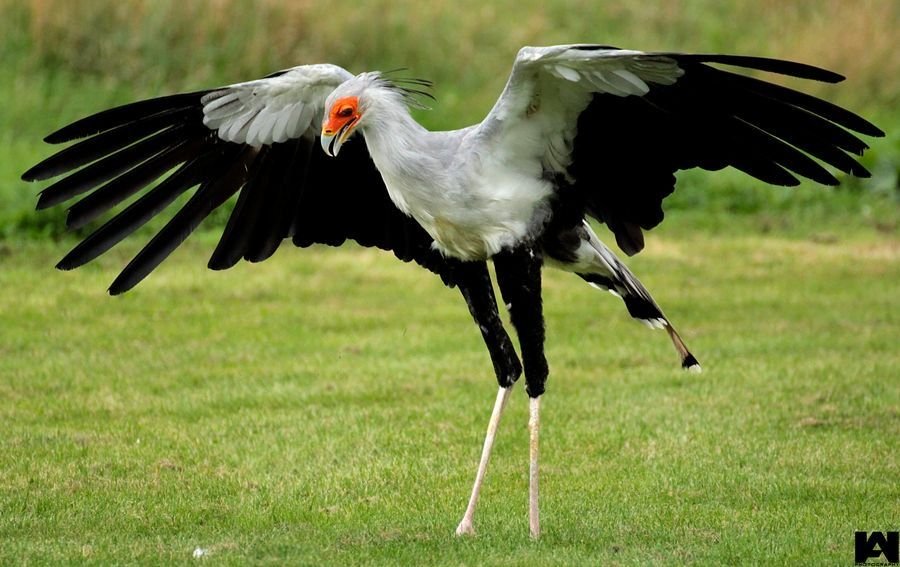
Secretarybird in Tanzania
Sagittarius serpentarius — terrestrial raptor, SagittariidaeWhat Is the Secretarybird?
The Secretarybird (Sagittarius serpentarius) is a remarkable African terrestrial raptor that hunts mainly on foot across open grasslands and savannas.
Standing about 1.2 m tall with long pink legs, a pale grey body, black crest and black flight feathers, it walks through open vegetation to find snakes, lizards, insects, rodents and amphibians — delivering famous rapid stomping strikes with its feet. In Tanzania it is a distinctive bird of Serengeti, Tarangire, Ngorongoro and other open habitats.
Scientific Classification
Unique: The Secretarybird is the only living species in the family Sagittariidae — a distinct terrestrial raptor lineage within Accipitriformes, not an eagle or Accipitridae species.
Is the Secretarybird Really a Bird of Prey?
Yes. Although it hunts on foot, the Secretarybird is a true raptor within Accipitriformes:
- Hooked pale bill and strong feet adapted for seizing prey.
- Predatory diet — snakes, lizards, rodents, insects, amphibians, small birds and eggs.
- Territorial behaviour and predatory lifestyle.
It is not Accipitridae — its family is Sagittariidae.
How to Identify a Secretarybird
- Long pink legs — unmistakable on the ground.
- Pale grey body with white/grey neck and head.
- Black flight feathers and black thighs.
- Long black crest on the back of the head.
- Long tail with elongated central feathers.
- Reddish/orange bare facial skin and hooked pale bill with broad wings.
Why Is It Called the Secretarybird?
The name is commonly associated with the long black crest feathers resembling quill pens tucked behind the ear of an old-fashioned secretary. The exact etymology has been debated, and no single origin theory is presented here as unquestionably proven.
Why Does the Secretarybird Hunt on Foot?
- Walks through open vegetation rather than hunting constantly on the wing.
- Scans the ground and flushes prey.
- Uses long legs to keep distance from dangerous prey such as snakes.
- Strikes prey with its feet and can capture and hold smaller prey.
Terrestrial walking hunting is the central theme of its ecology.
How Does a Secretarybird Kill a Snake?
- Cautious approach while maintaining distance with long legs.
- Delivers rapid stomping and kicking strikes — a documented source describes extremely rapid foot strikes.
- May use wings for balance and shielding during the attack.
- Continues striking until the snake is subdued.
No universal strike force is invented, and it is not claimed to kill every snake it encounters.
Does a Secretarybird Only Eat Snakes?
No. The Secretarybird is an opportunistic terrestrial predator with a broad diet. Snakes are only part of it:
- Snakes and lizards, grasshoppers and large insects, rodents and frogs, small birds and eggs and other small vertebrates.
Secretarybird Courtship Display
- High circular flight, soaring and undulating aerial display with sudden descent.
- Wing-spread ground display and pair interaction as part of territorial display.
Mating can occur on the ground and sometimes in trees. Generic "dominance ritual" language is not used unless directly appropriate.
Daily Behaviour and Social Life
Secretarybirds are primarily diurnal. No diurnal label or rigid 6am timetable is used. They:
- Forage, walk, hunt, scan, rest, preen, travel between feeding and nesting areas and interact with mates.
Social System
Secretarybirds are generally monogamous and territorial. Adults are commonly alone or with their mate — no Group Living, group vigilance, Leadership, Group Defence or Bachelor Groups. Young disperse as they mature.
Communication
- Vocal calls, territorial calls, posture, crest displays, wing displays, pair communication and courtship behaviour.
- No scent communication; precise meanings for individual calls are not invented.
Habitat: Open Grassland and Savanna
- Open grassland, savanna, dwarf shrubland and lightly wooded country.
- Semi-arid open landscapes and suitable agricultural landscapes.
Avoid dense forest, dense thicket, heavily wooded habitat, rocky mountainous terrain and wetlands as a core requirement.
Why Does Grass Height Matter?
Open or shorter grass improves visibility, walking, prey detection and snake/lizard hunting while allowing the bird to scan for threats. A source describes a preference for grass roughly one metre or less in height — avoided here as an exact universal claim unless cited.
Global Distribution
Secretarybirds are endemic to Africa and occur across much of sub-Saharan Africa. Tanzania is an important range country, but Tanzania is not described as the global centre and sentences such as "found primarily in Tanzania" or "populations occur across much of sub-Saharan Africa" are not used.
Secretarybird in Tanzania
In Tanzania, Secretarybirds are documented from Serengeti, Tarangire, Ngorongoro and the Mwiba / southern Serengeti ecosystem, where evidence includes adults, immature birds, nest-building, hunting and displaying pairs. No Tanzanian population total is invented.
Secretarybird Breeding Research in the Serengeti
Recent 2026 Serengeti breeding research examines grassland fragmentation and precipitation:
- Incubation plus chick-rearing to fledging lasts about 20 weeks in the study ecosystem.
- Breeding season can extend over approximately eight months.
- The research aims to understand reproduction under changing habitat conditions.
Findings are not extrapolated to every African population.
Where to See Secretarybirds in Tanzania
Serengeti National Park
Country: Tanzania | Region: Northern Tanzania
Vast open grasslands — classic Secretarybird walking territory.
Specialist sighting — rewarding but unpredictable
Tarangire National Park
Country: Tanzania | Region: Northern Tanzania
Savanna and dwarf shrubland with open hunting ground.
Specialist sighting — rewarding but unpredictable
Ngorongoro Conservation Area
Country: Tanzania | Region: Northern Tanzania
Crater floor grassland — open-country raptor observation.
Specialist sighting — rewarding but unpredictable
Mwiba / Southern Serengeti
Country: Tanzania | Region: Northern Tanzania
Southern ecosystem grasslands — territorial pairs.
Specialist sighting — rewarding but unpredictable
Low density, large territories and extensive landscapes mean reporting probability varies. Sightings are never guaranteed.
Birding Methods
- Game drives, specialist raptor birding, wildlife photography, open-country observation and guided birding where permitted.
Best Time to See Them
Secretarybirds can be encountered year-round in suitable Tanzania grasslands and savannas. Dry-season visibility may improve where open vegetation is easier to scan, but sightings depend on grass height, rainfall, prey availability, habitat condition and bird movements. No June–October universal best season is claimed.
Secretary Bird in Pictures
A closer look at the Secretary Bird in its natural East African habitat — its striking appearance, habitat and behaviour are best appreciated up close.
Where to Spot the Secretary Bird on Safari
Plan your trip around the destinations and safaris where the Secretary Bird is easiest to see. Explore the parks, itineraries and tour packages by destination below.
What Does a Secretarybird Eat?
Mammals & Birds
- Rodents and other small mammals
- Small birds and eggs
Reptiles & Amphibians
- Snakes and lizards
- Small tortoises/chelonians where documented
- Frogs and other small amphibians
Invertebrates
- Grasshoppers and large insects
Secretarybird Breeding and Nesting
No gestation, birth or parental feeding:
- Monogamous, territorial pair with a large flat stick nest usually in a thorny/acacia-type tree — nest often reused and can become very large.
- 1–3 eggs, usually 2, laid several days apart.
- Incubation 42–46 days — incubation starts before the clutch is complete so hatching can be asynchronous; both sexes incubate with the female doing more and the male providing food.
- Nestling period 64–106 days; young remain dependent after fledging.
How Many Eggs Does a Secretarybird Lay?
1–3 eggs, usually 2. No "one egg" or "single young" template is used.
How Do Secretarybird Chicks Develop?
- Semi-altricial hatchlings with white down and asynchronous hatching.
- Both parents feed young — regurgitation early, whole prey later.
- Nestling period 64–106 days; young learn hunting from parents after fledging.
- Post-fledging dependence can continue approximately three months.
Where three eggs hatch, the youngest chick may fail to compete for food and can die from starvation — presented scientifically without sensational language.
Where Does a Secretarybird Build Its Nest?
- Large flat stick platform in a thorny/acacia-type tree — dense tree or bush top, several metres above ground.
- Reused for years and can become very large — a reused nest can reach approximately 1.5–2.5 m diameter according to a zoological source.
Active nest coordinates are not published.
Natural Threats to Eggs and Chicks
Lions, leopards and hyenas are not generic primary threats. For eggs and chicks, source-supported predators include crows, ravens, ground hornbills, kites, eagle-owls and other nest predators. Adults have relatively few natural predators.
Conservation Status: Endangered
IUCN Red List Status: Endangered (EN) — uplisted in 2020 and remaining Endangered in current sources.
The species has undergone severe declines across parts of its range.
Why Is Grassland Loss Dangerous?
- Agricultural conversion, habitat fragmentation, woody encroachment, fire suppression, intensive grazing, urban expansion and loss of open hunting habitat.
Infrastructure Threats
Secretarybirds can be killed by fence collisions, power-line collisions, electrocution where applicable, wind-turbine collisions and road/vehicle collisions. No specific Tanzanian mortality totals are invented.
Poisoning
Intentional poisoning, secondary poisoning, predator-control poisons and poisoned carcasses contribute to declines. Percentages are not invented.
Conservation work: The BirdLife South Africa Secretarybird Project conducts satellite tracking, nest monitoring, ringing, citizen science, spatial analysis, infrastructure-risk assessment and habitat/land-use guidance. For Tanzania, focus is on protected grasslands, Serengeti habitat conservation, research, monitoring, infrastructure mitigation and maintaining open hunting landscapes. Generic African Parks/WWF/TAWIRI monitoring claims are not made without evidence.
Secretarybird Facts
Secretarybird vs Martial Eagle
| Feature | Secretarybird | Martial Eagle |
|---|---|---|
| Family | Sagittariidae | Accipitridae |
| Posture | Tall, crane-like, terrestrial | Compact, perch-hunting eagle |
| Hunting | Walking, foot-stomping | Soaring, powerful talon stoop |
| Legs | Very long pink | Feathered, powerful |
Secretarybird vs Bateleur
| Feature | Secretarybird | Bateleur |
|---|---|---|
| Size | 125–150 cm, >2 m wingspan | ~55–70 cm |
| Tail | Long tail | Very short tail |
| Diet | Snakes, lizards, insects, rodents | Carrion, small vertebrates |
Secretarybird vs Kori Bustard
| Feature | Secretarybird | Kori Bustard |
|---|---|---|
| Order | Accipitriformes (raptor) | Otidiformes (bustard) |
| Hunting | Terrestrial raptor, foot strikes | Omnivorous walking forager |
| Habitat | Open grassland | Open savanna — shared |
Secretarybird vs Ostrich
| Feature | Secretarybird | Ostrich |
|---|---|---|
| Class | Raptor (Sagittariidae) | Ratite, flightless |
| Legs | Long pink raptor legs | Two-toed running legs |
| Flight | Strong flier, aerial displays | Flightless, fast runner |
Why the Secretarybird Is an Iconic African Raptor
- Unique terrestrial hunting among raptors.
- Distinctive appearance — long legs, black crest, crane-like stature.
- Ecological role as a grassland predator.
- Conservation importance as an Endangered indicator of intact open landscapes.
Photographing the Secretarybird
- Walking through grassland — the classic profile.
- Snake hunting and stomping sequence.
- Black crest and full-body profile.
- Courtship flight, nest building and adult/juvenile together.
- Flight and parent-chick feeding from a respectful distance.
Do not disturb nests or hunting birds; use long lenses and follow your guide.
Frequently Asked Questions
The Secretarybird (Sagittarius serpentarius) is Africa's distinctive terrestrial raptor — the only living member of the family Sagittariidae — that hunts mainly on foot across open grasslands and savannas.
Yes. It belongs to Accipitriformes, has a hooked bill, strong feet, predatory diet and territorial behaviour, though it is distinct from eagles and Accipitridae species.
The name is commonly associated with long black crest feathers resembling quill pens behind the ear of an old-fashioned secretary, though the exact etymology has been debated.
About 1.2 m standing height, with a total length of approximately 125–150 cm.
Approximately 125–150 cm total length, with a wingspan over 2 m.
By walking through open vegetation, scanning the ground, flushing prey and striking with its feet — keeping distance from dangerous prey with its long legs rather than hunting constantly on the wing.
It approaches cautiously, maintains distance with long legs, delivers rapid stomping/kicking strikes (documented as extremely rapid), may use wings for balance/shielding and continues until the snake is subdued.
No. It is an opportunistic terrestrial predator eating snakes, lizards, grasshoppers and large insects, rodents, frogs, small birds and eggs.
Mammals (rodents), reptiles (snakes, lizards, small tortoises where documented), birds (small birds, eggs), invertebrates (grasshoppers, large insects) and amphibians (frogs).
Endemic to Africa, across much of sub-Saharan Africa in open grassland, savanna, dwarf shrubland and lightly wooded country — not dense forest or rocky mountains.
Open or shorter grass (roughly one metre or less in a cited source) improves visibility, walking, prey detection and scanning for threats.
Documented from Serengeti, Tarangire, Ngorongoro and the Mwiba/southern Serengeti ecosystem in suitable open habitat — as specialist, low-density sightings.
Yes. Serengeti National Park's open grasslands are classic hunting territory for territorial pairs.
Yes. Tarangire's savanna and dwarf shrubland provide open hunting ground where the species occurs at low density.
Yes. Ngorongoro's crater grasslands support open-country sightings.
Generally monogamous and territorial — adults are commonly alone or with their mate, not in groups. Young disperse as they mature.
A large flat stick platform in a thorny/acacia-type tree, dense tree/bush top several metres above ground, reused for years and growing to about 1.5–2.5 m diameter.
1–3 eggs, usually 2, laid several days apart.
Approximately 42–46 days. Incubation starts before the clutch is complete, so hatching is asynchronous; both sexes incubate with the female doing more.
Nestling period approximately 64–106 days, with post-fledging dependence continuing about three months while young learn hunting from parents.
Both parents provision — regurgitation early, whole prey later. When three hatch, the youngest may fail to compete and can die from starvation.
It has undergone severe declines and is assessed as Endangered (EN) since 2020, remaining Endangered in current sources.
Grassland loss (agricultural conversion, fragmentation, woody encroachment), fences, power lines, wind turbines, road collisions and poisoning (intentional, secondary, predator-control poisons).
Low-flying and terrestrial movement exposes them to fence collisions, power-line collisions, electrocution and wind-turbine strikes — a key focus of infrastructure-risk research.
A 2026 Serengeti breeding study examines grassland fragmentation and precipitation, finding about 20 weeks from incubation through chick-rearing to fledging and an eight-month breeding season, to understand reproduction under changing habitat.
Year-round in suitable grasslands and savannas. Dry-season open vegetation can improve visibility, but sightings depend on grass height, rainfall, prey and habitat — no June–October guarantee, and encounters remain specialist and never guaranteed.
Related Safari Packages & Tours
Book a safari to see the Secretary Bird and the rest of Africa's incredible wildlife with our expert guides.
References & Further Reading
- ITIS / IOC / MNHN: Sagittarius serpentarius — Sagittariidae, Accipitriformes; only living Sagittariidae species.
- BirdLife / IUCN: Secretarybird — Endangered (uplisted 2020).
- Tanzania Birds & park records: Serengeti, Tarangire, Ngorongoro, Mwiba.
- 2026 Serengeti breeding research: fragmentation, precipitation, ~20-week breeding cycle, ~8-month season.
- BirdLife South Africa Secretarybird Project: tracking, nest monitoring, infrastructure risk.
- About these facts: measurements and timings are approximate ranges.
Sightings are never guaranteed and depend on local conditions.