

.png)
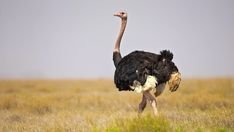
Ostrich in Tanzania
Struthio camelus - the world's largest living birdWhat Is the Common Ostrich?
The Common Ostrich (Struthio camelus) is the world’s largest living bird and the fastest running bird. Completely flightless, it can reach around 70 km/h on its long, powerful legs - each foot bearing only two toes - and towers over the open savanna it calls home.
With males standing up to about 2.7 m and weighing 100-130 kg, this giant dominates grassland and shrubland across sub-Saharan Africa. In Tanzania, ostriches are iconic sights on the Serengeti plains, around Tarangire and in Ngorongoro Crater.
This page covers the Common Ostrich only - not the Somali Ostrich (Struthio molybdophanes) of the Horn of Africa.
Scientific Classification
The Common Ostrich is the nominate species of the ostrich family. The Somali Ostrich, sometimes treated as a separate species, is not covered here.
How to Identify an Ostrich
- Extremely tall body - adult males up to about 2.7 m; females 1.7-1.9 m.
- Long, pale neck and small head with eyes about 5 cm across - among the largest eyes of any bird, built to spot movement across open terrain.
- Muscular thighs and long legs ending in two toes on each foot - the only bird with this count; the inner toe bears a sharp claw.
- Male plumage: black body and white wing and tail feathers.
- Female plumage: grey-brown, providing camouflage at the nest.
- Large wings used for balance, steering while running and male display - not for flight.
- Powerful feet used for defense.
Why Is the Ostrich the World’s Largest Living Bird?
No living bird exceeds the Common Ostrich for combined height and mass. Males stand up to roughly 2.7 m and can exceed 100 kg - heavier than any flying bird and taller than any other. Females are slightly smaller but still outsize every other bird species.
This is strictly a living record - prehistoric elephant birds were heavier, but among birds alive today the Ostrich stands alone.
How Fast Can an Ostrich Run?
Up to approximately 70 km/h in short sprints. The Ostrich is the fastest running bird on Earth.
- Powerful leg muscles and a long stride - a single step can cover several metres.
- Elastic running mechanics that store and return energy like a spring.
- Two-toed feet that reduce weight and provide a single powerful claw for traction.
- Wings used as balance and rudders - outstretched while running to steer, not to fly.
Ostriches do not sustain 70 km/h indefinitely - it is a maximum figure, not a cruising speed - and they are not faster than every land animal; the cheetah, for example, exceeds it.
Why Can’t an Ostrich Fly?
Size is only part of the answer:
- Very large body relative to wing area.
- Flattened sternum lacking the prominent keel that anchors strong flight muscles in flying birds.
- Relatively small flight muscles for its mass.
- Wings adapted for other roles: steering and braking while running, and dramatic male courtship display.
Flight was traded for running - a successful bargain on open ground where speed and vision matter more than wings.
How Good Is an Ostrich’s Vision?
Ostrich eyes measure about 5 cm across and rank among the largest eyes of any bird.
That size supports exceptional detection of movement across vast, open terrain - an essential early-warning system where cover is scarce and predators approach from distance.
Male vs Female: Black-and-White vs Grey-Brown
Male: black body and white wing and tail feathers, larger, major courtship role; dominant male may mate with several females.
Female: grey-brown plumage, smaller, contributes eggs; the major female participates in communal incubation alongside the male.
Daily Behavior and Social Life
Ostriches are diurnal, often most active during cooler morning and evening periods and resting during the hottest part of the day.
Social Arrangement
Birds may occur alone, in small groups or in larger gatherings under favorable conditions. A typical social group may include a dominant male, a dominant or major female, several other females and additional birds. Pairs are not strictly monogamous year-round; a territorial male may mate with several females whose eggs join the same communal nest.
Communication
- Male booming calls, hisses and grunts.
- Wing displays and body posture during dominance and courtship.
- Courtship movements and alarm behavior detectable across open ground.
How Does an Ostrich Courtship Dance Work?
The male performs an elaborate display for the female:
- Bows with neck lowered.
- Flaps one wing at a time, alternating sides.
- Shakes and fans the tail.
- Stomps and sways before the female.
Tanzania Birds documents mating behaviour in the Ngorongoro area, where females approach displaying males. The dance is species-specific and unmistakable - no other Tanzanian bird approaches this scale.
Habitat: Open Country
The Common Ostrich needs sightlines, not shelter:
- Grassland, savanna and shrubland.
- Dry plains and semi-arid open country, including sandy and dry landscapes where applicable.
Woodland is not the primary habitat, and reliable water is not a core requirement - ostriches obtain substantial water from food and drink when water is available rather than depending on constant access to open water.
Global Distribution
The Common Ostrich occurs across much of sub-Saharan Africa, especially eastern and southern Africa, in open grassland, savanna and shrubland. Tanzania is an important range country. Somali Ostrich geography is not mixed into this page.
Habitat and Global Distribution
The Common Ostrich occurs across much of sub-Saharan Africa, especially eastern and southern Africa, in open grassland, savanna and shrubland. Tanzania is an important range country where short-grass plains and dry savanna provide classic ostrich country.
Common Ostrich in Tanzania
Tanzania holds strong populations of the Common Ostrich in its northern open-country parks:
- Serengeti National Park - vast short-grass plains where males display.
- Tarangire National Park - dry savanna and Silale Swamp surrounds; Tanzania Birds has records including adults, chicks and breeding.
- Silale Swamp landscape within the Tarangire ecosystem.
- Ngorongoro Crater - open crater floor grassland.
Tanzania Birds documents males, females, eggs, chicks, mating behaviour and juveniles in Tanzania - rich local detail that shapes this page.
Where to See Ostriches in Tanzania
Serengeti National Park
Country: Tanzania | Region: Northern Tanzania
Short-grass plains - males black-and-white against green in the rains, dust-brown females nearby.
Good opportunity in suitable open grassland and savanna.
Tarangire National Park
Country: Tanzania | Region: Northern Tanzania
Dry savanna and Silale Swamp surrounds; strong recent records of adults, eggs and chicks.
Good opportunity in suitable open grassland and savanna.
Ngorongoro Conservation Area
Country: Tanzania | Region: Northern Tanzania
Crater-floor grassland - ostriches stride the open floor alongside wildebeest and zebra.
Good opportunity in suitable open grassland and savanna.
Silale Swamp / Tarangire Landscape
Country: Tanzania | Type: Wetland-adjacent grassland
The swamp’s grassy margins within Tarangire - included where appropriate as a distinct landscape feature.
Good opportunity in suitable open grassland and savanna.
Safari Methods
- Game drives across open plains.
- Specialist birdwatching focused on ground birds.
- Wildlife photography - running and display sequences.
- Open-country observation from high points and tracks.
- Guided birding where permitted.
Best Time to See Them
Ostriches can be seen year-round in suitable open habitats. Dry-season game viewing is generally good for wildlife, but no ostrich-specific universal season is imposed here.
Ostrich in Pictures
A closer look at the Ostrich in its natural East African habitat — its striking appearance, habitat and behaviour are best appreciated up close.
Where to Spot the Ostrich on Safari
Plan your trip around the destinations and safaris where the Ostrich is easiest to see. Explore the parks, itineraries and tour packages by destination below.
What Does an Ostrich Eat?
Ostriches are omnivores, but their diet is predominantly plant-based:
Plant Foods
- Grasses and leaves
- Flowering plants and roots
- Succulents, seeds and fruits
Animal Foods
- Grasshoppers and locusts
- Insects, mice, lizards and frogs
- Other small animals taken opportunistically
Animal matter supplements, rather than dominates, the plant base. No 50/50 claim is made.
Why Does an Ostrich Swallow Stones?
Ostriches have no teeth. They swallow grit, sand and small stones that lodge in the gizzard, where muscular contractions use the hard material to mechanically grind food - compensating for the lack of chewing. The stones are retained and gradually worn down.
Breeding and Communal Nesting
Ostriches are egg-laying birds with a polygamous mating system. A dominant male may mate with one or more females, and several females can lay eggs in the same communal nest.
- Nest: a shallow ground scrape - the communal nest.
- Incubation: shared by one dominant or major female and the male, taking turns.
There is no gestation, birth or milk - this is avian reproduction strictly.
How Does an Ostrich Communal Nest Work?
Several females lay in the same ground scrape:
- One male and the major female incubate, with eggs positioned so the dominant female’s eggs receive priority.
- Unsuccessfully incubated or peripheral eggs may be removed or ejected from the nest.
- The system spreads risk while concentrating defense.
How Many Eggs Does an Ostrich Lay?
Each female lays approximately 7-10 eggs. Because several females contribute to one communal nest, the total clutch can be much larger:
- Common totals around 30-40 eggs in the shared nest.
- Up to approximately 50 under some conditions.
No single fixed number is imposed for every nest - totals vary with the number of contributing females.
How Long Do Ostrich Eggs Take to Hatch?
Approximately 42-46 days. Tanzania Birds describes the period as roughly six weeks - consistent with that range.
Do not call this gestation.
What Are Ostrich Chicks Like?
Chicks are precocial:
- Can stand and walk soon after hatching.
- Leave the nest within days and accompany adults.
- Grow rapidly, forming nursery groups that can combine broods.
- Reach near adult size by approximately six months, though sexual maturity arrives later around 3-4 years.
Tanzania Birds documents chicks out of the nest within 3-4 days.
Do Ostriches Really Bury Their Heads in Sand?
No. The myth arises from the bird’s nesting behaviour: while checking and turning eggs, the bird lowers its head and neck close to ground level. From a distance, the pale head against sand can look as if it has disappeared. No healthy ostrich buries its head to hide.
Predators and Ostrich Defenses
Legitimate predators of eggs and young include lions, cheetahs, leopards and hyenas - a real threat on the Serengeti plains.
Ostrich defenses:
- Exceptional vision and early detection across open terrain.
- Speed - adults outrun most predators.
- Powerful two-toed feet delivering kick defense when cornered.
- Group vigilance - many eyes scanning together.
No claim is made that an ostrich can routinely kill a lion.
Conservation Status: Least Concern
IUCN Red List Status: Least Concern. The species has a broad distribution across sub-Saharan Africa.
Some local populations face pressures:
- Habitat loss and agricultural expansion.
- Overhunting and egg collection.
- Feather and skin exploitation where it occurs.
- Fencing, disturbance and local fragmentation.
- Vehicle collisions where documented.
Effective measures are landscape measures: habitat protection, anti-poaching, nest protection, community coexistence, responsible tourism and protected areas. Generic African Parks / WWF / TAWIRI monitoring claims are not made here without direct evidence.
Ostrich Facts
Ostrich vs Kori Bustard
| Feature | Common Ostrich | Kori Bustard |
|---|---|---|
| Flight | Completely flightless | Africa’s heaviest flying bird |
| Height / mass | Up to 2.7 m / 100-130 kg | Up to ~1.5 m / 11-19 kg males |
| Speed | Up to ~70 km/h running | Strong walker, reluctant flyer |
| Habitat overlap | Both stride Tanzania’s open savanna - the Ostrich towering above, the bustard walking below | |
Ostrich vs Secretarybird
| Feature | Common Ostrich | Secretarybird |
|---|---|---|
| Legs / feet | Two toes, powerful kick | Long crane-like legs for stomping snakes |
| Diet | Predominantly plant-based omnivore | Raptor: snakes, lizards, rodents |
| Shared habitat | Open grassland and savanna across the Serengeti-Tarangire-Ngorongoro triangle | |
Ostrich vs Marabou Stork
| Feature | Common Ostrich | Marabou Stork |
|---|---|---|
| Flight | Flightless; wings for balance/display | Soaring stork; neck folded like heron |
| Size | World’s largest living bird | Africa’s largest stork (1.5 m, 3 m wingspan) |
| Shared habitat | Both patrol Tanzania’s open savanna and gather near water-associated food | |
Why the Ostrich Matters to Tanzania’s Grasslands
- Large ground-bird ecology: its selective grazing and seed dispersal shape plant communities.
- Vegetation interactions: grass and shrub use influences structure at ground level.
- Prey and predator relationships: eggs and chicks link the Ostrich to the Serengeti predator guild.
- Safari tourism importance: a charismatic, easily seen giant that defines open-country game drives.
- Open-country biodiversity indicator: where ostriches thrive, expansive savanna remains.
Photographing the Ostrich
- Male and female contrast - black-and-white male beside grey-brown female.
- Courtship dance sequences - bowing, wing-flapping, tail-fanning.
- Running at speed - burst mode along the horizon.
- Chicks and nursery groups - striped young with adults.
- Communal nest and eggs - from a respectful, legal distance.
- Male booming display - inflated neck and deep calls.
- Large groups striding across savanna silhouettes.
Ethics first: never approach nests or chicks; use long lenses, keep to tracks and follow your guide’s instructions.
Frequently Asked Questions
The Common Ostrich (Struthio camelus) - the world's largest living bird and fastest running bird. Flightless, up to about 2.7 m tall, it dominates open savanna across sub-Saharan Africa including Tanzania's Serengeti and Tarangire.
Because no other living bird exceeds its height (males to ~2.7 m) or mass (males 100-130 kg, females 90-110 kg). Among birds alive today, the Ostrich stands alone for scale.
Up to approximately 70 km/h in short sprints. Powerful legs, elastic stride and two-toed feet make it the fastest bird on foot, though it does not sustain that speed indefinitely and is not faster than every land animal.
No. Despite large wings, the Ostrich is completely flightless. A flattened sternum without a prominent keel and relatively small flight muscles mean it cannot generate lift for its mass.
Large body, flattened sternum lacking a strong keel, small flight muscles, and wings adapted for steering, braking and display rather than powered flight. This is a trade-off that favours running on open ground.
Exceptional. Eyes about 5 cm across rank among the largest of any bird and help detect movement across vast, open terrain where cover is scarce.
Predominantly plant matter - grasses, leaves, flowering plants, roots, succulents, seeds and fruits - supplemented by grasshoppers, locusts, insects, mice, lizards, frogs and other small animals.
It has no teeth. Grit, sand and small stones are swallowed to sit in the gizzard, where muscular contractions grind food mechanically - compensating for the lack of chewing.
Strongest sites are Serengeti National Park, Tarangire National Park, Ngorongoro Conservation Area and the Silale Swamp landscape within Tarangire - all open grassland/savanna habitats where birds are conspicuous.
Each female lays approximately 7-10 eggs; because several females contribute to one communal nest, the shared clutch commonly totals 30-40 eggs and can reach around 50 under some conditions.
Yes. The communal nest is a single ground scrape into which several females lay. The dominant or major female's eggs are positioned centrally, and one male and the major female handle most incubation duties.
One dominant or major female and the dominant male take turns. Incubation duties are shared, with the female often on the nest by day and the male by night, varying by population.
Approximately 42-46 days - Tanzania Birds describes it as roughly six weeks, consistent with that range.
Precocial: they can stand and walk soon after hatching, leave the nest within days and accompany adults. Growth is rapid, nursery groups may form, near-adult size is reached by about six months and sexual maturity follows around 3-4 years.
No. While checking and turning eggs the bird lowers its head and neck close to the ground, which from a distance can mimic a buried head. No healthy ostrich hides by burying its head.
No. The Common Ostrich is assessed as Least Concern globally, with a broad range. Some local populations face pressures but the species as a whole is not currently threatened.
Habitat loss and agricultural expansion, overhunting and egg collection, feather and skin exploitation where it occurs, fencing, disturbance, local fragmentation and vehicle collisions where documented.
Year-round in suitable open habitats. Dry-season game drives often give good general visibility, but no ostrich-only universal season is imposed here.
Related Safari Packages & Tours
Book a safari to see the Ostrich and the rest of Africa's incredible wildlife with our expert guides.
References & Further Reading
- Smithsonian’s National Zoo: Common Ostrich - largest living bird; flightless; two toes.
- Tanzania Birds: Serengeti, Tarangire, Ngorongoro, Silale Swamp records and breeding details.
- BirdLife / IUCN: Struthio camelus - Least Concern.
- Ostrich biology references: communal nesting, 42-46 d incubation, grit swallowing, egg size.
- About these facts: measurements and timings are approximate ranges drawn from available sources; they vary with sex, age, region and method.