

.png)
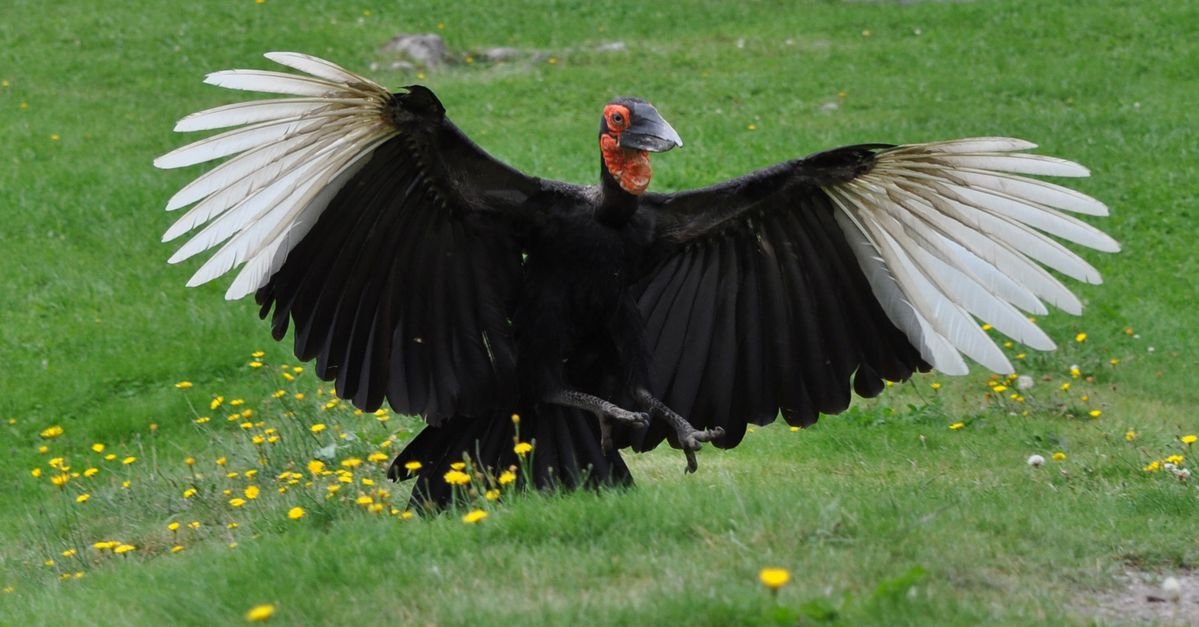
Southern Ground Hornbill in Tanzania
Bucorvus leadbeateri — largest living hornbillWhat Is the Southern Ground Hornbill?
The Southern Ground Hornbill (Bucorvus leadbeateri) is the largest living hornbill and a highly terrestrial African bird that forages on foot across open savanna and grassland.
Glossy black with striking white primaries, yellow eyes, a black bill and casque and a red throat pouch, it lives in cooperative family groups led by one dominant breeding pair, communicating with deep booming calls that carry across the savanna. In Tanzania it is a sought-after bird of Ruaha, Serengeti and Tarangire.
Scientific Classification
Why Is the Southern Ground Hornbill the Largest Living Hornbill?
With a length of approximately 90–100 cm, male mass of about 3.5–6.2 kg and female mass of about 2.2–4.6 kg, a massive bill, long legs and broad wings, the Southern Ground Hornbill exceeds any other living hornbill in size. It is not described here as the largest African bird or largest bird in Tanzania.
How to Identify a Southern Ground Hornbill
- Glossy black body with white primary wing feathers visible in flight.
- Yellow eyes, black bill and black casque on top of the bill.
- Red facial skin and red throat pouch — the female may show a small blue patch on the red pouch.
- Long legs adapted for walking.
Male vs Female
Male: generally larger and heavier with a red throat pouch. Female: smaller, may show a small blue patch within the red throat pouch. The breeding pair leads the group cooperatively — no female-only childcare or bachelor-hierarchy template is used.
Why Is It Called a Ground Hornbill?
Unlike most hornbills, the Southern Ground Hornbill is highly terrestrial: it walks long distances, forages on foot, hunts terrestrial prey and uses trees mainly for roosting and nesting rather than constant canopy feeding.
Cooperative Breeding — Helpers at Work
What Do Helper Hornbills Do?
- Food provisioning, territory defence, chick support, group defence and protection of the nesting pair.
This cooperative help is a key signature behaviour and is retained — not deleted as generic hierarchy.
Daily Behaviour and Social Life
Primarily diurnal. No diurnal label or 6am–10am timetable is used. Typical activities include walking, foraging, hunting, following herbivores, fire-associated foraging, resting, preening, social interactions and territorial calling.
Family Groups and Cooperative Breeding
Southern Ground Hornbills live in family groups, usually with one dominant breeding pair and several non-breeding helpers — often immature males — that defend territory, provide food, assist with incubation feeding and help raise chicks.
Communication
- Deep booming calls, group choruses, pair calls and body/posture displays.
- No scent communication.
Why Does It Boom?
The deep boom serves long-distance territorial communication, group cohesion and pair/group advertisement and can be heard across long distances.
Movement
Generally resident / non-migratory; family groups maintain large territories and move locally within them.
Habitat: Open Grassland and Savanna
- Open grassland, savanna, woodland, open bushveld and lightly wooded areas with large cavity-bearing trees.
It avoids extensive dense forest and arid desert, and is not described as woodland-only.
Why Do Southern Ground Hornbills Need Open Grassland?
Open vegetation supports walking, prey detection, hunting, visibility and movement of family groups. Exact grass-height values are avoided unless sourced.
Global Distribution
The species occurs in suitable habitat across sub-Saharan Africa south of the equator, including Kenya, Tanzania, DRC, Burundi, Rwanda, Malawi, Zambia, Zimbabwe, Angola, Mozambique, Namibia, Botswana, South Africa, Eswatini and Lesotho. Tanzania is not the global centre and the range is not reduced to Tanzania/South Africa.
Southern Ground Hornbill in Tanzania
Tanzania is part of the species' natural range. Verified destination examples where current site evidence exists include Ruaha, Serengeti and Tarangire. No Tanzanian population estimate or "largest/healthiest population" claim is made.
Where to See Southern Ground Hornbills in Tanzania
Ruaha National Park
Country: Tanzania | Region: Southern Tanzania
Open savanna and woodland — family groups with helpers.
Good opportunity in suitable habitat where family groups occur
Serengeti National Park
Country: Tanzania | Region: Northern Tanzania
Grassland and savanna with large cavity trees.
Good opportunity in suitable habitat where family groups occur
Tarangire National Park
Country: Tanzania | Region: Northern Tanzania
Savanna and open bushveld — territorial family groups.
Good opportunity in suitable habitat where family groups occur
Sightings are never guaranteed and remain location-dependent.
Birding Methods
- Game drives, specialist birdwatching, wildlife photography and guided nature observation.
Best Time to See Them
Southern Ground Hornbills are generally resident and may be encountered year-round. Dry-season visibility may improve in some open landscapes where vegetation is shorter and scanning is easier. No June–October universal season is imposed.
Southern Ground Hornbill in Pictures
A closer look at the Southern Ground Hornbill in its natural East African habitat — its striking appearance, habitat and behaviour are best appreciated up close.
Where to Spot the Southern Ground Hornbill on Safari
Plan your trip around the destinations and safaris where the Southern Ground Hornbill is easiest to see. Explore the parks, itineraries and tour packages by destination below.
What Does the Southern Ground Hornbill Eat?
A broad carnivorous terrestrial forager — not limited to snakes:
Reptiles & Amphibians
- Snakes, lizards and tortoises
- Frogs
Invertebrates
- Insects, spiders and scorpions
Mammals & Birds
- Hares, mongooses and rodents
- Small birds and eggs
Other
- Carrion
Why Do Southern Ground Hornbills Follow Fires?
Fire may flush insects, reptiles and other small prey. Recently burned areas can provide temporary foraging opportunities, though not every fire attracts hornbills.
Why Do Ground Hornbills Forage Near Large Herbivores?
Moving herbivores disturb insects, reptiles, small animals and vegetation, and hornbills may exploit these disturbed prey. No obligatory dependence is claimed.
Water Needs
Southern Ground Hornbills may drink when water is available, but core requirements are open foraging habitat, prey abundance, nesting/roosting sites and large territory — they are not presented as water-dependent birds.
Southern Ground Hornbill Breeding and Cooperative Nesting
No gestation, birth or parental feeding:
- One dominant breeding pair with family-group helpers.
- Cavity nesting — 1–3 eggs laid several days apart; female incubates while male and helpers provision her.
- Incubation approximately 40–45 days.
- Usually only one chick fledges due to asynchronous hatching and sibling competition.
- Fledging around 85–87 days with long post-fledging dependence.
Where Does the Southern Ground Hornbill Nest?
- Large tree cavities, natural holes and rocky cavities — protected cavities several metres above ground when tree-nesting.
- Females do NOT seal themselves into the cavity like many other hornbills.
Why Does Only One Chick Usually Fledge?
Eggs are laid several days apart and hatch asynchronously. The first chick becomes larger and gets more food; the younger chick often fails to survive. It is not described as parents intentionally killing the second chick. The distinction between 1–3 eggs and one chick fledging is kept clear.
Southern Ground Hornbill Chick Development
- Chicks hatch dependent and receive parental and helper feeding with rapid growth.
- Approximately 85–87 day nest period and long post-fledging dependence with family-group learning, continued for approximately 1–2 years or longer depending on conditions.
Natural Threats
Adult ground hornbills have few natural predators due to their large size. Threats include egg predators, nest predators, snakes, predatory birds and mammals that can access cavities or chicks. Adults are large and formidable.
Conservation Status: Vulnerable
Global IUCN Status: Vulnerable (VU). Regional note: South Africa assesses its regional population as Endangered — clearly labelled as REGIONAL, not global.
No global Least Concern, Near Threatened or Endangered claim is used. Threats include habitat loss, agricultural conversion, afforestation, bush encroachment, altered fire regimes, livestock land-use change, loss of old nesting trees, fragmentation, power infrastructure and poisoning/persecution where documented. No numerical percentages for Tanzania are invented.
How Does Habitat Change Affect Hornbills?
- Loss of open grassland reduces foraging; bush encroachment reduces visibility and walking; inappropriate fire regimes alter vegetation; agricultural conversion fragments habitat; and mature-tree loss removes nesting cavities even where foraging habitat remains.
Large Old Trees
Large natural cavities provide nesting sites and roosts; loss of mature trees can reduce breeding sites even where foraging remains.
Infrastructure
Source-supported risks include power lines, fences, roads and habitat fragmentation — no mortality figures are invented.
Generic African Parks/WWF/TAWIRI monitoring claims are removed unless directly verified; actual species-specific examples are used, with South Africa as a regional conservation example and Tanzania focus on protected savanna, large-tree conservation, habitat connectivity, fire management, prey protection and monitoring where documented.
Southern Ground Hornbill Facts
Southern Ground Hornbill vs Abyssinian Ground Hornbill
| Feature | Southern Ground Hornbill | Abyssinian Ground Hornbill |
|---|---|---|
| Scientific name | Bucorvus leadbeateri | Bucorvus abyssinicus |
| Range | Southern Africa, including Tanzania | Northern Africa, north of equator |
| Throat | Red pouch (female may show blue) | Blue pouch with red in male |
Southern Ground Hornbill vs Secretarybird
| Feature | Southern Ground Hornbill | Secretarybird |
|---|---|---|
| Family | Bucerotidae | Sagittariidae |
| Hunting | Terrestrial walking, bill probing | Terrestrial walking, foot stomping |
| Social | Family groups with helpers | Monogamous pairs, territorial |
Southern Ground Hornbill vs Kori Bustard
| Feature | Southern Ground Hornbill | Kori Bustard |
|---|---|---|
| Order | Bucerotiformes | Otidiformes |
| Size | 90–100 cm, 3.5–6.2 kg male | ~120 cm, heavier |
| Habitat | Savanna/grassland shared | Savanna/grassland shared |
Southern Ground Hornbill vs Ostrich
| Feature | Southern Ground Hornbill | Ostrich |
|---|---|---|
| Family | Bucerotidae | Struthionidae |
| Flight | Flies, tree-nesting | Flightless, fast runner |
| Social | Cooperative family groups | Flocks/pairs, communal nest |
Southern Ground Hornbill in African Culture
The species has documented cultural importance across parts of its range, without invented proverbs or rock-art claims. Only documented cultural statements are used.
Photographing the Southern Ground Hornbill
- Family groups, booming calls and walking through grass.
- Hunting and snake/lizard prey, post-fire foraging.
- Red throat pouch — and the female blue patch where visible — and white primaries in flight.
- Cavity nesting and parent/helper feeding chick.
Do not disturb nests or booming groups; use long lenses.
Frequently Asked Questions
The Southern Ground Hornbill (Bucorvus leadbeateri) is the largest living hornbill — a highly terrestrial black-and-white bird with white primaries, yellow eyes, a black bill/casque and a red throat pouch that forages on foot in open savanna and grassland.
Bucorvus leadbeateri.
Current AviList/Clements 2025 places it in Bucerotidae; older sources may use Bucorvidae for ground hornbills.
With a length of about 90–100 cm, male mass ~3.5–6.2 kg and massive bill, long legs and broad wings, it exceeds any other living hornbill.
Because unlike most hornbills it is highly terrestrial — it walks long distances, forages on foot and uses trees mainly for roosting and nesting.
Approximately 90–100 cm long; males ~3.5–6.2 kg, females ~2.2–4.6 kg.
Snakes, lizards, tortoises, frogs, insects, spiders, scorpions, rodents, hares, mongooses, small birds, eggs and carrion — a broad carnivorous diet.
Yes. Snakes are part of a broad diet that also includes lizards, tortoises, frogs, insects, scorpions, mammals and small birds.
Fire flushes insects, reptiles and small prey; recently burned areas provide temporary foraging opportunities.
Moving herbivores disturb insects, reptiles and small animals, which hornbills exploit — without obligatory dependence.
Yes. They live in cooperative family groups led by one dominant breeding pair, with several non-breeding helpers.
Usually one dominant breeding pair plus several helpers — often immature, often males — that defend territory, provide food and help raise chicks.
Food provisioning, territory defence, chick support, group defence and protection of the nesting pair — a key cooperative behaviour.
Its deep booming call serves long-distance territorial communication, group cohesion and pair/group advertisement and can carry far.
Open grassland, savanna and woodland with large cavity-bearing trees, across sub-Saharan Africa south of the equator from Kenya and Tanzania to South Africa.
In suitable savanna and grassland where resident family groups occur — verified examples include Ruaha, Serengeti and Tarangire, with sightings location-dependent and never guaranteed.
Yes. Ruaha's open savanna and woodland hold family groups.
Yes. Serengeti's grassland and savanna with cavity trees support resident groups.
Yes. Tarangire's savanna and open bushveld support territorial family groups.
No. Generally resident/non-migratory, moving locally within large family territories.
Large tree cavities, natural holes or rocky cavities several metres above ground; females are NOT sealed into the cavity like many other hornbills.
No. Southern Ground Hornbill females do not seal themselves in, unlike many true hornbills.
1–3 eggs, laid several days apart.
Approximately 40–45 days, with the female incubating while the male and helpers provision her.
Asynchronous hatching makes the first chick larger and better fed; the younger often fails to survive — not described as parents intentionally killing it.
Approximately 85–87 days before fledging.
Long post-fledging dependence with family learning, continuing approximately 1–2 years or longer depending on conditions.
Globally Vulnerable (VU), with South Africa's regional population assessed as Endangered — clearly separated.
Vulnerable globally; do not confuse with the South African regional Endangered assessment.
Habitat loss, agricultural conversion, afforestation, bush encroachment, altered fire regimes, livestock changes, loss of old nesting trees, fragmentation, infrastructure and poisoning.
See above; old-tree loss removes nesting cavities even where foraging habitat remains, and fire-regime changes and bush encroachment reduce open foraging and visibility.
Large natural cavities provide nesting sites and roosts; their loss can limit breeding even where food remains.
Inappropriate regimes alter vegetation, promote bush encroachment or afforestation, fragment habitat and change prey availability — active fire management is part of conservation.
Related Safari Packages & Tours
Book a safari to see the Southern Ground Hornbill and the rest of Africa's incredible wildlife with our expert guides.
References & Further Reading
- AviList / Clements 2025: Bucorvus leadbeateri — Bucerotiformes, Bucerotidae.
- BirdLife / IUCN: Southern Ground Hornbill — Vulnerable global; regional South Africa Endangered.
- Tanzania Birds: Ruaha, Serengeti, Tarangire records.
- South African Biodiversity Management Plan & SANBI: cooperative breeding, 40–45 d incubation, 85–87 d nestling.
- About these facts: measurements and timings are approximate ranges.
Sightings are never guaranteed and depend on local conditions.